Go looking for a Shree Yantra online and within about four minutes you will be told, very confidently, that crystal is the most powerful, that copper is for wealth, that gold is best but only if energised on a Friday, and that a wrong material can "backfire."
None of that comes from the text everyone is implicitly citing.
The Sri Chakra's most quoted description in Sanskrit literature sits in the Saundarya Lahari, the stotra attributed to Adi Shankaracharya. Verse 11 is the one that maps the yantra out. It counts the triangles. It counts the lotus petals. It counts the encircling lines. It says nothing at all about substance.
That single absence changes what a buying guide should actually be about. So let's do the honest version.
What a Shree Yantra actually is
A yantra is a diagram used as a form of the deity, in the same way a murti is a sculpted form of the deity. The Shree Yantra (Sri Chakra, Sri Yantra, all the same object) is the diagram of Sri, which is to say Lakshmi in her form as Tripura Sundari, the goddess at the centre of the Srividya tradition.
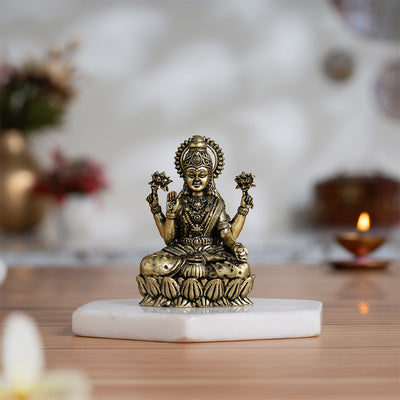
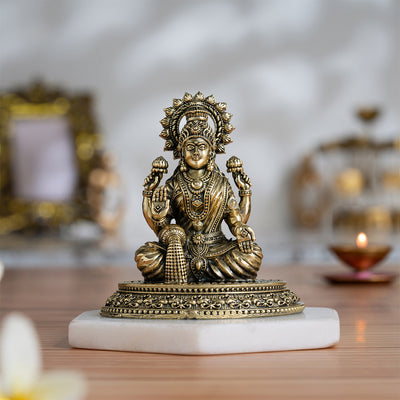
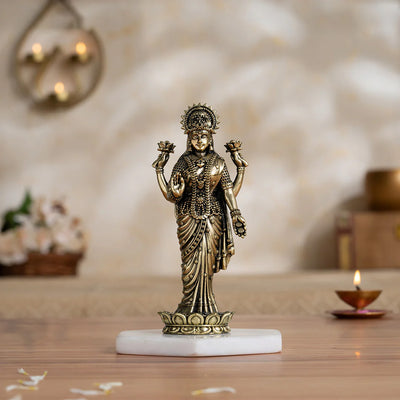
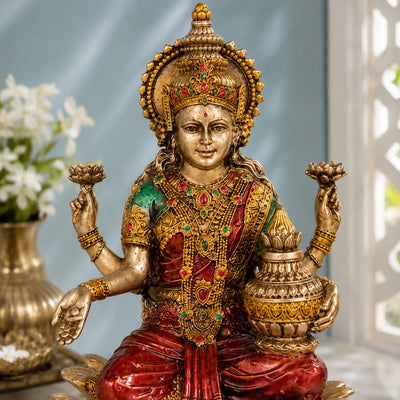
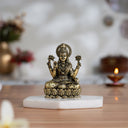
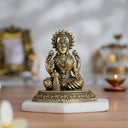
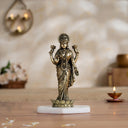
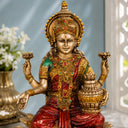
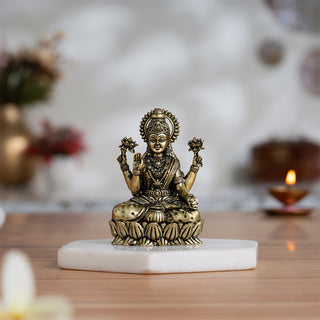
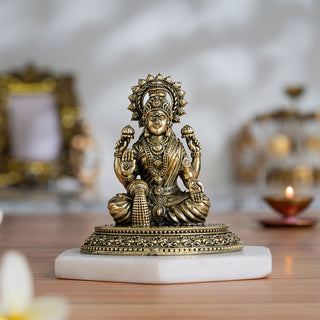
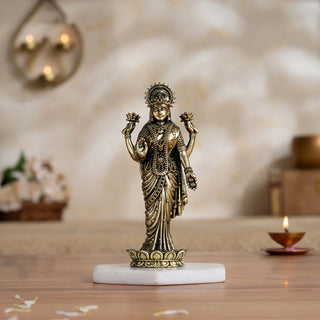
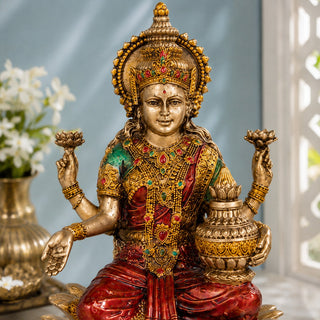
That is worth sitting with for a second, because it reframes the whole shopping question. You are not buying a lucky object. You are buying the same thing a Lakshmi murti is, rendered as line instead of volume. If a brass Lakshmi seated on a lotus makes sense to you as a presence in the house, a Shree Yantra is that presence expressed in geometry.
The structure, from the outside in: a square boundary with four gates, then a sixteen-petalled lotus, then an eight-petalled lotus, then the ring of interlocking triangles, and at the very centre a single point: the bindu.
Verse 11 of the Saundarya Lahari describes exactly this. It speaks of four triangles belonging to Shiva and five belonging to Shakti, which by their interlocking produce forty-four corners, and it names the eight-petalled and sixteen-petalled lotuses and the three encircling lines around them.1 It is a remarkably technical verse for a devotional poem. The poet clearly cared a great deal about whether the drawing was right.
He does not appear to have cared, anywhere in the text, whether it was drawn on copper, cut in crystal or scratched on a leaf.
So which material is best?
The straight answer is that the founding text does not rank them, and the broader tradition is far more relaxed about material than the market is.
There is a useful verse on this from a different direction. The Bhagavata Purana, in its chapter on deity worship, lists eight legitimate materials for a sacred image: stone, wood, metal, a smearable substance such as clay, painted, sand, jewels, and an image held purely in the mind (11.27.12).2
Read that list again. Sand is on it. Paint is on it. So is a picture you only hold in your head. They sit in the same sentence as jewels and metal, with no hierarchy attached.
That is a tradition that is genuinely indifferent to substance in a way that retail is not. The same principle turns up whenever you look closely at these questions: it is why the anxiety about "correct" materials for what you keep in a pooja room mostly dissolves once you read the source, and why a clay Ganesha is not a lesser Ganesha.
What material does honestly affect:
- How well the lines hold. An engraved brass or copper plate keeps crisp geometry for decades. A moulded resin yantra with shallow lines loses definition fast.
- Upkeep. Copper and brass darken and want occasional cleaning, the same way any murti at home needs a cleaning routine. Crystal shows dust immediately but wipes clean.
- Where it can live. A heavy metal plate is stable on a shelf. A crystal Meru is fragile and should not sit anywhere it can be knocked.
- Whether you will actually look at it. Not a small thing. An object you find beautiful gets attention. Attention is the entire point.
Flat, raised, or Meru: the three forms you will be offered
Sellers usually present three shapes, and the differences here are real, unlike the material rankings.
The flat plate
The whole yantra engraved on one level surface, usually copper or brass. This is the form most people picture. It is the easiest to check for accuracy, because every line is visible at once.
The raised or stepped form
The same design built up in low relief, so the rings sit at different heights. Easier to read at a glance, and it catches lamp light nicely on a shelf.
The Meru
A three-dimensional pyramid, where each ring of the yantra becomes a tier climbing toward the bindu at the apex. It is named for Mount Meru, the axis mountain of cosmology. Visually it is the most striking of the three.
You will read that the Meru is "more powerful." Treat that as trade convention. It is a different presentation of the same geometry, and the text that describes the geometry does not grade its formats. Choose the one you will keep clean and keep looking at.
How to actually check a Shree Yantra before you buy it
Zoom into the image and count. This is the part no product page will do for you, and it is the only part that matters.
- The bindu. There should be a single clear point at the very centre. Not a blur, not a decorative flourish, not a tiny image of something else. If the centre is mushy, the yantra was cast from a worn mould.
- Nine triangles, and they must interlock. Four pointing one way, five the other, genuinely overlapping. Cheap castings often show triangles that merely sit near each other without crossing properly.
- The two lotus rings. Eight petals inside, sixteen outside. Count them. Wrong petal counts are the single most common defect in mass-produced pieces.
- Three encircling lines around the lotuses, then the square boundary.
- Four gates in the square, one on each side, usually shown as T-shaped openings.
A piece that passes those five checks is a good Shree Yantra whether it cost eight hundred rupees or eighty thousand. A piece that fails them is a decorative object with a yantra-ish pattern on it, and no material can rescue that.
Three things people get wrong about the Shree Yantra
1. "Sphatik is the most powerful material."
The Saundarya Lahari, the classic source for this yantra, describes the geometry at verse 11 and names no material anywhere in the poem.1 The crystal-over-copper-over-gold ladder is absent from the text that made the Sri Chakra famous. Material prescriptions do exist in later Tantric ritual manuals, which are a different and much later stratum of literature, and anyone quoting one should say which manual they mean rather than gesturing at "the scriptures."
2. "It must face a particular direction or it does harm."
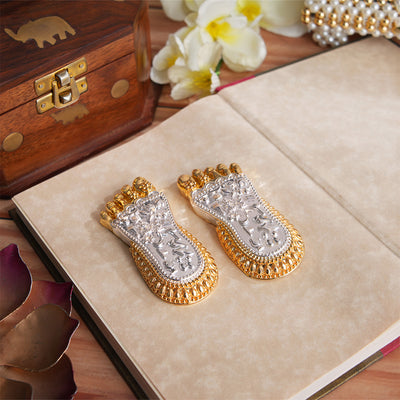
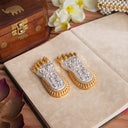
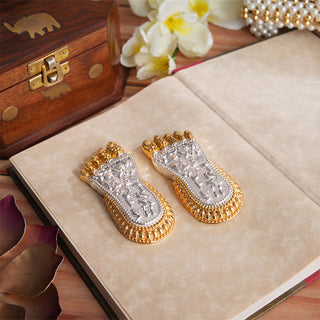
The direction rule that actually appears in the deity-worship literature governs the worshipper, not the object. The Bhagavata Purana's instruction is to lay the seat with kusha grass pointing east and then sit facing east or north, or simply face the deity, whichever way it happens to be (11.27.19).2 The elaborate object-facing charts are later domestic convention. The same correction applies to the endless arguments about which direction a Ganesh idol should face and about which way Lakshmi's charan paduka should point. These are affectionate household habits, and they are worth keeping as habits. They are not verses.
3. "A yantra must be professionally installed or it is inert."
Scripture recognises two classes of sacred image: the moved and the not-moved. Only the formally installed one is bound to stay in its place: "the installed deity is for His worship not taken away, or again brought forward" (Bhagavata Purana 11.27.13). A non-installed image is a legitimate category in its own right, not a compromise. That is precisely why household practice is more flexible than temple practice, and it is the same reasoning that makes a portable murti perfectly proper on a car dashboard.
Why the decor rules feel so authoritative and aren't
The Brihat Samhita of Varahamihira is the classical proto-Vastu authority everyone reaches for. Look at its chapter list in Subrahmanya Sastri's translation and the scope is clear: Chapter 58 on House-Building, Chapter 59 on the exploration of water springs, Chapter 62 on temples, Chapter 64 on the description of idols, Chapter 66 on the installation of idols.4 Building, water, temples, consecrated temple images.
There is no chapter on ornaments in a living room.
Even the underlying grid is not one settled rulebook. A comparative study by Apte and Supekar in the Bulletin of the Deccan College Research Institute found that the Vastu-Purusha-Mandala is handled differently in the Paushkara Samhita than in the Brihat Samhita.5 Classical Vastu is an argued architectural tradition, not a fixed list of where to put things.
Most of what circulates as Vastu decor advice is twentieth-century interior guidance wearing an old name. That is worth saying plainly, because it is the same machinery that produced the seven-running-horses rule and a good deal of the prosperity language around the Kamdhenu cow.
Where to keep it at home
Since there is no scriptural placement rule, here is honest practical advice, offered as advice.
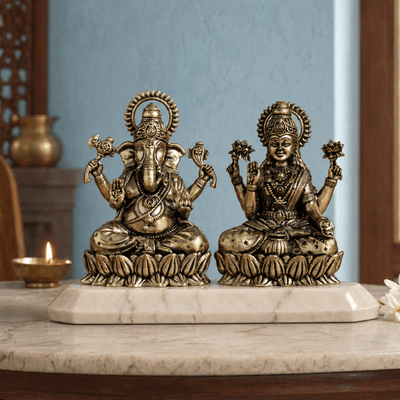
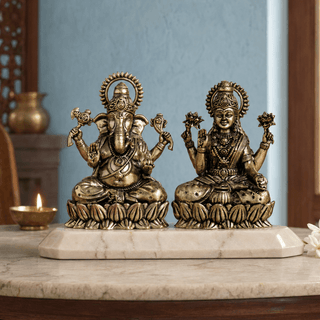
Keep it somewhere clean, at or above chest height, where it will not be handled casually or covered by everyday clutter. A shelf in the pooja space is the obvious spot, and it sits comfortably beside a Laxmi Ganesh murti pair, arranged as the Ganesh Lakshmi position guide describes, or a shankh, both of which have far older household footing than the yantra does as a domestic object.
An office desk or a cash drawer works too. That association with money and enterprise is Srividya practice, not a Puranic instruction, but it is a very old practice and it is not pretending to be something else.
Wipe it. A darkened, dusty yantra is not inauspicious, but it does tell you the object has stopped being looked at, and that is the only failure state that really exists here. The same goes for the rest of your pooja essentials.
So which Shree Yantra should you buy?
Work through it in this order.
Accuracy first. Nine interlocking triangles, a clean bindu, eight and sixteen petals, three circles, four gates. Everything else is secondary.
Then durability. Engraved metal holds its lines longest. If you want crystal, buy it for the light in it and place it where nothing will knock it over.
Then size and setting. Match the shelf, the way you would when choosing anything for a vastu shelf, buying Diwali gifts for someone else's, or planning Diwali decoration for the house.
Then price, last. Bhagavata Purana 11.27.12 is the verse to remember while you shop. Sand and jewels appear in the same list. The tradition never charged more for holiness.
If you want the goddess in the house and the geometry does not move you, an idol is the same devotion in a different grammar, and no text ranks the two. Keep whichever one you will actually stand in front of, on Diwali Lakshmi Puja, and on the ordinary Tuesdays in between.
Also read: Things to Keep in Pooja Room | Vastu-Friendly Home Decor Ideas | Where to Place Laxmi Charan Paduka | Ganesh Laxmi Murti Position Guide | Return Gifts for Vastu Shanti Pooja