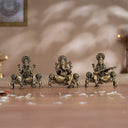
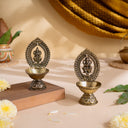
Every year around Diwali, somebody in the family says it with total confidence: "No no, Ganpati goes on that side." And then somebody else says the opposite, equally confidently. Both of them heard it from their mother. Neither can tell you where the rule comes from.
So let's actually find out. Not what a decor blog says, but what the texts say, what Vastu says, and what is simply custom that got repeated until it sounded like law.
The short answer on Ganesh Laxmi murti position
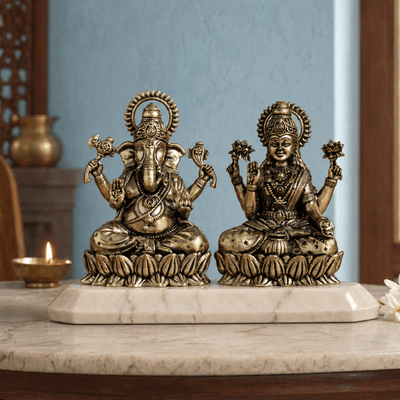
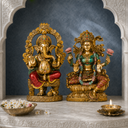
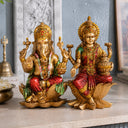
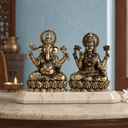
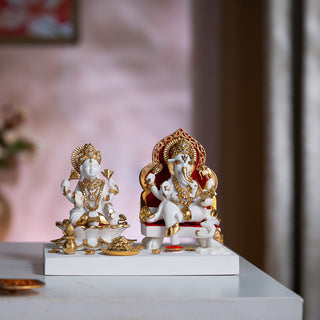
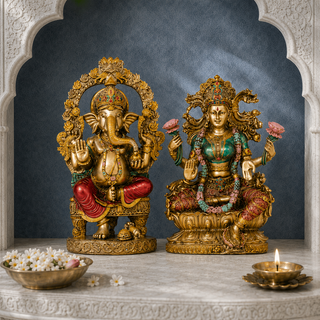
Place Lakshmi to Ganesha's right. That is the convention followed in most Indian homes, and it is the one you will hear from priests during Diwali Lakshmi Puja.
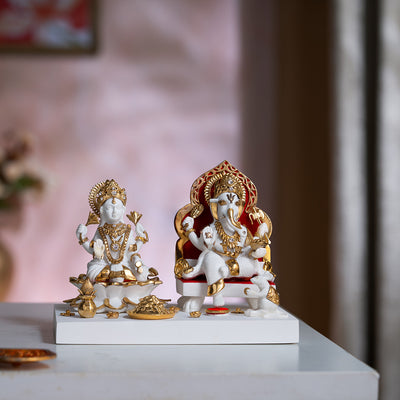
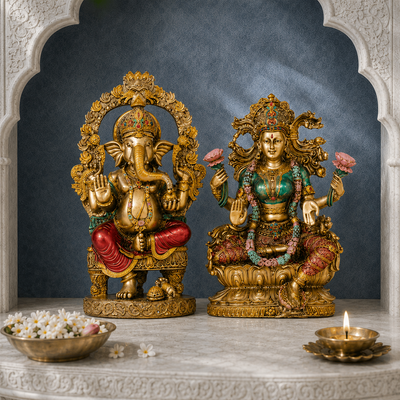
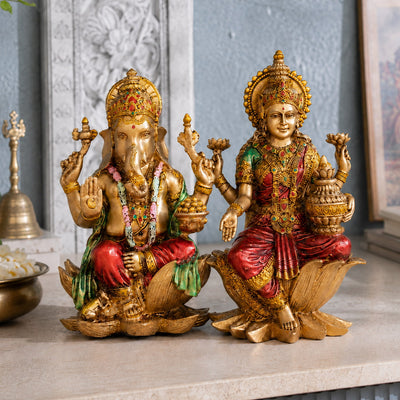
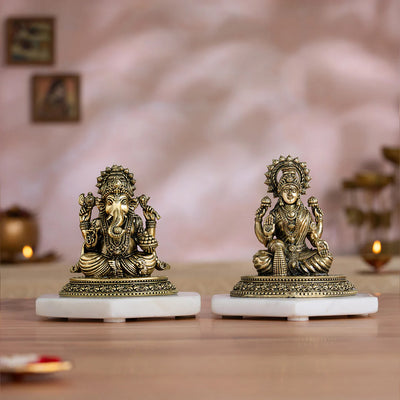
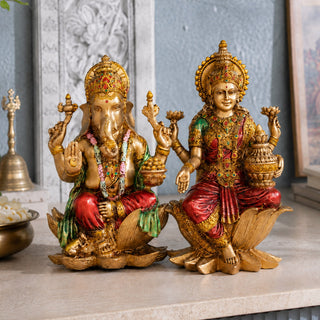
Here is where nearly everyone gets tangled. "Ganesha's right" means his right, not yours. The murtis are facing outward, towards you. So their right is your left. Stand in front of the pair and you should see Lakshmi on the left of your view and Ganesha on the right of your view.
If you have ever seen two people argue about this for twenty minutes, that mirror-flip is almost always what they were arguing about. They agreed on the rule and disagreed on the perspective.
Why Ganesha anchors the arrangement is easy to explain. He is invoked first in nearly every Hindu ritual, before any other deity is addressed. Since he goes first in the puja, he becomes the fixed point in the setup, and the goddess is placed at his right hand, which in Indian ritual grammar is the side of honour.
That is a coherent reason. It is not, however, a scriptural instruction, and it is worth being straight about that before we go further.
Does any scripture prescribe this position?
No. I went looking for it, and there is no Puranic passage that lays down how a Ganesha and a Lakshmi murti should be arranged on a shelf in a house.
The classical texts that do discuss placement and orientation of images (the Mayamatam and the Manasara) are architecture manuals. They deal with temple construction and the installation of consecrated images in a temple structure.1 They are not talking about a wooden platform in a two-bedroom flat, and pretending otherwise does nobody any favours.
What we have instead is Vastu Shastra reasoning, which is a real traditional system with its own internal logic, and household custom, which is often several centuries old and worth respecting on those grounds alone. Both are legitimate. Neither is a Purana. If you want the fuller version of that argument, the piece on which direction a Ganesh idol should face works through the same distinction.
This matters because the anxious version of the question, "have I placed it wrong, will something bad happen", comes from treating custom as command. It isn't one.
What the texts actually say about Ganesha and Lakshmi
The Ganesha-Lakshmi pairing that dominates Diwali imagery is not a family relationship. Lakshmi is not Ganesha's mother, wife or sister, and no Purana says she is.
Ganesha's family in the texts is clear enough. The Shiva Purana's Rudrasamhita, in the Kumarakhanda section, runs the whole sequence across consecutive chapters: chapter 13 is his birth, chapter 16 is his head being chopped off, chapter 17 his resuscitation, chapter 18 his coronation as chief of the ganas.2 His mother is Parvati (also called Gauri) and in that account she makes him herself, which is exactly why Shiva does not recognise the boy at the door. We wrote about that in detail in the relation between Ganpati and Gauri.
Lakshmi appears nowhere in that family. Her association with Ganesha is functional, not familial: he clears obstacles, she brings prosperity, and you want both before you begin anything. That is a devotional logic, and it is a good one. It just isn't a bloodline.
This is worth clearing up because the "wife" assumption leads people into odd placement decisions. They arrange the two like a couple, when the tradition has never treated them that way.
Three things people get wrong about this
1. "The position is prescribed by shastra"
It isn't. No Puranic source lays down the Diwali arrangement of these two murtis.1 The north-east preference you will hear attached to it comes from Vastu reasoning about the ishana corner belonging to the devatas: a real system, with a real rationale, but a different category of authority from a Purana. Present it as Vastu, and it stands on its own feet. Dress it as scripture and it collapses the moment somebody checks.
2. "There is no textual Ganesha-Lakshmi connection at all"
This one runs the other way, and it is the more interesting correction. There is a Ganesha-Lakshmi connection in the classical iconographic literature, just not the Diwali one. In T. A. Gopinatha Rao's 1914 survey of Ganapati forms, which covers pages 35 to 67 of the first volume of Elements of Hindu Iconography, one of the named Agamic forms is Lakshmi Ganapati. It sits alongside Heramba, Nritta, Uchchhishta, Unmatta-uchchhishta, Kavala and Prasanna Ganapati.
So a Lakshmi-associated Ganesha is genuinely old in the iconographic tradition. What is modern is the specific rule about which side of a shelf she goes on.
3. "The trunk direction changes where you should place him"
A widespread worry, and worth putting down gently. The idea that a right-curving trunk demands strict ritual purity and shouldn't be kept at home is temple and consultant lore. The same Gopinatha Rao survey classifies Ganapati by form (arms, posture, vahana, consort) across thirty-odd pages, and trunk-curve direction is not one of its categories at all.3 If this is nagging at you, the longer treatment is in the meaning of Ganesha's trunk facing right or left. Short version: you have not bought the wrong murti.
Setting the pair up at home: what actually matters
Once you stop looking for a rulebook, the practical guidance becomes simple, and most of it is plain respect rather than mysticism.
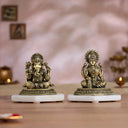
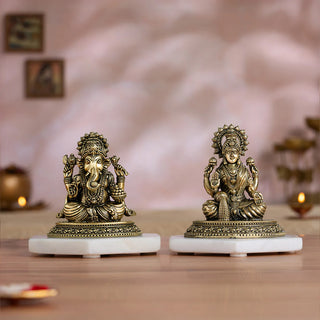
- Keep them on one platform. A single chowki or base for both reads as one shrine rather than two separate installations. If you're buying fresh, a matched Ganesh Lakshmi pair saves you the mismatched-scale problem, where one murti quietly towers over the other.
- Similar height and finish. A tall brass Lakshmi beside a small marble-dust Ganesha looks accidental. The eye notices before the mind does.
- Seated, at a respectful height. Roughly chest level when you stand, or comfortably at eye level when you sit to do puja. Not on the floor, not above a doorway.
- North-east if the room allows it. This is the Vastu preference, not a command. If your flat's layout makes it impossible, a clean east or north-facing shelf is entirely fine.
- Not in a bathroom-adjacent wall, not under a staircase. This one is common sense wearing a Vastu costume, and it is still good advice.
The things to keep in a pooja room guide covers the rest of the shelf (the diya, the kalash, the thali) and how not to overcrowd it. Overcrowding is the single most common mistake, well ahead of any placement error.
The Diwali arrangement, specifically
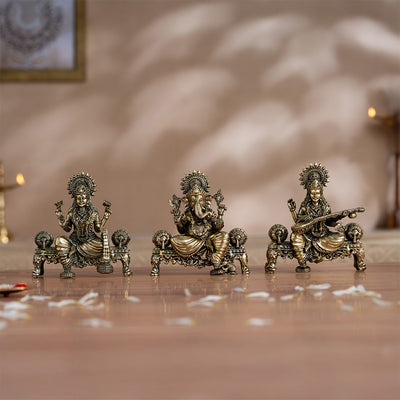
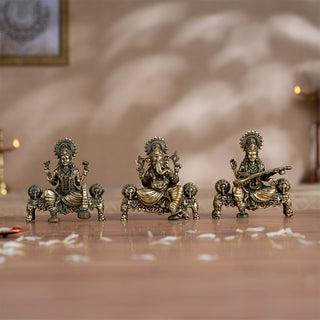
On Diwali the pair usually sits at the centre of a decorated platform, with the diyas in front rather than behind, and the puja items to the right of the person performing the ritual. Many households add a Saraswati murti to make the trio, which is standard in Maharashtra and Gujarat and completely optional elsewhere.
Some families also place Lakshmi's charan paduka at the entrance, footprints turned inward, on the night of the puja. That is a lovely custom with real feeling behind it, and again, custom.
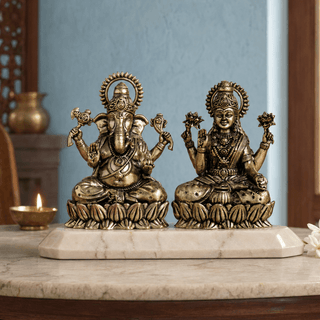
If you are planning the wider setup, the Diwali home decoration notes and the Vastu-friendly decor ideas both cover the surrounding space without turning it into a checklist of fears. Our Ganesh Lakshmi idols are built as pairs for exactly this reason, and a matched pair is a staple among Diwali gifts; if you'd rather choose each separately, pick a Lakshmi murti for Diwali and a Ganesha of the same height and finish, for the reason in the list above.
What you offer them matters more than where you put them
The Ganesha Purana's Upasanakhanda gives durva grass six full chapters: chapter 63 tells its origin story, and chapters 64 to 68 form an entire Durvamahatmya devoted to it.4 No flower anywhere in that text receives comparable attention.
Six chapters on a grass, and not one Purana on which side of the shelf to use. That tells you where the tradition's own priorities sat. If you want the full picture, we went through it in the favourite flower of Lord Ganesha, which ends up being a gentle correction of the question itself.
The other side of that coin is tulsi, which is kept away from Ganesha. That prohibition is one of the few beliefs in this whole area that turns out to be straightforwardly scriptural: the Brahmavaivarta Purana's Ganesa Khanda gives it chapter XLVI, framed around the reciprocal curses of Tulsi and Ganesa.5 Details in why tulsi is not offered to Lord Ganesha.
So: durva in, tulsi out, and both decisions have chapter numbers behind them. Placement doesn't. That is not an argument for carelessness. It is an argument for putting your attention where the tradition put its own.
Choosing the murtis themselves
Material is a practical decision more than a spiritual one. Brass is heavy, lasts generations and develops a patina you either love or polish off. Gold or silver plated pieces are a resin core with a copper layer under the plate, which gives you fine detail and a lighter piece, and marble dust is a different finish again, the white and gold range. Clay is for festival murtis that are meant to dissolve, which is a different ritual logic altogether: that is the world of home visarjan, where the impermanence is the whole point.
For a permanent shrine you want metal or stone, and you want to be able to clean it without dread. Cleaning a marble idol is straightforward once you know what not to use on it.
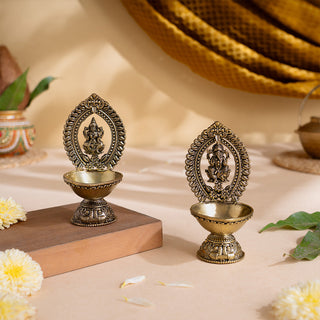
Posture is worth a thought too. A seated Ganesha in lalitasana (the relaxed seated pose) is the usual choice for a home shrine, and the honest reason is that it reads as settled and domestic rather than active. The dancing Nritta form is magnificent and belongs in a larger space. There is more on this in which type of Ganesha idol is good for home.
So does the position actually matter?
It matters the way a set table matters. Nobody claims a fork on the wrong side ruins the meal, but a table laid with care tells you someone thought about it.
Put Lakshmi at Ganesha's right because it is the arrangement your family and your neighbourhood recognise, because it follows the order of the puja, and because a shared convention is worth keeping for its own sake. Do not put her there because you are afraid of what happens if you don't. No text threatens you with anything.
The stories around Ganesha are full of this same texture: beliefs that turn out to be older and stranger than expected, and beliefs that turn out to be a hundred years old wearing ancient clothes. His broken tusk is a good example: the version everyone tells, where he snaps it off to keep writing the Mahabharata, isn't in the Mahabharata's own account of how it was written, though a genuine tusk-breaking episode does exist elsewhere. We traced all of it in who broke the tooth of Lord Ganesha.
Arrange the pair carefully, light the diya, and stop worrying about the compass. That is closer to what the tradition actually asks of you than any placement rule.
Also read: Ganesh Idol Direction | Which Ganesha Idol is Good for Home | Ganesha Trunk Right or Left Meaning | Relation Between Ganpati and Gauri | What to Do If You See the Moon on Ganesh Chaturthi