Most people do not search this question casually. They search it after buying an idol.
The murti is already on the shelf. Someone has walked past, glanced at it, and said something like "arre, the trunk is on the right side, you can't keep that at home." And now there is a small knot of worry attached to a god whose entire job is removing obstacles.
So let me say the useful thing first, and then earn it over the next two thousand words. The right-versus-left trunk rule is real, widely held, and genuinely meaningful to the people who follow it. It is also not something any Purana says. It comes from temple custom and from Vastu reasoning. Both are legitimate traditions with their own logic, but they are a different kind of authority from scripture. Nobody tells you that when they are frightening you about your Ganesh murti.
What the popular rule actually claims
The popular rule sorts Ganesha into three forms by the curve of the trunk.
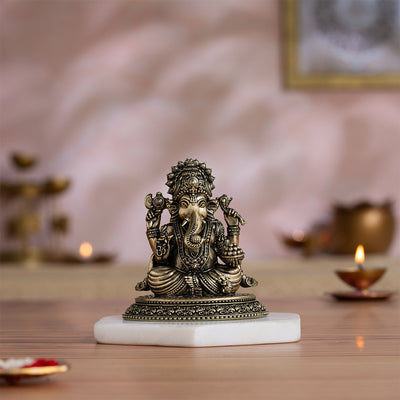
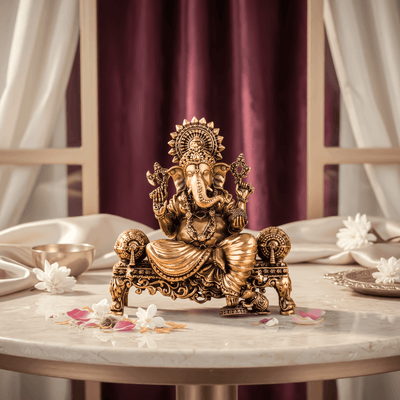
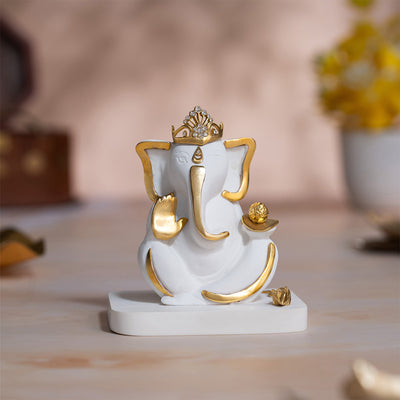
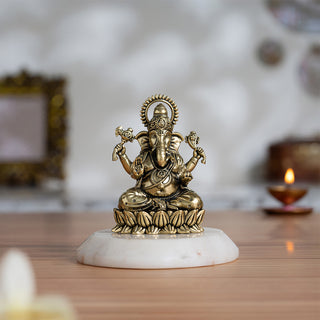
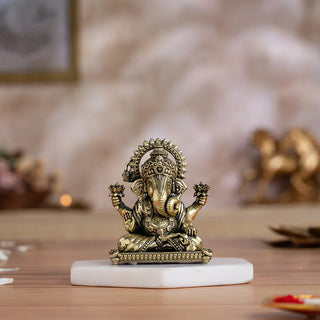
A vamamukhi Ganesha has the trunk curving towards his left. This is by far the most common form you will find in shops and homes. Left is associated with the moon, with coolness, with the ida nadi in yogic physiology, and with the softer, more forgiving side of divine attention. This is the form usually recommended for households.
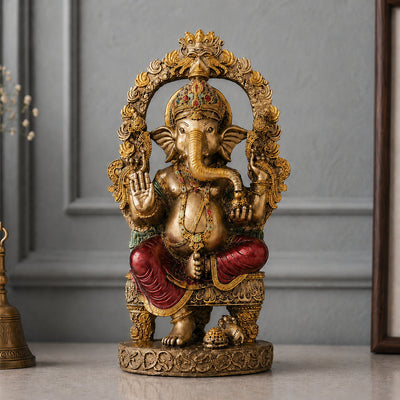
A dakshinabhimukhi Ganesha has the trunk curving to his right. Right is associated with the sun, with heat, with the pingala nadi, with discipline, and in ritual terms with the direction of the pitrus, the ancestors. The tradition holds that this form is more potent and correspondingly more demanding: that it wants strict purity, unbroken routine, and a level of ritual precision most households cannot sustain.
A straight or sondh trunk, pointing forward and downward, is rare and is generally treated as the most auspicious of all, precisely because it is so uncommon.
That is the belief system as its own adherents state it. It is coherent. It maps onto real ideas in Indian ritual thought about left and right, heat and coolness, the sun and the moon. If you already follow it, nothing in this article should make you feel foolish for doing so. What follows is simply where it comes from, and where it does not.
What the classical texts actually classify
The classical texts do not classify Ganesha by his trunk at all. They classify him by named form.
The standard reference work on Hindu image-making in English is T. A. Gopinatha Rao's Elements of Hindu Iconography, published in Madras in 1914. It is not a devotional book and it is not a modern summary. It is a systematic survey built directly out of the Agamic and Shilpa Shastra literature, and it is still the book scholars reach for. Ganapati occupies pages 35 to 67 of the first volume.1
Thirty-three pages on how to recognise and make a Ganesha image. And the organising principle is named form. Uchchhishta Ganapati. Unmatta-uchchhishta. Kavala. Lakshmi Ganapati. Heramba. Prasanna. Nritta Ganapati, the dancing one. Each is defined by the number of arms, what those arms hold, the posture of the body, the vahana, whether a consort is present, the complexion of the image.
Trunk direction is not a category in that scheme. Not as a primary classification, not as a subdivision, not as a warning. Thirty-three pages of fussy specification about how a Ganapati image should be built, and the curve of the trunk is never what decides which Ganesha you are looking at.
That silence is the whole story of this article.
Three things people get wrong about the trunk
1. "The Shastras say a right-trunk Ganesha should not be kept at home."
No text has ever been produced for this. Not a Purana, not an Agama, not a Shilpa Shastra passage. When you follow the claim back, it terminates in a Vastu consultant, a temple priest's practical advice, or another blog repeating the same sentence. The classical literature classifies Ganapati by form, arms, posture and consort, and it does not legislate a household ban based on which way the trunk turns.2 Say it plainly: this is tradition, and traditions do not need a fake scriptural passport to be worth respecting.
2. "Right-trunk means anger, left-trunk means blessing."
One of Ganesha's most repeated epithets is Vakratunda: the curved trunk. It is there in the invocation millions of people recite before beginning anything. Notice what it says and what it does not. It celebrates the curve itself. It does not specify a direction. The bend is the point; the side is not.
3. "The trunk direction is one of the ancient classifications, like the thirty-two forms of Ganapati."
This one is a category error and it is the most common. The tradition genuinely does have a rich classification system: the Agamic forms above, and in some enumerations thirty-two named Ganapatis. Those lists are real and old and worth knowing. Trunk direction is not part of them. People hear "there are many classical forms of Ganesha," assume the trunk rule is one of them, and the assumption hardens into fact. If you want the actual forms and what they mean, that belongs in the wider question of which type of Ganesha idol is good for home, where the names are the useful part.
This pattern (a confident belief that turns out to be custom rather than text) repeats across almost every popular Ganesha question. It happens with the story of his broken tusk, where the famous version of the tale does not appear in the Mahabharata's own account of how it was written. It happens with the moon. It happens with idol direction. Once you notice the pattern, you stop being frightened by any of it.
So where did the right-left idea come from?
Not from nowhere. That is the part worth taking seriously.
Indian ritual thought does genuinely treat left and right as different. The right hand is the one that gives and receives in worship. Circumambulation is done keeping the deity to your right. In tarpana and in rites for the ancestors, the sacred thread is shifted and the orientation changes, and the right side and the southern direction carry associations with the pitrus. None of that is invented. The trunk rule is a later, folk application of a real and old symbolic grammar onto a detail of the image.
There is also a straightforward practical layer. Temple deities are served by trained priests on a fixed schedule. The rules about purity are ones a household simply cannot match: abhisheka at set hours, offerings at set times, no lapse when someone is travelling or unwell. A priest telling a family "this form is very powerful, it needs strict routine, keep the gentler one at home" is giving sensible pastoral advice about what a household can realistically sustain. That advice then travels, loses its context, and arrives at your door as a prohibition with a threat attached.
The most famous right-trunk Ganesha in India is at Siddhivinayak in Mumbai, where the trunk turns to the right. It is one of the most visited shrines in the country. It is also a temple, with a temple's full ritual establishment behind it, which is exactly the point. Its regime is temple practice, not a template for your shelf.
Now go and look at your own idol
Do this before you do anything else, because a surprising number of these panics dissolve on inspection.
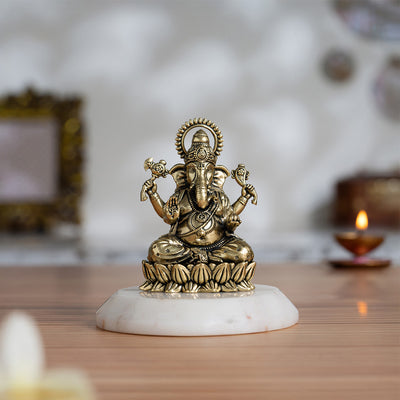
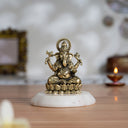
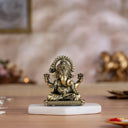
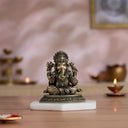
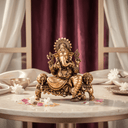
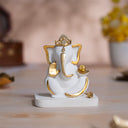
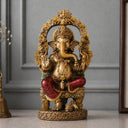
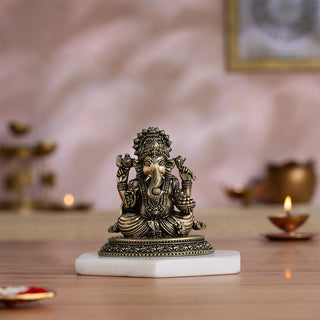
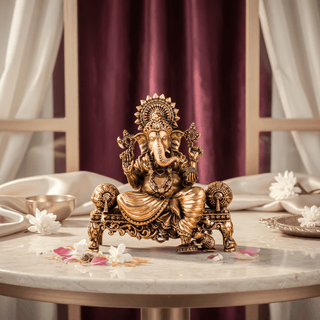
Stand in front of the murti and work out the direction from Ganesha's point of view, not yours. His left is on your right as you face him. A great many idols sold as household pieces (including the classic brass left-trunk Ganesh idol on a lotus) have the trunk curving to his left, which is the form the tradition already considers ideal for homes. People misread it constantly, worry for a week, and then find out they had the "safe" one all along.
And if the trunk does turn right? Keep it. Worship it. Nothing bad is going to happen to you. If it genuinely troubles your peace of mind, the honest reason to change it is your own comfort, not a scriptural rule, because there isn't one.
What the texts actually are emphatic about
If you want to know what Ganesha worship is really built out of according to the texts, the answer is not the trunk. It is the offerings, and the emphasis is startling once you see it.
The Ganesa Purana's Upasanakhanda (the section on worship, available in Greg Bailey's academic translation) gives durva grass chapter 63, and then follows it with a full five-chapter Durvamahatmya running from chapters 64 to 68. Six chapters for a grass.3 No flower comes close to that anywhere in the text, which makes the popular answer to Ganesha's favourite flower a genuinely interesting correction rather than a boring one.
The same text gives chapter 62 to the moon's curse and favour, which, incidentally, is where the moon material actually lives, and not in the Bhagavata Purana, contrary to what nearly every page about seeing the moon on Ganesh Chaturthi will tell you.56
And the reason tulsi is not offered to Ganesha turns out to be straightforwardly scriptural: the Brahmavaivarta Purana's Ganesa Khanda gives the mutual curses of Tulsi and Ganesa their own chapter, the forty-sixth.4 That one checks out, and it is worth saying so, because a writer who only ever debunks is not being honest either.
Notice what all of that attention is directed at. Leaves, grass, stories, the conduct of the worshipper. Not the geometry of the image.
The things that are worth caring about instead
None of this means placement and care are meaningless. It means they belong to their proper category (practical respect and Vastu custom) and are better followed when they are labelled honestly.
Keep the shrine clean and at a respectful height. Don't put it in a bathroom wall, under a staircase, or in a spot where it gets knocked. The north-east preference you will read about for which direction a Ganesh idol should face comes from Vastu's reasoning that the ishana corner belongs to the devatas. It is a coherent system, worth following if it means something to you, but it is Vastu rather than Purana. The same is true of the convention behind where Lakshmi sits relative to Ganesha at Diwali, and of most of the advice about what to keep in a pooja room.
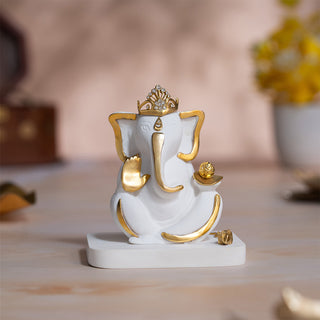
What genuinely matters, in a way the texts do support, is the difference between a permanent murti and a festival one. A clay Ganesha made for Ganesh Chaturthi is meant to dissolve: that is the whole logic behind immersing a Ganesh idol at home, and why a bucket of water is theologically complete rather than a compromise. A brass or marble-dust murti is the opposite: installed, permanent, kept and cleaned for decades. Getting that distinction wrong actually matters. The trunk does not.
Why it is still worth taking seriously
It would be easy to end by saying the whole thing is superstition. That would be lazy, and it would be wrong.
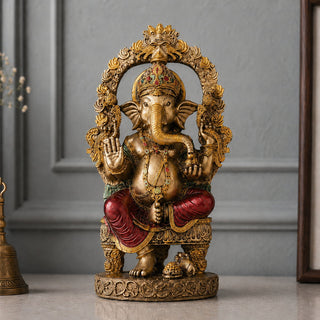
People have looked at these images for centuries and found meaning in the curve of a trunk, in the way the head tilts, in whether the deity is sitting or dancing. That looking is a form of devotion. A tradition does not have to be scriptural to be real. It has to be honest about what it is. Brass murtis in particular carry this well, because the same casting gets handed down for three generations and the family's whole way of looking at it comes with it.
What is not fair is using a piece of custom to make a devotee feel they have brought something dangerous into their house. That is the version of this belief that deserves to be retired.
So: look at your idol. Work out which way the trunk actually turns, from his side. Then keep it, clean it, offer durva if you can find it, and stop worrying. Whether the trunk curves left or right, what is standing on your shelf is Vighnaharta (the remover of obstacles) and it would be a small irony to let him become one.
Also read: Which Type of Ganesha Idol Is Good for Home | Who Broke the Tooth of Lord Ganesha | Relation Between Ganpati and Gauri | Why Tulsi Is Not Offered to Lord Ganesha | Ganesh Chaturthi 2026: Muhurat, Tithi and Visarjan