Every year the same argument runs in some family WhatsApp group. One person's panchang says the puja is on one date. An aunt in another city says the next day. Nobody can explain why.
The honest answer is not mystical. It is arithmetic, and once you see it the whole muhurat question stops being confusing.
What tithi is Ganesh Chaturthi on?
In 2026 Ganesh Chaturthi falls on Monday, 14 September; the chaturthi tithi runs from 7:06 am on 14 September to 7:44 am on 15 September (New Delhi). Ganesh Chaturthi is the fourth tithi of the shukla paksha (bright fortnight) of Bhadrapada, the lunar month that usually lands in August or September.
A tithi is not a day. It is the time the moon takes to gain 12 degrees of angular distance on the sun. Because the moon does not move at a steady speed, that stretch of time keeps changing. Sewell and Dikshit measured it in The Indian Calendar (1896) and found a range from 21 hours 34 minutes at its shortest to 26 hours 6 minutes at its longest, averaging 23 hours 37 minutes.1
So a tithi can start at 4 in the afternoon and end at 2 the next afternoon. It floats. Nothing about it lines up with a calendar square. That single fact explains almost every date dispute in the Hindu festival year, from Navratri to Diwali Lakshmi Puja.
Why the Ganesh Chaturthi muhurat is midday, not a clock time
Sewell puts the rule in the same technical language a panchanga uses: the worship of Ganesha "is directed to take place on the Bhadrapada sukla chaturthi during the third part (madhyahna) of the five parts of the day."
Read that carefully. The day from sunrise to sunset is cut into five equal parts. The third part, the middle one, belongs to Ganesha. That is madhyahna.
It is a fraction, not a reading off a clock. If your sunrise is at 6:10 and your sunset at 6:50, madhyahna starts around 11:00 and runs to about 1:36. Move to a city 800 km west and both edges shift. Change the date by two weeks and they shift again.
This is why a muhurat printed without a place attached is not really a fact. Any site giving one national time for the whole country has skipped the hardest part of the calculation.
Why two panchangas give two different dates
Two reasons, and both are real: the panchangas use different rules for naming a day, and a rite pinned to a time of day can land on the day before the one carrying the tithi's name.
The first is a disagreement about naming days. Sewell gives the sunrise rule: "the tithi current at sunrise of the solar day gives its name and numeral to that day." But Ebenezer Burgess, translating the Surya-Siddhanta in 1860, gives a different one: "The civil day receives the name of the lunar day which ends in it."2 Two respected authorities, two conventions. Different traditions follow different ones.
The second reason is the part everyone forgets. Sewell's own rule has a second half. The sunrise convention works for ordinary purposes, but "some religious ceremonies are ordered to be performed on stated tithis and at fixed times of the day." When a rite is pinned to a moment, you use the tithi running at that moment. Sewell gives worked examples where the correct day for the rite is the day before the day carrying the tithi's name.
Ganesh Chaturthi is exactly that kind of rite, because it is pinned to madhyahna. If chaturthi is current at sunrise on one day but only touches midday on the other, the two rules point at different dates.
And there is no single book to appeal to. Nehru told the Calendar Reform Committee in the 1950s that India had "at present thirty different calendars, differing from each other in various ways, including the methods of time reckoning." The Committee's own appendix listed more than fifty printed panchangas in seven languages.4 Sewell names the kind of book that actually decides these cases: nirnaya works like the Nirnayasindhu, "in general use at the present time in most parts of India."
Three things people get wrong about Ganesh Chaturthi
1. That Krishna was cursed for seeing the moon, and the Bhagavata says so. It does not. We searched the Sanskrit of both Syamantaka chapters (Bhagavata 10.56 and 10.57). Ganesha, Bhadrapada and chaturthi do not appear anywhere, and nobody looks at the moon.5 There is cursing, but it is people reviling each other: at 10.56.31 Krishna enters Jambavan's cave to wipe off a mithyabhishapa, a false accusation. The Bhagavata's own explanation for the slander is ordinary gossip: Satrajit's jewel goes missing, and Krishna follows Prasena's trail "in order to clear Himself of the gossip of His infamy." The moon-sighting rule is later Puranic material, and it is real tradition, but it is routinely mis-credited to a text that does not carry it. We have a longer piece on the moon prohibition if you want the detail.
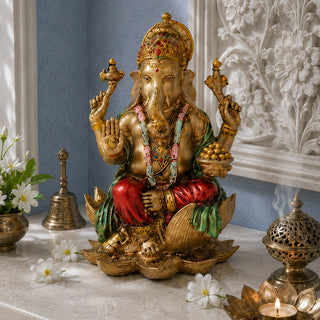
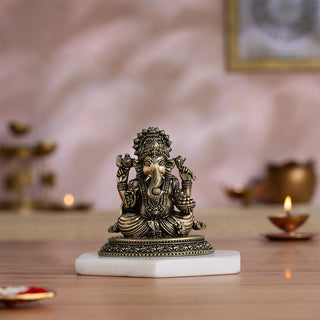
2. That the ten-day pandal festival is centuries old. The household vow is old. The public street festival started in 1893, in Pune, under Tilak.3
3. That there is one correct muhurat. There is one correct rule. The minute it produces depends on your latitude, your longitude, the date, and which panchanga you follow. Those are four different variables, and no printed table can hold all of them for you.
The ten-day public festival started in 1893
D.V. Athalye's 1921 biography of Bal Gangadhar Tilak says it flatly. Tilak "inaugurated the Ganapati and the Shivaji festivals," and "The Ganapati festival, started in 1893, appealed to the religious instincts of the masses and to the religious and patriotic instincts of the educated people in Maharashtra." Athalye lists what came with it: "Lectures, processions, singing parties are the invariable accompaniments of the festival."

Athalye's wording is careful, and it matters. Tilak gave "a bent" to a religious festival, "converting it into a social and national force." He did not invent the worship. The private vow was already there. What was new was the public, organised, political shape of it.
Line up the two documents and the picture is clean. In 1893 Tilak turns Ganesh Chaturthi into a street festival in Pune. Three years later Sewell, writing in Madras about calendars, still describes only the quiet midday household rite. Both are true at once.
Athalye also records something that gets left out of the retellings: "The Reformers and Moderates have stood aloof from the festival and have misunderstood its aims." The pandal tradition was argued over from its first year.
When is visarjan, and how many days should you keep Ganpati?
Households keep the idol for a day and a half, three days, five, seven or ten. All of these are real practice. None of them comes from a verse. This is regional and family custom, and anyone telling you a specific day count is scripturally required is filling a gap with confidence.

The big public immersion falls on Anant Chaturdashi, the fourteenth tithi of the same bright fortnight, ten days after the fourth. That is the day the large pandal idols go to the water in Mumbai and Pune.
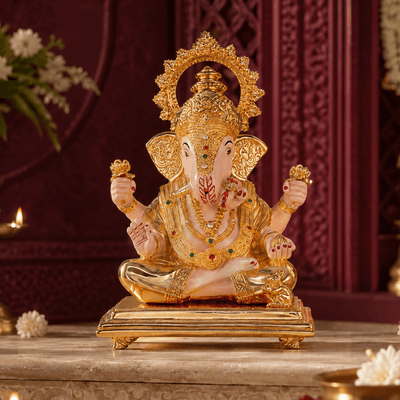
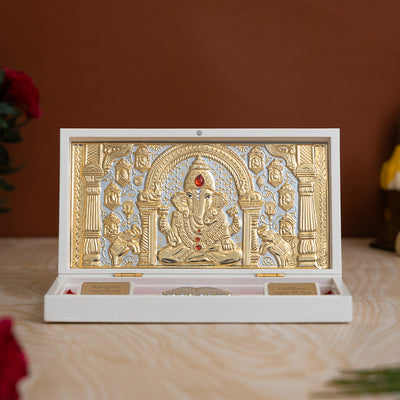
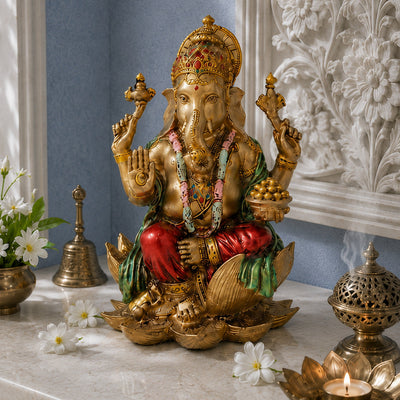
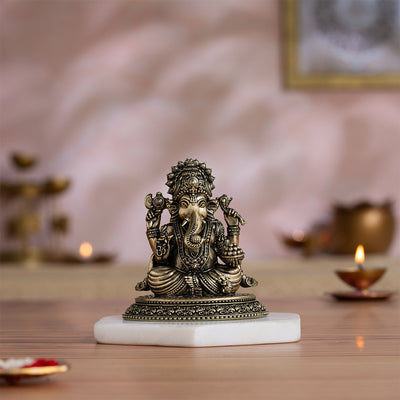
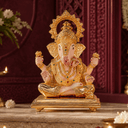
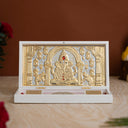
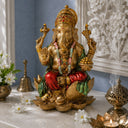
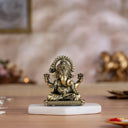
If you are immersing at home, a bucket or a drum works, and the practical steps are covered in our guide on how to immerse a Ganesh idol at home. Many families now keep a permanent metal or marble murti for daily worship and immerse only a small clay one. If that is your plan, which Ganesha idol suits a home and which direction it should face are worth reading before you buy. A small Ganesha pocket temple is what a lot of people settle on for the year-round shrine, since it travels and does not need immersing.
Sankashti Chaturthi, the monthly version
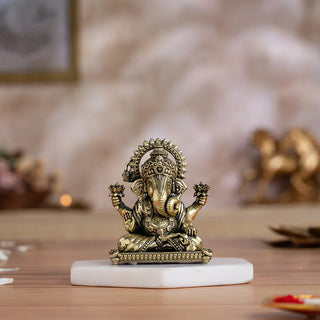
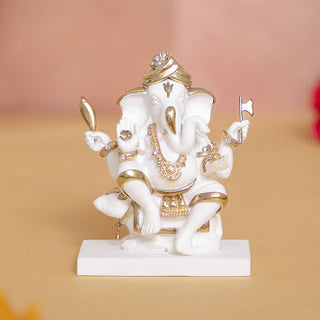
Ganesha does not get one tithi a year. He gets one a month.
Sewell records a vow he calls Sankashta-nasana-chaturthi, in which a person "binds himself to observe a fast on every krishna chaturthi up to moonrise, which takes place about 9 p.m. on that tithi, but is allowed to break the fast afterwards." Then he adds the crucial bit: "this has of course to be done on the day on which the chaturthi is current at moonrise."1
Not the day whose sunrise carries the name. The day the tithi is running when the moon comes up. That is the same logic that governs Karwa Chauth, which belongs to the same family of dark-fortnight chaturthi fasts broken at moonrise.
One nice side effect of Ganesh Chaturthi being a bright-fortnight festival: it escapes the north-south month name problem. Sewell notes that "the purnimanta scheme is now in use in Northern India, and the amanta scheme in Southern India," so the north's month ends at full moon and the south's at new moon. That splits the names of dark-fortnight festivals. Janmashtami is Bhadrapada krishna ashtami in the north and Shravana krishna ashtami in the south, same night. Ganesh Chaturthi is Bhadrapada shukla chaturthi everywhere.
How to find your own muhurat
You need three things, and only three.
- Your city's sunrise and sunset for that date. Not the national average.
- The window of the fourth tithi of Bhadrapada shukla paksha, from a panchanga your family already follows.
- The middle fifth of the daylight period. Subtract sunrise from sunset, divide by five, and take the third block.
Where the chaturthi tithi overlaps that middle block, that is your muhurat. If the tithi covers madhyahna on one day and not the other, that day is your day, even if the other one carries the name at sunrise.
This is the same reasoning a good panchanga is doing behind the scenes. Doing it yourself once takes ten minutes and permanently ends the family argument.
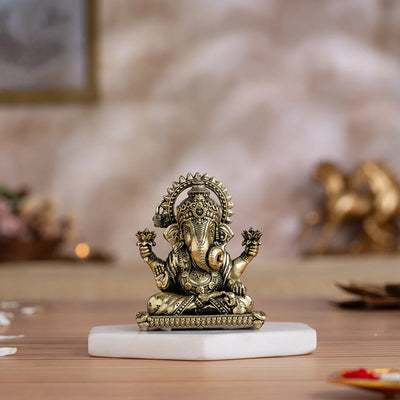
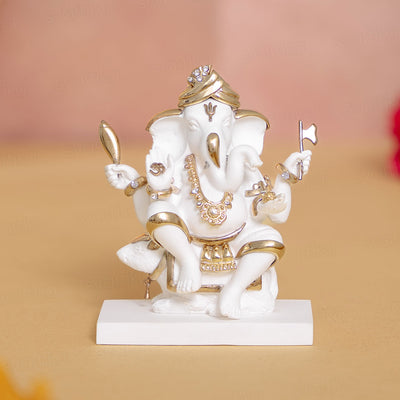
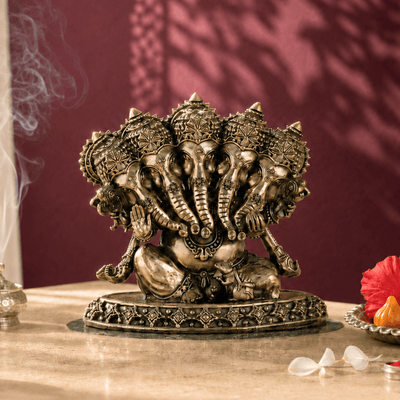
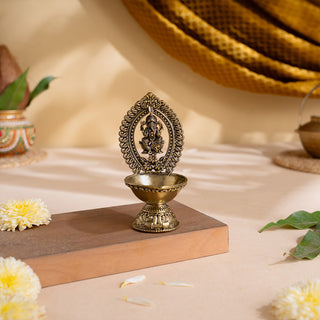
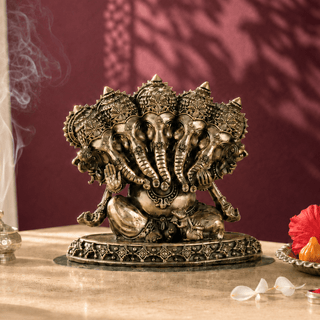
Then the rest is just the puja: the murti, the durva grass, the modaks, the flowers Ganesha is offered, and the one leaf that is famously never offered to him. Families who like to go bigger usually start with the decoration, and gift-givers can browse Ganesh Chaturthi gifts or the wider range of Ganpati murtis for home and brass idols.
Why the mechanism is worth knowing
A festival date is not handed down. It is computed, every single year, by people applying rules to a moving sky. The rules are old, the disagreements are old, and the arithmetic is honest work.
Knowing that your neighbour's date is not wrong, just calculated on a different convention, is a small thing. But it takes the sting out of the argument, and puts you closer to what the tradition is doing than any table of minutes could.
Also read: What to Do If You See the Moon on Ganesh Chaturthi | Who Broke the Tooth of Lord Ganesha | Relation Between Ganpati and Gauri | Ganesha Trunk Right or Left Meaning | Ganesh Laxmi Murti Position Guide