Every year the same argument starts in some family group chat. One cousin says Janmashtami is on Friday. An aunt says her temple is keeping it on Saturday. Both have a panchanga open. Both are right.
This is not carelessness. The split goes back to the oldest account of the birth.
What the Bhagavata says about the night Krishna was born
The Srimad Bhagavatam describes the moment in Canto 10, Chapter 3. It gives two markers, only two.
अथ सर्वगुणोपेतः कालः परमशोभनः । यर्हि एव अजनजन्मर्क्षं शान्तर्क्ष-ग्रहतारकम् ॥
In plain English: Then came the finest of all moments, calm and full of every good quality, when the birth star of the Unborn One rose and the stars and planets stood at peace.
Bhagavata Purana 10.3.1
A few verses later it gives the hour:
निशीथे तम उदभूते जायमाने जनार्दने । देवक्यां देवरूपिण्यां विष्णुः सर्वगुहाशयः । आविरासीद् यथा प्राच्यां दिशि इन्दुरिव पुष्कलः ॥
In plain English: At midnight, when the dark had deepened, Vishnu, who lives hidden in every heart, was born from Devaki, whose form had turned divine. He rose the way the full moon rises in the east.
Bhagavata Purana 10.3.8
Read that again and notice what is missing. There is an hour: the deepest part of the night. There is a birth star, but the verse never says which one. And there is no tithi at all. The passage never says ashtami.
That silence is the whole story. The chapter before it (10.2) sets the scene: Kamsa had already killed six of Devaki's children, and she carried this one in captivity, "confined in the Bhoja house like the flames of a covered fire".2 Krishna was born there, in Mathura, to Devaki and Vasudeva, the eighth of the ten avatars of Vishnu. The text cared about the hour. It did not care about a calendar square. The ashtami was added later, and the markers have pulled against each other ever since.
Why Krishna Janmashtami falls on two different days
In 2027 the Smarta date is Wednesday, 25 August. The split happens because a tithi is not a day.
A tithi is the time the moon takes to move 12 degrees further from the sun. Because the moon does not travel at a steady speed, that time keeps changing. Robert Sewell and Sankara Balkrishna Dikshit measured the range in The Indian Calendar (1896): as short as 21 hours 34 minutes, as long as 26 hours 6 minutes, averaging about 23 hours 37 minutes.4
So a tithi can start or end at any hour, and rarely lines up with a sunrise-to-sunrise day. This is the same machinery that moves Navratri, Ganesh Chaturthi and Diwali Lakshmi Puja around the English calendar every year.
Sewell gives the ordinary rule: the tithi running at sunrise gives the day its name. But he adds an exception most muhurat pages skip. Some rites are fixed to a set part of the day or night, and for those, the tithi running at that moment counts, not the one at sunrise.
Janmashtami is exactly that kind of rite. The puja is at midnight. So the day whose sunrise carries the label "ashtami" may not be the day ashtami is actually running at midnight.
Now add Rohini. The moon's passage through Rohini is a separate event with its own clock. Some years it lines up neatly with the ashtami at midnight. Some years it does not.
When they do not line up, a panchanga has to pick a winner. Smarta households usually follow the ashtami that is current at midnight. Many Vaishnava traditions wait for the Rohini alignment, which often puts them a day later. Nobody is wrong. They are honouring two different lines of the same text.
Bhadrapada or Shravana? Both, depending on where you live
Both, and it has nothing to do with astronomy. Sewell records that north India ends its lunar month at the full moon (purnimanta) and south India at the new moon (amanta).
The same dark fortnight therefore sits in different months. In the north this is Bhadrapada krishna ashtami. In the south the very same nights fall in Shravana. One festival, one night, two month names. If a relative in Chennai says the month is wrong, they are using a different book, not a different sky.
The muhurat: what nishita kaal actually means
Nishita is not a clock reading. It is the middle stretch of the night, worked out from your local sunset and sunrise. Move city or change the date, and it moves.
That is why the one nishita window we print, in the box above, is tied to New Delhi. A puja time that arrives without a place attached is not a fact. The Report of the Calendar Reform Committee (1955) explains why. Opening the Committee, Nehru said India had "at present thirty different calendars, differing from each other in various ways, including the methods of time reckoning". The report's own appendix lists more than fifty printed panchangas across seven languages.6
They also disagree at the level of basic rules. Sewell says the tithi running at sunrise names the day. Ebenezer Burgess, translating the Surya-Siddhanta (1860), gives a different convention: "The civil day receives the name of the lunar day which ends in it."5 Two respected authorities, two rules. That alone can produce two dates.
The practical answer is simple. Use a panchanga from your own city, and keep the vigil to midnight. That is what the text asks for.
Janmashtami vrat vidhi at home
What follows is living custom, not a fixed rulebook. Households vary.

- The fast. Most people keep a full-day fast and break it after the midnight puja. Some take only fruit and milk, some keep a waterless fast, and older people and children usually take phalahar.
- The bath and sankalp. A morning bath, clean clothes, and a simple resolve stating the reason for the fast.
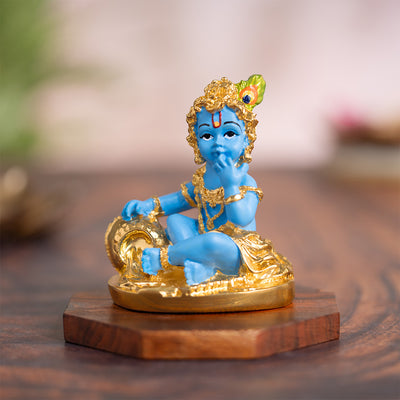
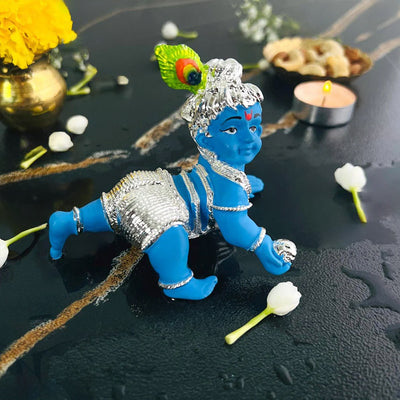
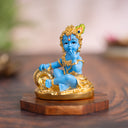
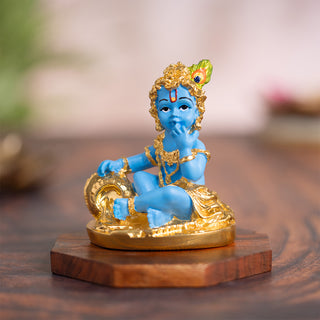
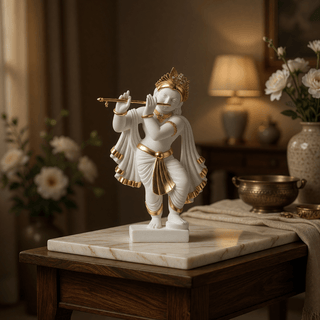
- The abhishek. At midnight the small Krishna image is bathed with milk, curd, honey, ghee and sugar, then water, then dressed. Many families use a Baal Krishna form, since the night is about a newborn.
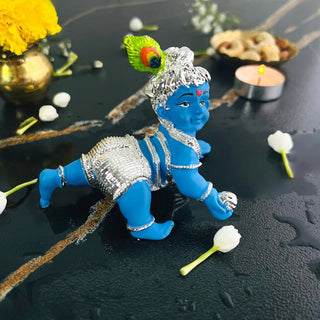
- The cradle. The image is placed in a jhulan, a small swing, and rocked. This is the part children remember. A light Laddu Gopal murti is the usual choice, meant to be picked up and handled.
- Bhog and aarti. Makhan mishri, panjiri and dhaniya panjiri are common. Tulsi leaves are added to the offering.
- Parana. The fast is broken after the puja, or the next morning, depending on family practice.
If you want the wider daily method rather than the festival one, our guide on how to worship Lord Krishna covers it, and the Krishna mantras people chant on this night are collected separately.
Three things people get wrong about Janmashtami
1. "The Bhagavata says he was born on ashtami." It does not. The birth passage gives the darkest hour of the night and an unnamed birth star, and stops there. The only "eighth" those chapters know is that Krishna was Devaki's eighth child (10.1.34). The ashtami comes from the later dharmanirnaya tradition, the decision literature that settles which day a rite belongs to. Sewell names the Nirnayasindhu as one such work. Saying this out loud does not weaken the festival. It explains it.
2. "One of the two dates must be the wrong one." Neither is. They come from two honest readings of the same night. It is the same argument that gives Karwa Chauth its moonrise rule and Raksha Bandhan its narrow window.
3. "Some years the ashtami just disappears." This one is true, and it surprises people. Because tithis are shorter or longer than a civil day, a tithi with no sunrise inside it is dropped (kshaya) and one with two sunrises is repeated (vriddhi). Sewell counts roughly thirteen expunctions and seven repetitions in twelve lunar months.4
Rohini, and a correction we owe you
An earlier version of this article said the Bhagavata's birth verses name the Rohini nakshatra. Checked against the Sanskrit, that is wrong.
Verse 10.3.1 uses one word for it, janmarkṣaṃ, meaning birth star. It does not say which star. Rohini is not in the chapter at all, and every Rohini in the whole tenth canto is a person, Vasudeva's wife and Balarama's mother.1 Translators supply the name because the commentators identify it that way. That reading is old and near-universal. It is still an identification, not the verse.
So the text is quieter than we said. Rohini is one of 27 nakshatras, usually matched with the reddish star Aldebaran. A panchanga can time the moon's passage through it exactly. But the Bhagavata gave an hour and an unnamed star.

Dahi handi, Nandotsav and the morning after
The next morning is Nandotsav, and this one is in the text. Bhagavata 10.5 opens with Nanda "overjoyed that a son had been born". He calls in the Vedic scholars, bathes, dresses, and gives away decorated milk cows, sesame, jewels and cloth.3 There is music and drumming, and the gopas and gopis join in. In Maharashtra this is when the dahi handi happens, with the pot of curd strung high and a human pyramid going up for it. It re-enacts the butter thefts, and belongs to the day after, not the midnight rite.

Regional names change too. Gokulashtami, Sri Jayanti, Krishnashtami and Ashtami Rohini all point at the same night. In the south the emphasis often falls on the Rohini reading, which is why the local date lands a day apart from the north Indian one.
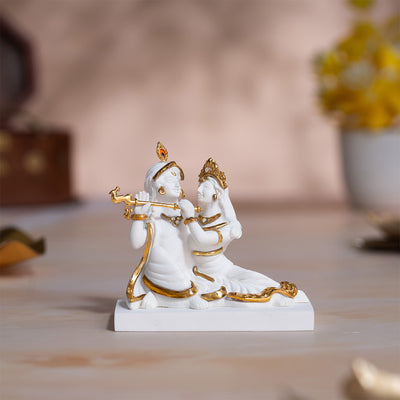
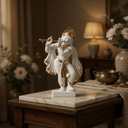
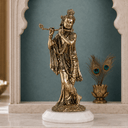
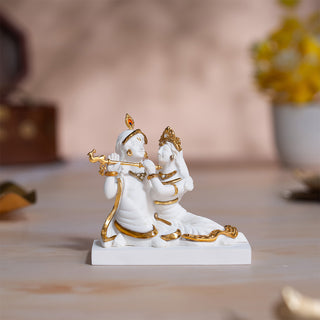
Gifting has grown around the night too. Families send small murtis, cradles and Janmashtami gifts the way they send sweets. A Radha Krishna murti is the most common choice. But the birth night belongs to Mathura and Devaki, and Radha's story begins later, in Vrindavan.
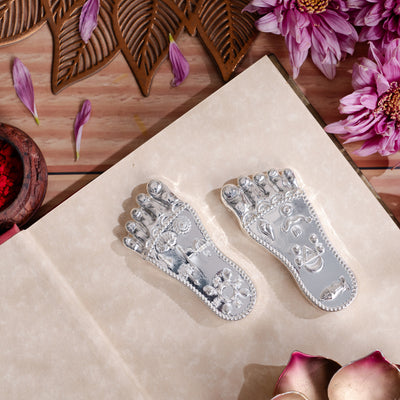
Homes decorate the same way they have for generations: a footprint trail to the puja room, a cradle, and lamps. If you are setting up, our Janmashtami decoration ideas and the guide on decorating a Krishna idol at home both help. The painted footprints at the door come from the same idea as the lotus feet of Krishna.
Why the two dates are not a problem
A festival this old has survived disagreement. The Krishna murti in your home does not care which panchanga your neighbour bought. Radha's own festival, Radha Ashtami, sits fifteen days later on the bright ashtami of the same month, and it moves for exactly the same reasons.
The Bhagavata wanted you to know that he came at the darkest hour, under a rising birth star, into a prison cell. Everything after that, the tithi, the star's name, the month, the muhurat table, is people trying to keep good faith with a night they were not present for.
Also read: What Happened to Krishna's Body After His Death | How Many Wives Krishna Had | Where is Krishna's Flute Now | Why Krishna Didn't Marry Radha | Why We Celebrate Chaitra Navratri