Ask how many wives Krishna had and you get 16,108. People either laugh at the number, get uncomfortable, or explain very fast that it is all a metaphor.
So I read it. Tagare's translation of the Bhagavata Purana (Motilal Banarsidass), Canto Ten, next to the Sanskrit. The story runs across four chapters. The number is slightly wrong. And the detail everyone leaves out is the one that matters.
How many wives did Krishna have?
8 queens, plus 16,000 women rescued from a prison.
The eight are named one by one, and each gets her own marriage episode. The 16,000 arrive together, in one chapter, as the aftermath of a war.
Here is the line, from the Bhagavata's summary at the end of chapter fifty-eight:
अन्याश्चैवंविधा भार्याः कृष्णस्यासन्सहस्रशः। भौमं हत्वा तन्निरोधादाहृताश्चारुदर्शनाः
In plain English: Krishna had other wives like these by the thousands, beautiful women brought back after he killed Bhauma and freed them from his prison.
Bhagavata Purana 10.58.58
That verse contains no number at all, though it is where most retellings pick one up. The Sanskrit says sahasrashah, "by the thousands". Tagare's English supplies "(sixteen thousand)" in brackets, borrowing the figure the rest of the canto uses. Chapter fifty-nine is where the count is actually stated.
Where the extra hundred comes from
The extra hundred comes from the Vishnu Purana, not from the Bhagavata. Chapter fifty-nine describes Krishna entering Narakasura's palace after the battle:
तत्र राजन्यकन्यानां षट्सहस्राधिकायुतम् । भौमाहृतानां विक्रम्य राजभ्यो ददृशे हरिः ॥
In plain English: There Hari saw sixteen thousand daughters of kings, carried off by force by Bhauma after he defeated their fathers.
Bhagavata Purana 10.59.33
Tagare's English adds "(and one hundred)" in brackets here, with a footnote at that exact spot. The commentator Shridhara gets the extra hundred girls from a verse in the Vishnu Purana, not from the Bhagavata's own wording. The Sanskrit reads shat-sahasradhikayutam, ten thousand plus six thousand. Sixteen thousand exactly. Add the eight queens and you get 16,008, which is not the number anyone says.1
Shridhara was right about where it comes from. Wilson's Vishnu Purana, Book V, says of Krishna entering Naraka's palace: "In the apartments of the women he found sixteen thousand and one hundred damsels."2 Two different Puranas, two different counts. Macdonell notes that the Bhagavata "is later than the Vishnu, which it presupposes", so a commentator reaching back to the older text for a number is doing something ordinary.6
Still, the Bhagavata itself keeps saying sixteen thousand every time it returns to the subject: when Narada visits Dwarka (10.69.2), and when it notes that "those sixteen thousand wives of Krsna failed to agitate his mind" (10.61.4). Dowson's Classical Dictionary, in the 1870s, hedged it the way an honest reader should: "he had 16,000 and a hundred or so besides."5
None of this makes 16,108 wrong to say. It is a very old number and it is what tradition settled on. It just is not what the Bhagavata counts. If you are quoting scripture, it is worth knowing which part is scripture and which is commentary. The same care applies to what happened to Krishna's body, where the popular version and the text diverge the same way.
The Narakasura story, properly told
Narakasura is the son of Bhumi, the earth goddess. That makes him, in the older lineage, a son of Vishnu's boar avatar and the earth he lifted out of the waters. That parentage is the tragedy of him.
He took Aditi's earrings, seized a divine umbrella, and drove the gods out of a mountain peak. Indra came to Dwarka to complain. Krishna flew to Pragjyotishapura on Garuda with Satyabhama beside him (10.59.2). The general Mura is killed first, which is where the name Murari comes from. Then Narakasura. The Mahabharata remembers the same episode from the outside: killing the asura Naraka, son of the Earth, Krishna took his earrings.4 Krishna then installs Narakasura's own son Bhagadatta on the throne, reappoints the ministers, and walks into the harem.
What he finds there is a prison. Sixteen thousand daughters of kings, gods and asuras, taken as spoils after their fathers were defeated in war. Not concubines who chose a life. Captives, held for years, in a palace built for the purpose.
The text does not say Krishna married them on the spot. Almost every retelling skips what it says instead:
ताः प्राहिणोद् द्वारवतीं सुमृष्टविरजोऽम्बराः । नरयानैर्महाकोशान् रथाश्वान् द्रविणं महत् ॥
In plain English: He sent them to Dwarka, washed and in spotless clothes, in palanquins, and sent great treasuries, chariots, horses and much wealth along with them.
Bhagavata Purana 10.59.36
Baths. Clean clothes. Palanquins. An escort. Wealth sent with them, in their own names. Before that, two verses in which the women themselves decide what they want: "May this hero be my husband. May god Brahma approve and grant my prayer" (10.59.35).
The sequence is rescue, restore, then consent. Read in that order it stops looking like an acquisition.
Why marriage at all, though?
Marriage here is legal status, not romance. In the world the text describes, a woman taken captive in war had no standing when she came home, and her father's house was often destroyed. Marriage gave her property, protection, and a name nobody could take back. Sixteen thousand former captives arriving in Dwarka would have been sixteen thousand women with nothing. Arriving as queens, they had everything.
The Bhagavata does not editorialise. It records that they became his wives, that each bore ten sons (10.61.1), and that they lived in separate mansions rather than one shared quarter. Chapter sixty-nine makes the point explicit. Narada hears that one man has married sixteen thousand women "each in a separate house" and goes to Dwarka to see how it can work. He finds Krishna in every house at once: in one playing with children, in another in conversation, in a third at a ritual. Tagare titles the chapter "Sri Krishna's Household Life," a wonderfully flat heading for a chapter about omnipresence.
The eight wives of Krishna, each with her own story
The 16,000 are a group. The eight are people, and the text gives each of them a scene.
Rukmini
She wrote to him. Her brother Rukmi had arranged her marriage to Shishupala, so Rukmini sent a brahmana to Dwarka asking Krishna to come. He took her from the temple procession on the morning of the wedding and fought off the assembled kings on the way out. Chief queen, and the only one of the eight who starts it herself.
Satyabhama
She rides to Pragjyotishapura on Garuda with him. Whatever else that chapter is, it is one in which a wife is at the battle rather than waiting at home for news.
Jambavati
Daughter of Jambavan, the bear king who fought Krishna for twenty-eight days and nights over the Syamantaka jewel (10.56.24) before realising who he was fighting. The marriage is the peace treaty. Jambavan had served Rama in the previous age, the sort of link the ten avatars are full of.
Kalindi
Arjuna and Krishna find her doing austerities by the Yamuna. She states her business without embarrassment: "I am the daughter of the Sun-god. I am performing austere penance with the desire of getting the boon-bestowing god Visnu who is worth courting, as my consort" (10.58.20). She had built a house under the river and meant to wait there. He married her in due course (10.58.29).
Mitravinda
Princess of Avanti, and Krishna's cousin, daughter of his paternal aunt Rajadhidevi, who married Jayasena of Avanti. Her brothers Vinda and Anuvinda, allies of Duryodhana, would not let her choose him at her swayamvara. He carried her off in front of the assembled kings (10.58.31).
Nagnajiti
Also called Satya, daughter of King Nagnajit of Kosala. Her father had set a test: seven wild bulls, all at once, none of them ever tamed. Suitors had been gored trying. Krishna divided himself into seven and took them together, then dragged them along like a child pulling wooden toy bulls (10.58.45–46).
Bhadra
Princess of the Kekayas, another cousin, daughter of his paternal aunt Shrutakirti, offered to him in marriage by her brother Santardana (10.58.56). Wilson's Vishnu Purana confirms the same family: Shrutakirti married the Kaikeya raja and bore "Santardana and four other sons."3 This is the plainest of the eight, and it is worth saying so rather than inventing a legend.
Lakshmana
Princess of Madra, carried away single-handed from her own svayamvara. The text compares him to Garuda swooping on the pot of nectar past a whole assembly of gods (10.58.57).
Look at the pattern. Three are taken from svayamvaras against a family's wishes. One writes and asks. One is won by a test of strength. One is a peace settlement. One is given by her brothers. One waits under a river. Eight different kinds of marriage, in a text that clearly enjoyed the variety.
 30% off
Three things people get wrong about this
1. "The Bhagavata says 16,108."
It doesn't. The Sanskrit gives sixteen thousand plainly in three places (10.59.33, 10.61.4, 10.69.2). A fourth passage, 10.58.58, says only "by the thousands", and the sixteen there belongs to the translator. The extra hundred is the Vishnu Purana's figure, brought across by Shridhara's commentary and flagged in a footnote. Eight queens plus sixteen thousand is 16,008. The rounder, bigger number is tradition, and tradition is allowed to round. But if someone tells you there is a Bhagavata verse reading sixteen thousand one hundred and eight, ask which one.
2. "It was a harem. It was about desire."
The text says the opposite in as many words: those sixteen thousand wives "failed to agitate his mind with those shafts of the god of love" (10.61.4). And the rescue chapter has him sending them home with wealth and an escort before marriage is mentioned. You can find the whole arrangement strange, and it is strange, without pretending the text says something it plainly denies.
3. "Radha was one of them."
Radha is not in the Bhagavata Purana at all. Not among the eight, not among the 16,000, not anywhere. Tagare says it flatly in his introduction: the Bhagavata "knows nothing of Radha."1 She becomes central much later, through Jayadeva's twelfth-century Gitagovinda and through the Vaishnava poets after him. She matters to devotion precisely because she stands outside the marriage register. That is the whole point of her, and it is why Krishna never married Radha is a real question with a real answer rather than an oversight. The related pieces on what happened to Radha after Vrindavan, how Radha died and whether she was older than Krishna all run into the same gap in the sources, and are honest about it.
What the number is doing
The number is large on purpose. Narada's question in chapter sixty-nine is not "how could he want so many". It is "how can one person be genuinely present to that many at once." The number exists to be too large for a human husband, so that whoever satisfies it cannot be a husband in the ordinary sense.
That is the same point the Sudarshan chakra stories make from another angle, and it is why the Sudama episode lands so hard: attention that does not thin out when it is divided.
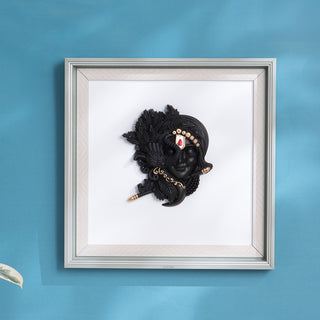
People who keep Radha Krishna murtis at home are, mostly without thinking about it, choosing the relationship the scripture does not record over the eight it does. That is not confusion. It is a preference for the version where nothing is transactional.
Reading it without flinching
You can hold two things at once. This is a story about a war ending with sixteen thousand imprisoned women getting their lives back. It was told by a culture with no way to restore a woman's standing except marriage. In its own terms it is generous. It is also a story in which a woman's status flows entirely through a man, and no devotional framing makes that modern. The text does not need us to pretend otherwise. It survives being read carefully.
What it does not survive is being flattened into a punchline on one side or a hurried metaphor on the other. The eight queens each did something specific. The sixteen thousand were rescued from something specific. The hundred is a footnote.
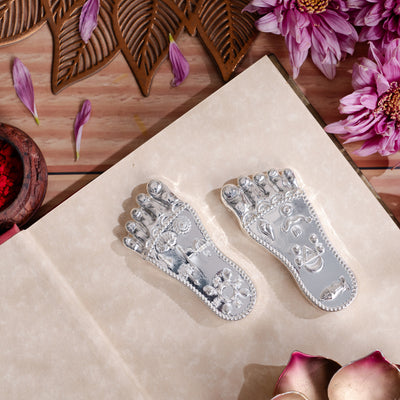
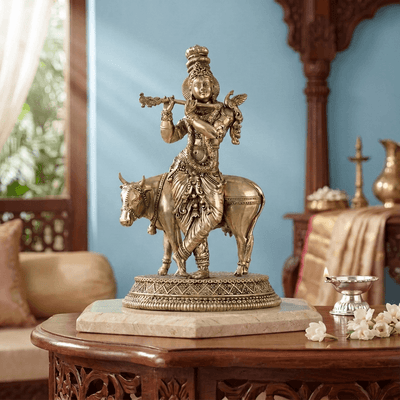
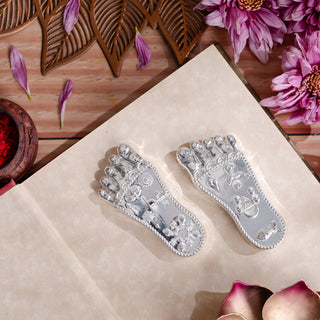
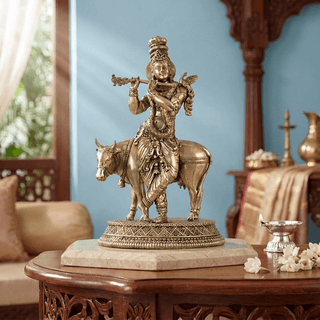
For the devotional layer rather than the arithmetic, start with how Krishna is actually worshipped at home or the Krishna mantras people use daily. There is a reason the object most households keep is not a statue of a king with sixteen thousand wives but a pair of lotus feet: the part of him you approach rather than the part you count. The symbolism of those feet is worth reading, and decorating a Krishna idol covers the practical side. Most of the Krishna murtis people actually live with are the flute-player or the child, not the king of Dwarka.
And if you got here before Janmashtami (the season the Baal Krishna forms come out) the birth story is the other end of the same life, beginning in a prison cell in Mathura with a father carrying a baby across a river. Prisons at both ends. He gets out of one and empties another.
Also read: Why Krishna Didn't Marry Radha | What Happened to Krishna's Body | Krishna and Sudama | Where Is Krishna's Flute Now | Why Radha Ashtami Is Celebrated