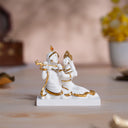
Somewhere in a Vrindavan forest, a group of women are on their hands and knees reading the ground.
They have lost Krishna in the dark. So they do the only thing available to them: they follow his footprints. And the Bhagavata Purana tells us how they know the prints are his. Not by size, not by direction, but by the marks pressed into the soil from the soles of his feet.
That scene, more than any sermon, is where the phrase "lotus feet of Krishna" comes from. Most articles treat it as a pretty way of saying "Krishna". The texts are far more specific.
What does "lotus feet" actually mean?
It names a relationship, not a compliment about Krishna's appearance. Sanskrit devotional writing gives you pada-pankaja, charana-kamala, pada-aravinda: feet-lotus, in various flowers. It is used for Vishnu, for Krishna, for a guru, for a mother.
The lotus half is doing real work. A lotus roots in pond silt, and the flower above the water stays clean: water beads and rolls off instead of soaking in. Completely present in a messy world, completely untouched by it.
The feet half does different work, and that is the half people miss. In Indian practice you touch someone's feet when you place yourself under them: a parent's, a teacher's, an elder's. It is the body's own vocabulary for "you outrank me and I'm glad."
The marks on his soles
In the tenth canto, the gopis are tracking Krishna through the forest at night, and the text says his footprints are recognisable because his soles carry distinctive symbols.
पदानि व्यक्तमेतानि नन्दसूनोर्महात्मनः । लक्ष्यन्ते हि ध्वजाम्भोज वज्राङ्कुशयवादिभिः ॥
In plain English: These are clearly the footprints of Nanda's great son. You can tell them by the flag, the lotus, the thunderbolt, the goad, the barleycorn and the rest.
Bhagavata Purana 10.30.25
Five things named: a flag (dhvaja), a lotus (ambhoja), a thunderbolt (vajra), an elephant goad (ankusha) and a barleycorn (yava). Then the Sanskrit adds adi, "and so on", and stops. It gives examples. It never says how many there are.1
Notice a detail people slide past. The verse calls him "the son of Nanda." Not the son of Vasudeva, who fathered him. Even in a moment this intimate, the Bhagavata uses his foster father's name. That is a small window into how the texts handle the question of Krishna's father: they refuse to pick one.
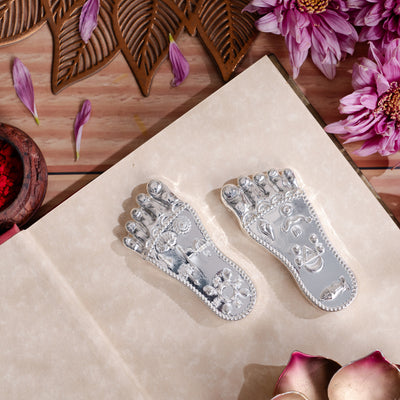
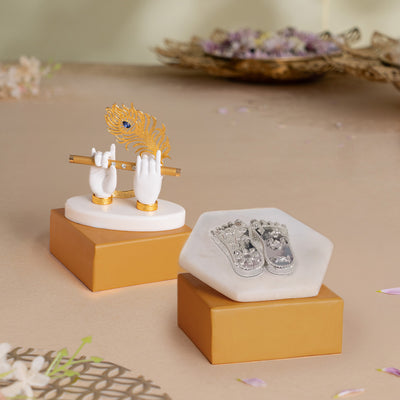
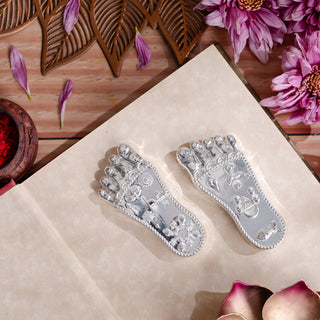
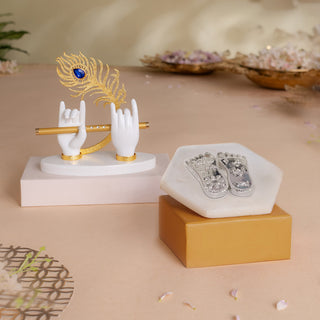
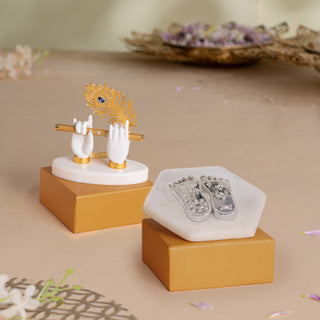
These marks have a long afterlife in iconography. On a metal or stone charan paduka, a pair of footprints kept on an altar instead of a full idol, the symbols come from this family of images. The conch and disc appear in many versions too, borrowed from Vishnu's emblems, which is why the Sudarshana chakra turns up on a sole the verse never puts it on.
The gopis' song: the tenderest verses in the whole corpus
If chapter 30 describes the feet, chapter 31 loves them. The Gopi-gita, the song the gopis sing when Krishna has vanished on them, is the densest lotus-feet passage in Sanskrit scripture, and it is not restrained.
They ask him, plainly, to put his feet on their chests. They say those feet destroy the past wrongs of anyone who takes shelter in them (10.31.7).2 Then, a few verses later, the register changes completely and becomes almost domestic:
चलसि यद् व्रजाच्चारयन् पशून् नलिनसुन्दरं नाथ ते पदम् । शिलतृणाङ्कुरैः सीदतीति नः कलिलतां मनः कान्त गच्छति ॥
In plain English: When you walk out of Vraj herding the cows, your foot is lovelier than a lotus. We think of the stubble and grass and small sharp shoots hurting it, and our minds go to pieces.
Bhagavata Purana 10.31.11
They have just called him the shelter of the universe. In the next breath they are worried about gravel.
That flip is the genius of the Bhagavata. The feet are at once the cosmic refuge and a real pair of feet walking barefoot in a cow pasture. The poem never resolves the two. The surrounding story is worth reading as well. What happened to the women of Vraj after he left, and what the texts actually say about Radha after Vrindavan, is a stranger and sadder record than the popular version.
One honest note while we are in chapter 30. At verse 26 the gopis find a second set of footprints beside Krishna's: one woman he took aside. The Sanskrit calls her only gopi. Every English Bhagavata that prints "Radha" there is printing a commentator's identification, and careful translations bracket it. That reshapes a lot of what people assume, including whether Radha was older than Krishna.
Why feet, and not hands or eyes?
Because surrender happens at floor level. Krishna's eyes, face, palms and navel are all compared to lotuses too. But you cannot bow to someone's eyes.
Another part of it is the dust. In the Vrindavan material the ground Krishna walked on becomes holy by contact. Uddhava, a Yadava prince sent to console the gopis, ends his visit wishing he could be reborn as a shrub there just to catch the dust off their feet (10.47.61). The man sent to comfort them leaves envying them.
And part of it is that feet are the humble end of a body. Choosing them as the point of contact says something about who is doing the reaching.
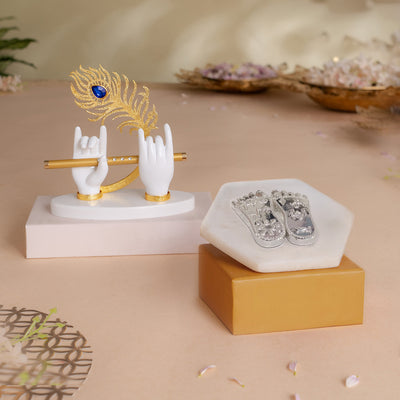
There is a practical reason too. Footprints stand in for him without showing a face. They are small, easy to place, and right for a house where a full murti feels like too much. That is why charan padukas exist as their own category of object, and why the same logic governs where you place Lakshmi's charan paduka at home.
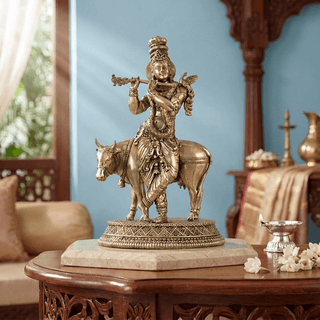
The feet are a practice, not a picture
In the seventh canto, the boy Prahlada lists the nine limbs of devotion, the tradition's own curriculum, called navadha bhakti:
- Shravanam: hearing about him
- Kirtanam: singing about him
- Smaranam: remembering him
- Pada-sevanam: serving the feet
- Archanam: formal worship
- Vandanam: prayer
- Dasyam: servitude
- Sakhyam: friendship
- Atma-nivedanam: giving yourself away
Look at item four. Pada-sevanam sits between remembering and formal worship (7.5.23) as a distinct practice.3 Not a mood, a limb: something you do.
In practice that means washing an idol's feet, offering flowers there first, keeping a paduka on the altar, or beginning a prayer at the feet and working upward. If you want the wider frame, the scriptural basics of worshipping Krishna and the best-sourced Krishna mantras both sit on this same nine-limbed structure: kirtanam is item two on the list above.
And the entry cost is famously small. In the Bhagavad Gita, Krishna says a leaf, a flower, a fruit and water, offered with devotion, are accepted (9.26).7 The most detailed beginner's puja anywhere in the source literature is Narada teaching the child Dhruva: go to a clean place by the river, bathe, prepare a seat, chant, and offer water, forest flowers, fruit and tulsi (Bhagavata 4.8.42-56).5 No gold anywhere in the instructions.
Four things people get wrong about Krishna's lotus feet
1. "Bhagavad Gita 18.66 tells you to surrender at his lotus feet." It does not. The verse says sarva-dharman parityajya mam ekam saranam vraja: abandon all duties, come to me alone for shelter. There is no word for feet in it.6 The lotus-feet vocabulary is Bhagavata vocabulary and bhakti-poetry vocabulary. Both are scriptural; they are just different books. Getting this right is the difference between an article you can cite and one you cannot.
2. "The Bhagavata says there are exactly five marks." We said that in an earlier version of this article, and it is wrong. The verse ends with yavadibhih, barleycorn "and so on", so it names five and leaves the list open. The longer inventories of eleven, nineteen or thirty-two come from Gaudiya commentarial and Shilpa Shastra literature, and the verse does not rule them out. It invites them. Checking that turned a neat contrast into a duller and truer answer: nobody was ever counting.
3. "It is a later devotional invention, not in the old texts." The opposite. It is embedded in the plot (the footprints are how the gopis locate him) and named as one of the nine limbs of bhakti in canto seven. It is about as structural as an image gets.
4. "The woman with the second set of footprints is Radha, and the text says so." The Bhagavata never uses the name Radha, not once. Not at 10.30.26 and not at 10.47.11, where a gopi famously talks to a honeybee. Radha becomes a named, central figure in the Brahma Vaivarta and Padma Puranas and above all in Jayadeva's twelfth-century Gita Govinda.8 The devotion is genuine and old. The name is simply not in this book, which is also why no scripture describes Radha's death, and why Radha Ashtami draws its charter from the Padma Purana rather than from the Bhagavata.
The arrow: how the story closes the circle
At the very end of Krishna's life, in the eleventh canto, he is sitting alone in a forest. The text describes his posture carefully: his right foot, reddish like a lotus, resting on his thigh.
A hunter named Jara is moving through the trees. He sees a patch of reddish colour through the leaves, mistakes it for the face of a deer, and looses an arrow. It strikes the foot (11.30.33).4
When Jara comes close and realises what he has done, he collapses. Krishna's answer contains no reproach at all: don't be afraid, what you did was my desire (11.30.39).
Sit with that. The part of Krishna scripture praises most, that devotees bow to and cast in silver, is also the part that is wounded, and the wound ends the incarnation. The tradition never made the feet invulnerable. It made them the place where everything, including the arrow, arrives. What happened next is its own long story, and the record of what happened to Krishna's body afterwards is more interesting than the versions usually told.
It is also a fitting close for an avatar of Vishnu whose whole career refuses grandeur at the crucial moments. He is born in a prison and raised by cowherds. He drives someone else's chariot in the war. He accepts a handful of beaten rice from a poor classmate and gives back a palace. And he goes out because of a hunter's honest mistake.
What this means if you keep Krishna at home
None of this requires you to buy anything. Gita 9.26 sets the ceiling at a leaf and some water, and it is the strongest verse here precisely because the list is so short.
But if you already keep an altar, the texts suggest a shape. Offer at the feet first and work upward. Flowers and tulsi land at the base. When you wash an idol, the feet are where the water goes. That is pada-sevanam done literally, and it is why a pair of Krishna's charan paduka works even in a house with no room for a full Krishna murti. It is the smallest possible version of the whole gesture.
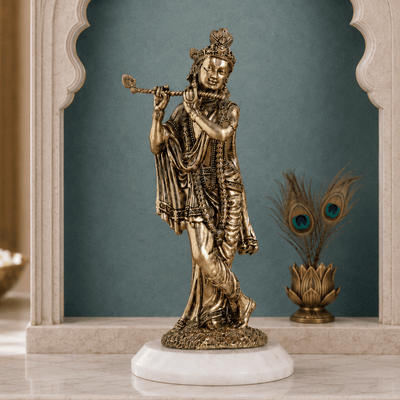
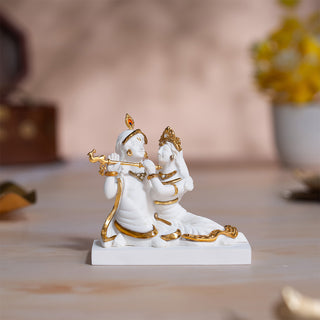
The practical side (direction, height, what sits beside what) is covered in our guide to decorating a Krishna idol at home, and the once-a-year version is in the Janmashtami decoration ideas. If it is a Radha Krishna murti, the same logic holds; the feet still come first.
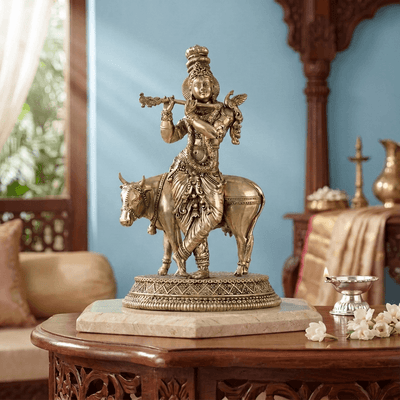
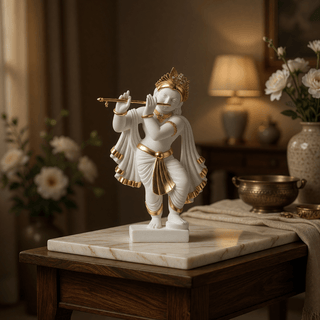
One last image. The Vrindavan Krishna is a boy with a flute and dusty feet, walking behind cows, and the women who love him worry about the gravel. Everything "lotus feet" is trying to say is already in that picture. The theology came later and gave it a name.
Also read: What Happened to Krishna's Body After His Death | What Happened to Radha After Krishna Left Vrindavan | How to Worship Lord Krishna | Where is Krishna's Flute Now | How to Decorate a Krishna Idol at Home