Everyone in India knows this story before they can read. The poor friend. The knotted cloth. The rice. The palace.
Much of the version most of us grew up with isn't in those chapters. The text is better than the retelling.
So here is the story as the Bhagavata Purana tells it, in order, with what's verse and what's later tradition kept separate.
What actually happens in Bhagavata Purana 10.80 and 10.81
Chapter 80 opens with a brahmin. The text introduces him at 10.80.6 as "a certain friend of Krishna, a brahmin well versed in the Vedas." He is described as detached, peaceful, with his senses under control. He is also extremely poor.
His wife is the one who moves the story. She is hungry, thin, and practical. She points out what he has never thought to use: he knows Krishna. Not as a devotee knows a deity, but as a classmate. They studied together. Go, she says. He is kind to brahmins. He will give you something.
The brahmin agrees, but on his own terms. He decides that simply seeing Krishna is worth the walk, and that he should not turn up empty-handed. So he asks his wife for a gift to carry. She has nothing. She goes to the neighbouring brahmins and begs four fists of husked, parched rice, what most of us call poha, and ties it in a scrap of cloth (10.80.14).
He walks to Dwarka with that bundle. He gets past the gates. And then Krishna, who is a king by now, sees him and gets off his own bed to greet him, embraces him, seats him, and washes his feet with his own hands.
The brahmin sits there in a palace with the bundle hidden under his arm, and cannot bring himself to produce it.
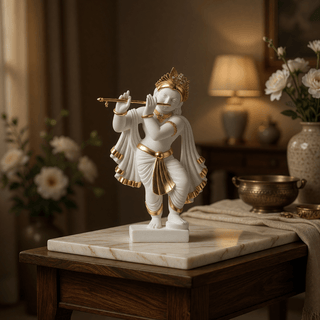
The part almost nobody mentions: the text never names him
Read 10.80.6 in an honest translation and you will not find the name Sudama. You will find "a certain friend of Krishna, a brahmin." Some editions add "[Sudama]" in square brackets, which is exactly how a careful translator flags a word that is not in the Sanskrit.1
The Bhagavata simply does not name him in this episode. The name comes from later tradition and commentary, where it is old, settled and universally used. Nobody made it up to fool anyone. But if you want to cite the Bhagavatam for the name, the verse isn't there.
And there's a second layer to this. The Bhagavata does use the name Sudama, for someone else entirely.
Where the name probably came from
Back in chapter 41, when Krishna and Balarama first walk into Mathura as boys, they meet a garland-maker. He is delighted to see them, worships them, and gives them garlands, betel nut and sandal paste. The text names him: Sudama, the garland-maker of Mathura (10.41.43-44).3
Two humble men. Two small offerings. Two moments where Krishna receives something worth almost nothing and gives back something enormous. It is very easy to see how, over centuries of retelling, one man's name drifted onto the other man's story. Translators have noticed the overlap and footnoted it.
I find this more interesting than a correction. It tells you what the tradition was actually paying attention to: not the identity of the giver, but the shape of the gift.
If you want the wider Krishna story that these chapters sit inside, the Mathura years, the move to Dwarka, and how it all ended, we've written about what happened to Krishna's body after his death and about who gave him the Sudarshana Chakra.
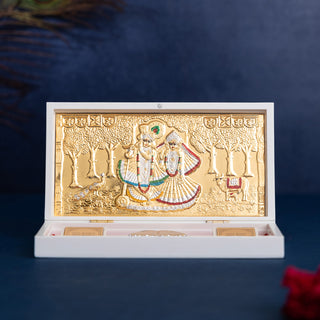

What the two friends actually remembered
The reunion scene is where the Bhagavata stops being a moral fable and starts feeling like two men in a room.
Krishna doesn't make a speech about friendship. He brings up a specific afternoon. Their guru Sandipani's wife had sent them into the forest for firewood. A storm broke. The rain came down hard, the sun set, and the two boys spent the night lost, holding hands, waist-deep in water (10.80.27, 10.80.35-39). In the morning the guru came looking for them.
That's the memory Krishna picks. Not a miracle. A bad night in the rain.
The Bhagavata is quietly making a point here. In Prahlada's famous list of the nine limbs of devotion, sakhyam, friendship, is one of them, sitting alongside hearing, singing and remembering (7.5.23-24).5 Friendship is a legitimate way to relate to God in this tradition, not a lesser one. Chapter 80 is that idea with a face on it.
If you want the whole list and what each limb means in practice, it's the backbone of our guide to how to worship Lord Krishna.
One handful, not three
Krishna ate one handful of the rice, not three. This is the most commonly mis-told line in the whole episode.
Krishna spots the bundle. He teases his friend about hiding it, snatches it, and unwraps the flat rice. He takes one handful and eats it. He reaches for a second, and Rukmini catches his hand (10.81.8-10).2
One handful. Then a hand on his wrist. That's the verse.
The version most of us heard has three handfuls, with each one signing away a world, and Rukmini stopping him before the third to save the universe from bankruptcy. It's a lovely piece of devotional maths. It is not in chapter 81.
Translations also disagree about why she stops him. Some read it as concern, since dry parched grain is hard on the stomach. The popular telling reads it as Lakshmi herself putting a limit on how much her husband can give away in one sitting. The Sanskrit leaves room for both, and it's more honest to say so than to pick the dramatic one and call it scripture.
What the text is unambiguous about is that the brahmin never asks. Not once. He spends the night, talks about old times, and walks home in the morning with nothing in his hands, and, the text says, feeling entirely satisfied anyway. This is the same logic the Gita uses in its most quoted line about offering: a leaf, a flower, fruit, water, given with devotion, and that's enough (Bhagavad Gita 9.26).6 The rice qualifies. A palace was never the transaction. The same principle runs through the best-sourced Krishna mantras: what you say matters more than what you spend.

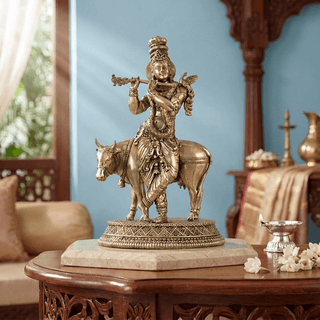
What he finds when he gets home
He walks back expecting his hut, and can't find it.
Where it stood there are now palaces that the text compares to the sun, fire and the moon put together: gardens, lotus ponds full of flowering lilies, pillars set with gems, birds calling, servants everywhere (10.81.21-28). He assumes he has taken a wrong turn.
Then his wife comes out to meet him, dressed and ornamented, and the text says she looked like Lakshmi stepping out of her own abode.
What I like is what happens next in his head. He doesn't celebrate. He works out where it came from, decides Krishna must have done it without ever being asked, and then worries about it. He prays that he won't lose his devotion now that he's comfortable. The Bhagavata gives a poor man wealth and then immediately shows him treating wealth as the more dangerous of the two conditions.
Three things people get wrong about Krishna and Sudama
1. "The Bhagavatam says his name was Sudama." It doesn't. 10.80.6 says only "a certain friend of Krishna, a brahmin well versed in the Vedas." The name is genuine tradition, ancient, universal, and worth keeping, but the verse you'd cite for it doesn't exist. The one Sudama the Bhagavata actually names is the garland-maker of Mathura at 10.41.43.
2. "He ate three handfuls, one for each world." He ate one and was reaching for a second when Rukmini took his hand (10.81.10). The three-handfuls-three-worlds accounting is later devotional elaboration. Beautiful, widely repeated, not the verse.
3. "Sudama went to Dwarka to ask for money." The text is careful about this and so should we be. His wife suggests it. He agrees to go, but decides the darshan alone is worth the trip, and he never makes the request, not when he arrives, not overnight, not when he leaves. The whole moral of the episode depends on the ask never happening, and it's in the text rather than imposed on it.
Getting these right matters more than it looks. It's the same discipline that separates a citable article from a decorative one when people write about how Radha died or where Krishna's flute is now, two questions where the popular answer is confident and the scripture is silent.
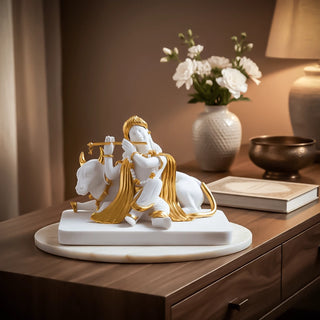
Why this small story outlived bigger ones
Canto 10 is full of spectacle. A mountain lifted on one finger. Kamsa killed. Sixteen thousand queens. Compared to that, two men eating poha is nothing.
And yet this is the episode that ended up in every child's storybook, every Janmashtami skit, every grandmother's version. I think it's because it's the only one you can actually do something with.
Most Krishna stories ask you to marvel. This one asks you to notice the friend you stopped calling because your life went one way and theirs went another. It asks whether you'd greet them at the door. It asks what you'd bring if you had nothing worth bringing.
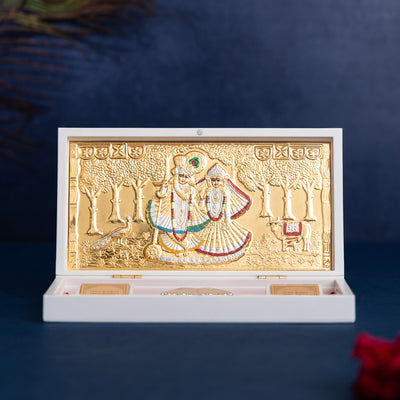
It also quietly settles an argument about worship. If four fists of begged rice were acceptable, then the size of the offering was never the point, which is exactly what the tradition says when it tells you how to set up a Krishna idol at home, or what to put out at Janmashtami. A clean space, a lamp, a flower, something you actually made or brought. A small Radhe Krishna pocket temple travels the way that knotted bundle travelled: the point was never the object's price.
There's a matching moment later in the same canto, when Uddhava, a Yadava prince sent to console the gopis of Vrindavan, ends up wishing he could be reborn as a shrub there just to receive the dust of their feet (10.47.61, 10.47.63).4 The Bhagavata keeps doing this. The person with status envies the person with love. Sudama's chapter is the same idea told as a friendship instead of a longing, which is also why the gopis' story after Krishna leaves Vrindavan reads so differently from the Dwarka chapters.
Where to read it yourself
You don't need a scholar's library. Chapters 80 and 81 of Canto 10 are short, half an hour honestly, and freely readable online in full translation. Read 41 too, for the garland-maker. If you've only ever heard the story, the text will surprise you at least twice.
And if you're chasing the rest of Krishna's life around it, the useful starting points are who his father actually was, how many wives he had (Rukmini, the one who catches his hand here, is the first), and where Krishna sits among the ten avatars of Vishnu. For the devotional side, Dhruva's story is the one place scripture gives step-by-step instructions to a complete beginner.
Krishna's last word on all of it, in the Gita, has nothing to do with quantity either: come to me alone for shelter (18.66).7 No mention of what to carry.
The brahmin already knew that. He just brought the rice anyway, because you don't visit a friend empty-handed.
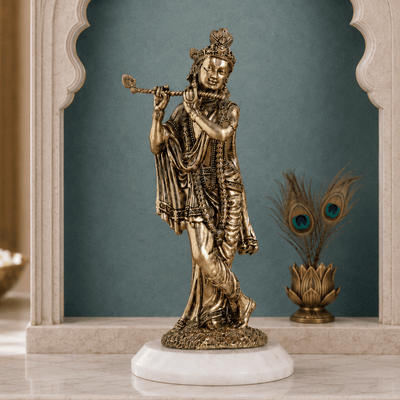
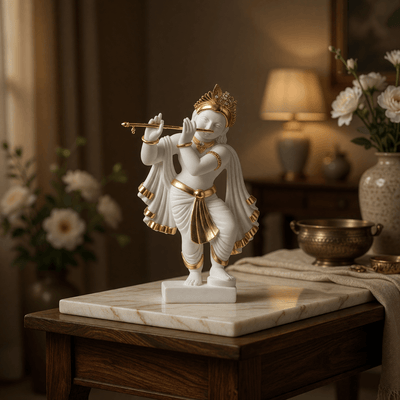
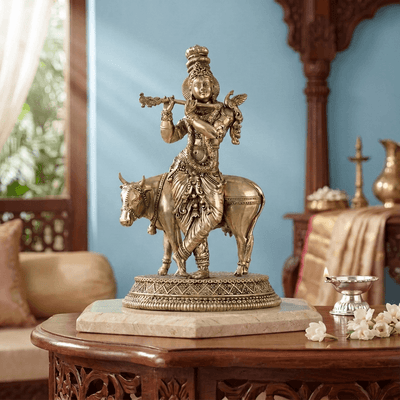
Browse our Krishna idols, Radha Krishna murtis and handcrafted brass idols if you're setting up a corner at home, or our Janmashtami gifts if you are carrying something to someone else's.
Also read: What Happened to Krishna's Body After His Death | Why Krishna Didn't Marry Radha | The Sacred Lotus Feet of Krishna | Krishna Janmashtami: Vrat Vidhi & Muhurat | Why Radha Ashtami Is Celebrated