Ask this question out loud in most Indian homes and you will get two answers in the same breath. "Vasudeva." "No, Nanda." Both people are right, and the strange thing is that the scripture agrees with both of them too.
Most articles on Lord Krishna settle this in one line and move on. The texts do not. They keep two fathers in play for the whole of Krishna's childhood, and then Krishna himself adds a third answer that dissolves the question entirely. That triple answer is the actual subject here, and it is far more interesting than a name.
The short answer, in the order the Bhagavata gives it
The Bhagavata Purana's tenth canto is the main source for Krishna's life: his birth, his childhood, his marriages, and eventually the end of his life. Chapter three of that canto is the birth chapter, and it is very clear about who the parents are.
- Vasudeva: biological father. A Yadava of the Vrishni clan, son of Shurasena. His other name is Anakadundubhi.
- Devaki: mother. Cousin-sister of Kamsa, the king who imprisoned them both.1
- Nanda: the father who raised him, head of the cowherd settlement at Gokula.
- Yashoda: Nanda's wife, and the mother in every story anyone actually tells about Krishna's childhood.
Note that the Bhagavata never presents the second pair as substitutes. It presents them as parents. That is the detail worth sitting with.
Vasudeva: the father who gave his son away the night he was born
Kamsa had been told that Devaki's eighth child would kill him. So he locked his cousin and her husband up and killed their children as they came. By the time the eighth arrives, Vasudeva and Devaki are prisoners in their own city.
The Bhagavata says Krishna appeared from Devaki's form as a fully formed, four-armed, ornamented being (10.3.7-11). Vasudeva looks at the newborn and recognises exactly what he is holding: the Original Person, not an infant (10.3.13). Then he is asked to put him down and carry him out.
What he does next is the part that makes him worth writing about. That same night he lifts the child, walks out of Mathura, crosses to Nanda's cowherd village, and exchanges his son for the newborn daughter lying beside Yashoda, who is still unconscious from labour and knows nothing about it (10.3.51-53). He carries the girl back to the prison cell and lets the guards find her.
He does not get to raise the child. He gets one night. And the text never gives him a scene of complaint about it.
A name that trips almost everyone: Vasudeva or Vaasudeva?
Vasudeva is the father. Vaasudeva (with the long first vowel) is a name of Krishna himself, and it simply means "son of Vasudeva". Sanskrit builds patronymics that way. So when you see "Vasudeva" in a mantra like om namo bhagavate vasudevaya, that is Krishna being named through his father, not the father being worshipped. You will meet this same name again in the well-sourced Krishna mantras, where the twelve-syllable one is built on exactly that word.
Anakadundubhi is not a second person either. It is an epithet of Vasudeva: the tradition says drums and kettledrums sounded at his birth, and the name stuck.8 Some blogs list Anakadundubhi as a separate relative. He is the same man.
Vasudeva's own father is Shurasena, which places Krishna in the Yadava line: Shurasena, then Vasudeva, then Krishna.8 That lineage is also why Krishna is called Yadava and Vrishni throughout the epics, and why the story of how he received the Sudarshan Chakra reads as a warrior's story rather than a cowherd's.
Nanda: the father the text keeps calling his father
Long after the birth chapter, the Bhagavata is still calling Krishna the son of Nanda. When the gopis search the forest and find his footprints in the dust, the text does not say "the footprints of Devaki's son". It says the footprints of the son of Nanda (10.30.25). That is the narrative voice, not a character's mistake.
The same holds through the rest of the Vrindavan chapters. When Krishna finally leaves for Mathura on Akrura's chariot, Nanda goes along as his father.4 When the people of Vraj meet Krishna years later at Kurukshetra during a solar eclipse, Nanda is there, and the reunion is written as a father and son meeting after a long separation (10.82.31-35). Nobody in the text ever downgrades him to a guardian.
The Bhagavata even records Nanda's celebration of the birth in detail: swept courtyards sprinkled with water, gates hung with festoons of garlands, cloth and mango leaves, cattle smeared with turmeric and decked with peacock feathers, and a great noise of instruments (10.5.6-13). That passage is, incidentally, the oldest description we have of what a Krishna birthday celebration looked like, and a lot of what people still do on Janmashtami traces straight back to it.
Two mothers, and no ranking between them
Devaki carried him. Yashoda fed him, chased him, tied him to a mortar and was scolded by her neighbours about his butter thefts. Sanskrit tradition has a tidy word for this arrangement (janma-mata and palana-mata, the mother who bore and the mother who nourished) but the texts do not use it to rank them.
Indian scripture is oddly comfortable with this. Sita is found in a furrow and raised by Janaka, and nobody calls him her step-father. Hanuman has both Kesari and Vayu as fathers, at the same time, with no contradiction flagged. Shiva's parentage is a question the texts answer several different ways depending on which Purana you open.
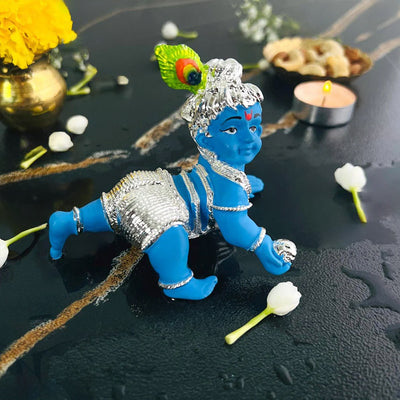
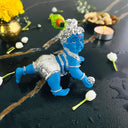
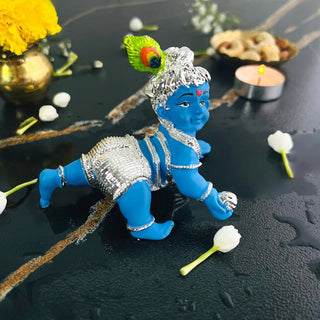
Which is why the child form of Krishna that most homes actually keep (the crawling Laddu Gopal, the butter thief) belongs to Yashoda's house, not to the palace at Mathura. If you have ever wondered why the murti people dress and feed every morning is a crawling baby rather than a prince, that is the reason. The tradition chose the fostered childhood as the one to keep close.
The third father: Krishna's own answer
In the ninth chapter of the Bhagavad Gita, Krishna makes a claim that reframes the whole question:
pitāham asya jagato mātā dhātā pitāmahaḥ: "I am the father of this universe, the mother, the support and the grandsire." (Bhagavad Gita 9.17)
Read that beside the birth story and you get the tradition's real position. Vasudeva fathered the body. Nanda fathered the boy. And the one being fathered is, in his own words, the father of everything doing the fathering. It is a loop, and it is deliberate.
This is the same logic that runs through the ten avatars of Vishnu: an avatar takes on a genuine, limited, local life, parents included, without ceasing to be what it is. If the avatar's parents were a formality, the descent would be theatre.
Four things people get wrong about Krishna's parentage
1. "There is one answer to this question." There are three, and scripture holds all of them at once: Vasudeva biologically, Nanda in practice, and Krishna himself cosmically at Gita 9.17. The Bhagavata is not confused. It simply refuses to rank them, and the footprint verse at 10.30.25 shows it still calling him Nanda's son long after the birth chapter.
2. "Anakadundubhi was another relative." No, it is Vasudeva's own epithet. And Vaasudeva, the name you meet in mantras, is Krishna, not his father. Two of the most common factual errors on this topic are just Sanskrit name confusion.
3. "Nanda and Yashoda were told, or knew all along." The Bhagavata gives no such scene. Yashoda was unconscious during the exchange (10.3.51-53), and the text does not narrate anyone breaking the news later. That silence is worth respecting rather than filling in. Popular retellings supply an explanation because a modern reader wants one.
4. "Devaki and Yashoda are mother and step-mother." The step- vocabulary is ours, not the text's. The Bhagavata uses no such demotion. Krishna's last recorded meeting with the people of Vraj at Kurukshetra (10.82.39-46) has him consoling them as his own, not as a family he has outgrown, the same emotional territory as what happened to the gopis after he left Vrindavan.
Why keeping all three answers matters
You could easily imagine a tradition that tidied this up. Declare Vasudeva the real father, file Nanda under caretaker, and be done. Indian tradition went the other way and made the fostered years the emotional centre of the entire Krishna story.
Almost everything people love about Krishna happens in Nanda's village, not in his birth father's city. The butter. The cows. The flute, which the Bhagavata describes lavishly in Vrindavan and stops mentioning once he leaves. Radha and the gopis, and the questions people still ask about them, like whether Radha was older than him. Even the friendship with the poor brahmin classmate belongs to his student years, not to Mathura's throne room.
The last image of Krishna in the Bhagavata closes the circle in a quiet way: he is sitting with his right foot resting on his thigh when a hunter named Jara mistakes it for a deer and pierces it (11.30.28-33). The most worshipped part of him is the part that gets wounded, which is roughly the same lesson the parentage story teaches. Greatness in these texts is always attached to something ordinary and vulnerable. If you want that idea unpacked properly, we have written about the lotus feet of Krishna and where the imagery comes from.
How this shows up at a home altar
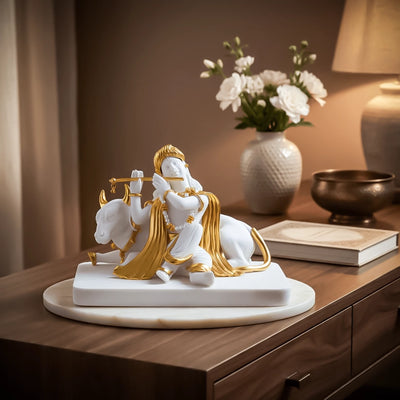
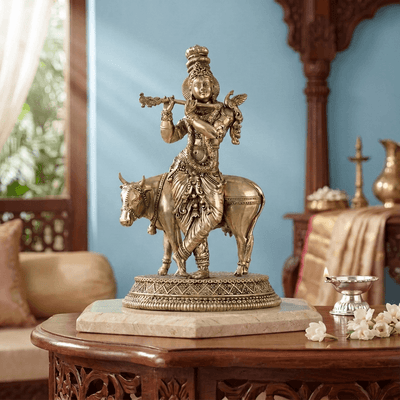
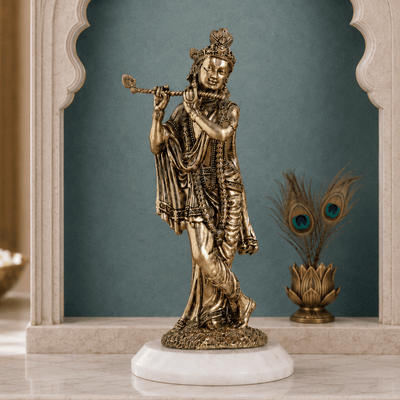
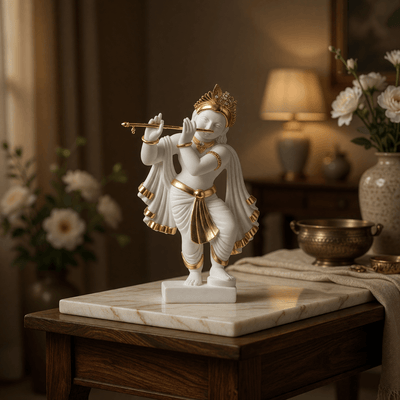
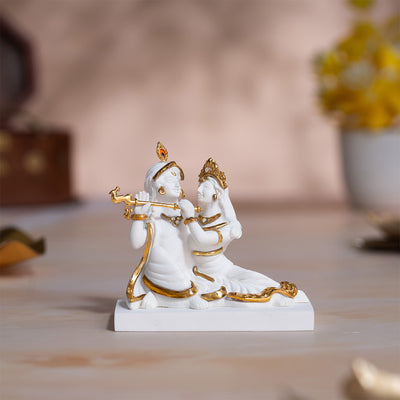
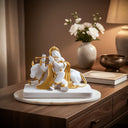
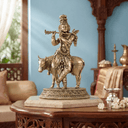
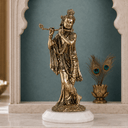
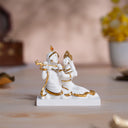
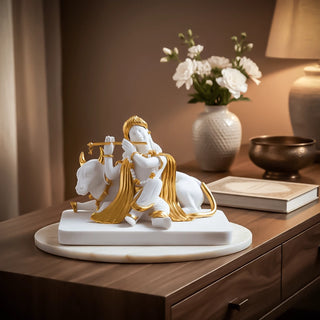
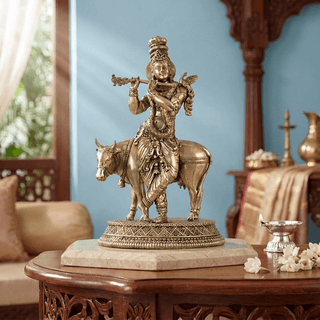
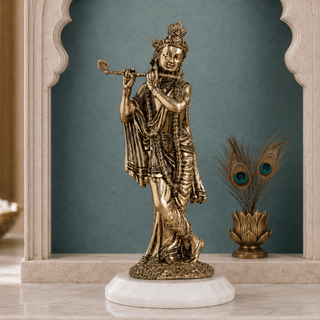
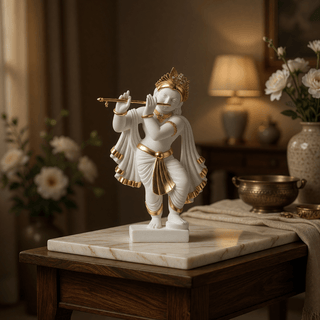
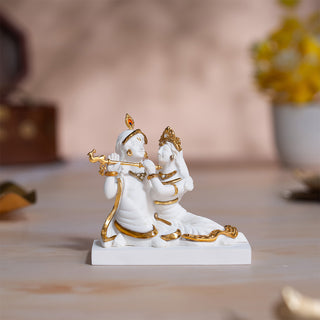
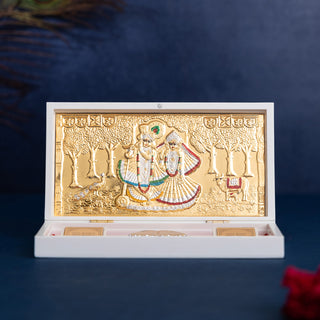
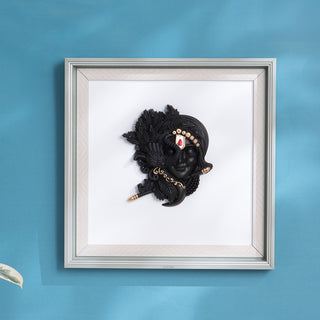
It shows up more than you would expect. A Radha Krishna murti belongs to Nanda's Vrindavan. A Laddu Gopal is Yashoda's son, which is why the practice around him is maternal: dressing him, feeding him, putting him to sleep. A standing flute-playing Krishna is the cowherd, not the Yadava prince.
None of that requires a big setup. If you are working out where to begin, our guides on how to worship Krishna and how to decorate a Krishna idol at home stay close to what the texts actually prescribe, and around Janmashtami, these decoration ideas mark which customs are Puranic and which are simply loved.
The short version of the whole thing: Krishna has two fathers, two mothers, and a claim to be the father of everyone. The tradition kept all of it. That was not sloppiness. It was the point.
Also read: How Many Wives Krishna Had | What Happened to Krishna's Body After His Death | Krishna and Sudama | Where Is Krishna's Flute Now | How to Worship Lord Krishna