Krishna died at Prabhasa, on the coast of what is now Gujarat, struck by a hunter's arrow. Every text agrees on that. What happened to his body afterwards is where they part ways.
Krishna is the eighth of the ten avatars of Vishnu. Hinduism already has a category for beings who never die, the seven chiranjeevis. Krishna is not one of them. So what exactly was left behind?

How Krishna died
A hunter named Jara mistook Krishna's foot for a deer and shot him. The account sits in the Mausala Parva, the sixteenth book of the Mahabharata, and a bleak one. The Yadava clan has destroyed itself in a drunken brawl at Prabhasa. Balarama has already gone. Krishna is alone in a forest.
Where this article follows a published translation it is Ganguli (1883–96) for the Mahabharata, and Tagare or Bhaktivedanta for the Bhagavata Purana. The Sanskrit is quoted from the text itself.
In plain English: A fierce hunter named Jara came there looking for deer. Krishna lay on the ground, deep in yoga. The hunter took him for a deer and shot him in the sole of the foot. Coming closer, he saw what he had done and was afraid, and touched Krishna's feet. Krishna comforted him, then rose upward, filling the whole sky with light.
Mahabharata, Mausala Parva
He was struck on the sole of the foot, not the heel. An earlier version of this article said heel. That was wrong:
स केशवं योगयुक्तं शयानं
मृगासक्तो लुब्धकः सायकेन।
जरोऽविध्यत्पादतले त्वरावां-
स्तं चाभितस्तज्जिघृक्षुर्जगाम।।In plain English: The hunter, intent on a deer, shot the sleeping Krishna. Jara struck him on the sole of the foot.
Mahabharata, Mausala Parva 5.23
Padatale means "on the sole of the foot." The heel word parshni appears nowhere in the Mausala Parva, in either the vulgate or the critical edition. "Heel" is Ganguli's English.17 That one word is why the internet calls this Krishna's Achilles heel. The texts agree after all: the Bhagavata Purana says sole (11.30.33), and so does the Vishnu Purana.
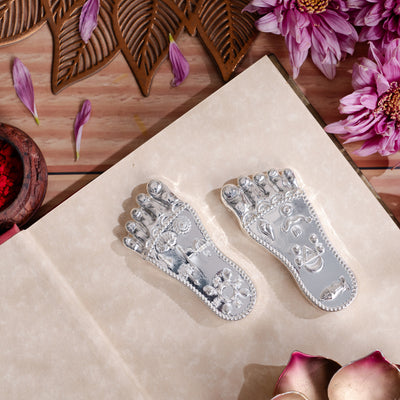
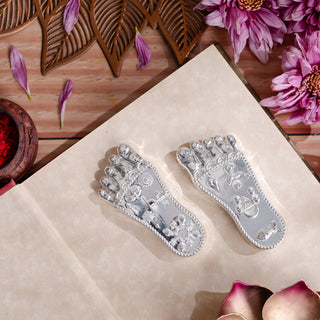
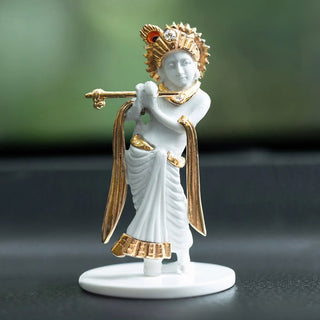
The irony is plain. The lotus feet of Krishna have been venerated for centuries as a symbol of refuge, and they are exactly where the arrow found him. It is why the Charan Paduka is kept in so many homes.
Krishna says nothing. The Mahabharata gives him no dialogue with Jara at all: only the narrated phrase "comforted him." The famous speech, where Krishna tells the trembling hunter not to be afraid, is genuine, but it belongs to other books: Bhagavata Purana 11.30.39, where he says "My dear Jara, do not fear. Please get up. What has been done is actually My own desire," and Vishnu Purana 5.37, where he tells the hunter not to be afraid and sends him to heaven by his grace.
The three curses behind that arrow
Krishna's death was no accident of the woods. The Mahabharata builds it from three separate strands, which popular retellings squash into one.
Gandhari's curse
After Kurukshetra, having walked the battlefield and counted her hundred dead sons, Gandhari turns on Krishna for not stopping the war.
यस्मात्परस्परं घ्नन्तो ज्ञातयः कुरुपाण्डवाः।
उपेक्षितास्ते गोविन्द तस्माज्ज्ञातीन्वधिष्यसि।।
त्वमप्युपस्थिते वर्षे षट्त्रिंशे मधुसूदन।
हतज्ञातिर्हतामात्यो हतपुत्रो वनेचरः।।
अनाथवदविज्ञातो लोकेष्वनभिलक्षितः।
कुत्सितेनाभ्युपायेन निधनं समवाप्स्यसि।।In plain English: You stood by while the Kurus and the Pandavas, your own kinsmen, killed each other. So, Govinda, you will kill your own people too. In the thirty-sixth year from now, your kinsmen dead, your ministers dead, your sons dead, you will wander in a forest. Unknown and unnoticed, with no one to help you, you will die by a low and ugly means.
Mahabharata, Stri Parva, Section 25
Krishna answers with a faint smile:
जानेऽहमेतदप्येवं चीर्णं चरसि क्षत्रिये।
दैवादेव विनश्यन्ति वृष्णयो नात्र संशयः।।
संहर्ता वृष्णिचक्रस्य नान्यो मद्विद्यते शुभे।
अवध्यास्ते नरैरन्यैरपि वा देवदानवैः।।In plain English: I know all this, princess. In cursing me you are only doing what I am already doing myself. Fate will destroy the Vrishnis, and there is no doubt about it. No one but me can destroy the Vrishni clan. No other man can kill them, and neither can the gods or the demons.
Mahabharata, Stri Parva, Section 25
He is not the victim of the curse. He accepts it as help. And when the thirty-sixth year arrives, the Mausala Parva says plainly that Krishna read the omens and set about making Gandhari's words come true. He is the one who orders the pilgrimage to Prabhasa.1
The sages' curse on Samba
Some Yadava youths dressed Krishna's son Samba as a pregnant woman and asked the sages Vishvamitra, Kanva and Narada what "she" would bear. The answer was an iron bolt that would destroy the clan. King Ugrasena had the bolt ground to powder and thrown into the sea. Later, at Prabhasa, the Yadavas killed one another with blades of eraka grass that turned to iron in their hands.
One careful note: the Mahabharata never states that the powder washed ashore and became the reeds. It reports the powder, then the grass, and leaves you to join them.
Durvasa's blessing: not a curse
This strand is the most misreported, including by an earlier version of this article. Sage Durvasa, famous for his temper, once ate at Krishna's house and told him to smear the leftover payasa over his limbs. Durvasa then says:
यावदेतत्प्रलिप्तं ते गात्रेषु मधुसूदन।
अतो मृत्युभयं नास्ति यावदिच्छसि चाच्युत।।
न तु पादतले लिप्ते तस्मात्ते मृत्युरत्र वै।
नैतन्मे प्रियमित्येवं स मां प्रीतोऽब्रवीत्तदा।।In plain English: As long as this food stays smeared on your limbs, Madhusudana, you have nothing to fear from death there, for as long as you wish. But the soles of your feet were not smeared. That is where death can reach you. I do not like that. He said it kindly, and he was pleased as he spoke.
Mahabharata, Anushasana Parva, Section 159
That is a blessing of invulnerability with one gap left in it, not a furious curse.
The popular embellishment is that Krishna skipped his feet out of reverence, or would not put food on his head. That is not what the text says. The manuscripts differ: the critical edition has him smear "limbs and head" (13.144.22), the vulgate "limbs and body" (13.264.26).16 His head was not spared. No text gives a reason for the soles.
And the epic ties the strands together at the moment of death. Just before Jara's arrow, Krishna remembers what Durvasa had said when the payasa was smeared on him. The soles of his feet were the one place the blessing never reached.
What the Mahabharata says happened to his body
Arjuna found the bodies and had them cremated:
ततः शरीरे रामस्य वासुदेवस्य चोभयोः।
अन्वीक्ष्य दाहयामास पुरुषैराप्तकारिभिः।।In plain English: Then Arjuna searched out the bodies of both Rama and Vasudeva, and had them cremated by trusted men.
Mahabharata, Mausala Parva, Section 7
Rama here is Balarama, and Vasudeva is Krishna. The text gives nothing further. No location beyond Prabhasa, no description of the pyre.
But the Mahabharata does not sit easily with its own account. Sections 4 and 8 say Krishna cast off his body and ascended to heaven, while Section 7 has Arjuna find that body and burn it.2 Ganguli's text never reconciles the two.
What the Bhagavata Purana says instead
The Bhagavata Purana says Krishna's body was never burned at all. It was composed centuries later (most scholars say the ninth or tenth century CE), and it looks like a deliberate correction of the epic.
The key verse is 11.31.6. Everything turns on one Sanskrit word, adagdhva, meaning "not having burned." A yogi leaving the world is expected to incinerate his own body through a fire-meditation called agneyi dharana. The verse says Krishna deliberately did not:
लोकाभिरामां स्वतनुं धारणाध्यानमङ्गलम् ।
योगधारणयाग्नेय्यादग्ध्वा धामाविशत् स्वकम् ॥ ६ ॥In plain English: He did not use the fire-meditation of yoga to burn up his own body, the body that delights every world and is the blessed object of all meditation. He entered his own abode still in it.
Bhagavata Purana 11.31.6
The argument rests on a negative, so it is worth a second translator. G.V. Tagare, working independently for Motilal Banarsidass, has the Lord "did not consume with fire his world-enchanting form... but entered with his body his own realm." Two traditions, the same negative.
On the Bhagavata's reading there was no cremation at all. Krishna left with his body. The same book puts it again at 11.31.13 (he "simply did not desire to keep His body in this world any longer") and at 1.15.36, where he departs sva-tanva, "in His selfsame body."
There is a quieter piece of evidence a few verses on. At 11.31.20 the women of the family enter the funeral fires. Balarama's wives embrace tad-deham, his body. Vasudeva's wives embrace tad-gatram, his body. But Krishna's queens are only tad-atmikah, "absorbed in Him." No body is named for Krishna, and only for Krishna.
What happened to Dwarka and to his family
Arjuna came to Dwarka to evacuate it. He told the citizens in the Sudharma hall that he would take the surviving Vrishnis and Andhakas with him, that the sea would soon swallow the city, and that they would leave at sunrise on the seventh day.
It happened as they walked out:
निर्याते तु जने तस्मिन्सागरो मकरालयः।
द्वारकां रत्नसंपूर्णां जलेनाप्लावयत्तदा।।
यद्यद्धि पुरुषव्याघ्रो भूमेस्तस्या व्यमुञ्चत।
तत्तत्संप्लावयामास सलिलेन स सागरः।।In plain English: Once the people had gone out, the sea, the home of sea-monsters, flooded Dwarka and all its jewels. Every piece of land Arjuna left behind, the sea covered over.
Mahabharata, Mausala Parva
The journey went badly. At the Panchanada in the Punjab, Abhira robbers attacked the caravan with clubs. Arjuna could barely string Gandiva, and his celestial weapons would not come to him. Many Vrishni women were carried off in full view of the warriors. He settled the survivors and placed Krishna's great-grandson Vajra on the throne at Indraprastha.
Rukmini did not "jump into a flame." The Mahabharata has her perform sati on a pyre at Indraprastha, after the evacuation, alongside three other queens: the princess of Gandhara, Saivya and Haimavati. It was a rite, not an impulse, and not at Dwarka.
Satyabhama did not die. The text is explicit: she and other wives of Krishna went into the woods to live as ascetics, on fruits and roots, beyond the Himavat at a place called Kalpa.2
Radha appears nowhere in any of this; she is absent from the Mahabharata entirely. We covered that in why Krishna didn't marry Radha and what happened to Radha after he left Vrindavan.
One trap if you read the text yourself. Ganguli uses the name Vasudeva for both Krishna and his father. Earlier in Section 7, four wives (Devaki, Bhadra, Rohini and Madira) ascend a pyre. Those are Krishna's father's wives, not his. Wilson flagged the same ambiguity in 1840, and many articles online have merged the two funerals into one.
Is Krishna's heart inside the Jagannath idol at Puri?
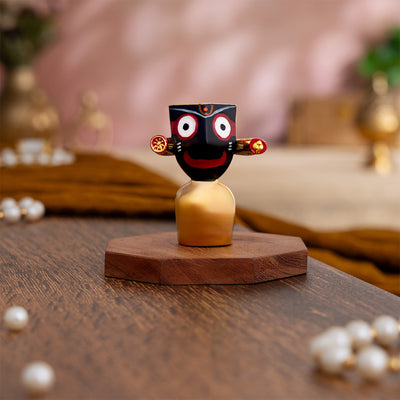
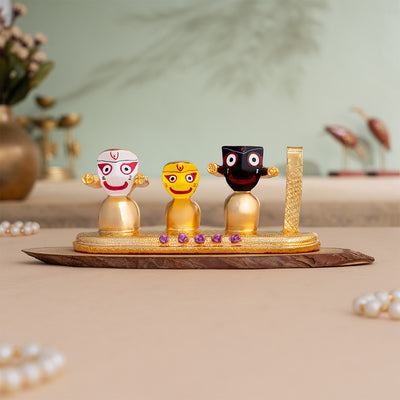
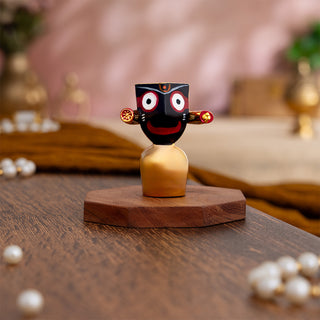
The tradition holds that Krishna's remains did not perish in the fire. They floated across the sea to the Odisha coast, were found by a tribal Shabara who worshipped them as Nila Madhava, and were finally sealed inside the wooden idol of Lord Jagannath at Puri as the Brahma Padartha: the "substance of Brahman."
This tradition also sits behind the temple's most-asked oddity: why Jagannath has no hands, and why his eyes are so large. They were left unfinished, and never corrected.
It is not in the Mahabharata. It is not in the Bhagavata Purana. Neither text mentions Krishna's remains, bones, ashes, a casket, the sea, or Puri. In the Mahabharata the body is burnt; in the Bhagavata there is no body at all.
It is not in the Sanskrit temple-origin scripture either. The primary text for the temple's own founding is the Purushottama-kshetra-mahatmya in the Vaishnava-khanda of the Skanda Purana. In that account the daru (the sacred wood) is a divine tree from which Vishnu manifests himself directly: "That Janardana has taken up a wooden body and has become directly perceptible, O king, in order to bless you." There is no Dwarka in it, no relic, no bones, and no Jara.9
Where it does come from is Odia vernacular literature, and much later. The floating-remains story appears in Sarala Dasa's fifteenth-century Odia Mahabharata, and is carried forward by Jagannatha Dasa in the sixteenth century and the Deula Tola in the seventeenth. That is roughly a thousand years after the Mausala Parva. The temple itself frames the Brahma Padartha as tradition rather than scripture. The archaeologist Alexander Cunningham argued separately that the relic-cult reflects an older Buddhist substrate at the site.
None of that makes the belief less real or less alive. It has shaped one of the largest living pilgrimage traditions on earth. You can see its scale in how Puri comes alive during Rath Yatra, and in these ten facts about the Jagannath Temple. But it is tradition, held by a community across centuries, not a verse you can look up in the epic.
What actually happens at Nabakalebara
The renewal ceremony is called Nabakalebara, "the new body." It falls in a year when the month of Ashadha repeats (an Adhika Masa) which has meant gaps of eight to nineteen years. It was held in 1912, 1931, 1950, 1969, 1977, 1996 and, most recently, 2015.10

New idols are carved from neem trees identified by specific marks. Then, on a moonless night with the temple's lights cut off, Daitapati servitors called badagrahis transfer the Brahma Padartha from the old idols to the new. They do it blindfolded, hands wrapped in cloth, so they neither see nor touch it. They are sworn to silence for life.
Nobody outside that handful of families knows what the Brahma Padartha physically is, and no one has ever examined it. No authorised temple statement describes it, and the guesses in circulation (a shaligram stone, a gold yantra plate) are guesses.

The places you can visit today
Three sites in Gujarat are tied to this story. Tradition and documentation are not the same thing here.
Bhalka Tirth, near Veraval, is held to be where the arrow struck. There is a temple with an unusual semi-reclining Krishna idol and a peepal identified by tradition as the tree he rested under. It is also one of the eighty-four baithaks of the Pushtimarg tradition, giving it a documented devotional history from around the sixteenth century.
Dehotsarga, on the Hiran river, is held to be where the body was cremated. The name carries it: deha, body, and utsarga, casting off.
Neither site has archaeological documentation, and the Mausala Parva never names either. It says only "Prabhasa," and a lonely forest. The precise locations are later devotional geography mapped onto the epic.
Prabhas Patan itself is a different matter. It has been genuinely excavated (Subbarao and Pandya in the 1950s, Dhavalikar and Ansari in the 1970s, Deccan College more recently), with a real occupation sequence from the Chalcolithic to the medieval period. But no excavated material there has ever been linked by archaeologists to Krishna or the Yadavas. The antiquity is real. The association is textual.12
The same care applies to the submerged structures off Dwarka. Marine archaeologists from the National Institute of Oceanography did find stone structures and more than a hundred stone anchors offshore. S.R. Rao identified the site as Krishna's Dwarka and dated it to about 1500 BCE. His own institution later revised that. Writing in Current Science in 2004, NIO researchers concluded the offshore structures are most likely a jetty of late medieval date. They noted the complete absence of pottery offshore, and pointed out that a stone block among them carries an inscription in the Gujarati script.11 The Archaeological Survey resumed work there in 2025 and has been careful not to claim more than the evidence carries.

Dwarka was clearly a working port for a very long time. The "9,000-year-old city" figure that circulates online comes from unrelated sonar claims in the Gulf of Khambhat, and should not be attached to Dwarka at all.
Five things people get wrong
- That Jara was Vali reborn. Not in the Mahabharata, the Valmiki Ramayana, or the Bhagavata Purana. It traces to the Ananda Ramayana, Sara Kanda 8, a fifteenth-century text, roughly a thousand years later than the Mausala Parva. If you want the epic's own account of Rama's end, we covered how Rama died separately.
- That a fish swallowed the iron fragment. True, but it is the Vishnu Purana (5.37), not the Mahabharata. Wilson noted it in 1840: "The Mahabharata says nothing of the piece which could not be pounded."8
- That Krishna gave Jara a long farewell speech. Not in the epic. That dialogue is from the Bhagavata Purana and the Vishnu Purana.
- That Durvasa cursed him. Durvasa blessed him. The vulnerability was a gap in the blessing, not a punishment.
- That Rukmini killed herself in grief and Satyabhama died with her. Rukmini performed sati at Indraprastha; Satyabhama became a forest ascetic and outlived him.
So what is the answer?
The Mahabharata's answer is cremation at Prabhasa. The Bhagavata's is that there was no body left to burn. Hinduism has never required anyone to pick just one.
What all three share is a refusal to treat his death as a defeat. Even Gandhari's curse, in the epic's own telling, is something Krishna thanks her for.
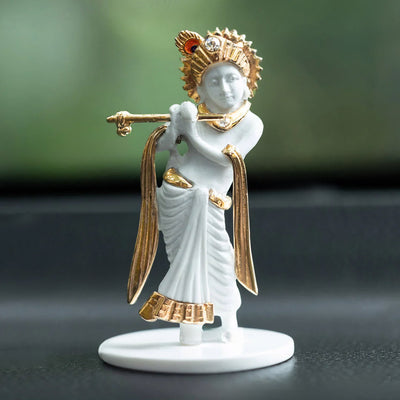
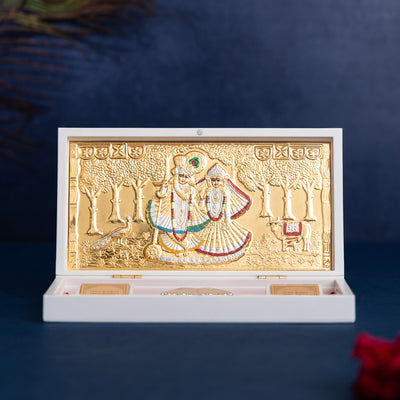
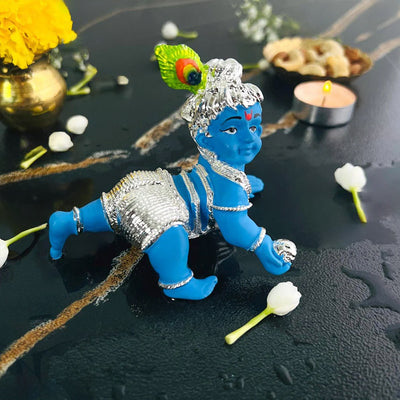
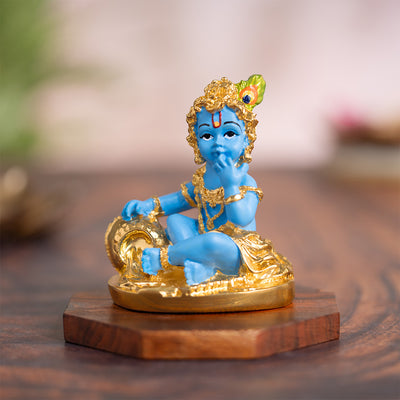
Whether it is a Krishna murti in the mandir, a Radha Krishna pair, or the simple footprints of the Charan Paduka, the practice around it is the same. Our guides on how to worship Lord Krishna, the seven most powerful Krishna mantras, and how to decorate a Krishna idol at home cover the essentials.
Also read: Why Krishna Didn't Marry Radha | How Many Wives Did Krishna Have? | Why Jagannath Has No Hands | Where Is Krishna's Flute Now? | Krishna Janmashtami 2027