Almost every page you will read about Balarama says the same thing: that some traditions put him in the ninth slot of the Dashavatara in place of the Buddha.
It is not true, and it is checkable. Go to the actual texts that seat him among ten — there are two well-known ones — and in both he is eighth. Google's own AI summary says “eighth” on one search, “eighth or ninth” on a reload of the same search, and “generally not the ninth” on another. It cannot decide, because the sources it is drawing on cannot either.
Getting the number right matters more than it sounds, because it changes what the tradition was doing. Nobody was demoting the Buddha to make room for Krishna's elder brother. They were deciding something else entirely.
Is Balarama an avatar of Vishnu?
Yes, and the Bhagavata Purana says so directly. In its own enumeration of the Lord's descents:
“In the nineteenth and twentieth incarnations, the Lord advented Himself as Lord Balarama and Lord Krishna in the family of Vrishni, and by so doing He removed the burden of the world.” (1.3.23)1
Nineteenth and twentieth — as a pair, in one verse. Buddha follows at 1.3.24 as the twenty-first, Kalki at 1.3.25 as the twenty-second, and then the chapter closes the question: the incarnations are innumerable, “like rivulets flowing from inexhaustible sources.” (1.3.26)
So the Bhagavata — the text people usually think they are quoting — never gives a Dashavatara at all. It gives twenty-two and then says the count is not the point. We set that full list out, with the verse for each, in the ten avatars of Vishnu.

The ninth slot is the wrong number
Here are the two texts that actually place him in a ten, side by side with the familiar list.
Jayadeva's Gita Govinda, composed around 1200 CE, opens with a hymn to the ten forms. Its eighth stanza is unambiguous — keshava dhrita-haladhara-rupa, “O Keshava, who took the form of the plough-bearer.” The ninth stanza is dhrita-buddha-sharira. Buddha is not displaced. The one who is missing from the ten is Krishna, and the hymn says why in its closing line: the ten forms are addressed to Krishna, who is dasha-akriti-krite, the maker of the ten.
Vedanta Desika's Dashavatara-stotra, composed at the Dashavatara shrine at Srirangam in the thirteenth or fourteenth century, runs Matsya, Kurma, Varaha, Narasimha, Vamana, Parashurama, Rama, then Balarama, then Krishna, then Kalki. Here Buddha is absent — but Balarama is still eighth, and it is Krishna who has moved to ninth.
Set out plainly:
- The familiar Dashavatara — eighth Krishna, ninth Buddha, tenth Kalki.
- Jayadeva — eighth Balarama, ninth Buddha, tenth Kalki. Krishna sits outside the ten as their source.
- Vedanta Desika — eighth Balarama, ninth Krishna, tenth Kalki. No Buddha.
- The Bhagavata Purana — no ten at all. Balarama nineteenth of twenty-two, Buddha twenty-first.
In none of them is Balarama ninth. He is the figure who fills the gap when Krishna steps out of the list — because a tradition that regards Krishna as the source rather than one of the forms needs an eighth, and the elder brother is the obvious one. That is a theological decision about Krishna, not a sectarian swipe at the Buddha.
 20% off
Is Balram Sheshnag or Vishnu?
This is the question the forums argue about hardest, and the Bhagavata dissolves it in half a line.
When Vishnu instructs Yogamaya to move the embryo, he says: “Within the womb of Devaki is My partial plenary expansion known as Sankarshana or Shesha. Without difficulty, transfer Him into the womb of Rohini.” (10.2.8)2
Read the possessive. Shesha is dhama mamakam — My expansion. The choice the internet keeps offering, Shesha or Vishnu, is not a choice the text poses. Shesha is not an alternative to Vishnu; he is an expansion of him.
The Vishnu Purana says the same thing more plainly still: the seventh conception “shall be formed of a portion of Shesha, who is a part of me… and he shall be valiant and strong, and like the peak of the white mountain in bulk and complexion.”3
That last clause is where Balabhadra's whiteness at Puri comes from, and we will come back to it.
Why he is called Sankarshana — and why the Bhagavata gives two reasons
Here is something nobody seems to have noticed: the same Purana explains the name twice, six chapters apart, and the two explanations do not match.
At 10.2.13, the narrator says he will be called Sankarshana “because of being sent from the womb of Devaki to the womb of Rohini” — from karsh, to drag or draw across. Rama because he pleases everyone; Balabhadra for his strength.
At 10.8.12, Garga Muni performing the naming ceremony gives a different reason: “because He will unite two families — Vasudeva's family and the family of Nanda Maharaja — He will be known as Sankarshana.”2
Dragged across, or draws together. Both are in the Bhagavata; neither cross-references the other. The tradition kept both, which is what it usually does when two good explanations arrive for one name.
The plough, the pestle, and the palm-tree banner
A small correction with a satisfying payoff at the end of it.
Balarama's weapons in the Sanskrit sources are the plough (hala, langala) and the pestle or club (musala) — hence Halayudha, Haladhara, Langali, Musali. The gada, the mace, that appears in many summaries is a slippage.
The plough is a real weapon in the texts, not a symbol. When the Yamuna refuses to come to him he tells her: “Therefore with the tip of My plow I shall bring you here in a hundred streams!” (10.65.26). She comes, and falls at his feet, and says something that settles the Shesha question from inside the story: “With a single portion of Yourself You hold up the earth, O Lord of the universe.” (10.65.28) The Purana then adds, with evident satisfaction: “Even today one can see how the Yamuna flows through the many channels created when it was dragged by the unlimitedly powerful Lord Balarama.” (10.65.33)2
Now the payoff. In the Mahabharata his banner carries the tala-dhvaja, the device of the palmyra palm — “Rama, whose banner bore the device of the palmyra palm, and who owns the plough for his weapon.”4 At Puri, Balabhadra's chariot is called Taladhwaja. The same word, running from the epic straight into a festival that still rolls down the Bada Danda every year. We went into the chariots themselves in who drives the Nandighosh rath.
He did not stay neutral out of love. He was overruled.
Every retelling says Balarama sat out the Mahabharata because he loved Bhima and Duryodhana equally, both being his students in the mace. That is half the story, and the missing half changes it.
The Udyoga Parva has him arrive at the Pandava camp “attired in garments of blue silk… with eyes having their ends reddened with drink” and say, in front of everyone, that he had argued with Krishna and lost:
“I said unto Vasudeva repeatedly in private, ‘O slayer of Madhu, unto those that bear equal relationship to us, observe thou an equal behaviour. As are the Pandavas to us, even so is king Duryodhana. Therefore, give him also the same aid.’ … For thy sake, however, the slayer of Madhu regarded not my words.”4
And the Shalya Parva is blunter about how it ended: “let us render assistance to the Kurus!” he says to Krishna, who does not listen — and then, “with heart filled with rage,” he leaves on pilgrimage. Forty-two days along the Sarasvati, by his own count: “I had set out under the constellation Pushya and have come back under Sravana.”

When he returns for the final duel, his own two students are fighting, and Bhima strikes Duryodhana below the waist. Balarama's reaction is not serene: “Oh, fie on Bhima!… Never before hath such an act as Vrikodara hath done been witnessed in an encounter with the mace!” — and then, plough raised, he rushes at Bhima, and Krishna has to physically hold him back.4
Here the two texts part company, and it is worth saying so. The Bhagavata records no rage at all. Its Balarama tells the two men their fight is pointless, is ignored, concludes that “the battle was the arrangement of fate,” and goes home to Dvaraka (10.79.26–29). The epic gives us a man barely restrained; the Purana gives us a man who shrugs and leaves. Both are in the tradition.
Four things people get wrong about Balarama
1. “He is the ninth avatar, replacing Buddha.” No text places him ninth. Jayadeva and Vedanta Desika both put him eighth. What moves is Krishna.
2. “The Bhagavata says a thousand-headed serpent left his mouth when he died.” It does not. The Bhagavata's whole account is one verse: “Lord Balarama then sat down on the shore of the ocean and fixed Himself in meditation… Merging Himself within Himself, He gave up this mortal world.” (11.30.26)5 The white serpent belongs to the Mahabharata's Mausala Parva — and even there, the text never names it. It says only a white naga of a thousand heads, received at the ocean by Varuna and the serpent kings, and leaves you to draw the conclusion.6
3. “His weapons are the plough and the mace.” Plough and pestle. The epithets are Musali and Halayudha, not Gadadhara.
4. “He killed Pralamba with the plough.” With his fist. The Bhagavata says the demon carried him on his back in a boys' game, that Balarama “became as heavy as massive Mount Sumeru,” that he even “seemed to become a little frightened” — and then “struck the demon's head with His hard fist,” and the cowherd boys shouted “Excellent! Excellent!” (10.18.26–30)2
That momentary fright is the sort of detail retellings sand off, and it is exactly the sort the Puranas keep.
 9% off
Who died first, Balram or Krishna?
Balarama, and Krishna watched him go.
The Bhagavata puts it in two consecutive verses: Balarama merges himself within himself at the ocean shore (11.30.26), and then “Lord Krishna, the son of Devaki, having seen the departure of Lord Rama, sat down silently on the ground under a nearby pippala tree.” (11.30.27)5
The elder brother goes first, alone, into the sea. The younger sits down under a tree and waits. Whatever else the Mausala Parva adds, that is the shape of it in the Purana, and it is quieter than anything the internet tells you about either of them. There is more on what followed in what happened to Krishna's body.
Balabhadra at Puri, and the oldest image of him anywhere
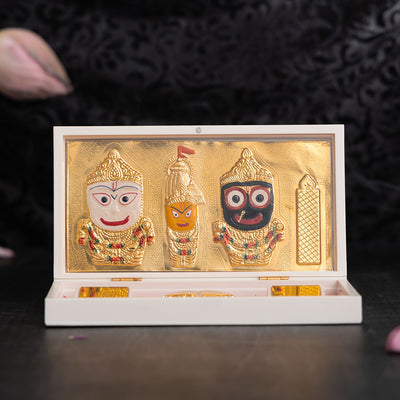
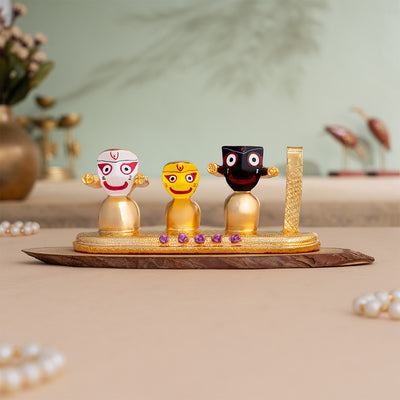
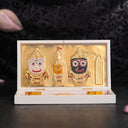
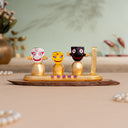
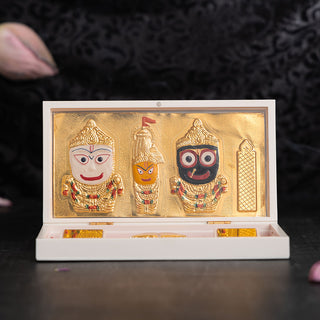
Balarama is not a minor figure in Odisha. He is Balabhadra, the white one, and at Puri he stands to Jagannath's left with Subhadra between them.

W. W. Hunter, surveying Orissa in 1872, described what he saw with colonial bluntness: “There sits Jagannath, with his brother Balabhadra and his sister Subhadra, in jewelled state. The images are rude logs, coarsely fashioned into the form of the human bust from the waist up.”7 He also found a temple to Balabhadra alone in a village at Jajpur — the elder brother has his own worship there, not merely a place in a triad.
And then the thing almost nobody mentions. The oldest datable image of any Vaishnava deity is Balarama, and it is on a Greek king's coin. Silver drachms of Agathocles of Bactria, struck around 190–180 BCE and excavated at Ai-Khanoum in Afghanistan in 1970, carry a deity with a plough and a club on one face and one with a discus and conch on the other — read by scholars as Samkarshana-Balarama and Vasudeva-Krishna.

The plough-bearing brother was being struck on coinage before the Bhagavata Purana existed in the form we have it. Whatever the numbering disputes, he is not a late addition to anything.
What that leaves you with
A god who is worshipped for strength and is shown, in his own scripture, briefly frightened. Who argued for the losing side and lost the argument. Who is white where his brother is dark, carries a farmer's tool where his brother carries a discus, and whose name means both dragged-apart and drawn-together depending on which chapter you open.
He is not the ninth avatar. He is the eighth, in the lists that have him, and in the Bhagavata he is one half of a single verse he shares with Krishna — which is probably the most accurate thing any text says about him.
If you keep Krishna at home, the brother is rarely far away: Krishna-Balarama pairs are among the oldest images in the tradition, older than almost anything else in it.
Also read: The 10 Avatars of Vishnu | Kalki Avatar: What the Texts Say | What Happened to Krishna's Body | Who Is the Mother of Lord Jagannath | Who Drives the Nandighosh Rath