Ask this question in a group of ten people who have been to Puri and you will get two answers. Some will say Daruka. Some will say Matali. Both sound right, because both names are genuinely attached to the Ratha Yatra chariots.
Only one of them belongs to Nandighosh.
What Puri's own records say
Start with the source that is hardest to argue with. The Government of Odisha runs an official portal for the festival, and its page on the chariots puts it in one sentence:
"The three charioteers attached to the chariots of Jagannatha, Balabhadra and Subhadra respectively are Matali, Daruka and Arjuna."
Read the word "respectively" slowly, because that is where people trip. Jagannath gets Matali. Balabhadra gets Daruka. Subhadra gets Arjuna.1
The Shree Jagannatha Temple Administration, which actually runs the temple, lists the same assignment on its own chariots page, along with the rest of the specifications.2 Two independent official sources, agreeing. That is about as settled as anything in this subject gets.
So if you are writing a school project, a caption, or a quiz answer: Nandighosh ka sarathi Matali hai.
Then why does everyone say Daruka?
Because in the epics, Daruka is Krishna's charioteer. That is his job. He drives Krishna's chariot in the Mahabharata, he is the one who handles the horses when Krishna moves, and he appears again and again in the Krishna story. And Jagannath, as most devotees understand him, is Krishna at Puri.
Matali, meanwhile, is Indra's charioteer. He belongs to the sky, to the king of the devas, not to the wooden Lord of Nilachala.
So the logic goes: Krishna's chariot, Krishna's driver. Daruka on Nandighosh. It is a clean, sensible guess. It is also not what Puri does.
Puri assigns Indra's charioteer to Jagannath and Krishna's charioteer to Balabhadra, and it does not explain itself on either page. That is worth sitting with instead of quietly "correcting". Puri has a long habit of not following the rules other Vaishnava sites follow. The images are wood, not stone. The Lord has no hands or feet in the usual sense, and the reason Jagannath has no hands is not the one most people repeat. The eyes are enormous circles that no verse anywhere describes, which is the honest answer to why Lord Jagannath has big eyes. Against that backdrop, an unexpected charioteer is barely a surprise.

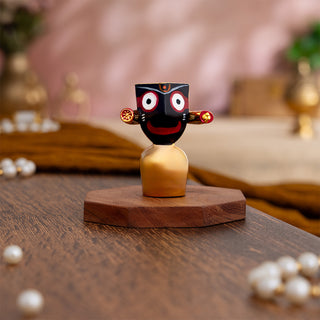
The three chariots, side by side
Once a year, on Ashadha Shukla Dwitiya, three chariots stand outside the Simhadwara and are pulled about three kilometres to the Gundicha temple.3 Here is the full data, straight from the Temple Administration's chariot listing:
- Nandighosa: Jagannath's chariot. About 45 feet tall, 16 wheels, covered in red and yellow cloth, four dark horses. Sarathi: Matali.
- Taladhwaja: Balabhadra's chariot. About 44 feet, 14 wheels, red and blue, white horses. Sarathi: Daruka.
- Darpadalana: Subhadra's chariot. About 43 feet, 12 wheels, red and black, red horses. Sarathi: Arjuna.
Notice the descending order. Height, wheels, everything steps down by one from the eldest brother's rath to the sister's. The names carry meaning too. Nandighosa is roughly "the sound of joy". Taladhwaja is "the one with the palm-tree banner", which is Balarama's own emblem. Darpadalana means "the crusher of pride".
And Arjuna on Subhadra's chariot is a lovely detail once you remember that Subhadra is Arjuna's wife. The Mahabharata's Adi Parva tells that whole story: Krishna telling Arjuna to simply carry her off rather than wait for a swayamvara.9 Puri put her husband at her reins. Whether that is deliberate or a happy coincidence, nobody at the temple has said in print, so I will not pretend to know.
The proportions are much older than the chariots
The 16-and-14 pattern is not a modern carpentry decision.
The Purushottama Kshetra Mahatmya, a long section of the Skanda Purana and the oldest sustained scriptural account of Puri, already describes the chariot festival. It gives Jagannath's chariot as sixteen arms and Balarama's as fourteen.4 That is the same 16:14 ratio the modern chariots keep in their wheel counts, centuries later, with the physical chariots being rebuilt from scratch every single year.
The units changed. The proportion did not. For a festival where nothing physical survives one year to the next, that is a remarkable piece of continuity, and it is a better "amazing fact" than most of what circulates about Puri. If you want more of that kind of thing, the verified facts about the Jagannath temple are genuinely stranger than the viral ones.
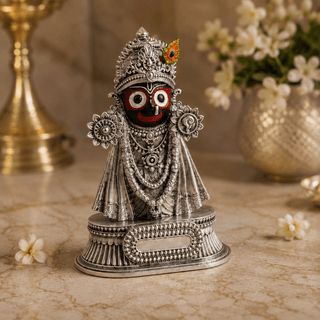
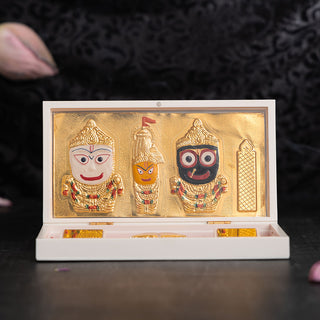
What does a sarathi actually do here?
None of these three charioteers is a person you can meet.
The chariots are pulled by devotees. Thousands of hands on four thick ropes. There are no horses walking down the Grand Road either: the horses are wooden, fixed to the front of each rath and painted in the colours listed above. The sarathi is a carved wooden figure seated at the front.
So the charioteer is not a driver in any practical sense. He is a declaration. Putting Matali on Nandighosh says something about who is being carried: this is not a prince going for a ride, this is the one whom even Indra's charioteer would serve. The chariot on Ratha Yatra day is a moving statement of rank, and the sarathi is part of the sentence.
The Skanda Purana is blunt about what the whole thing is for. It says that those who see Jagannath, Balabhadra and Subhadra placed on the chariots during Rathotsava will get salvation. That is the scriptural reason for the festival, and it explains the crowds better than any tourism copy does. If you want the fuller version of that argument, we have written separately on why Rath Yatra is celebrated and on the Lord Jagannath Rath Yatra story from King Indradyumna onwards.
Three things people get wrong about the Nandighosh sarathi
1. "Daruka drives Nandighosh."
He does not. He drives Taladhwaja, Balabhadra's chariot. Both the Odisha government portal and the Temple Administration list Matali on Nandighosh. The confusion is understandable: Daruka is Krishna's charioteer in the epics, so the swap feels correct. Puri simply does not follow that logic. Some Odia-language and popular listings do print it the other way round. If you have read that somewhere, you were not imagining it. But the two official sources agree, and they are the ones to cite.
2. "The sarathi is a temple servitor who actually steers the chariot."
No. The chariots have no steering and no live horses. They are pulled by devotees with ropes, and they stop when they stop. Every year there are stretches where a chariot refuses to move for hours. The sarathi is a carved figure, and the horses are carved too.
3. "Rath Yatra is Jagannath going to his aunt's house, so the charioteers are family retainers."
Two different figures have been mashed into one here. In the Skanda Purana, Gundicha is not a person at all: it is a mandapa, a pavilion where the Lord stays and where devotees earn merit by seeing him. In Puri's own legend, Gundicha is King Indradyumna's queen, the one who opened the workshop door too early. The "aunt" belongs to the separate Mausi Maa shrine on the Grand Road where poda pitha is offered. Neither the Purana nor the temple's Ratha Jatra page calls the journey a visit to an aunt. The related question of who the mother of Lord Jagannath is runs into the same tangle, and the answer there is stranger than you would expect.
How the deities get onto the chariots
Before any chariot moves, the deities have to come out. That procession is called pahandi, and the order is fixed: Sudarshan first, then Balabhadra, then Subhadra, and Jagannath last.
Sudarshan going first is a quiet reminder that Puri does not really count three deities. The chakra is a worshipped form in its own right there, which is a very different status from the weapon most of us picture when we ask who gave the Sudarshan Chakra to Krishna. The temple's own FAQ page lists Jagannatha, Balabhadra, Subhadra, Chakra Sudarshan, Bhudevi, Sridevi and Madhaba among the deities worshipped. The Nabakalebara page speaks of five wooden idols being replaced.8 Three is shorthand, not a count.
The deities are carried out in a rocking, swaying motion, not lifted cleanly, and it takes hours. Anyone who has watched it once understands why Jagannath Puri comes alive during Ratha Yatra in a way no photograph carries.
The chariots reach Gundicha and stay. How long is a small, honest mess: the Temple Administration's FAQ says nine days, its festivals page says seven.56 The return journey, Bahuda, falls on the tenth day of the bright fortnight of Ashadha. I mention the contradiction because pretending it does not exist is how bad articles get written.
Where Jagannath sits in the larger picture
Jagannath is worshipped as a form of Vishnu. The Skanda Purana identifies the group theologically rather than as a household: Subhadra as a birth of Lakshmi, Balabhadra as Ananta the serpent king, and Sudarshana as the fourth of what it calls "these four forms of Lord Vishnu". That framing sits comfortably beside the ten avatars of Vishnu and beside other Vishnu forms who took on a distinct local life, such as Balaji at Tirumala.
At the same time the Temple Administration states plainly on its own culture page that Jagannath was originally a deity of the aboriginal tribes, known as Nila Madhava, his image made of some sort of blue stone.7 Both things are true at once. That layered honesty is a big part of why the Puri material is so much more interesting than the listicle version of it.
For readers who came here through the Krishna door, the Puri story connects to what happened to Krishna's body after his death and to the question of who the father of Lord Krishna was, though be warned, the "relic at Puri" belief is tradition, not something the Skanda Purana's own account records.
Bringing the three home
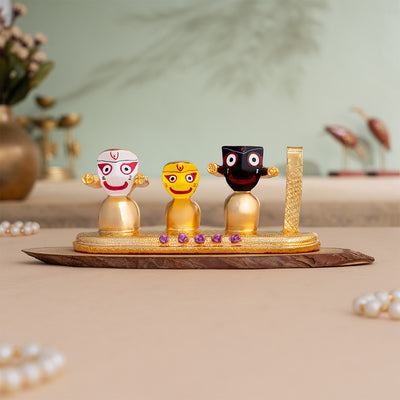
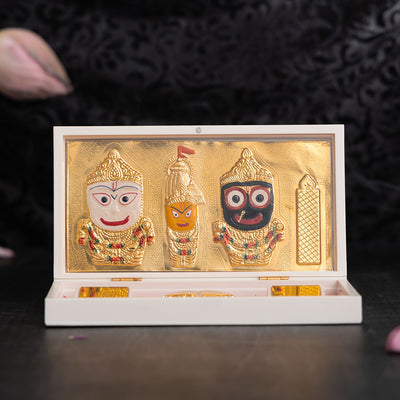
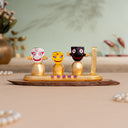
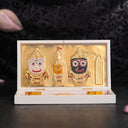
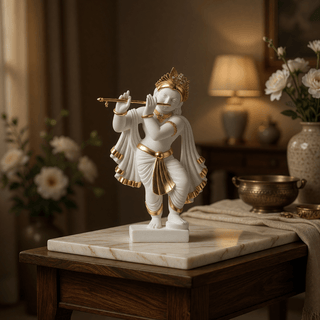
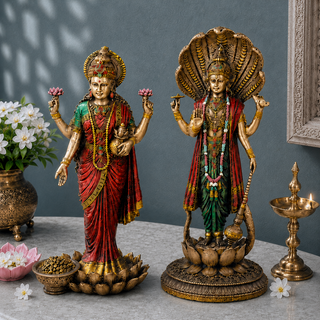
Most of us will never pull the ropes at Puri. What people do instead is keep the three of them together on a shelf at home, in the same order they ride: Balabhadra, Subhadra, Jagannath. A Jagannath, Subhadra and Balabhadra murti set is the one arrangement where the trio makes sense as a group rather than as separate idols, which is exactly how Puri presents them.
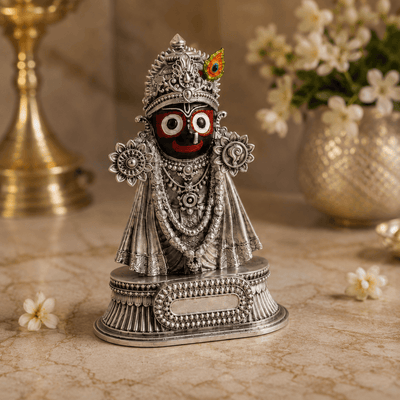
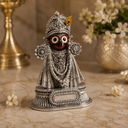
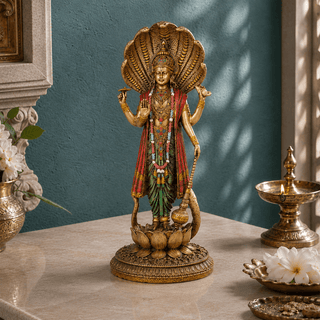
If you are choosing, our Jagannath idols and the Rath Yatra edit are the obvious starting points, and the gold and silver plated idols hold up well in a daily-worship mandir. Placement matters more than size: the same thinking behind keeping a standing Vishnu idol at home applies here, and decorating a Krishna idol at home covers the everyday care side. For daily practice, how to worship Lord Krishna transfers directly to Jagannath.
So, one line to remember
Nandighosh is Jagannath's chariot. Its sarathi is Matali. Daruka is on Balabhadra's Taladhwaja, and Arjuna is on Subhadra's Darpadalana. If someone insists otherwise, the Odisha government's Rath Jatra portal settles it in one sentence, and it takes about ten seconds to look up.
The day the elephants appear is a separate wonder altogether, and the story of the Hati Besha of Lord Jagannath is worth reading before next Snana Yatra.
Also read: Why Jagannath Has No Hands | Why Lord Jagannath Has Big Eyes | Lord Jagannath Rath Yatra Story | Facts About the Jagannath Temple | Who Is the Mother of Lord Jagannath | Does the Jagannath Temple Flag Fly Against the Wind?