Once a year, on one specific evening, the Lord of the Universe puts on the face of an elephant.
Not a metaphor. An actual mask, a broad elephant head with a trunk, ears and tusks, fitted over the wooden form that people have travelled hundreds of kilometres to see. It lasts one night. Then he disappears from public view for a fortnight.
If you have seen a photograph of it, you have probably also read the story attached to it: a devotee of Ganesha came to Puri, could not find his god there, and was shown one anyway. It is a lovely story. I went looking for where it is written down, and this is what I found, along with the parts of Hati Besha that are genuinely stranger than the legend.
What Hati Besha actually is
On the full moon day of the month of Jyestha (roughly June), Puri celebrates Snana Yatra, the bathing festival. The deities are brought out to the Snana Vedi, a raised platform near the northern wall, where the crowd can see them. There they are bathed with 108 pitchers of water drawn from a well inside the temple, mixed with sandalwood paste, camphor and incense.1
Then, according to the Shree Jagannatha Temple Administration's own description of the festival, "the deities are then adorned with elephant masks in the Gaja Besha."
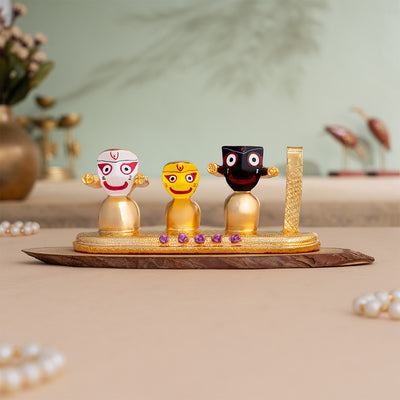
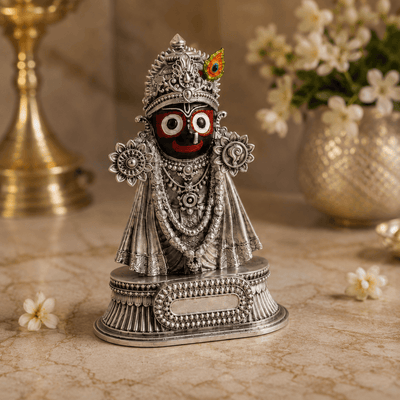
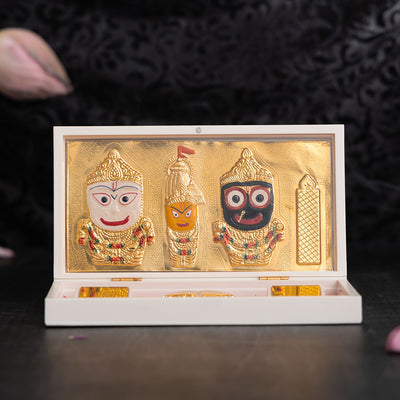
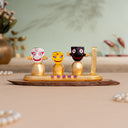
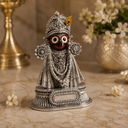
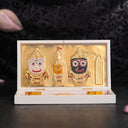
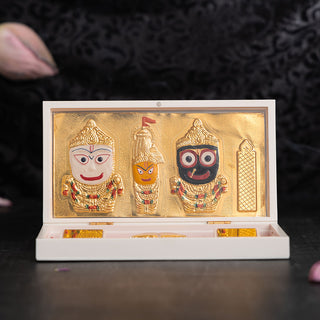
That single line is the verified core of the whole thing. On the day itself, Jagannath and Balabhadra wear the elephant heads and Subhadra is dressed separately, which is why most photographs show two elephant faces flanking a smaller central figure. The Jagannath, Balabhadra and Subhadra set that most homes keep is the right mental picture: three, always three, moving together.
Why the three of them look the way they do at all is a separate and much older question: see why Jagannath has no hands and why his eyes are so large. Short version: the answers most articles give are not in the Purana either.

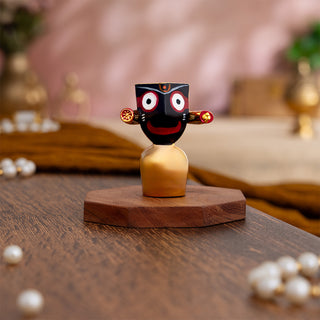
The story everyone tells: Ganapati Bhatta
Here is the version you will hear in Puri, told by guides, priests and grandmothers.
A brahmin from the south (most tellings name him Ganapati Bhatta) was a lifelong devotee of Ganesha. He worshipped no other form. On a pilgrimage he reached Puri, went into the temple, and stood before the three wooden figures on the ratnavedi. And he felt nothing. There was no elephant face here. No trunk, no modak, no mouse. He had come all this way to a god who was not his god.
He wept, and he decided to leave.
That night, depending on who is telling it, either the king dreamt of the Lord or the priests did. The next morning the devotee was called back to the temple. When the doors opened, Jagannath was wearing the face of an elephant.
The point of the story is not the costume. It is the argument it makes: the god you are looking for and the god in front of you are the same. For anyone raised on Ganesha's own stories (the broken tusk, the trunk turned left or right, the bond between Ganpati and Gauri), it lands hard.
Why I cannot call that story scripture
The story is not in the oldest text. The Purushottama Kshetra Mahatmya, a long section of the Skanda Purana that runs to more than forty chapters, is where the Puri story lives. It has King Indradyumna, his envoy Vidyapati, the Savara chief Visvavasu and his blue deity Nilamadhava, the sacred tree floating in the sea, the old carpenter who carves the images and vanishes, and the chariot festival with its promise of liberation.
It contains no elephant form. No Ganesha episode. No Ganapati Bhatta.4
The Temple Administration's festival pages are the other obvious place to look. Their Major Festivals page describes the Gaja Besha in one clean sentence and attaches no legend to it. Their long list of other festivals (around forty of them) has no separate Hati Besha entry with a backstory.3
So: the ritual is documented. The story is not. That does not make it false, and it certainly does not make it worthless. Puri runs on a huge body of oral and Odia-language devotional tradition that never got a Sanskrit chapter number, and a lot of what people love most about the temple lives there. It just means that if you see an article citing "the Skanda Purana" for Ganapati Bhatta, that citation was invented. There is nothing to cite.
This is the same pattern I keep running into across the Jagannath questions people search for most. The tradition is rich and the internet keeps trying to give it fake paperwork.
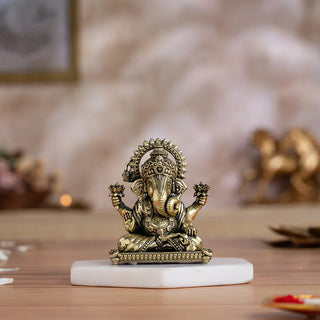
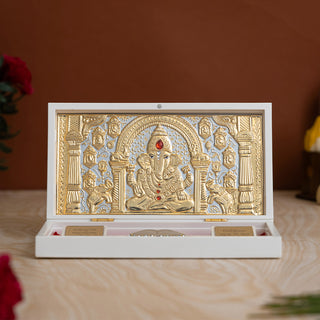
The bath, then the illness: why the timing matters
Immediately after Snana Yatra, the deities are taken into Anasara, seclusion. The temple's FAQ page puts it about as plainly as an institution can: "On the full moon day of Jyesta, the snana yatra of the gods take place. After this the Gods fall ill. So darshan is not possible for 15 days."
They are said to have caught a fever from the bath. They are moved to a private chamber, treated with herbal preparations, and nobody is allowed near them except the Daitas and Patis, servitor families who trace their descent from the tribal keepers of the original deity. The public sees nothing until the new moon of Ashadha.
Now put the two together. The elephant appears on the last evening the Lord is visible before he vanishes for a fortnight. Whatever else Hati Besha means, that is what it does to the people standing there: it is the face they carry for the next fifteen days.
Then the deities come back out, in the Nabajaubana Besha, the "new youth" appearance. And a few days later the chariots roll. That next chapter is the whole Rath Yatra story, and the reason behind it is not the one most people give. See why Rath Yatra is celebrated.
Three things people get wrong about Hati Besha
1. That the Ganapati Bhatta story is Puranic. It is not in the Skanda Purana's account of Puri, which has no elephant or Ganesha form anywhere in it, and it is not on the Temple Administration's festival pages. Tell it as a Puri story, because that is what it is. That framing costs the story nothing.
2. That it is only about Jagannath. Snana Yatra is a group event. Balabhadra and Subhadra are bathed with the same 108 pitchers, and the Sudarshana pillar is part of the sequence. Puri's own count of who is worshipped there is not three anyway: the temple's FAQ lists Jagannatha, Balabhadra, Subhadra, Chakra Sudarshan, Bhudevi, Sridevi and Madhaba, and the Nabakalebara page talks about five wooden idols being replaced. The Skanda Purana itself calls Sudarshana one of "these four forms of Lord Vishnu." Sudarshana has his own long backstory, incidentally: who gave the Sudarshan Chakra to Krishna.
3. That the elephant face is a one-off oddity. Puri dresses its deities constantly. There is a whole cycle of beshas (Padma Besha, Suna Besha, Raja Besha, Banabhoji Besha) each on its own date, each with its own ornaments.11 Hati Besha is one entry in a working ritual calendar, not a stray miracle. The other famous Puri "facts" you see in listicles (no bird ever flies over the temple, the temple casts no shadow, the flag always flies against the wind) are a different matter. I could not trace any of them to the Purana, to the temple's history, architecture or culture pages, or to any institutional source.7 That is not proof they are false. It does mean nobody who repeats them can tell you where they come from. I went through the sourceable ones in facts about the Jagannath temple.
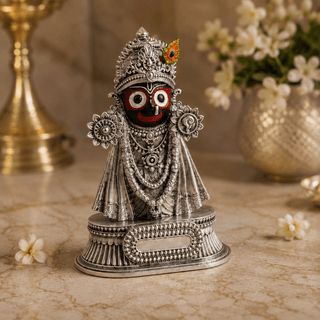
Why an elephant, of all forms?
Even with the legend set aside, the choice makes sense. Jagannath is understood as a form of Vishnu: the temple and the tradition both say so, and he sits in the same family as the ten avatars of Vishnu. Vishnu is the one who takes whatever shape the situation needs. He has been a fish, a boar, a dwarf, a lion-headed man. An elephant head for one night is entirely in character.
There is also the plainer Odishan logic: the elephant is the royal animal. Gaja Lakshmi, the goddess flanked by elephants, is carved all over eastern Indian temples. A king rode an elephant in procession. Puri treats Jagannath as a reigning monarch: he has a wardrobe, a kitchen, a court, an annual outing, and a Gajapati king who sweeps the road in front of his chariot.10 Dressing the king as the royal mount on the night of his ceremonial bath is not a random costume. It is court protocol.
And there is the honest historical layer underneath all of it. The Temple Administration says outright that "Jagannatha was originally a deity of the aboriginal tribes and was known as Nila Madhava." A wooden god, absorbed into Vaishnavism, still cared for by the descendants of the tribe that kept him. A form that flexible was never going to refuse an elephant mask.
What happens to the wood underneath
The Puri deities are not permanent objects. Every so often (at intervals of 8, 11, 12 and 19 years, depending on the calendar) the temple performs Nabakalebara, the "new body." Parties go out on the Banjara Yatra to find four neem trees carrying prescribed marks. Carpenters from the Biswakarma Maharana families carve new images under Daitapati supervision. On the fourteenth night of the dark fortnight of Ashadha, a substance called the Brahma Padartha is moved from the old images to the new, by servitors whose eyes and hands are covered. The old deities are buried at Koili Baikuntha.5
Nobody living has publicly seen what the Brahma Padartha is. The temple's own page lists four competing theories: a tooth of the Buddha, an image of Vishnu, a Salagrama shila, or a piece of bone from the Krishna incarnation.6 That last one connects to what happened to Krishna's body after his death.
So the elephant mask goes over a form that is itself temporary, holding something sealed that even the institution describes only as "something unknown." The costume is the least mysterious part of the evening.
If you want to see it
Hati Besha falls on Snana Purnima, the Jyestha full moon, usually in June. Check the year's panchang, because it moves. The bathing happens through the day on the Snana Vedi, and the elephant masks come later. It is one of the few Puri occasions where non-Hindus, who cannot enter the temple, can still see the deities, since the Snana Vedi is visible from the road.2
Then the doors shut for a fortnight, and the town waits. For what the streets look like when the wait breaks, there is how Puri comes alive during Ratha Yatra, and if you have argued with anyone about the chariots, who the sarathi of Nandighosh actually is settles it with two government sources.
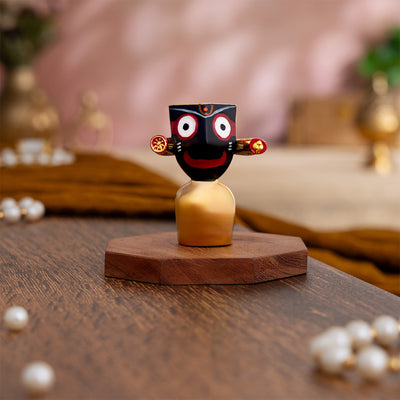
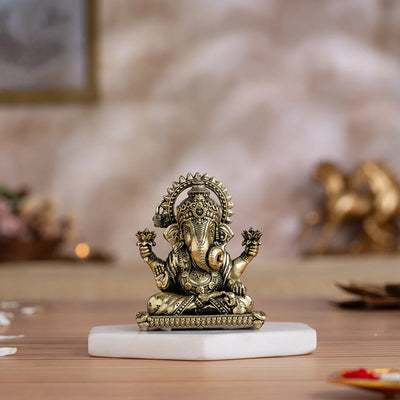
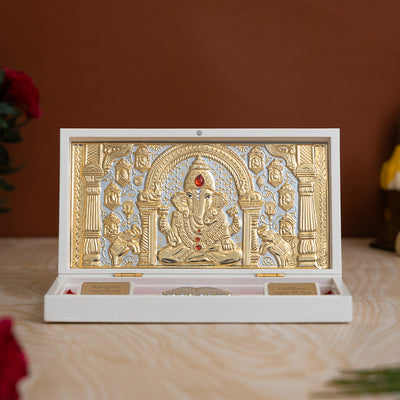
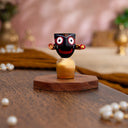
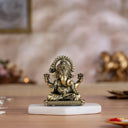
Most of us are not going to be in Puri that week. What people do instead is keep a small form of the trio at home and mark the day quietly: a lamp, a bath for the murti, sweets. Our Jagannath idols and the Rath Yatra collection are built for exactly that, and cleaning a marble idol properly matters more than people think in a season this humid. For a Ganesha shelf, the Ganesh idols are here, and his favourite flower and why tulsi is never offered to him are worth ten minutes.
The short version
Hati Besha is real, dated and on the record: elephant masks, on the Jyestha full moon, immediately after a bath with 108 pitchers, on the last evening before a fifteen-day disappearance.
Ganapati Bhatta is a story Puri tells about that ritual. It has no chapter number and does not need one. A god who will put on your god's face rather than send you home empty is a good enough idea that it survived without paperwork for centuries, which is a stronger recommendation than a citation.
Also read: Why Jagannath Has No Hands | Why Jagannath Has Big Eyes | The Rath Yatra Story | Facts About the Jagannath Temple | Who Is the Mother of Lord Jagannath | Balarama Avatar of Vishnu: Eighth, Not Ninth