Almost every retelling of the Rath Yatra story builds to the same moment. A door opens too early. A carpenter disappears. Three idols are left half-carved forever.
It is a wonderful ending. It is also not in the Purana.
That does not make it false, or less loved. But if you came for the actual origin of the chariot festival, you deserve to know which parts come from a Sanskrit text and which come from Puri's own living memory. The seam between the two is the interesting part.
The king who wanted to see God with his own eyes
The oldest full account of Puri is a long section of the Skanda Purana called the Purushottama Kshetra Mahatmya. It runs past forty chapters, and it holds the whole story people still retell.
It opens with King Indradyumna. He is not asking for wealth or victory. He wants darshan, a form of Vishnu he can stand in front of, and he sends men across the country to find it. Word reaches him of a deity in the east, worshipped in a forest near the sea, called Nila Madhava. The blue one. He sends a brahmin envoy, Vidyapati.
Before the wooden form existed, before any chariot rolled, the God of Puri was already worshipped by somebody else. The Temple Administration says so on its own website: Jagannatha was originally a deity of the aboriginal tribes and was known as Nila Madhava, his image being made of some sort of blue stone. That is the temple's sentence, not a scholar's provocation.

A tribal chief, and a trail of mustard seeds
The keeper of Nila Madhava is Visvavasu, a Savara chief. In the Purana the deity stands beneath a banyan near the Rauhina pool, and the worship is private and hereditary.
Vidyapati marries into the family, which earns him the right to be taken there. In the version Puri itself tells, he is led there blindfolded. He drops mustard seeds along the path, so he can find his way back once the rains make them sprout. It is a small, practical detail, and it is why everybody remembers this part.
Then Nila Madhava vanishes. The stone deity is simply gone.
That is the hinge of the legend. A god who belonged to one family disappears, and what comes back belongs to everyone. That is why Rath Yatra feels less like a temple ritual and more like a crowd claiming something. We have written separately on why Rath Yatra is celebrated and on how Puri comes alive during the festival.
The log in the sea, and the carpenter who vanished
What replaces the stone is wood. The Purana describes a divine tree floating in the sea, said to have come from a hair fallen from Vishnu's body, drifting to the shore. This is the daru, the sacred log, and everything at Puri still turns on it. Daru simply means wood. The temple also reads the syllables devotionally, Da for the bestower of bliss and Ru for the remover of sorrow, and calls the deity Daru Brahma.9
Then comes the carving, and here the Skanda Purana is remarkably brief. An old carpenter agrees to prepare the image in the form Indradyumna had seen in a dream. The carpenter then disappears. The very next chapter has the images being decorated in different beautiful colours.1
Read that slowly. No locked door. No twenty-one days. No broken promise. No unfinished idols. The images get made, then they get painted.
Puri's own theology adds the best line in the legend, which most retellings drop. The Temple Administration states that the old carpenter was none other than the Supreme Lord Himself. Not Vishwakarma. The Lord carved himself, out of wood that was already him.
Where the Purana ends and Puri begins
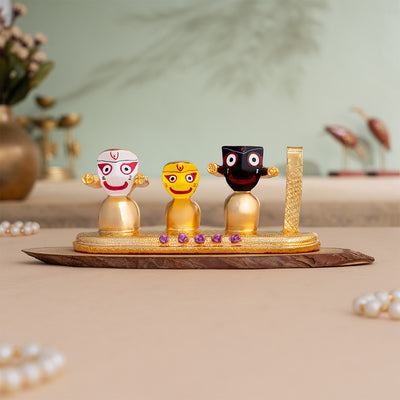
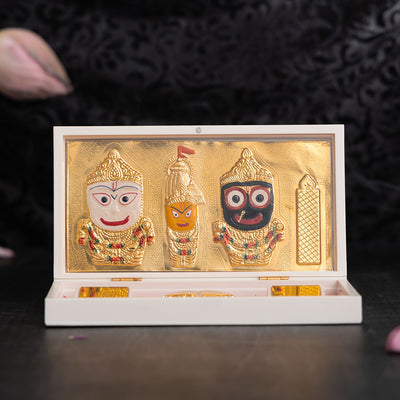
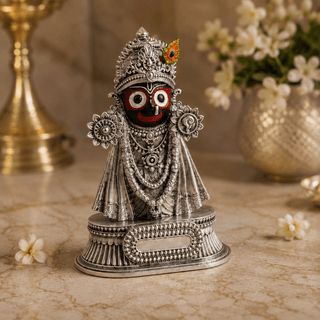
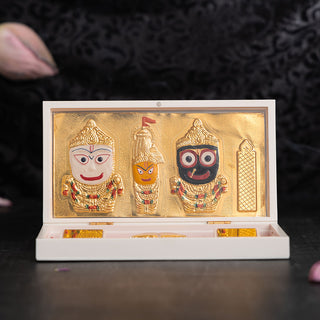
The unfinished-idol story comes from Puri, not the Purana. In the version the Shree Jagannatha Temple Administration tells on its own site, Vishnu comes to Indradyumna as an old craftsman and sets one condition. Twenty-one days alone, behind a closed door, nobody may look. Fifteen days in, the tools go quiet. Queen Gundicha, afraid the old man has died in there, persuades the king to open the door. The carpenter is gone. What remains, in the temple's own words, is four wooden images in incomplete form: Jagannatha, Balabhadra, Subhadra and Sudarshana.

That page cites no scripture, and it does not need to. This tradition is retold because it does something the Sanskrit text does not: it explains the form you are standing in front of. The local tradition improved on the scripture, and that is worth saying out loud. We went deeper in why Jagannath has no hands, where the temple's real defence turns out to be Upanishadic rather than Puranic. The line Puri quotes is from the Shvetashvatara Upanishad:
He is without hands, feet, and yet moves and grasps; He sees, though without eyes.
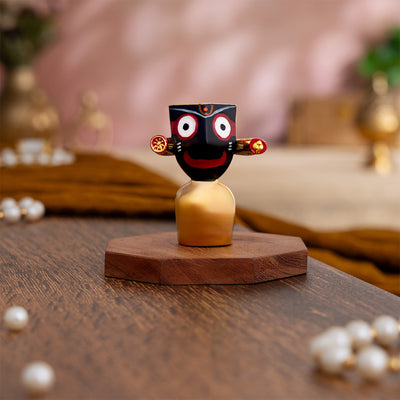
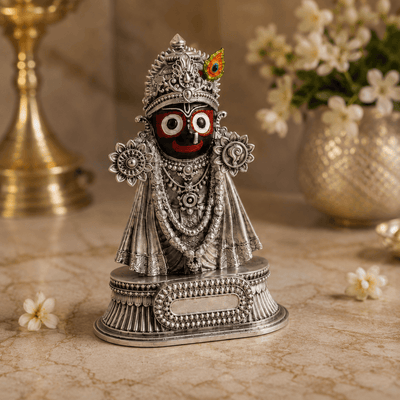
That is a much bigger claim than an accident with a door. It says the form is not incomplete at all. It is a deliberate picture of a God who does not need limbs to hold you. On the same logic, the huge round eyes people write so much about are never described in the Purana, which calls him only lotus-eyed. More in why Lord Jagannath has big eyes.
So why the chariots?
Because the Purana promises salvation to anyone who sees the deities on the chariot. Chapters 33 to 37 of the Purushottama Kshetra Mahatmya say that those who take darshan of Jagannath, Balabhadra and Subhadra placed on the chariot will get salvation, and that those who see the Lord during the days of Rathotsava will certainly get salvation.1 That is the stated reason for the festival. Not a family visit. Not a commemoration. A yearly chance at liberation, given to anybody standing on the road.
Which explains the shape of the day. The temple admits only Hindus inside. The Grand Road admits everyone. Once a year the Lord leaves the building and goes to where the people actually are. The destination is the Gundicha temple, roughly three kilometres away.7 The deities go out on Ashadha Shukla Dwitiya and return on Shukla Dashami, the ride called Bahuda.
The three chariots, in numbers
- Nandighosa carries Jagannath. 45 feet, 16 wheels, red and yellow cloth, dark horses. Charioteer: Matali.
- Taladhwaja carries Balabhadra. 44 feet, 14 wheels, red and blue, white horses. Charioteer: Daruka.
- Darpadalana carries Subhadra. 43 feet, 12 wheels, red and black, red horses. Charioteer: Arjuna.4
One detail is worth keeping. The Skanda Purana already gives Jagannath's chariot as sixteen arms and Balarama's as fourteen, and the modern chariots hold exactly that sixteen-to-fourteen proportion in their wheel counts. Whatever else shifted over the centuries, that ratio did not.

The deities are carried out in a swaying procession called pahandi, in a fixed order: Sudarshan, Balabhadra, Subhadra, Jagannatha. Sudarshan, the discus, is a deity here in his own right, which surprises people who assume Puri worships three. It does not. We wrote about the discus in who gave the Sudarshan Chakra to Krishna.
Four things people get wrong about this story
1. That Vishwakarma was the carpenter. The Purana leaves him anonymous, just an old carpenter. Puri's own position is that he was not Vishwakarma at all but the Lord himself. The Vishwakarma attribution is popular retelling, and it has travelled far, but neither source says it.
2. That Gundicha is Jagannath's aunt. Two figures have been squashed into one. In the Skanda Purana, Gundicha is not a person. It is a mandapa, a pavilion, where the Lord stays and where devotees earn merit by bathing in the tirtha and seeing him.1 In Puri's legend, Gundicha is Indradyumna's queen, the one who opened the door. The aunt belongs to a different shrine, Mausi Maa on the Grand Road, where the famous poda pitha is offered.
3. That Daruka drives Nandighosh. This one is everywhere online, and it is backwards. The Odisha government's Rath Jatra portal states it plainly: the three charioteers attached to the chariots of Jagannatha, Balabhadra and Subhadra respectively are Matali, Daruka and Arjuna. The confusion is forgivable, because in the epics Daruka is Krishna's own charioteer and Matali is Indra's, so the swap feels wrong. Puri does not follow that logic. We took it apart in who is the sarathi of Nandighosh Rath.
4. That the festival re-enacts Krishna's journey to Kurukshetra. In that reading the gopis pull his chariot back towards Vrindavan, and the ropes in your hands are theirs. It is a real and deeply held Gaudiya Vaishnava interpretation, and it is beautiful. It is also a later devotional layer, not the Purana's reason.
One more tangle: the three on the chariots are not siblings with one mother. Balarama's mother is Rohini, Krishna's is Devaki, and the Mahabharata calls Subhadra the uterine sister of Sarana, whom the Bhagavata lists among Rohini's sons.10 That thread runs through who is the mother of Lord Jagannath, and the fatherhood question through who is the father of Lord Krishna.

What happens just before the yatra
On the Jyestha full moon comes Snana Yatra, when the deities are bathed with 108 pitchers of scented water at the Snana Vedi.6 They are then dressed in elephant masks for the Gaja Besha, better known as Hati Besha, and there is a much-loved Puri story about a Ganesha devotee behind it, with no text under it. We separated ritual from legend in the story of Hati Besha.
Then they fall ill. The temple says it exactly like that: after the bath the Gods fall ill, so darshan is not possible for fifteen days. This is Anasara, and only the Daita and Pati servitors may go in. When the doors open again, the crowd that waited a fortnight sees them on the chariots.
A bath, an illness, a disappearance, then the road. For anyone who keeps the Lord at home rather than at Puri, a small travelling shrine like a Jagannath pocket temple carries the same idea in miniature, a God meant to move rather than stay sealed behind a door.
A temple that is honest about itself
Puri does not oversell its own age. That is part of why these stories are worth trusting. The present temple was built in the twelfth century by King Anantavarman Chodaganga Deva, and Anangabhima Deva III installed the deities in 1230 AD.3 The Temple Administration says reliable historical material begins only around the ninth century, and that attempts to push the cult back to Kharavela in the second century BC have achieved almost negligible success.
Two facts from those pages beat anything on a viral list. The deities are physically remade in the Nabakalebara rite, at intervals of eight, eleven, twelve and nineteen years, from four neem trees identified by prescribed marks.8 And inside each image is a cavity holding a sealed casket, the Brahma Padartha, whose contents the temple itself will only describe through four competing theories. The rest are in facts about the Jagannath temple.
Jagannath is counted among the forms of Vishnu, so the ten avatars of Vishnu stand behind him, as does the question of what happened to Krishna's body after his death, which is where many readers first arrive at Puri. Households that keep him alongside other Vaishnava forms usually look through the Jagannath idols and Vishnu idols collections together, and the Rath Yatra collection is put together for these weeks. For the daily side of it, how to worship Lord Krishna applies more or less unchanged.
Why the story still works
Strip it down and Rath Yatra is about a God who refuses to stay put. He begins in a forest, kept by one tribal family. He ends up in a temple with rules about who may enter. Then, once a year, he leaves it for a public road where nobody can be turned away.
The Purana promises that seeing him there is enough. That is the whole festival. Everything else, the mustard seeds, the closed door, the aunt, the ropes from Vrindavan, is the human habit of telling a good story better each time. Knowing which layer is which does not spoil it. If anything it makes the ropes feel older.
Also read: Why Rath Yatra is Celebrated | Why Jagannath Has No Hands | Who is the Sarathi of Nandighosh Rath | Facts About the Jagannath Temple | Who is the Mother of Lord Jagannath | Does the Jagannath Temple Flag Fly Against the Wind? | Balarama Avatar of Vishnu: Eighth, Not Ninth