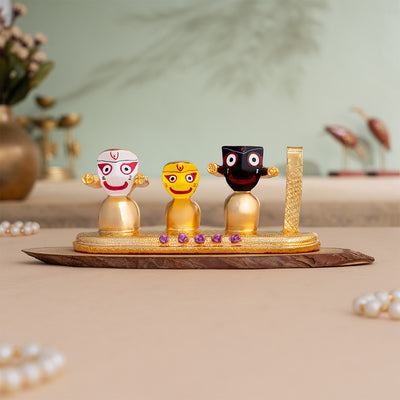
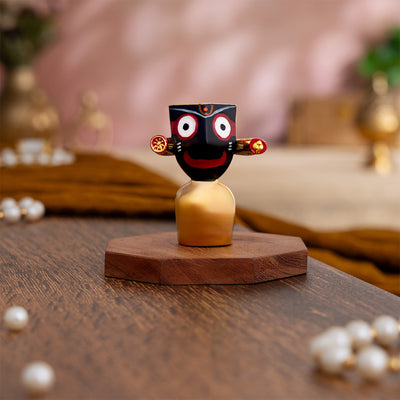
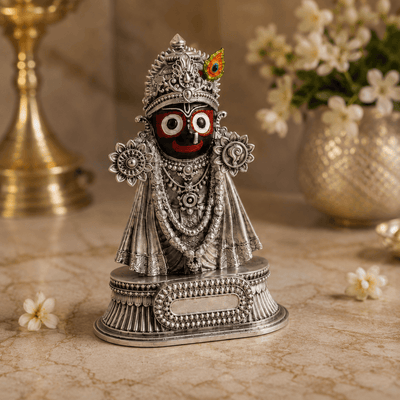
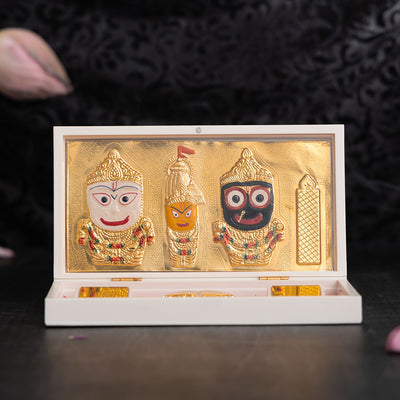
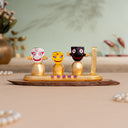
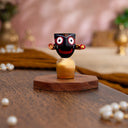
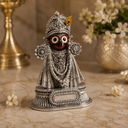
Stand in front of the Puri deities once and you will understand why this question exists. Everything else about the form is reduced almost to nothing: no legs, no carved arms, a head and a torso and not much more. And then there are the eyes. Enormous, perfectly round, wide open, painted white with a black disc in the middle.
So people ask what verse explains them. I went looking for that verse. It isn't there.
The short answer: no text describes those eyes
The oldest sustained Sanskrit account of Puri never mentions them. It is the Purushottama Kshetra Mahatmya, a long section of the Skanda Purana running to more than forty chapters, and it is where the whole story lives: King Indradyumna, his envoy Vidyapati, the Savara chief Visvavasu who worshipped a blue deity called Nilamadhava, the sacred tree that floated in on the sea, the old carpenter who carved the images and vanished.
It is a detailed text. It describes the images being decorated in colours. It describes the chariots down to their measurements. And when it describes the Lord's face, it uses one word: lotus-eyed.1
That is the standard Vaishnava epithet. Pundarikaksha. It is used of Vishnu in a hundred places and it means beautiful eyes, gentle eyes, eyes like a lotus petal. A lotus petal is long and narrow. It is close to the opposite of what you see at Puri.
So the honest position is this: the form came first, and the Sanskrit story was written around a form that already existed. That is a more interesting answer than any invented verse, and it is the thread worth pulling.
What the eyes actually grew out of
The temple's own website says Jagannath began as a tribal deity. On its page about Jagannath culture, the Shree Jagannatha Temple Administration states plainly that "Jagannatha was originally a deity of the aboriginal tribes and was known as Nila Madhava, his image being made of some sort of blue stone."
Read that again. The temple itself says the deity began outside the Sanskrit fold, among forest communities, before being absorbed into Vaishnavism.11 The Purana keeps a trace of it: Nilamadhava belongs to Visvavasu the Savara, and the king has to send a man into the forest to find him.
This matters for the eyes. A face that does not look like other Hindu icons probably does not look that way because a Sanskrit text asked for it. It looks that way because it was inherited: a wooden form carved in a particular idiom, older than the literature written around it. Compare it with any of the ten avatars of Vishnu as they are usually sculpted and the difference is immediate. The same logic explains the missing limbs, which I've written out separately in why Jagannath has no hands.

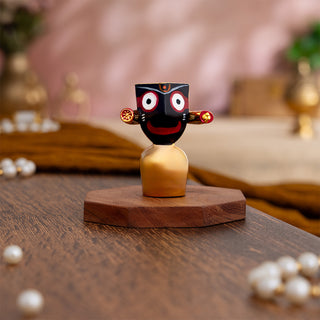
The line Puri quotes says something stranger than "big eyes"
When the Temple Administration explains the unusual form, it does not reach for a Purana. It reaches for the Shvetashvatara Upanishad, and quotes a line describing the Supreme Being as one who "is without hands, feet (and yet) moves and grasps; He sees (though) without eyes."2
Sit with that, because it cuts against the whole premise of the question. The scriptural defence Puri offers for this form is that God does not need eyes to see you, or arms to hold you. And then that same image is given the largest eyes in Indian religious art.
I don't think that's a contradiction. I think it's the point. The eyes are not there so that he can see. They are there so that you can be seen. The whole exchange of Hindu worship is darshan (sight, mutual sight, being looked at by the deity), and the Puri form pushes that idea as loud as it will go. Everything you would use to identify a person is stripped away except the part that meets you.
That is a reading, not a verse, and I'll keep saying so. But it is a reading the form invites.
Are the eyes ever closed? The fortnight Puri waits through
Yes. For fifteen days every year those eyes are behind a closed door.
On the full moon of Jyestha comes Snana Yatra. The deities are brought out to the Snana Vedi and bathed with 108 pitchers of water mixed with sandalwood paste, camphor and scent.7 Then, per the temple's own festival record, they are "adorned with elephant masks in the Gaja Besha": the elephant dress that has its own much-loved story, which I've told in full in the Hati Besha of Lord Jagannath.
And then they fall ill.
The temple's FAQ page says it without any softening: "After this the Gods fall ill. So darshan is not possible for 15 days." The deities go into Anasara, a seclusion that lasts until the new moon of Ashadha. Nobody enters except the Daitas and Patis, the servitor families who care for them.13 For a fortnight, the most famous eyes in India are behind a closed door.
That is why those eyes carry the weight they do in Odisha. They are not permanently available. They are withdrawn every year, and the day the doors open again is one of the great days of the Puri calendar. Then the chariots go out: the festival most people know Puri for. For that, start with the Rath Yatra story, or the plainer question of why Rath Yatra is celebrated, which has a much better scriptural answer than the one usually given.
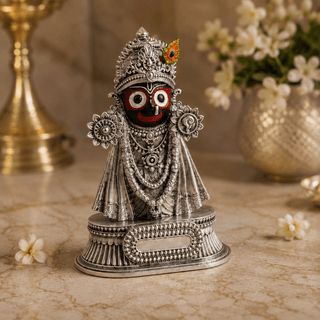
The eyes are repainted, and the whole body is replaced
These are not the original eyes, and they were never meant to be.
Puri performs a rite called Nabakalebara ("new body") which the temple says occurs at intervals of 8, 11, 12 and 19 years. Four neem trees are located during the Banjara Yatra, identified by prescribed marks on the wood called Daru characteristics. New images are then carved by Biswakarma Maharana servitors, guided by the Daitapati families.6
Then, on the fourteenth night of the dark fortnight of Ashadha, the Brahma Padartha (the life substance) is moved from the old images to the new ones in the dark. The old deities are buried at Koili Baikuntha in a rite called Patali.14
Read that as a sentence about the eyes. The eyes in a photograph from 2010 are, physically, not the eyes in the temple today. The face is a design that gets rebuilt by hand, by named families, roughly every dozen-odd years, closer to a living craft than to a fixed idol.
The temple's page on Darubramha explains the name: daru is wood, brahma the all-pervading soul. Inside the image is a cavity holding a casket the temple describes as "containing something unknown". Its own page lists four competing theories about what is in it: a tooth of the Buddha, an image of Vishnu, a Salagrama shila, or a piece of the bone of the Krishna incarnation. Nobody living has published what it is.
That last theory is the one that connects Puri to what happened to Krishna's body after his death, and the Buddha theory connects it to an older Buddhist layer around Puri that also shows up in the story of the 108 snails on Buddha's head. Neither is settled. The temple prints all four and takes no side, which is more honest than most of what gets written about it.
Three things people get wrong about Jagannath's eyes
1. "A Purana describes his large round eyes."
It does not. The Purushottama Kshetra Mahatmya calls him lotus-eyed and leaves it there. If an article quotes you a verse about huge circular eyes, ask which chapter. There isn't one. The eyes are a feature of the carved daru form and of the Odishan painting tradition that maintains it, not of a Sanskrit description.12
2. "Vishwakarma was interrupted mid-carving, so the form stayed unfinished."
This is the story everyone tells, and it is not in the Purana. In the Skanda Purana an old carpenter agrees to make the image in the form the king saw in a dream, then simply disappears, and the very next chapter has the images being decorated in beautiful colours. No broken promise, no unfinished stumps.
The twenty-one-days version, with Queen Gundicha opening the door after fifteen, is Puri temple tradition. The Temple Administration tells it on its own website and cites no scripture for it. And the temple adds a detail that quietly cancels the Vishwakarma part anyway: the old carpenter "was none other than the Supreme Lord Himself."4 Not the architect of the gods. The Lord, carving himself.
3. "The eyes never close because he never stops watching over you."
This one I would not argue with in a temple queue, and I would not print it as scripture either. It is devotional interpretation: beautiful, widely felt, and entirely unsourced. Worth adding: the Upanishad line the temple itself quotes says he sees without eyes, which sits oddly beside a doctrine built on eyes that never shut. Hold the sentiment. Drop the citation.
Two more that travel with this topic: Gundicha was Indradyumna's queen, not Jagannath's aunt (the aunt belongs to the separate Mausi Maa shrine on the Grand Road), and Nandighosh's charioteer is Matali, not Daruka, worth reading properly in who is the sarathi of Nandighosh rath. The question of who Jagannath's mother is has a surprising answer too, once you read the Bhagavata carefully.
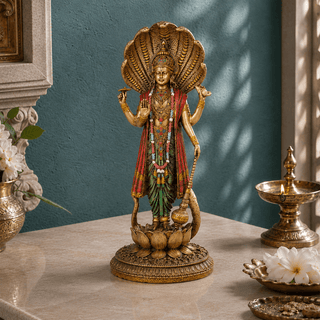
Why three deities, and why only one face gets asked about
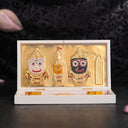
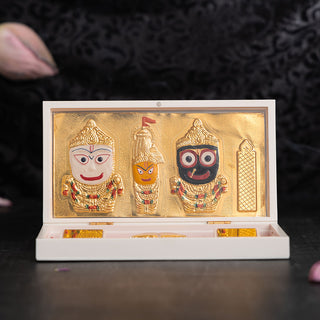
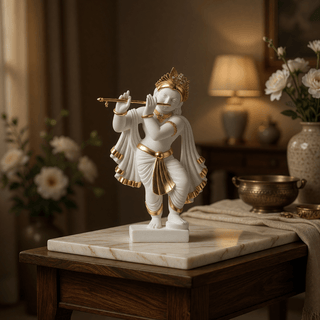
The eyes question is almost always asked about Jagannath alone, but he does not stand alone. The Skanda Purana identifies his companions theologically rather than as a family: Lakshmi herself born as Subhadra, and Balabhadra as Ananta, the king of serpents. The household reading of "three siblings" is a later, warmer way of talking about them. It is also why a Jagannath, Subhadra and Balabhadra murti set is what most people want at home rather than a single figure: the three read as one image, the way they do on the platform at Puri.
And Puri's own count is not three at all. The temple's FAQ lists Jagannatha, Balabhadra, Subhadra, Chakra Sudarshan, Bhudevi, Sridevi and Madhaba; the Nabakalebara page speaks of five wooden idols; the origin legend describes four images carved. Three is shorthand. For more of this, see facts about the Jagannath temple, and who gave the Sudarshan Chakra to Krishna for the fourth of them.
How old is any of this?
The internet inflates this constantly. The present temple was built in the 12th century by King Anantavarman Chodaganga Deva, and Anangabhima Deva III completed it and installed the deities in 1230 AD.9
On antiquity the temple's own history page is careful where listicles are not: reliable material begins only around the 9th century AD, with Shankaracharya's visit and the founding of the Govardhana Matha. Attempts to push the cult back to Kharavela in the 2nd century BC have, in the administration's own words, achieved success that "is almost negligible."
A temple willing to say that about its own age is a temple worth trusting on the rest. It's the same instinct that makes the Tirumala temple secrets worth separating into what is recorded and what is merely repeated.
So what should you actually believe about the eyes?
That they are old, and not Sanskrit in origin. That they are carved and painted by named families, replaced within a lifetime, and shut away for a fortnight every year. That the temple's own theology says God sees without eyes, and then gives him the biggest eyes in the country anyway.
And that when Odias say he is watching, they are not quoting a verse. They are describing a relationship: a different kind of claim, not a weaker one, and it deserves to be labelled correctly rather than dressed up.
If you keep him at home, he is usually kept facing the room rather than a wall, because the entire point of the form is the meeting of eyes. Beyond that the ordinary rules apply: our notes on what to keep in a pooja room, how to clean a marble idol and how to worship Lord Krishna cover most of it, since Jagannath is worshipped as Krishna at Puri. The full range sits in our Jagannath idols collection, alongside the Rath Yatra pieces and the wider Vishnu idols range.
The eyes have no verse. They have something better: a form nobody can fully date, kept alive by hands that still carve it. And once a year, on the Grand Road, he comes out of the building so that everyone can look back. If you want to know what that day is actually like, Puri during Ratha Yatra is the closest thing to being there.
Also read: Why Jagannath Has No Hands | Who Is the Mother of Lord Jagannath | Who Is the Sarathi of Nandighosh Rath | Facts About the Jagannath Temple | Why Rath Yatra Is Celebrated | Does the Jagannath Temple Flag Fly Against the Wind?