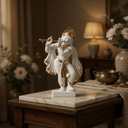
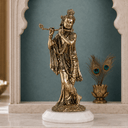
Ask ten people why Rath Yatra happens and nine will say the same thing: Jagannath goes to his aunt's house for a week.
It is a lovely answer. It is also not what the oldest text on Puri says, and the real reason is stranger and much bigger.
The Skanda Purana carries a long section on Puri called the Purushottama Kshetra Mahatmya, forty-plus chapters, and the source almost every retelling of the Jagannath Rath Yatra story quietly borrows from. When that text explains the chariot festival, it does not talk about relatives. It talks about you. Whoever sees the three deities placed on the chariots gets salvation. Whoever takes darshan during the days of Rathotsava, it says, will certainly get salvation.1
That is the reason. Everything else (the aunt, the poda pitha, the seven or nine days) sits on top of it.
Why the Lord has to leave the building
The Jagannath temple at Puri admits only Hindus.8 That rule is old and it is enforced, as at several great temples, including the ones behind these Tirumala temple secrets. It means a very large number of people who love Jagannath will never stand in front of him inside that compound.

The Grand Road outside has no such rule. It is a road.
So once a year the deities are carried out of the sanctum, set on three enormous wooden chariots, and pulled through the middle of a city by whoever grabs the rope. For those few days there is no gate, no queue system, no priest deciding who may approach. If salvation comes from seeing him, then he has to go where everybody can see him. The festival is the delivery mechanism for the promise.
Nobody is being let in. He is coming out.
The temple's own name for the festival is Gundicha Yatra: the journey to the Gundicha temple, about three kilometres up the road.4 Which brings us to the aunt.

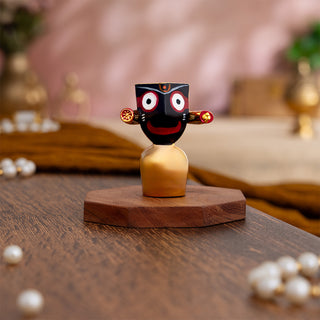
So who is Gundicha, if not his aunt?
Two different figures have been squashed into one.

In the Skanda Purana, Gundicha is not a person at all. It appears as a mandapa: a pavilion, a place. The merit described there comes from bathing in the tirtha at that spot and from seeing the Lord during his stay. No queen. No aunt. Just a building the Lord goes to and sits in.
In Puri's own legend, told on the Shree Jagannatha Temple Administration's website, Gundicha is King Indradyumna's queen. She is the one who, depending on how you feel about her, either ruined everything or gave us the form we love. The story goes that Vishnu came as an old carpenter. He agreed to carve the images on one condition: that he be left alone behind a closed door for twenty-one days. Gundicha persuaded the king to open it after fifteen. Inside were four wooden images in incomplete form. That is the temple's telling of why Jagannath has no hands.2
And the aunt? She is real, but she is a different deity entirely: Mausi Maa, whose small shrine sits on the Grand Road, where the famous poda pitha is offered as the chariots pass. Somewhere along the way "he stops at Mausi Maa's" and "he goes to Gundicha" collapsed into "he visits his aunt Gundicha."
Neither the Purana nor the Temple Administration's Ratha Jatra page describes this journey as a family visit. The aunt story is how a difficult theological idea became something a child could hold.
What the Purana says about the chariots themselves
The chariots are not a medieval addition. They are in the text.
The Skanda Purana already gives Jagannath's chariot as sixteen arms and Balarama's as fourteen. Look at the modern chariots and that same 16:14 proportion is still there, now counted in wheels: Nandighosa, Jagannath's, has sixteen; Taladhwaja, Balabhadra's, has fourteen. Something about the proportions survived a thousand years of rebuilding.
The official numbers, from the Temple Administration and the Odisha government's Rath Jatra portal:
- Nandighosa: Jagannath. 45 feet, 16 wheels, red and yellow cloth, dark horses. Charioteer: Matali.
- Taladhwaja: Balabhadra. 44 feet, 14 wheels, red and blue, white horses. Charioteer: Daruka.
- Darpadalana: Subhadra. 43 feet, 12 wheels, red and black, red horses. Charioteer: Arjuna.56
Yes, that is the right way round, and yes, most articles online have it backwards. If you have read that Daruka drives Nandighosa, we have written a whole piece on who the sarathi of Nandighosh rath actually is.
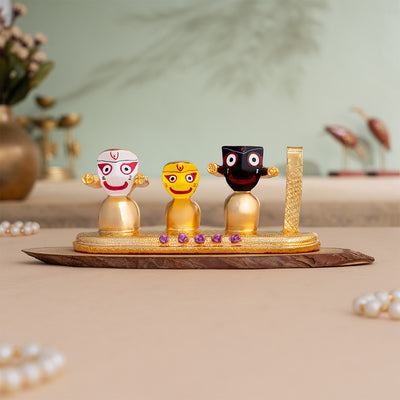
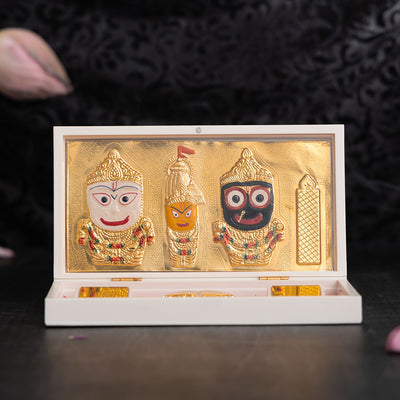
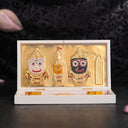
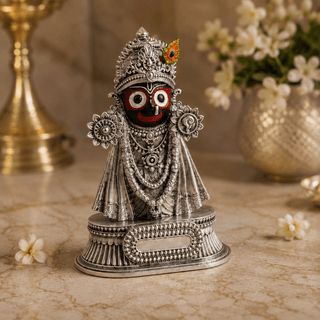
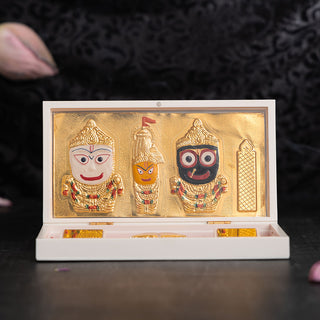
One more thing about that trio. We say "three deities" out of habit, but Puri does not. The origin legend describes four images being carved, Sudarshana included. The Nabakalebara page speaks of five wooden idols being replaced. The temple's FAQ lists seven worshipped forms: Jagannatha, Balabhadra, Subhadra, Chakra Sudarshan, Bhudevi, Sridevi and Madhaba. If you keep a Jagannath, Subhadra and Balabhadra set at home, you are keeping the travelling three: the ones who ride.
The Vrindavan reading, and why it is not the same answer
There is a second explanation you will hear, especially from Gaudiya Vaishnavas and in ISKCON's Rath Yatras around the world.
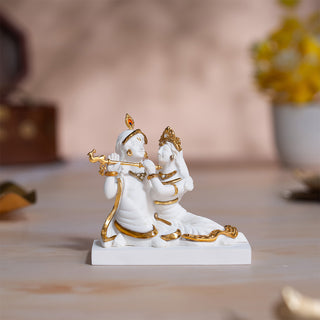
In that reading, the chariot journey is Krishna at Kurukshetra. He has left Vrindavan long ago and become a king in Dwarka. The gopis meet him again there after years, and they do not want the ruler. They want the cowherd boy. So they take hold of his chariot and pull, trying to drag him back to Vrindavan. Rath Yatra becomes that pull: love hauling God homeward.
It is genuinely held. But it is an interpretation layered on later. It is not the reason the Skanda Purana gives, and it is not in the Temple Administration's account either. If you have wondered what happened to Radha after Krishna left Vrindavan, this reading is the sequel a whole tradition wrote for her.
Two reasons, then: one from a Purana about liberation, one from bhakti poetry about longing. Both worth carrying, just labelled correctly.
Three things people get wrong about Rath Yatra
1. "It is Jagannath's yearly trip to his aunt's house."
In the Skanda Purana, Gundicha is a pavilion, not a woman. In Puri's own legend, Gundicha is Indradyumna's queen. The aunt is Mausi Maa, a separate shrine on the route. Three different things, one popular sentence.
2. "The idols are unfinished because Vishwakarma was interrupted."
The Skanda Purana has no interruption and no unfinished idols. In its account an old carpenter agrees to prepare the image in the form Indradyumna saw in a dream, and then simply disappears. The very next chapter describes the images being decorated in beautiful colours.
The twenty-one-days-and-a-broken-promise version is Puri temple tradition, and the Temple Administration tells it on its own site without citing a single scripture. It also says the carpenter was not Vishwakarma at all: he "was none other than the Supreme Lord Himself." The Lord carved himself. Puri's actual theological defence of the armless form is Upanishadic: the administration quotes the Shvetashvatara Upanishad's line about a God who is without hands and feet, and yet moves and grasps. That is not an accident of woodwork. That is a statement.
3. "Scripture describes his huge round eyes."
It does not. The Skanda Purana calls him lotus-eyed: the standard Vaishnava epithet used of Vishnu and his avatars everywhere. There is no verse about size or shape. The enormous unblinking eyes belong to the carved daru form and to Odisha's own painting tradition, and the meanings devotees give them are devotional readings, not scriptural ones. We looked at this properly in why Lord Jagannath has big eyes.
Bonus, since it comes up every June: no bird flies over the temple, the temple casts no shadow, the flag flies against the wind. None of these appear in the Skanda Purana's Puri section or on any of the Temple Administration's history, architecture, culture or FAQ pages. We are not calling them false. We are saying nothing we could find supports them, and the sourced facts about the Jagannath temple are far more astonishing anyway.
The shape of the festival, in order
Rath Yatra does not begin on Rath Yatra. It begins with a bath.
On the Jyestha full moon comes Snana Yatra: the deities are bathed with 108 pitchers of water mixed with sandalwood paste, camphor and incense at the Snana Vedi.7 They are then adorned with elephant masks in the Gaja Besha: the day behind our piece on Hati Besha of Lord Jagannath.
Then they vanish. The temple's FAQ puts it with startling plainness: "After this the Gods fall ill. So darshan is not possible for 15 days." This is Anasara: a fortnight of seclusion in which only the Daitas and Patis may go in. Gods who catch a fever and are nursed in private.
Which means that when Rath Yatra arrives on Ashadha Shukla Dwitiya, the crowd on that road has not seen his face in two weeks. That is the emotional charge nobody explains in the listicles. He was bathed, he fell ill, he disappeared, and now he is coming out into the sun.
The deities come out in the swaying pahandi procession, in a fixed order: Sudarshan, Balabhadra, Subhadra, Jagannatha.4 Three kilometres to the Gundicha temple. They stay. Here the temple's own pages disagree: the FAQ says nine days, the festivals page seven. On the fifth day comes Hera Panchami, when Lakshmi arrives at Gundicha Ghar to see Jagannath. The return journey, Bahuda, falls on Shukla Dashami.7
If you want the day-by-day version with what to expect on the ground, we have written that up separately in how Jagannath Puri comes alive during Ratha Yatra.
The part that is easy to miss
The deities at Puri are made of wood, and wood does not last.
So every eight, eleven, twelve or nineteen years, in the rite called Nabakalebara, they are remade. Four neem trees are found by prescribed marks during the Banjara Yatra, and new images are carved by Biswakarma Maharana servitors under Daitapati guidance. On the fourteenth night of the dark fortnight of Ashadha, the Brahma Padartha (the life substance) is moved from the old bodies to the new. The old deities are then buried at Koili Baikuntha in a rite called Patali.9
Buried. Like a person.
And what is that life substance? The temple's own page says the cavity holds a casket "containing something unknown", then lists four competing theories: a tooth of the Buddha, an image of Vishnu, a Salagrama shila, or a piece of the bone of the Krishna incarnation.10 That last one is why so many people connect Puri to the question of what happened to Krishna's body after his death, though the temple offers it as one theory among four, not as fact.
So the God on that chariot is a God who gets bathed, falls ill, hides for a fortnight, comes out on wheels, visits a house, and is eventually buried and reborn in new wood. Read the whole cycle together and the chariot ride stops looking like a parade. It looks like a life.
Why it is still celebrated, in one line
Because the promise was never that you should come to him.
Most of what we do in worship is arrival: we go to the temple, we climb the steps, we wait our turn. Rath Yatra inverts it completely. For a few days in Ashadha the direction of the whole thing reverses, and the enormous, armless, wide-eyed Lord of the Universe is dragged through traffic by ordinary people, past shops, past the aunt's place, to a house up the road.
The Purana said seeing him there is enough. Millions of people every year take that literally, and honestly, so should we.
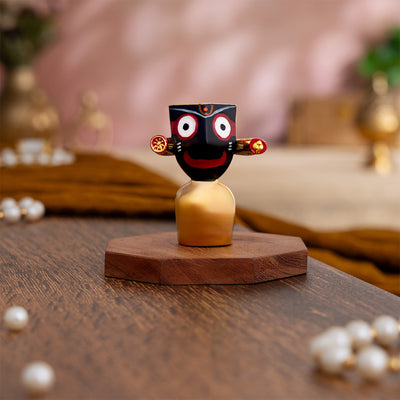
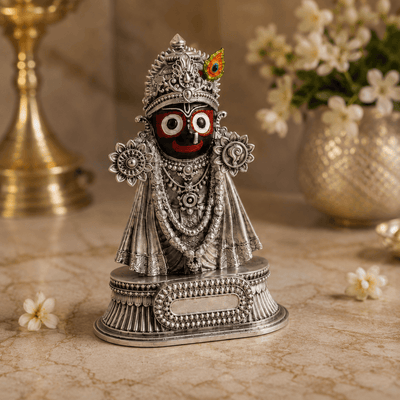
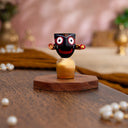
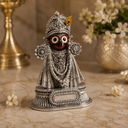
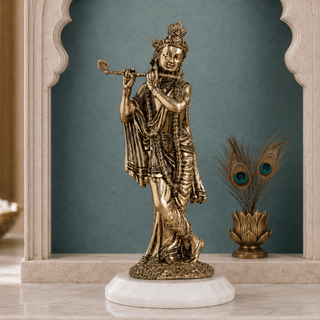
If you keep Jagannath at home, Rath Yatra season is the natural time to bring the trio together on your altar, and the Krishna forms sit beside him comfortably: he is the same Lord under different wood, the one whose birth we mark at Krishna Janmashtami. For the practical side, see how to decorate a Krishna idol at home and how to worship Lord Krishna.
And if you have been wondering who exactly is on those three chariots (three siblings who, read strictly, do not share one mother), we pulled that apart in who is the mother of Lord Jagannath.
Also read: Lord Jagannath Rath Yatra Story | Why Jagannath Has No Hands | Who is the Sarathi of Nandighosh Rath | Facts About the Jagannath Temple | Who Gave the Sudarshan Chakra to Krishna | Balarama Avatar of Vishnu: Eighth, Not Ninth