For most of the year you cannot get near Jagannath. He sits on his throne inside the sanctum at Puri, behind gates and rules about who may enter.
Then one day in Ashadha the doors open, and he comes out to the street. Anyone can see him. Anyone can pull the rope. That reversal is what Rath Yatra is actually for, and it explains almost everything odd about the week.
When Jagannath Rath Yatra falls, and why the date moves
In 2027 Rath Yatra is on Monday, 5 July. Rath Yatra falls on Ashadha shukla dwitiya. The festival is fixed to a tithi, a lunar day, not to an English date. M. M. Underhill's 1921 survey of the Hindu year lists it plainly: "Ratha yatra or Chariot fair. Ashadha sukla second." The return, which she calls Punaryatra, falls on Ashadha shukla tenth.
So the festival lands in late June some years and in early July in others. That is normal for a lunar festival.
Two almanacs can also disagree by a full day. Sewell and Dikshit explain why in their 1896 handbook of the Indian calendar: "A tithi on which the sun does not rise is expunged," and a tithi on which the sun rises twice "is repeated." That happens roughly thirteen and seven times a year.4 The same wobble is why Chhath Puja and Kajari Teej shift too. Festivals fixed by a solar month instead, like Onam, barely move at all.
Check your local panchanga for the exact hour. Do not take a timing from a blog, including this one.

The bath, the fever and the fortnight nobody sees
The ride is the last step, not the first. It starts a month earlier with Snana Yatra on the full moon of Jyeshtha.
Underhill records the detail: "One hundred and eight pitchers of water from a special well, drawn only on this day, are brought and used in bathing the images before sunrise." On this day the deities also wear the elephant form, which is the origin of the Hati Besha people travel to see.
After that bath the deities fall ill. They are moved to a side room and kept there for a fortnight. Rajendralala Mitra, the Bengali archaeologist who documented the Puri rituals in the nineteenth century, calls the room the Andur Ghar, or sick chamber, and says "the divinities are said to be laid up with fever in consequence of their unusual bath." The temple doors close. Cooking stops.
Mitra is honest about what happens inside. The real work is cleaning off a year of lamp soot and repainting the images, and this is also when a worn image is renewed. Anyone who has ever tried to clean a household idol will recognise the problem, only here it runs on a temple scale. On the fourteenth day the eyes are painted, and that is its own festival, Netrotsava.
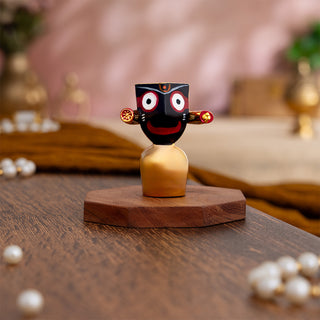
Those famous large round eyes are literally repainted every year before the god goes out in public.
Who actually carries the gods out of the temple
The Daitas do, not the priests. Rajendralala Mitra corrected that mistake 150 years ago.
Andrew Stirling, writing on Orissa in the early nineteenth century, described the images being dragged out of the Lion Gate by "certain priests to whom the duty appertains."5 Mitra says flatly that this is not so. The images are brought to the cars "not by the priests as stated by Stirling, but by a set of aboriginal men called Daityas or barbarians, to which class this office has belonged from time immemorial, it being believed that they are the descendants of the fowler Visvavasu."2
The Daitas carry Subhadra on their shoulders. The two larger images are moved with a silken rope tied at the waist, while priests steady them so they do not fall. Once on the chariots, the deities are given golden hands and feet for the day.
Why a tribal-descended family and not the Brahmin priesthood? Because the temple's own origin story says Jagannath was a forest god first. W. W. Hunter recorded the legend at Puri in 1872 and called Jagannath "no less the god of the Brahmans than of the low-caste aboriginal races."1 The family at Puri and the temple's daily customs both carry that double inheritance.
Three chariots built to a written rule
The chariots are not made up freehand each year. Mitra quotes the Purushottama Mahatmya for the specification of each one.

- Nandighosa, for Jagannath: 32 cubits high, sixteen wheels of sixteen spokes each, four corner pavilions, and Garuda for its crest.
- Taladhvaja, for Balabhadra: fourteen wheels of fourteen spokes, with Hanuman as its crest.
- Padmadhvaja, for Subhadra: twelve wheels of twelve spokes, with the lotus for its crest.
Mitra adds the one place where practice departs from the text. The book asks for iron wheels; the carpenters use wood. He also gives the working sizes of his day: 45, 43 and 44 feet tall, on platforms 35, 33 and 34 feet square.2
The pulling itself is organised. Mitra names a body of 4,200 men called Kalabetiyas. They hold rent-free land in nearby villages in return for this service, and are helped by however many pilgrims can reach a rope. If you have read about the charioteer of Nandighosh, this is the machine he sits on. Sets of Jagannath, Subhadra and Balabhadra together follow the same order the three cars keep on the road.
A king who sweeps the road
Before the ropes move, the Gajapati king arrives with horses, elephants and palanquins. Then he gets down.
Mitra describes it: about a hundred yards in front of the first car "he descends from his vehicle and walks barefoot, and, as the hereditary sweeper of the temple, sweeps the ground before the cars with a jewelled broom and worships the images in due form with flowers and incense." This is the Chhera Pahara.
A king performing the temple's lowest job, in public, once a year.
Why the images look unfinished
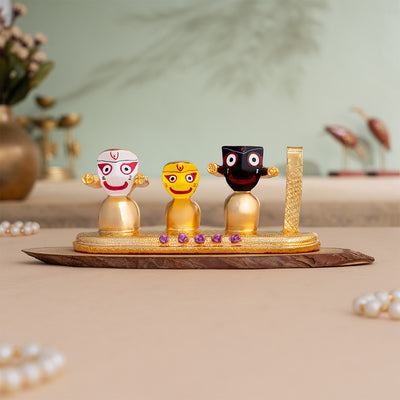
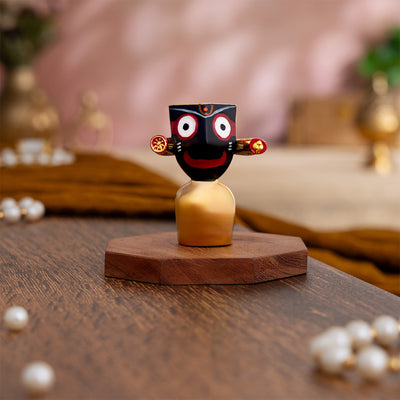
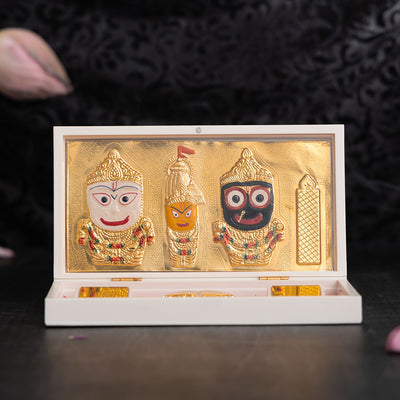
Jagannath has stumps for arms. Subhadra has none. The temple has its own explanation, and Hunter took it down at Puri in 1872.

King Indradyumna's carpenters could not work the sacred log. Then Vishnu came "in the form of an aged carpenter" and asked to be sealed in alone for twenty-one days. The king agreed and sealed the doors himself. But the queen wanted to see the god's face, and persuaded her husband to open the door early.
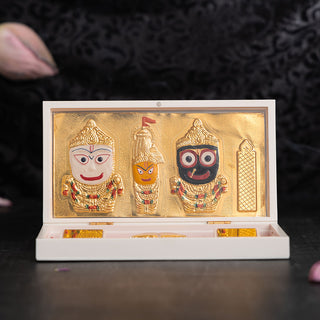
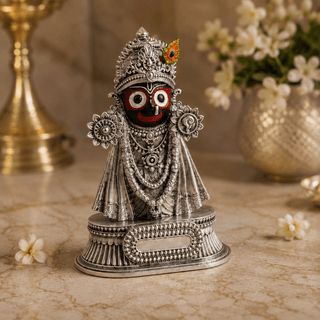
Inside he found the three images "fashioned from the waist upwards. But Jagannath and his brother had only stumps for arms, while his sister had none at all, and even so they remain to this day."
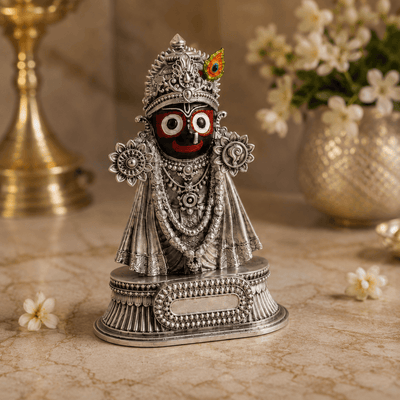
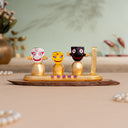
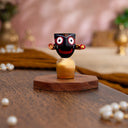
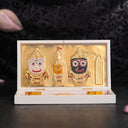
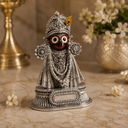
That is temple legend, not history, and it should be read as legend. It is still the reason Puri gives for why Jagannath has no hands, and it fits a god who is worshipped as an avatar of Vishnu yet looks like nothing else in Indian temple art. Household Jagannath idols keep the same shape for exactly this reason.
Three things people get wrong about Rath Yatra
1. That devotees threw themselves under the wheels
This is the "juggernaut" story, and it was already being taken apart in the 1870s. Hunter's chapter on it carries the running head "SELF-IMMOLATION UNKNOWN." He writes that deaths "were almost invariably cases of accidental trampling," that the few suicides were "diseased and miserable objects, who took this means to put themselves out of pain," and that "nothing could be more opposed to the spirit of Vishnu-worship than self-immolation."1 An accidental death inside the temple makes the whole place unclean and stops the ritual.
His strongest point is textual. Chaitanya's literature describes the Car Festival constantly, yet "makes no mention of self-sacrifice, nor does it contain any passage that could be twisted into a sanction for it." Abul Fazl is silent too.
Be fair to the record, though. W. J. Wilkins, writing in the 1880s, accepted that some pilgrims did die this way. He argued the motive was misplaced hope of heaven, not a bloodthirsty god. He noted that in European writing Jagannath "is regarded as the Moloch of India," and answered that there is "nothing to lead men to regard him as a cruel deity delighting in death, but the very opposite."6 Underhill in 1921 still called the accident-or-suicide question an open one. The honest version: a few real deaths were inflated into an entire genre of English rhetoric, and Indian scholars said so at the time.
2. That priests carry the deities to the chariots
They do not. Mitra corrects Stirling by name on this, and the office belongs to the Daitas. Mitra also protested the wider slander in his own book, writing that no Indian deity had a more unenviable reputation in English literature than Jagannatha.
3. That everyone agrees on what the journey means
Puri tradition says Jagannath is going to the Gundicha temple, his aunt's house. Stirling recorded the same building as the Gundicha Nour, named after the queen of Indradyumna who founded the worship.
But Underhill reports a different reading: "The chariot procession celebrates the setting out of Krishna and Balarama to Mathura from Gokula, to kill their uncle, Kamsa."3 That fits the fact that Jagannath is worshipped as Krishna in most of eastern India. Traditions disagree here, and there is no need to pretend otherwise.
The return, and the week in between
The deities stay at Gundicha for a week. On the fifth day comes Hera Panchami, when Lakshmi arrives looking for her husband, an episode played out with real theatre.
Then on Ashadha shukla dashami the cars are pulled back. Wilkins watched the Bengal versions of the festival. He noticed that the return draws far smaller crowds than the outward ride, and that helpers sometimes had to be tempted with sweets. Some things have not changed in 140 years.
Back at the Lion Gate the deities are dressed in gold ornaments for Suna Besha, and families light lamps at home the same evening. Then the doors close, and the ordinary year starts again.
What the week is really for
Look at who does what. A tribal-descended family carries the gods. A king sweeps the road. Thousands of ordinary people pull the ropes. The priests, for once, have the smaller part.
That is not an accident of custom. It is the point of the festival, and it is why the Rath Yatra story has held for centuries while other temple traditions faded. Puri's Rath Yatra is the one week the god belongs to everybody.
Even the belief about what a glimpse of him does is levelling. Underhill recorded it simply: whoever sees Jagannath on the road that day is believed to be freed from rebirth. No fee, no gate, no permission. Just the street.
Also read: Lord Jagannath Rath Yatra Story | Facts About Jagannath Temple | Why Jagannath Has No Hands | Who Is the Mother of Lord Jagannath | 10 Tirumala Temple Secrets | Does the Jagannath Temple Flag Fly Against the Wind? | Balarama Avatar of Vishnu: Eighth, Not Ninth
Cover photo: Prashant Kharote, CC BY-SA 4.0, via Wikimedia Commons.