The short answer, and why it isn't the one you've heard
Almost everyone answers this with the same story. A carpenter was carving behind a locked door. Someone opened the door too early. The work froze halfway. That story is real, it is old, and Puri tells it on its own website. It just isn't scripture.
The temple's theological page gives a completely different reason, and honestly a better one. Quoting the Shvetashvatara Upanishad, the Shree Jagannatha Temple Administration describes the Supreme Being as one who "is without hands, feet (and yet) moves and grasps; He sees (though) without eyes."3
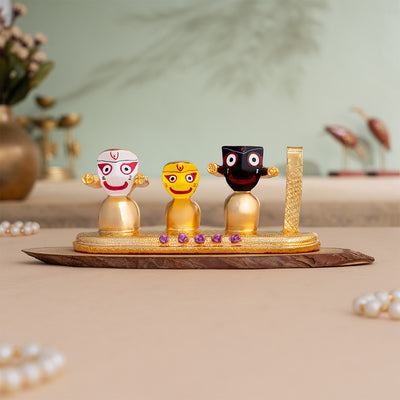
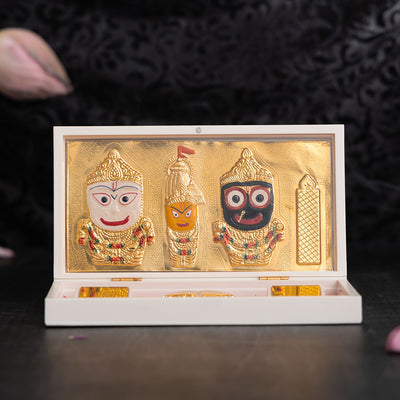
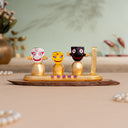
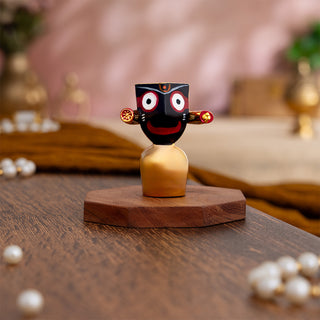
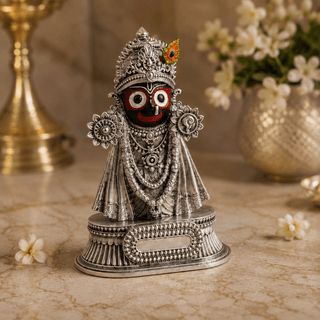
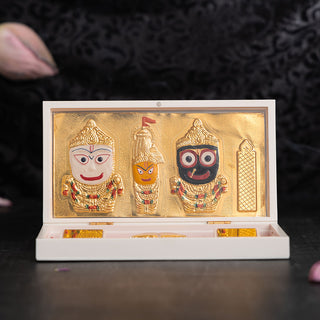
Stand in front of the three figures at Puri and you are looking at something that does not resemble any other Hindu image. No arms reaching down. No feet. Enormous round eyes. Painted wood, on a stone platform, in one of the largest temples in the country. Read that Upanishad line with the murti in front of you. It is not describing an accident. It is describing exactly what you are looking at.
What the oldest text actually says
The oldest sustained account of Puri is the Purushottama Kshetra Mahatmya, a long section of the Skanda Purana running to forty-odd chapters. It has everything people recite: King Indradyumna of Malwa longing to see Vishnu, his envoy Vidyapati, the Savara tribal chief Visvavasu who worshipped a blue deity called Nilamadhava, the disappearance of that deity, and a divine tree found floating in the sea.
In the Purana, the moment everyone builds their retelling around is almost boringly plain. An old carpenter agrees to prepare the image in the form Indradyumna had seen in a dream. He works. And then the old carpenter simply disappears. The next chapter has the images being decorated with different beautiful colours.1
No twenty-one days. No locked door. No queen. No unfinished idols. The text that gives us the entire framework of the Jagannath origin story never mentions the interruption that the whole popular version turns on.
The most repeated explanation of Jagannath's form is missing from the oldest source about Jagannath.

So where does the broken-promise story come from?
From Puri. And Puri is upfront about it.
The Temple Administration's own "Legendary Origin" page tells it in detail. Vishnu appears as an old carpenter and agrees to make the images on one condition: twenty-one days alone, behind a closed door, with nobody allowed in. Queen Gundicha, hearing no sound from inside, persuades the king to open it after fifteen. The carpenter is gone. Four wooden images are left "in incomplete form": Jagannatha, Balabhadra, Subhadra and Sudarshana.2
Notice the page cites no scripture. Not a chapter, not a verse, not a text name. It is presented as the legend, and that is exactly what it is. Scholars generally trace this telling to later Odia devotional literature rather than to Sanskrit Purana. I could not open that literature directly, so treat the attribution as a pointer, not a citation.
None of this makes the story fake. It makes it tradition, which is a different and equally real thing. Communities tell stories about their gods, and the stories get better over centuries. This one is a genuine improvement on the Purana as narrative: a promise, a doubt, a door, a consequence. It is simply not what the Skanda Purana says.
One correction while we're here, because it travels with the story: Gundicha is not Jagannath's aunt. In Puri's legend she is Indradyumna's queen. In the Skanda Purana she isn't a person at all. Gundicha is a mandapa, a pavilion where the Lord stays. The "aunt's house" idea belongs to the separate Mausi Maa shrine on the Grand Road, and it is one of the most common mix-ups in every article on why Rath Yatra is celebrated.
The carpenter was not Vishwakarma
The Skanda Purana doesn't name him. It says "an old carpenter" and leaves it there. Almost every retelling names Vishwakarma, the architect of the gods. It is an obvious guess. Divine carving job, divine carpenter.
And Puri's own theology goes further, in a line that deserves to be quoted more than it is: "the old carpenter who carved the images of the Lords out of that Celestial Tree was none other than the Supreme Lord Himself."
So according to the temple, nobody interrupted a craftsman. The Lord carved himself, in the shape he wanted, and then walked out of the room. Which changes the entire meaning of the "incomplete" form: if the sculptor and the subject are the same person, there is no such thing as unfinished.
The real argument: a God who grasps without hands
The scriptural defence Puri offers is Upanishadic, not Puranic. The Shvetashvatara Upanishad line the temple quotes (a Being without hands and feet who still moves and grasps, who sees without eyes) is a statement about a God who does not need a body to do what a body does. It appears on the temple's own page about Mahaprabhu Shree Jagannatha as the basis of the form. (I am quoting it as the temple prints it; I could not open Max Müller's translation to confirm a verse number, so I'm not going to invent one.)
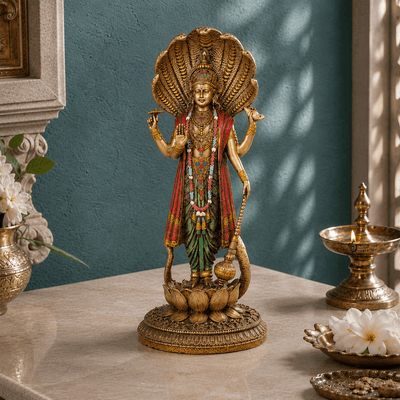
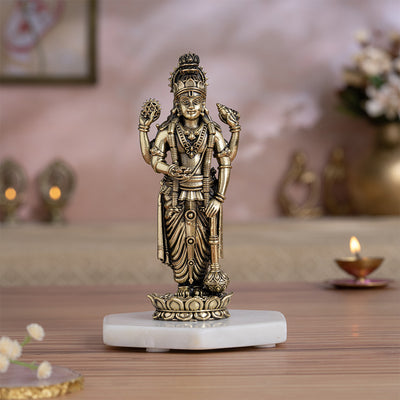
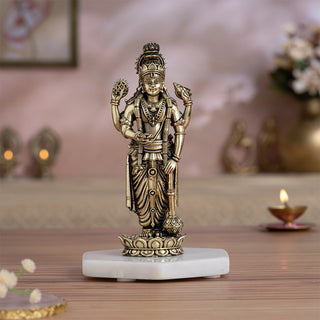
That reframing is huge. Every other major murti in Hinduism is defined by its hands. Vishnu holds a conch, a discus, a mace and a lotus. Shiva holds a trident and a damaru. Durga's arms are literally how you count her power. The Sudarshan Chakra only means anything because someone is holding it.
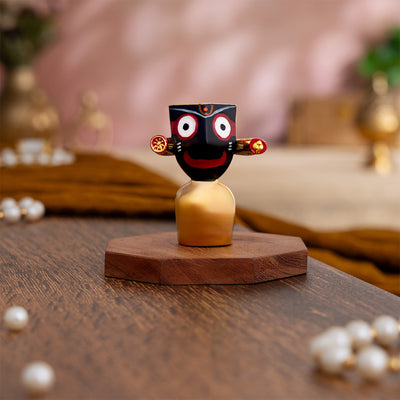
Jagannath removes the entire vocabulary. No weapon, no mudra, no attribute. Just a face and two stumps thrown open, which devotees read as arms permanently extended, an embrace rather than a grip.
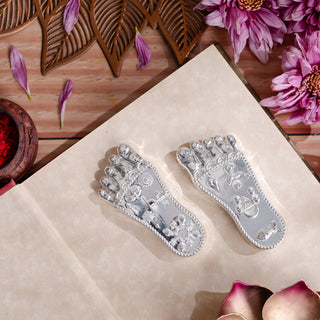
It is the same instinct behind venerating Krishna's lotus feet or his hands alone: the part stands in for the whole, and the absence does more work than the presence would. If you have ever wondered why a form so unlike the polished Vishnu murtis people keep at home still commands that kind of devotion, this is why. It isn't a statue that fell short of realism. It is a picture of something that was never meant to look human.
The layer under the Sanskrit story
Jagannath has a tribal past, and the temple says so itself rather than leaving it to academics.
From the Administration's page on Jagannath culture: "Jagannatha was originally a deity of the aboriginal tribes and was known as Nila Madhava, his image being made of some sort of blue stone."6
The Savara chief Visvavasu isn't a decorative character in the origin story. He is the older worship the story is absorbing. The daru form, the neem wood, the Daita servitors who alone may touch the deities during Anasara, the whole non-anthropomorphic look: these read as continuous with a wooden tribal god that Sanskrit theology later wrote a beautiful frame around.
Which means the honest answer to "why no hands" may be older than any of the stories. The form came first. The explanations (the carpenter, the Upanishad, the embrace) came afterwards, as people tried to account for a shape they had inherited and would not change.
The temple is careful about age too. Reliable historical material for Puri starts around the 9th century AD with Shankaracharya's visit and the founding of the Govardhana Matha. The present temple was built in the 12th century by Anantavarman Chodaganga Deva, and Anangabhima Deva III completed it and installed the deities in 1230 AD. Attempts to push the cult back to Kharavela in the 2nd century BC have, in the administration's own words, achieved "almost negligible" success.7 There are more genuinely strange facts about the Jagannath temple than the internet's favourite ones.
Four things people get wrong about Jagannath's form
1. "The Puranas say the carving was interrupted." They don't. The Skanda Purana's Purushottama Kshetra Mahatmya has the carpenter agree, work, and vanish, and the next chapter has the images painted in colours. The twenty-one-day version is Puri's tradition, told without a scriptural citation.
2. "The carpenter was Vishwakarma." The Purana leaves him anonymous. Puri says he was the Lord himself. Vishwakarma is an assumption that stuck.
3. "Scripture describes his huge round eyes." It does not. The Skanda Purana calls him "lotus-eyed", the ordinary Vaishnava epithet used for Vishnu everywhere.1 The famous circular eyes belong to the carved wooden form and Odisha's painting tradition, not to a verse. We've written about why Jagannath has big eyes separately, and the honest answer there is the same shape as this one.
4. "There are three deities at Puri." Puri counts more. The origin legend describes four images carved, including Sudarshana. The Nabakalebara page speaks of five wooden idols being replaced. The FAQ lists Jagannatha, Balabhadra, Subhadra, Chakra Sudarshan, Bhudevi, Sridevi and Madhaba.9 The Skanda Purana itself calls Sudarshana one of "these four forms of Lord Vishnu."
And a bonus, since it comes up in the same breath: no birds over the temple, no shadow, the flag against the wind. None of these appear in the Skanda Purana's account, or on the temple's history, architecture, culture or FAQ pages. I'm not calling them false. I'm saying nothing I could read supports them, and a temple that replaces its own gods every dozen-odd years doesn't need the help.
The bodies are remade, and something is moved between them
The deities at Puri are not permanent objects. In the Nabakalebara rite, which occurs at intervals of 8, 11, 12 and 19 years, four neem trees are identified by prescribed Daru characteristics during the Banjara Yatra. Entirely new images are then carved by Biswakarma Maharana servitors under Daitapati guidance.5
Then, on the fourteenth night of the dark fortnight of Ashadha, the Brahma Padartha (the life substance) is transferred from the old images to the new. The old deities are buried at Koili Baikuntha in a rite called Patali.
Inside the image is a cavity holding a casket that the temple's own page describes as "containing something unknown." It then lists four competing theories about what it is: a tooth of the Buddha, an image of Vishnu, a Salagrama shila, or a piece of the bone of the Krishna incarnation.4 That last one connects straight to the question of what happened to Krishna's body after his death, and it is a theory, published as a theory, by the temple.
So the wood is temporary. Whatever is inside it is what continues. A form with no hands, no feet, and no permanent body, carrying something nobody living has seen.
So which story should you tell?
Both. Just label them.
Tell the carpenter and the door, because it is the story Puri tells and it carries real feeling. Then tell the Upanishadic answer, because it is the one the temple offers when it is being theological rather than narrative. And keep the tribal Nila Madhava layer in view, because it is the reason the form looks the way it does in the first place.
He has no hands because the form is older than the explanations; because Puri says the Lord shaped himself; and because a God who can hold you without hands is a much larger idea than a God with the right number of them.
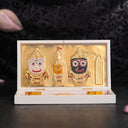
If you keep a Jagannath murti at home, or bring one out for Rath Yatra, that's the thought worth carrying. The trio (Jagannath with Balabhadra and Subhadra) are not incomplete. They were never trying to be complete in the way we mean it. For related reading, our pieces on the mother of Lord Jagannath, the sarathi of Nandighosh, and the Hati Besha follow the same rule: what the text says, what the tradition says, and where the seam between them runs.
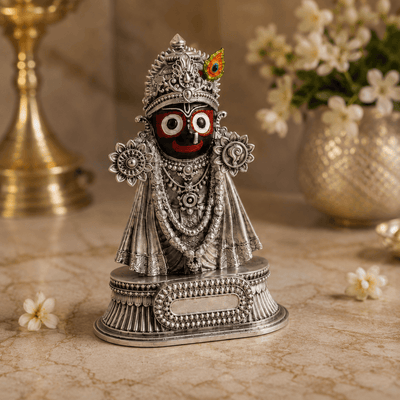
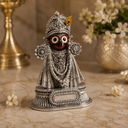
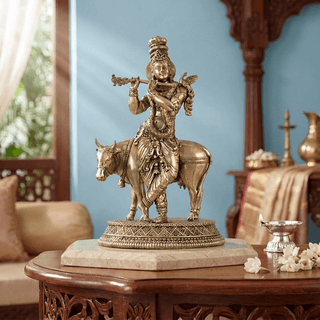
Whether the murti in your home is wood, brass or plated metal, the same logic applies: you are keeping a form, not a portrait. And if you are wondering how the Jagannath form sits inside the larger Vaishnava picture, our piece on the ten avatars of Vishnu and the one asking who the most powerful god in Hinduism is both circle the same question from other directions.
Also read: Why Lord Jagannath Has Big Eyes | Lord Jagannath Rath Yatra Story | Facts About the Jagannath Temple | How Jagannath Puri Comes Alive During Ratha Yatra | 10 Tirumala Temple Secrets