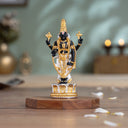
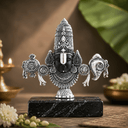
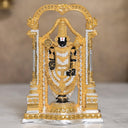
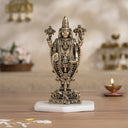
Search "Tirumala temple secrets" and you will get the same nine or ten lines, copied from site to site, none of them with a source attached. A lamp that has burned since forever. An idol that sweats.
The Tirumala Tirupati Devasthanams (the trust that runs the temple) publishes its own legend and its own history on its own website, and neither page mentions most of those famous secrets. What those pages do contain is far more interesting.
So here are ten things about Tirumala that are lesser known and actually sourced, followed by an honest look at the viral ones.
1. The first darshan at Tirumala is not Venkateswara's
According to TTD's own Temple Legend, the Venkata hill did not belong to Srinivasa. This is the one that surprises lifelong devotees. It belonged to Adi Varaha, Vishnu's boar form, who had been there long before.
Srinivasa asked Varaha for a piece of land to live on. Varaha gave it as a gift. TTD states plainly that because the land was Varaha's, the first darshan, the first worship and the first offerings at Tirumala belong to Sri Bhu Varaha Swamy.1
The Varaha shrine sits by the temple tank, and most pilgrims walk straight past it toward the main queue. If you know the story of the Varaha avatar, you already know why he has that right: he is the one who lifted the earth out of the water.
2. The temple runs on a rulebook standardised nine centuries ago
Tirumala follows the Vaikhanasa Agama, one of the two main Vaishnava ritual systems, and the older one. Every seva has a fixed hour, a fixed sequence, a fixed set of hands allowed to touch what.
TTD records that Ramanuja (1017–1137) visited Tirumala three times and streamlined the temple's rituals according to that agama.2 So when you watch a priest work in a particular order at a particular hour, you are watching a procedure locked down about nine hundred years ago.
It is why the temple resists change so stubbornly: the agama is not a preference, it is the operating manual.
3. A god who lived in an anthill and drank a cow's milk
The Tirumala story is not a grand one. In TTD's telling, Srinivasa arrives on the hill alone and takes shelter in an anthill under a tamarind tree. A cow comes daily and empties her milk into the anthill. The cowherd, not knowing what is happening, raises his axe at the cow. And the Lord takes the blow himself.
Only later does the romance start: Padmavati, daughter of Akasa Raja, whom he meets while chasing an elephant. Vakula Devi arranges the match. And then a wedding he cannot afford.
Vishnu's avatars are usually about power: Narasimha tearing through a pillar, the ten avatars arriving to fix something enormous. This one is about a god living in a termite mound, fed by a cow, in love with a local princess. The full sequence is in our piece on who Balaji actually is.
4. Its history is a list of dated gifts, not a mystery
Tirumala is one of the best documented temples in India, because kings kept recording what they gave. People assume its past is unknowable. It is the opposite.
From TTD's own history page: a Pallava queen, Samavai (Perundevi), gifted a silver Bhoga Srinivasa image, which TTD dates to 614 AD. The sanctum walls were built between 1244 and 1250. Saluva Narasimha Raya added pavilions in 1470. Krishnadevaraya's copper statues were installed on 2 January 1517, an exact date, for a temple people describe as timeless. Venkatapatiraya of Chandragiri sent gifts in the 1570s.
Samavai's gift is worth stopping on. It is the best example here of how a real fact and a shaky date travel together.
The record itself is solid. Two inscriptions on the north wall of the first prakara, published with translation in the temple's own Early Inscriptions volume, open: "In the 14th year of the reign of Koppatra-Mahendra-Panmar, I, Samavai alias Kadavan-Perundevi... founded this charity, so as to last as long as the moon and the sun endure." They then itemise what she gave, down to "1 crown containing 23 diamonds, 16 big pearls, 2 big central rubies and 3 cut rubies," along with land, a perpetual lamp, and a festival to run "for nine days."3 A queen, her jewellery, and a nine-day festival, written on a wall.
What the wall does not give is a year. It gives a regnal year (the fourteenth of a king recorded as Koppatra-Mahendra-Panmar) and the whole date depends on who that king was. Sadhu Subrahmanya Sastry, the temple's own epigraphist, argued in a later book that it must be the Pallava Mahendravarman I, which lands the gift in 614 AD. He was candid about the weak point: of the two halves of the prefix, he wrote, "'KO' may mean 'King,' but 'Patra' seems inexplicable. There might be some mistake in the engraving of the name."
T.K.T. Viraraghavacharya, writing TTD's own History of Tirupati, read the same king as Ko-Parthivendravarman, a Chola-period ruler, and dated the endowment to 966 AD instead, roughly 350 years later. Sastry's official epigraphical report also placed it in the third quarter of the tenth century.6
So the queen is real, the jewels are real, and the inscription is real and readable today. The famous 614 AD is one scholar's minority reading, and the temple's own publications disagree with each other about it. We quote TTD's website figure because it is the temple's published number, not because the question is closed.
5. Tirumala has its own scripture, and it is enormous
The hill has its own dedicated text, and very few visitors know it. The Srinivasa story lives in the Venkatachala Mahatmya, which sits inside the Vaishnava Khanda of the Skanda Purana.8
And it is not a chapter. TTD publishes its own edition of the Sri Venkatachala Mahatmyam running to roughly 11,000 verses, compiled across several Puranas.9 TTD's legend page names Varaha, Padma, Garuda, Brahmanda and Markandeya as the sources behind its narrative.
So "the Tirupati story" is really a compilation: many texts, gathered over a long time, around one hill. That is normal for Indian sacred geography, and it is how Puri's Jagannath tradition grew too.
6. The temple keeps two different clocks
TTD's legend page says Srinivasa came to Tirumala five thousand years ago. TTD's history page dates its physical evidence to the medieval period. Both pages are on the same website, and there is no contradiction: they are measuring different things.
Legend-time is the age of the story. Building-time is the age of the stone. A temple can honestly be both: an old narrative housed in a structure a Pallava queen, a Kakatiya-era mason and a Vijayanagara emperor each added to.
A lot of temple arguments online stop being arguments once you see this. Nobody is lying. People are quoting two different clocks at each other.
7. In the oldest version, Lakshmi never storms off
Everyone knows the trigger for the Tirumala story: the sage Bhrigu kicks Vishnu's chest, Lakshmi takes it as an insult to her own seat, and leaves the world in fury. Vishnu comes down to Venkatadri to search for her.
Now read the Bhagavata Purana's account of the same incident, in Canto 10, Chapter 89. Bhrigu (one of Brahma's mind-born sons) does kick Vishnu's chest. But Vishnu and Lakshmi both rise. Vishnu bows, apologises for not noticing the sage's arrival, and tells Bhrigu that his foot has purified the chest he struck.
Lakshmi is not angry. She does not leave. There is no search.7
The furious departure belongs to the Venkatachala Mahatmya, the local text of the hill, not to the Bhagavata. Two real scriptures, telling one incident differently. Neither is fake. The Tirumala version is the later, regional layer, and knowing that makes the story more interesting, not less.
8. The loan from Kubera is real. The interest story is folk belief.
The loan is genuinely in TTD's legend: Srinivasa borrowed heavily from Kubera to pay for his wedding to Padmavati.
What is not in TTD's legend page, or its history page, is the line everyone repeats: that your hundi offering is helping repay that loan with interest until the end of Kali Yuga. It is a beautiful piece of devotional reasoning and millions find it meaningful.
Just call it what it is: folk interpretation, not temple doctrine. Give freely if you want to. The temple has never asked you to do it as debt collection.
9. "Balaji" is a loved name, not a scriptural one
The Puranas and the liturgy call him Venkateswara, Srinivasa, Venkatachalapati, and in Tamil, Tiruvengadamudaiyan. Those are the names in the Mahatmya's own title and on TTD's pages.
"Balaji" is what North and West India began calling him: a warm, familiar name that travelled along pilgrimage routes rather than one you will find in a verse. It is not wrong. It is simply affection rather than scripture, the same way a family name is not a legal one.
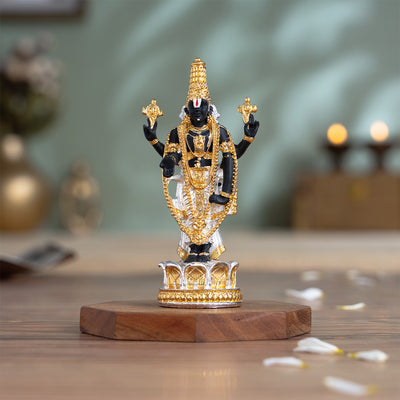
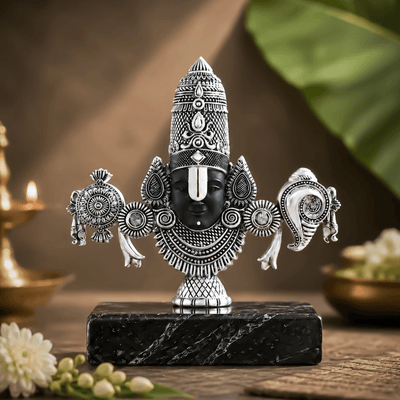
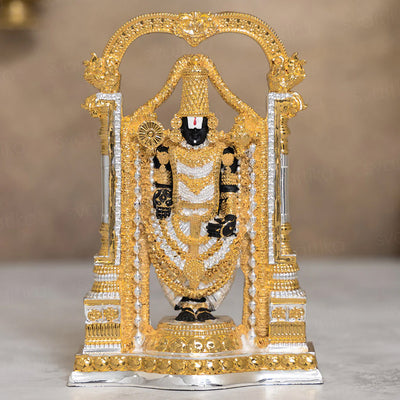
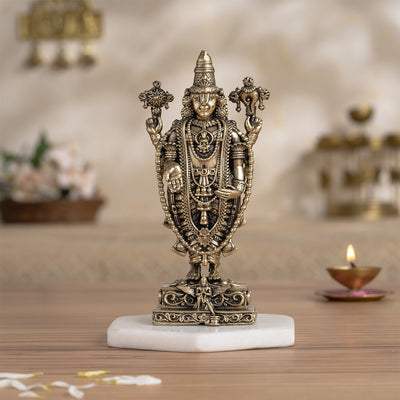
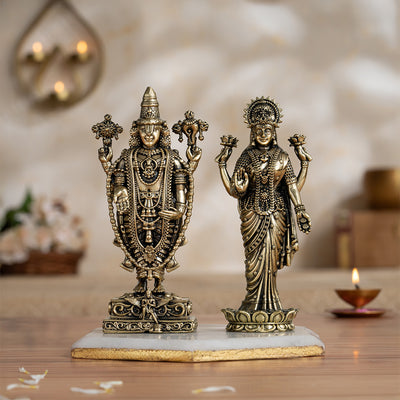
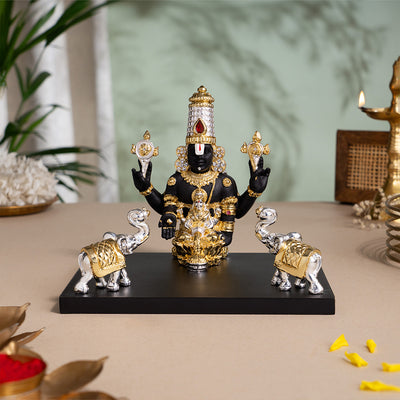
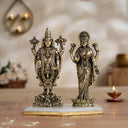
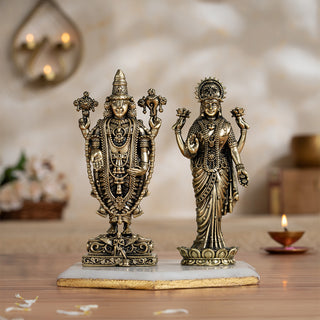
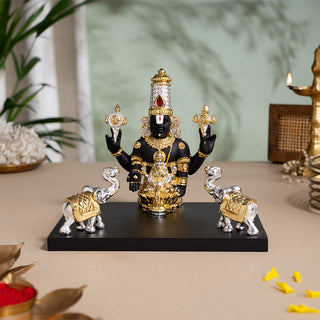
Most homes that keep him keep him by that name too, which is why our Balaji idols carry it. If you are placing a form of Vishnu at home, the standing Vishnu guidance applies here as well.
10. The tonsure is living tradition, and that is not a downgrade
Shaving your head at Tirumala is one of the most moving things you will see anywhere: thousands of people giving up the thing they are most vain about, in a queue, without ceremony.
It is carried by the Neela Devi story and by centuries of unbroken practice rather than by a Puranic verse anyone can point you to. That is worth saying plainly, because "tradition" is not a lesser category. Half of what makes a temple a temple is what people have done there for long enough that it became the rule. The form of Jagannath's eyes works the same way.
The viral secrets, one by one
Now the famous ones. None of these are claimed on TTD's legend or history pages, and none can be verified by anyone outside the sanctum. That does not make the people who share them liars. This is temple lore, and temple lore is its own kind of love.
- The eternal lamp nobody refills. Not claimed by the temple. Unverifiable by design, since nobody outside the ritual staff can watch.
- The village no outsider has entered. Usually told about a settlement that supplies temple materials. There is no temple statement establishing it, and the claim changes shape every retelling.
- The sea you can hear behind the idol. A beloved line. No source, no way to test it.
- The idol that sweats, or bled when struck. Devotional memory. Not in TTD's published legend or history.
- Real hair growing on the murti. Repeated everywhere, sourced nowhere.
- Hundi offerings repaying Kubera with interest. The loan is official. The repayment explanation is not.
- A 5,000-year-old temple building. Legend-time mistaken for building-time: see point 6.
If a claim about any temple has no source and no way to check it, hold it loosely. The documented things are usually stranger anyway, which is the same reason people are still fascinated by which god is considered the most powerful.
What to actually do before you go
Three small things will change your visit.
Find the Bhu Varaha Swamy shrine and go there first. The temple's own legend says that is the order. It takes ten minutes and almost nobody does it.
Read the Bhrigu chapter of the Bhagavata before you climb, so you know the story has more than one version. And look at the walls, the pavilions, the copper figures: those were paid for by named people on known dates, which is a quieter miracle than an unrefilled lamp.
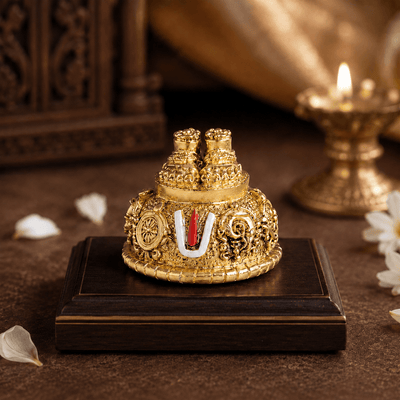
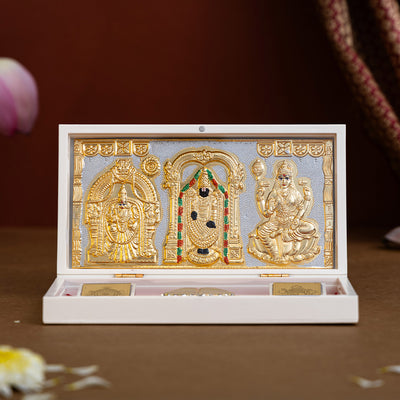
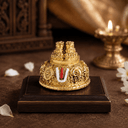
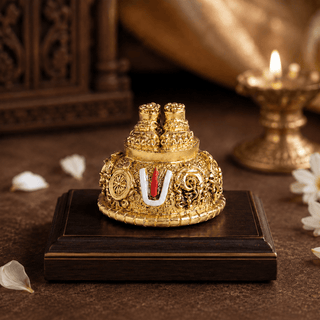
People usually bring something home. A Balaji Charan (the Lord's feet with the Shanku, Chakra and Namam) is the most common, because the whole hill is finally about standing at someone's feet. The same idea runs through the symbolism of divine feet and where charan padukas are placed at home. Our full range sits in charan padukas, alongside the wider Vishnu idols.
Keep it simple. The basics of a pooja room matter more than size, a car dashboard idol needs its own thought (what scripture says about a murti in the car), and marble forms need the right cleaning to last. Vishnu's tradition rewards steadiness over scale, which is the point of the story about his first devotee.
Ten secrets, all of them checkable. The temple wrote most of them down itself.
Also read: Who is Balaji | Varaha Avatar Story | The 10 Avatars of Vishnu | Facts About Jagannath Temple | Can We Keep a Standing Vishnu Idol at Home