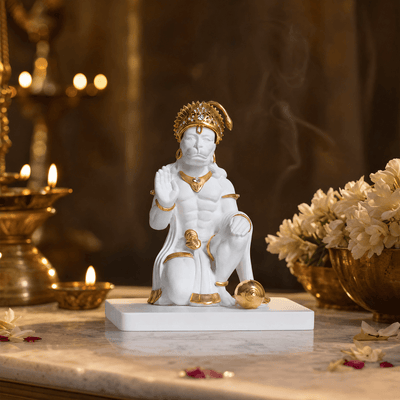
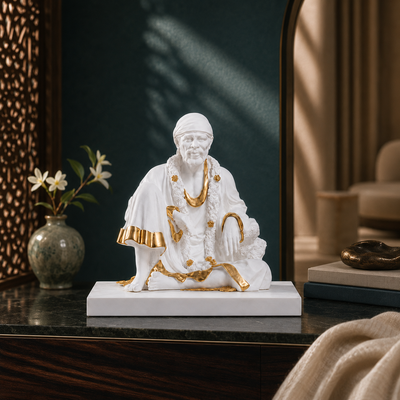
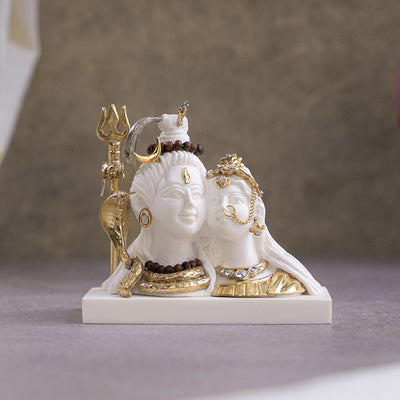
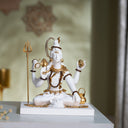
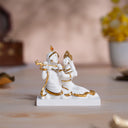
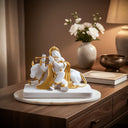
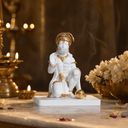
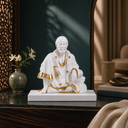
Most of us clean a marble idol the way we clean a bathroom tile. A little lemon for the yellow patches. A pinch of baking soda for the stubborn spot. A scrubber, because it feels like it is working.
That is how marble gets ruined. Not in one go, but slowly, over a few years of Sundays. The idol goes chalky, then dull, and no amount of polishing brings the shine back.
Here is the honest part first. No Hindu text tells you how to clean a marble idol, and that is not a gap in your knowledge. Marble idols in Indian homes are barely a century old. So the useful answers come from stone conservation, and the good news is that stone conservators have written this down very clearly.
What a marble idol is actually made of
Marble is limestone that heat and pressure turned into a harder, crystalline stone. The US National Park Service calls it "crystalline, metamorphic rock" in its guide on abrasive cleaning.2
Chemically it is calcium carbonate. That is the same family as limestone and chalk. Acid dissolves it. Not stains it, not dulls it. Dissolves it.
Preservation Brief 1, which covers cleaning historic masonry, names marble on its short list of acid sensitive stones and says acidic cleaners cause "etching and dissolution of these stones."1
A quick note on honesty. The conservation sources used here are US National Park Service briefs written about buildings and about grave markers in old cemeteries, not about murtis. The stone chemistry carries over exactly. The context does not, and pretending otherwise would be dishonest.
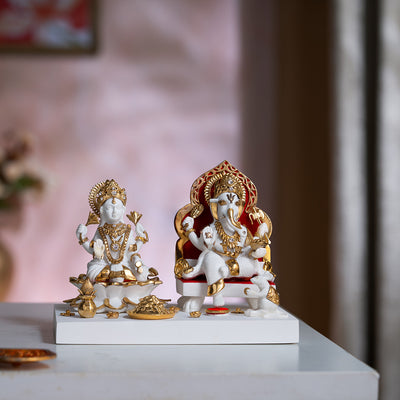
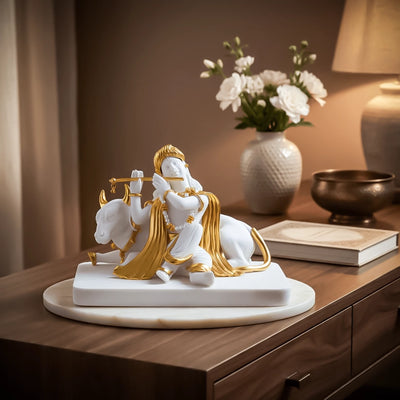
One more thing worth knowing. Many idols sold today, including most of the premium marble dust pieces in Indian homes, are marble dust bound with resin rather than a single carved block. They are softer than quarried marble and take gold or colour on the surface. Conservators call that family cast stone, and Preservation Brief 42 warns that blasting "can seriously damage the surface of the cast stone and should not be used."4 Everything below applies to these pieces too, only more gently.
How to clean a marble idol safely, step by step
The whole method fits in five steps, and four of them are about restraint.
- Dust it dry first. Use a soft dry cloth or a clean, soft brush. Loose dust plus water makes a grey slurry that you then rub into the pores.
- Then use plain water. Brief 1 says outright that "prolonged spraying or misting with water is particularly effective for cleaning limestone and marble." Water is the recommended method, not the weak option.
- For stubborn soiling, a soft natural bristle brush. Brief 48, on grave markers, is exact about this: soft natural bristle brushes are best, and you should "avoid metal bristle brushes or firm nylon brushes."3
- Rinse with clean water. Whatever you loosened has to leave the stone, not dry back into it.
- Dry it properly. A soft cloth, then air. Water left sitting in carved folds is how a rim of grime forms in the first place.
If you ever try anything beyond water, test it on a hidden spot first. The base, the back, somewhere nobody sees during daily worship. That single habit is standard conservation practice and it has saved a lot of stone.
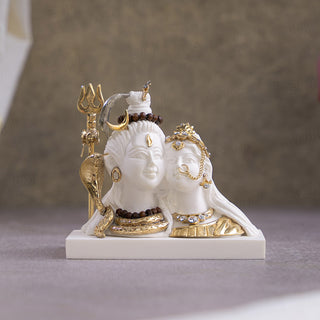
For a gold plated or painted idol, stop at the dry dusting and a barely damp cloth. Plating sits on the surface. Anything that scrubs the stone also scrubs the gold.
What you should never use on marble
Never use acid, bleach, abrasives, pressure washing or sealers. Each has a specific reason, so remember the reason rather than the list.
- Lemon, vinegar, tamarind, any descaler. All acidic. They dissolve calcium carbonate. The dullness you see afterwards is the stone itself, gone.
- Bleach and other alkaline cleaners. Brief 48 says these are "notorious for leaving residual salts that are deposited on the surface," a process called efflorescence. The white haze comes back, and worse.
- Baking soda paste, scouring pads, steel wool. All abrasives. Brief 6 is blunt: polished or honed marble "should never be treated abrasively, as the abrasion would remove the finish in much the way glass would be etched or frosted by such a process." That damage is permanent.
- Pressure washing. Water above roughly 500 to 1,000 psi "can needlessly damage materials," and on a small idol even far less pressure will etch.
- Sealers and shine coatings. This one surprises people. Brief 48 records a coating that "trapped moisture within the stone, eventually resulting in deterioration and surface loss."3 A coat meant to protect the idol can quietly destroy it from inside.
The same caution belongs to everything else on the altar. Brass behaves differently from stone, so a shankh, a lamp and a marble murti should not all get the same treatment on the same cloth.
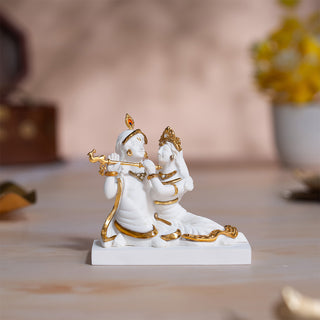
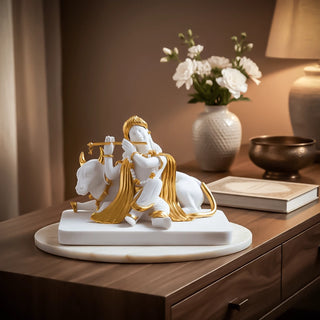
How to remove oil, kumkum and lamp soot stains from marble
Marble is porous. Ghee, oil, turmeric, kumkum and lamp soot sink into it. Once a stain is inside the stone, scrubbing the surface cannot reach it. What works is a poultice, which pulls the stain back out.
That is reasoning from porosity, not a finding quoted from the conservation briefs, so treat it as sensible practice rather than a rule someone tested.
- Mix a white absorbent clay, such as kaolin, with water into a thick paste.
- Spread it over the stain and slightly past its edges.
- Cover it so it does not dry too fast, and leave it about 24 hours.
- Let it dry out fully, then lift it off and rinse.
Brief 48 describes exactly this: the clay draws the stain out, and the treatment stays on the surface for a day. It may need a second round. That is normal, and a second slow round is still gentler than one hard scrub.
Prevention beats all of it. Keep the lamp far enough from the idol that soot does not settle on it, and keep the tilak thali off the stone itself. Those two changes matter more than any cleaning method, and they follow from how people arrange a pooja room in the first place.
Why cleaning less is the professional rule
Conservators have a phrase for their whole approach: first do no harm, and use the gentlest means possible.
Brief 6 explains why in one sentence. "It is generally preferable to underclean, as too strong a cleaning procedure will erode the stone, exposing a new and increased surface area to collect atmospheric moisture and dirt."2
Read that again, because it flips how most people think. A hard clean does not leave the idol cleaner for longer. It leaves a rougher surface that gets dirty faster. Then you scrub again, and the loop tightens.
The same brief notes that stones weather faster once their protective quarry crust or patina is removed. There is a thin outer skin doing real work, and it does not grow back.
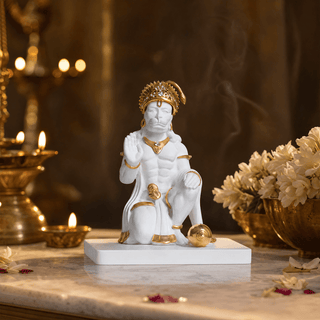
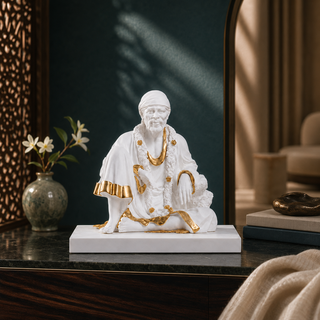
What tradition actually says about bathing an idol
The tradition never meant the installed stone image to be bathed daily. It made a second image for that job. So if abhisheka is scriptural, why be careful with water, milk and honey?
The Agamas, the ritual manuals that govern temple worship, answer it in a way most of us never hear. T. A. Gopinatha Rao, in his 1914 study of Hindu iconography, sets out the classes of images. The permanently installed stone image in the sanctum is the mula vigraha or dhruva bera. It stays fixed.
Alongside it sits a separate small image called the snapana bera, kept specifically, in Rao's words, "for the purpose of offering the bath."5
Rao also records that smearing images with oil is "comparatively a recent practice."
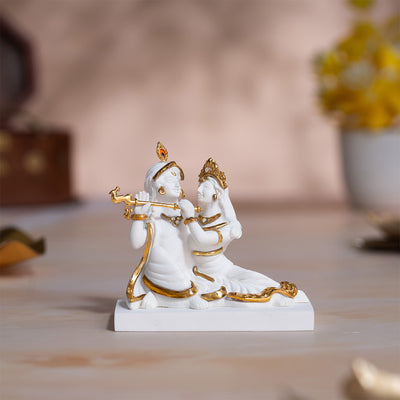
Rao then describes the "modern marble images of Krishna and Radha, of Vishnu and Lakshmi, of Ganesa and other gods and goddesses offered in the bazaars for sale" as a recent development, spreading in Rajputana, Central India and the Bombay Presidency under Western influence.
He wrote that in 1914. A marble Radha Krishna murti of the kind he was describing has been in Indian homes for roughly a century, no longer. That is why no ancient text has a rule for it, and why anyone quoting you one is inventing it. If the pairing itself interests you, we have written separately on why Krishna did not marry Radha and on how to decorate a Krishna idol at home.
Three things people get wrong about cleaning marble idols
"Lemon or vinegar will make it white again." It will make it lighter for a day and thinner forever. Marble is on the conservator's acid sensitive list, and the result is etching and dissolution. This is the single most common mistake, and it is the least reversible.
"Baking soda is gentle." Baking soda is an abrasive, just a fine one. On a polished or gold plated murti it frosts the finish the way sandblasting frosts glass. Gentle means soft bristles and water, not a milder grit.
"A sealer will protect it." Coatings trap moisture inside stone, and trapped moisture causes surface loss. An uncoated idol that is dusted often and washed rarely will outlast a coated one by a wide margin.
Chips, cracks and darkening: when to stop
If your idol has darkened evenly over many years, that is often patina, not dirt. Removing it removes the quarry crust, and the stone then weathers faster than before. Age on stone is usually worth keeping.
If there is a crack or a chip, water is the risk. Water gets into a crack, sits there, and widens it. Keep a damaged idol dry, dust it only, and do not try to glue a broken piece with whatever is in the drawer. A visible bead of hard glue is much harder to undo than a clean break.
If an idol is broken past repair, most families choose visarjan in flowing water or in earth rather than a bin. The practical questions there are the same ones people ask about immersing a Ganesh idol at home, and resin bonded marble dust should go into earth, never into a lake.
A simple routine that actually works
Weekly, dust dry with a soft cloth. Monthly, a barely damp cloth on the plain surfaces and a soft brush in the carving. Once or twice a year, a proper wash with plain water if the piece is solid and undamaged, then a full dry.
That is it. Nothing in the routine costs anything, and nothing in it can hurt the stone.
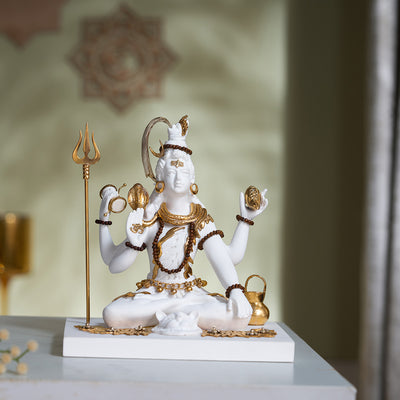
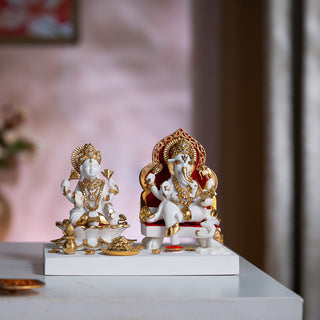
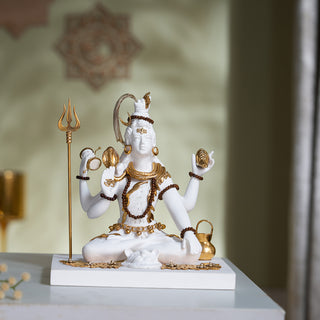
Where the idol sits changes how often you will need any of this. A murti near a window that catches dust and sun needs more care than one inside a closed home mandir. The same logic decides where a Ganesh Lakshmi pair sits, whether a Shiva statue belongs at home, and which Ganesha idol suits a house.
Car dashboards are the hardest place of all for marble, because of heat and vibration, which is why car dashboard idols are usually chosen in metal rather than stone. If that is where yours lives, read what scripture says about a murti in the car and how to fix an idol safely before you worry about cleaning it.
Cleaning an idol is care, not correction. The aim is to keep it as it is, for as long as possible, and a well made murti asks for very little.
Also read: Things to Keep in Pooja Room | Why Tulsi is Not Offered to Ganesha | Where to Place Laxmi Charan Paduka | Which Hanuman Idol is Good for Home | Can We Keep a Standing Vishnu Idol at Home