Search "Jagannath temple facts" and you get the same nine or ten lines everywhere. No bird flies over the dome. The temple casts no shadow. The flag flies against the wind. They are repeated so confidently that nobody stops to ask where they come from.
So I went looking, in the Skanda Purana's Purushottama Kshetra Mahatmya, the oldest sustained Puranic account of Puri, and in the Shree Jagannatha Temple Administration's own pages, written by the people who run the place. Almost none of the viral facts are there. What is there is far stranger.
Here are ten facts about the Jagannath temple that come from the records themselves, and then the three famous ones I could not trace to a single source.
1. The temple has a completion date, and it is 1230 AD
The Temple Administration's own history page says plainly that the present temple was built in the 12th century AD by King Anantavarman Chodaganga Deva, and that Anangabhima Deva III "completed the temple in 1230 AD and installed the Deities."2
Not "lost in the mists of time." A king, a century, a year.
The administration is also careful about how far back the cult itself goes. Its historical background page says reliable historical material is available only from the 9th century AD onward, beginning with Shankaracharya's visit and the founding of the Govardhana Matha. Attempts to push Jagannath back to King Kharavela in the 2nd century BC exist, but the page says the success those attempts have achieved is "almost negligible."3 A temple website that tells you its own antiquity claims are weak is rare enough to be worth noticing.
2. The building is four buildings
The temple has four component parts, each with a job: the Vimana or Deula, the tower over the sanctum; the Jagamohana, the assembly hall; the Natamandapa, the dancing hall; and the Bhogamandapa, the hall of offerings. The style combines the Rekha and Pidha forms of Odishan architecture, with the Vimana on a pancharatha ground plan.4
If the Puri skyline looks like several temples stacked into one, that is because it is. Several halls, joined along a single axis.
3. The gods are made of wood, and the wood is the theology
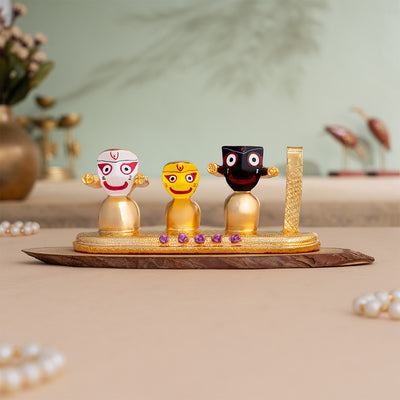
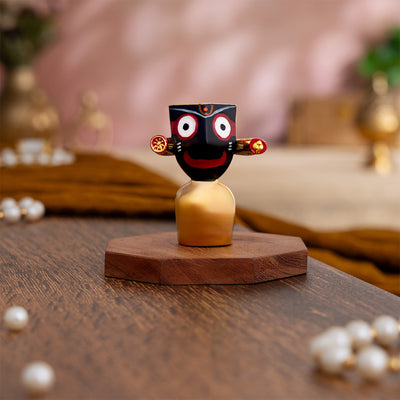
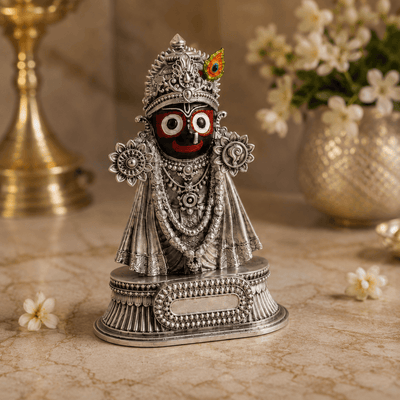
Jagannath, Balabhadra and Subhadra are not stone and not metal. They are carved from margosa, the neem tree, and the temple calls the material Daru Brahma. Daru means wood. Brahma is the all-pervading soul. The temple splits the word further for devotees: Da, the bestower of bliss, and Ru, the remover of sorrow.
This is also why the form looks like nothing else in Hinduism. The armless, wide-eyed shape has produced a whole literature of explanations: see why Jagannath has no hands and why his eyes are so large. The short version: the popular carpenter-interrupted story is Puri tradition rather than Puranic text, and no scripture describes the eyes at all.

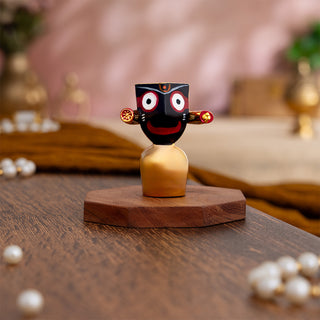
4. The deities are replaced, and the old ones are buried
In the Nabakalebara rite the wooden images are not repaired or repainted. They are remade. The temple says it "occurs once at intervals of 8, 11, 12 and 19 years," following the calendar rather than the condition of the wood. A party of servitors goes out on the Banjara Yatra to find four neem trees carrying the prescribed Daru characteristics. Biswakarma Maharana carpenters carve the new bodies under the guidance of the Daitapati servitors.
Then the old deities are buried at Koili Baikuntha, in a rite called Patali.5
The gods have funerals. Most temples treat the installed image as permanent and its damage as a crisis. Puri built impermanence into the calendar. If you keep a Jagannath murti at home, that is worth sitting with. This is one of the very few forms in India meant to be born, worn out and returned to the earth.
5. There is a sealed casket inside the idol and nobody will say what it holds
During Nabakalebara one thing moves from the old body to the new: the Brahma Padartha, the life substance. It is transferred at night, on the fourteenth day of the dark fortnight of Ashadha, by blindfolded servitors.
The temple's own page on Daru Brahma describes a cavity in the image holding a casket "containing something unknown." Then it does something I did not expect from a temple website. It lists four competing theories about what is inside: a tooth of the Buddha, an image of Vishnu, a Salagrama shila, or a piece of the bone of the Krishna incarnation.6
That last theory keeps Puri tangled up with the end of the Mahabharata, and we followed it in what happened to Krishna's body after his death. The Buddha-tooth theory is why Puri turns up in arguments about Buddhism being absorbed into Vaishnavism, which touches even what the Buddha actually preached.
Four theories on an official page means the honest answer is that nobody knows. Which is better than any of the four.
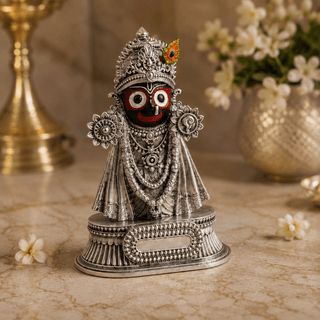
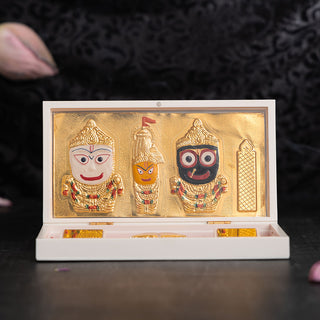
6. There are not three deities at Puri
Everyone pictures three: Jagannath, Balabhadra, Subhadra. Puri's own count is higher, and it varies depending on which page you read.
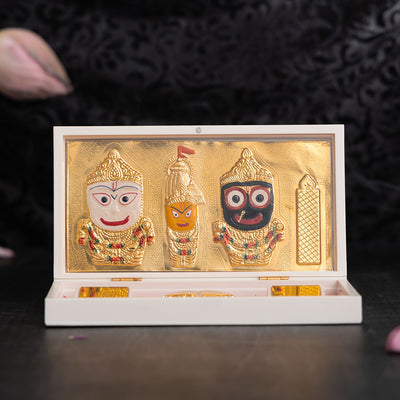
The origin legend describes four images being carved, adding Sudarshana, the personified discus. The Nabakalebara page speaks of five wooden idols being replaced. The FAQ page lists Jagannatha, Balabhadra, Subhadra, Chakra Sudarshan, Bhudevi, Sridevi and Madhaba as the deities worshipped. And the Skanda Purana itself counts Sudarshana among "these four forms of Lord Vishnu."1
Sudarshana here is the same chakra whose origin we traced in who gave the Sudarshan Chakra to Krishna. At Puri it is not a weapon in a hand. It is a person, with its own pillar of wood and its own place in the procession.
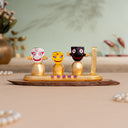
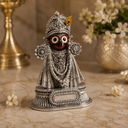
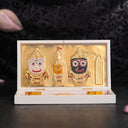
The trio everyone photographs is real, but it is a crop of a larger family. A Jagannath, Balabhadra and Subhadra murti set at home follows the same convention the postcards do. Nothing wrong with that, as long as you know the sanctum holds more.
7. The siblings do not share a mother
People assume the three are siblings in the ordinary sense. The texts do not support that neatly.
In the Bhagavata Purana, Krishna is born to Devaki and raised by Yashoda, and the two women are kept carefully distinct. Balarama's mother is Rohini. The Bhagavata has his embryo transferred from Devaki's womb to hers while she lived in seclusion in Vraja. The Mahabharata calls Subhadra "the uterine sister of Sarana," and the Bhagavata lists Sarana among Rohini's sons, which points to Rohini as her mother too.11
So, read strictly, three different origins on three chariots. And at Puri the whole question dissolves anyway, because the Skanda Purana identifies Subhadra as a birth of Lakshmi and Balabhadra as a form of Ananta, and the images come from a log of wood rather than from any womb. We took the full genealogy apart in who is the mother of Lord Jagannath.
8. Once a year the gods fall ill
Once a year the gods fall ill and darshan stops for 15 days. It begins with a bath. On the full moon of Jyestha, at the Snana Vedi, the deities are bathed with 108 pitchers of water mixed with sandalwood paste, camphor and incense. That is the Snana Yatra.8 They are then adorned with elephant masks in the Gaja Besha, the day Odias call Hati Besha, which we covered as the story of Hati Besha.
And then they get sick. The temple's FAQ says it without a trace of metaphor: "After this the Gods fall ill. So darshan is not possible for 15 days."
That fortnight is Anasara. The deities go behind a screen, only the Daitas and Patis are allowed in, and the rest of Puri waits. The elephant face is the last thing anyone sees before the doors shut. Then, on Ashadha Shukla Dwitiya, they come back out and climb onto the chariots.
9. The chariots keep a proportion the Purana already knew
Nandighosa carries Jagannath: 45 feet, 16 wheels, red and yellow cloth, dark horses. Taladhwaja carries Balabhadra: 44 feet, 14 wheels, red and blue, white horses. Darpadalana carries Subhadra: 43 feet, 12 wheels, red and black, red horses.9
Now the good part. The Skanda Purana, describing the festival centuries ago, gives Jagannath's chariot as sixteen arms and Balarama's as fourteen. The same 16 to 14 ratio survives today in the wheel counts. Whatever else has changed at Puri, the proportion has not.
One correction, because it is the most repeated error in this subject. The charioteer of Nandighosa is Matali, not Daruka. The Odisha government's Rath Jatra portal states it flatly: the charioteers of Jagannatha, Balabhadra and Subhadra are Matali, Daruka and Arjuna respectively, and the Temple Administration agrees. The confusion is honestly earned. Daruka is Krishna's own charioteer in the epics and Matali is Indra's, so the swap feels right. Puri does not follow that logic. Both sides are laid out in who is the sarathi of the Nandighosh rath.
If the festival brought you here, the full narrative sits in the Rath Yatra story, the reasoning in why Rath Yatra is celebrated, and what the town feels like in how Puri comes alive during Ratha Yatra. Our Rath Yatra collection is built around that week.
10. The temple says Jagannath began as a tribal god
The Temple Administration says so on its own culture page. This is often presented online as a scholar's provocation, and it is not: "Jagannatha was originally a deity of the aboriginal tribes and was known as Nila Madhava, his image being made of some sort of blue stone."7
The same page says all the major cults of India were assimilated into the texture of Jagannathaism. The Purana keeps the memory too, in Visvavasu, the Savara chief who worshipped Nila Madhava in the forest before any king arrived.
So the deity people queue for today is a forest god, a Vaishnava theology and a royal temple settling into one wooden form. In practice he is Vishnu, which is why he belongs beside the ten avatars of Vishnu and among Vishnu idols generally. But his face never stopped remembering where it came from.
Three famous facts I could not source anywhere
The bird, the shadow and the flag appear in no record I could find. I am not saying they are false. I am saying I read the Skanda Purana's Purushottama Kshetra Mahatmya and the Temple Administration's history, architecture, culture, festival and FAQ pages, and none of them mention any of these.
- "No bird ever flies over the temple." Not in the Purana. Not on any temple page. It is a claim about observable physics that no institution appears to make.
- "The main dome casts no shadow." Same. Absent everywhere I looked.
- "The flag always flies against the wind." Same again. The flag is real and the daily climb to change it is real. The wind claim has no record behind it, and we took that one apart on its own in does the Jagannath temple flag fly against the wind? That piece also covers what the Archaeological Survey actually asked the temple to do about it.
Two more corrections while the broom is out. The carpenter of the origin legend is usually named as Vishwakarma, but the Purana leaves him anonymous and Puri's own theology says he "was none other than the Supreme Lord Himself." And Gundicha, in the popular telling, has quietly become Jagannath's aunt. In the Skanda Purana, Gundicha is not a person at all but a mandapa, a pavilion. In Puri's legend, she is Queen Gundicha, King Indradyumna's wife, the one who opened the door too early. The aunt belongs to a different shrine on the Grand Road altogether, Mausi Maa, where the poda pitha is offered.
Temples collect stories the way old houses collect furniture. That is not a scandal. It only becomes a problem when tradition gets dressed up as scripture, because then a reader who checks feels lied to, and stops trusting the real material as well.
What is actually worth being amazed by
A temple with a completion date of 1230 AD. Gods made of a tree, remade every dozen years or so, and buried when their term ends. A sealed casket that the institution guarding it will only describe as four possibilities.
None of that needs a bird that will not fly or a shadow that will not fall.
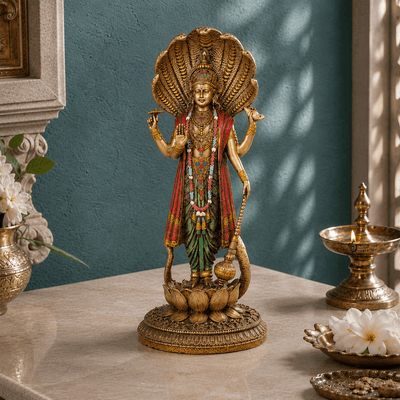
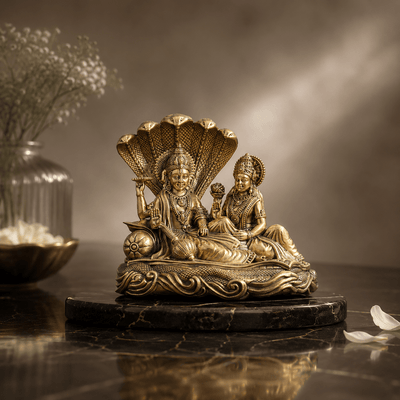
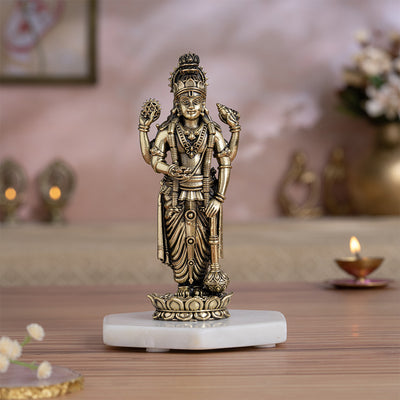
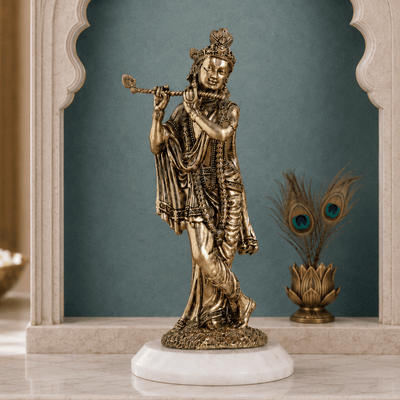
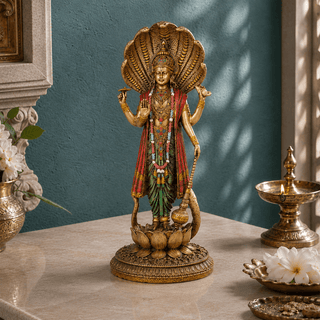
If you keep a Puri form at home, how to clean an idol at home covers the safe routine, and the placement rules are the same ones that apply to a standing Vishnu idol at home. If daily puja is the habit, how to worship Lord Krishna will feel familiar, since at Puri that is exactly who he is.
If you enjoy this kind of checking, the Tirumala temple secrets piece does the same work on another pilgrimage site.
Also read: Why Jagannath Has No Hands | Why Lord Jagannath Has Big Eyes | Lord Jagannath Rath Yatra Story | Who Is the Sarathi of Nandighosh Rath | Who Is the Mother of Lord Jagannath | Balarama Avatar of Vishnu: Eighth, Not Ninth