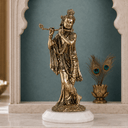
Here is the strange thing about the most famous love story in India. If you open the Bhagavata Purana (the text that gives us Krishna's childhood, the butter, the flute, the rasa dance, all of it) and go looking for Radha, you will not find her. Not once. The name does not appear.4
That is not a gap someone forgot to fill. It is the starting point of the real answer.
The day he left, and what he actually said
Akrura arrives in Vrindavan with a chariot and a summons from Mathura. Krishna and Balarama get on it. The cowherd women run after it.
Most retellings put a promise in Krishna's mouth here: that he would come back, that this was temporary. The verse does not. At Bhagavata Purana 10.39.35, everything he offers them amounts to a single careful line: he will do his best. That is it. Two verses later, at 10.39.37, the text says flatly that they were left without the hope of ever seeing him back.
That is the honest hinge of the story. The Bhagavata does not soften the departure or hand the gopis a return date. It tells you they lost him, and lets that sit.
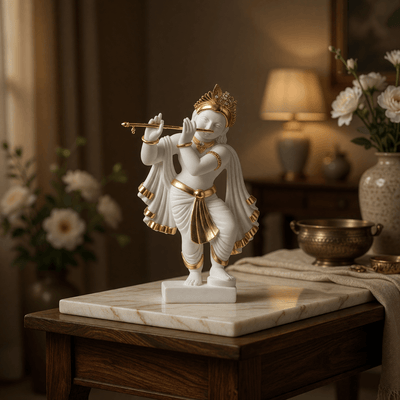
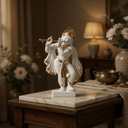
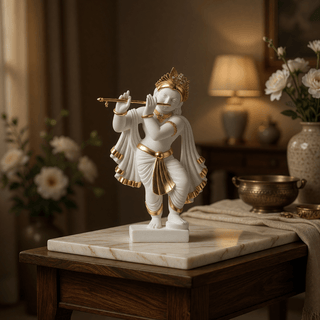
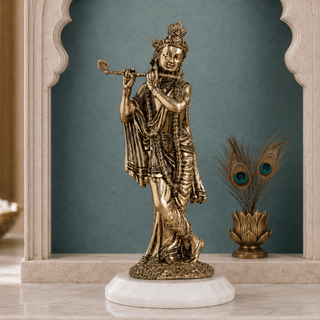
And he does not go back. Not in the next chapter, not in the next canto. Krishna's life after Vrindavan is Mathura, then Dwarka, then Kurukshetra: a king, a diplomat, a charioteer, a teacher. The boy with the flute simply does not reappear in that landscape. If you have ever wondered where Krishna's flute went, this is your answer too: the flute belongs to Vrindavan, and he left Vrindavan.
So who is the woman the texts do describe?
The Bhagavata gives us two moments where later tradition confidently says "that is Radha," and in both, the Sanskrit says something much quieter.
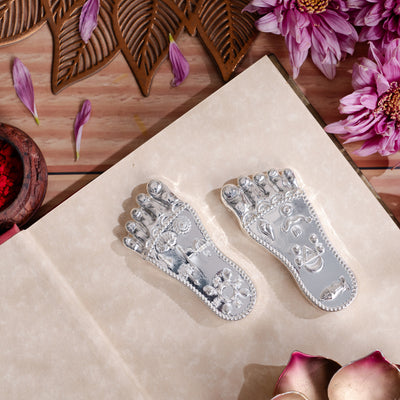
The first is at 10.30.26. The gopis are searching the forest and find Krishna's footprints, which they recognise by the marks on his soles: the flag, the lotus, the thunderbolt, the barleycorn, the elephant goad (10.30.25). Then they notice a second set of footprints beside his. One gopi, they realise, was taken aside and specially favoured. She is never named.
The second is at 10.47.11, where a gopi speaks bitterly and beautifully to a honeybee, using it as a stand-in for the absent Krishna. In honest English editions you will see the name "Radha" printed there inside square brackets. Brackets, in a translation, mean the translator supplied it. The verse says gopi.
The Vishnu Purana (older, drier, less devotional) does the same thing. H. H. Wilson's translation covers the rasa dance in Book V without naming a single gopi. Radha is not in that text either.6
None of this makes Radha less real to the tradition. It just means her name arrives later, and from other books. The Brahma Vaivarta Purana and the Padma Purana carry it.7 So, above all, does Jayadeva's twelfth-century Sanskrit poem the Gita Govinda, which is the work that made her a household name across India. If you want the fuller argument about why the marriage question also has no scriptural answer, we went through it in why Krishna didn't marry Radha.
Uddhava is sent, and comes back changed
Krishna does one thing for the women of Vraj after he leaves. He sends a messenger.
Uddhava is a Yadava prince, sharp, philosophically trained, the kind of person you send when you need something explained properly. He arrives in Vrindavan with Krishna's message, and the message is not an apology. It is metaphysics.
भवतीनां वियोगो मे न हि सर्वात्मना क्वचित्।
यथा भूतानि भूतेषु खं वाय्वग्निर्जलं मही।
तथाहं च मनःप्राणभूतेन्द्रियगुणाश्रयः॥In plain English: You are never separated from me, in any way at all. Just as space, air, fire, water and earth sit inside every living thing, so I am there in your mind, your breath and your senses.
Bhagavata Purana 10.47.29
And then, at 10.47.34, Krishna says the part that answers this article's title more directly than anything else in scripture: the distance is deliberate. He is far from their eyes so that their minds stay on him. Absence, in his own account, is not a failure of the love story. It is the method.
You can find that cold. Plenty of readers do. But notice what happens to Uddhava. The man sent to console the gopis ends the episode saying he would happily be reborn as any bush, creeper or herb in Vrindavan, just to be dusted by the feet of these women (10.47.61 and 10.47.63). The consoler leaves envying the consoled. The Bhagavata rarely ranks its characters so openly, and here it does. The unlettered cowherd women of Vraj are placed above a prince who understands everything.
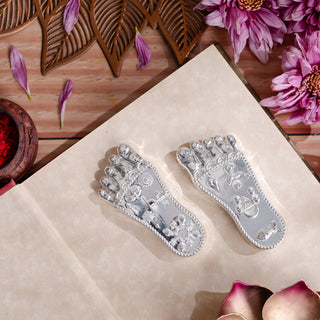
That is also why a household Krishna charan paduka is not a decorative object in Indian homes. Feet, in this tradition, are what you touch when you accept someone's authority over you. The dust of a devotee's feet outranks a philosopher's argument. We wrote about that image in detail in the sacred lotus feet of Krishna.
One meeting, many years later, in an eclipse
There is exactly one reunion in the Bhagavata, and almost nobody talks about it.
A total solar eclipse draws all of India to Samanta-panchaka, the field also called Kurukshetra. Krishna comes from Dwarka. Nanda and the cowherds come from Vraj (10.82.31–35). The women of Vrindavan come too, and they and Krishna meet again after decades (10.82.39–46).
It is not a romantic scene. Krishna's answer is the one Uddhava carried: separation was his own arrangement, and he is present in all beings. Then everyone goes home. No gopi is named here either, and he never returns to Vrindavan.
Compare that with how carefully the same scripture records Krishna's own end: the hunter Jara mistaking his lotus-red foot for a deer's face, the arrow, the forgiveness (11.30.33 and 11.30.39). We covered it in what happened to Krishna's body after his death. The asymmetry is the point. The tradition wrote down his ending in detail and declined to write hers.
Three things people get wrong about this
1. "Radha died in Krishna's arms in Dwarka, and he broke his flute"
This story is everywhere, and it is not in any Purana, any epic, or any classical Sanskrit poem. There is no Dwarka deathbed, no final flute recital, no broken bamboo. The Gita Govinda (the text most responsible for Radha's fame) has no death scene for her at all.8 It is a modern devotional retelling, and it is genuinely lovely, but it is not scripture and should never be cited as one. There is more on this in how did Radha die.
2. "Krishna promised to come back"
He said he would do his best (10.39.35). That is the whole promise. The narrator then tells us the gopis were left without hope of seeing him again (10.39.37). Everything warmer than that was added by people who found the verse too hard.
3. "Radha was older than Krishna, by five years or eleven"
No primary text gives an age gap, or any comparison of their ages at all. The only two numbers in scripture describe her divine form, not her birthday, and they contradict each other: the Brahma Vaivarta Purana calls her sixteen in Goloka, the Padma Purana says she assumed a form resembling a girl of fourteen. We unpacked that in was Radha older than Krishna.
None of these three corrections are meant to take anything away. Popular tradition fills silences because silences are hard to live with, and the fillings are often beautiful. They just are not evidence.
The answer the older theology gives
There is one text where "what happened to Radha after Krishna left" is not even a valid question.
In the Brahma Vaivarta Purana's Brahma-khanda, chapter 5, Radha emerges from the left side of Krishna's own body in Goloka. She is not a village girl who fell in love with a visiting god. She is his own energy, personified: his shakti. In that framework there is no separation to survive, because there was never a division to begin with.
The Padma Purana adds another surprise. In the chapter that establishes Radha Ashtami, Radha is not born from a womb at all. She appears, with a divine form, on the sacrificial ground of the cowherd Vrishabhanu, who was clearing the earth for a yajna and found her there.9 He raised her as his daughter.
So the record has three incompatible origins for her: daughter of Vrishabhanu and Kalavati, found on a sacrificial ground, or emerged from Krishna's left side. That is not a mess to be tidied up. It is what an honestly reported tradition looks like when several communities loved the same figure and remembered her differently. The same thing happens with Krishna's own father, where scripture holds a biological father, a foster father and a cosmic one at once, and never ranks them.
Why the blank is the better story
Every SEO page on this question fills the silence: with a reunion, a death, a curse, a reincarnation. The texts leave it open on purpose, and then Krishna explains why: you were never separated from me.
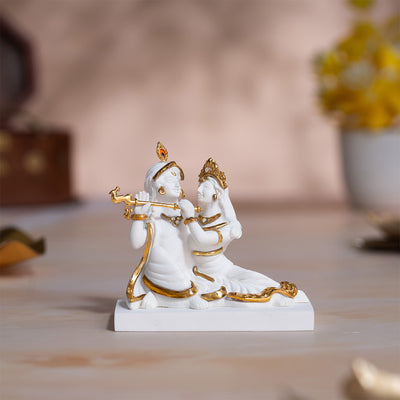
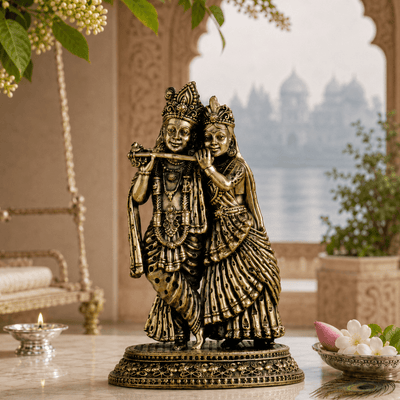
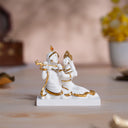
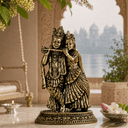
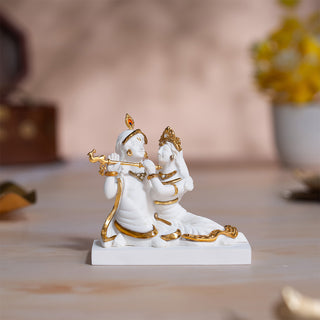
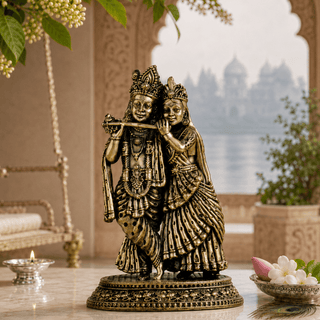
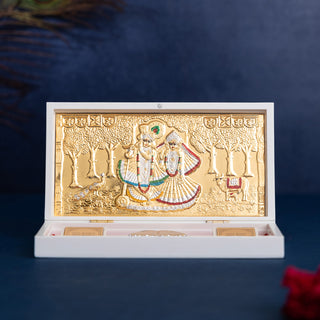
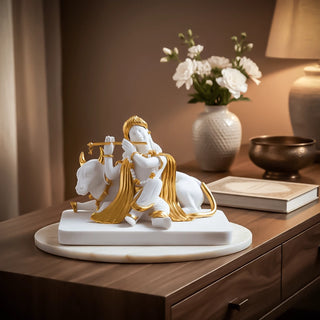
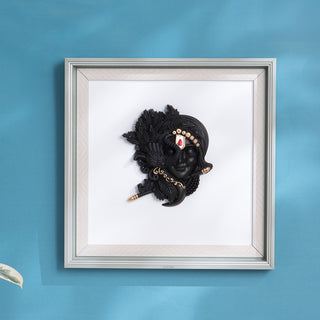
That is the reason Radha and Krishna are worshipped together in Indian homes as one image rather than as a couple with a history. A Radha Krishna murti on a shelf is not commemorating a romance that ended. It is stating that the two were never two. The devotional grammar of the whole thing (the Krishna mantras, the simple home worship of a leaf, a flower, fruit and water, the way people dress a Krishna idol at home) runs on presence, not on reunion.
And that is also why Vrindavan itself never let him go. Krishna's later life gave the world the Gita, the Sudarshan chakra, the politics of Kurukshetra, the friendship recorded in Krishna and Sudama, and a household in Dwarka. Vrindavan kept the flute, the cows, and the women who refused to stop remembering him. When Janmashtami comes around and homes are decorated with mango-leaf torans and tiny painted footprints, it is Vrindavan's Krishna being invited in, not Dwarka's king.
The short version
What happened to Radha after Krishna left Vrindavan? The oldest texts do not say, because they do not name her. What they record is this. The women of Vraj grieved. A messenger told them the separation was intentional, and in some sense unreal. They met Krishna once more under an eclipsed sun, many years later. And that same messenger went home calling them the highest devotees in the story.
Krishna never went back. That is the honest answer, and it has held up for two thousand years without needing a better ending.
Also read: How Did Radha Die | Why Krishna Didn't Marry Radha | Where is Krishna's Flute Now | Why Radha Ashtami is Celebrated | What Happened to Krishna's Body After His Death
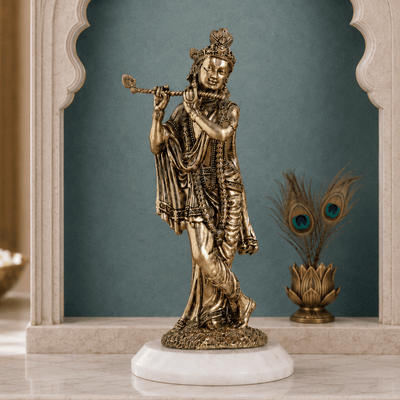
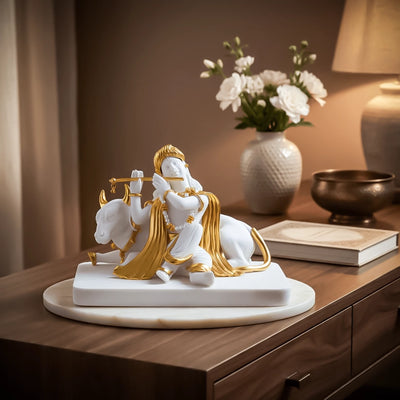
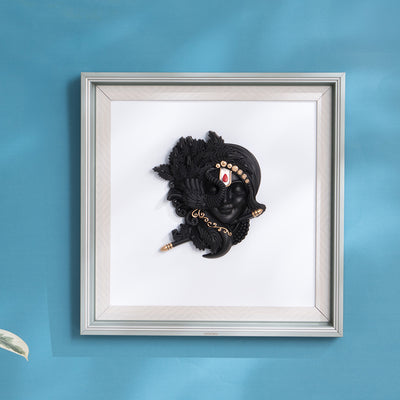
Browse the Krishna idols and charan padukas collections if you are setting up a Krishna corner at home.