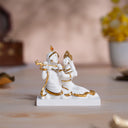
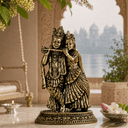
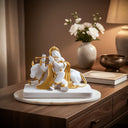
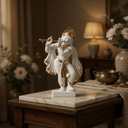
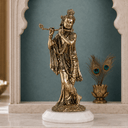
I went looking for the verse. That is really all this article is: a record of where I looked and what was there.
Search this question online and you find a very specific story told with great confidence. Radha, old now, comes to Dwarka. Krishna does not recognise her, or she serves quietly in the palace, or she wanders the streets. At the end he plays the flute one last time, she dies listening to it, and he snaps the bamboo in half and never plays again.
It is a beautiful story. Millions hold it dearly. It is also not in any primary text, and saying so plainly is more respectful than pretending otherwise.
The short answer: the texts are silent, and the silence is deliberate
Radha is not named anywhere in the Bhagavata Purana, the single most important scriptural source for Krishna's life.
There are two famous places where English editions print her name. At 10.30.26, when the gopis find a second set of footprints beside Krishna's and realise one of them has been taken aside. And at 10.47.11, where a gopi speaks bitterly to a honeybee. In both places the Sanskrit says only gopi, or "a certain one."1 Honest translations put "Radha" in square brackets, because it is the translator's identification, not the text's.
The Vishnu Purana, which is older and more sober, is the same. H. H. Wilson's translation covers the whole Vrindavan life including the rasa dance in Book V, chapter 13, and does not name a single gopi.7
So the Bhagavata says nothing about Radha's death because it says nothing about Radha at all. This is the same reason the texts go quiet about what happened to Radha after Krishna left Vrindavan: there is no named character to follow.
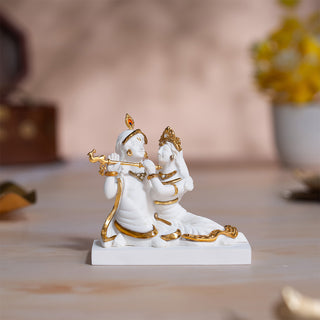
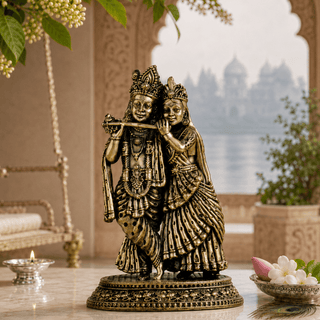
Where exactly I looked
Proving absence takes more care than proving presence, so here is the full list.
- Bhagavata Purana, Cantos 10 and 11: the entire Krishna narrative from birth to departure. The name does not appear. Krishna's own death is narrated in detail at 11.30. No woman of Vraj is given a death scene.
- Vishnu Purana, Book V (Wilson's translation): Vrindavan, the rasa dance, Mathura, Dwarka. No Radha.
- Gita Govinda, Jayadeva's 12th-century Sanskrit poem, in Edwin Arnold's 1875 translation. Radha is the whole subject here. She is never called Krishna's wife, she is never given an age, and there is no death scene. The poem ends in reunion, not loss.
- Padma Purana: the Radha material sits in Brahma-khanda chapter 7 and Patala-khanda chapter 71. Both are about her appearance and her festival. Neither describes an end.
- Brahma Vaivarta Purana, Brahma-khanda chapter 5: the fullest Puranic account of who Radha is. It answers the question in a way I will come to below.
Five major sources, and not one death scene between them. That is not an oversight. Sanskrit texts narrate deaths readily. The Mahabharata describes hundreds, and the Bhagavata gives Krishna's own last hour in close detail.
What the Bhagavata actually says about the women of Vraj
When Akrura's chariot comes to take Krishna to Mathura, he makes no promise to return. At 10.39.35 his entire message to the gopis is that he will do his best. Two verses later the text says flatly that they were left without the hope of ever seeing him back.2
He does not return. Most retellings quietly fix that. The Bhagavata records exactly one later meeting: at Samanta-panchaka, which we call Kurukshetra, during a solar eclipse, many years on (10.82.39–46).4 Nanda and the cowherds come too. No gopi is named. Krishna does not stay.
Before that, he sends Uddhava to Vrindavan as a messenger. The gopis are not comforted. And Krishna's message, when Uddhava delivers it, is not romantic at all:
भवतीनां वियोगो मे न हि सर्वात्मना क्वचित्।
यथा भूतानि भूतेषु खं वाय्वग्निर्जलं मही।
तथाहं च मनःप्राणभूतेन्द्रियगुणाश्रयः॥In plain English: You are never separated from me, in any way at all. Just as space, air, fire, water and earth sit inside every living thing, so I am there in your mind, your breath and your senses.
Bhagavata Purana 10.47.29
And then, at 10.47.34, the reason for his absence, in his own voice: he stays far away on purpose, because distance keeps their minds fixed on him. Presence, in this theology, would be the lesser gift.
The chapter ends with something startling. Uddhava is a Yadava prince, Krishna's advisor, the man sent to console village women. He leaves wishing he could be reborn as any bush or creeper in Vrindavan, just to catch the dust of the gopis' feet (10.47.61, 10.47.63).3 The counsellor ends up envying the people he came to counsel.
The Brahma Vaivarta answer: she doesn't die, because she was never separate
The Brahma Vaivarta Purana is where Radha becomes a fully developed scriptural figure, and its account changes the question completely.
In its Brahma-khanda, chapter 5, Radha emerges from the left side of Krishna's own body in Goloka. She is described as sixteen years old, and as the lady of his life. She is named Radha because she was born mid-dance and ran toward him.8
She is not a village girl who fell in love with a divine boy. She is his own energy (his shakti) taking a form so that love can happen at all. In that framework, asking how Radha died is like asking how a flame's heat died. She returns; she does not end.
This is also why the tradition never treats her as a wife in the legal sense, a point worth reading alongside why Krishna didn't marry Radha and how many wives Krishna actually had. Marriage is a contract between two parties. The texts are describing something that was never two.
The Padma Purana gives yet another version. In Brahma-khanda chapter 7 (the chapter that establishes Radha Ashtami) she is not born at all. She appears, with a divine form, on the sacrificial ground of Vrishabhanu, who was clearing the earth for a rite and raised her as his daughter.11
Three texts, three incompatible origins. If the tradition cannot agree on how she arrived, you should not expect a settled account of how she left.
Three things people get wrong about Radha's death
1. "She died in Krishna's arms at Dwarka and he broke the flute."
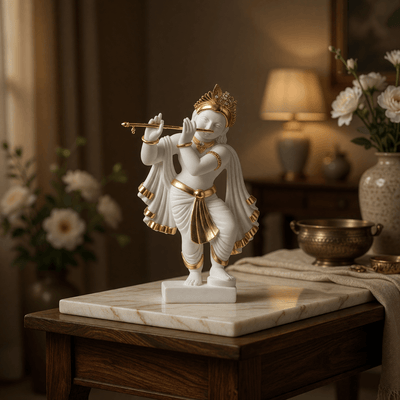
Every checkable piece of this (Dwarka, old age, the last song, the breaking) is absent from the primary sources. And no text records the fate of the flute either. The Bhagavata describes it lavishly while Krishna is in Vrindavan. The whole Venu-gita, chapter 10.35, is the gopis singing about what it does to cattle, rivers and birds.6 Then the text simply stops mentioning it as a played instrument. That silence is explored properly in where Krishna's flute is now. The flute belongs to Vrindavan. So, in a sense, does she.
2. "We know what age Radha died at, and she was older than Krishna."
No primary text gives an age at death, because no primary text gives a death. None gives an age difference either. The only two numbers in scripture describe the divine form she assumed: sixteen in the Brahma Vaivarta's Goloka account, and "resembling a young girl fourteen years old" when she reveals herself to Narada in Padma Purana, Patala-khanda chapter 71.10 They contradict each other, and neither is a birthday. The full argument is in was Radha older than Krishna.
3. "Krishna promised to come back, so the ending was happy."
He promised nothing of the kind (10.39.35, 10.39.37). What he offers instead, years later, is a claim that separation was never real. That answer satisfies almost nobody the first time they hear it, and then slowly does.
Krishna's death is recorded. Hers isn't. That gap is the point.
The Bhagavata gives Krishna's end in almost forensic detail and gives Radha none.
He sits beneath a tree, his right foot (reddish like a lotus) resting on his thigh. A hunter named Jara, seeing a flash of red through the leaves, mistakes the foot for a deer's face and looses an arrow (11.30.28–33).5 When Jara realises what he has done and falls apart, Krishna's reply is one line: fear not, what you did was my desire (11.30.39).
The tradition kept every bit of that, and what happened afterwards, which we've written about in what happened to Krishna's body after his death.
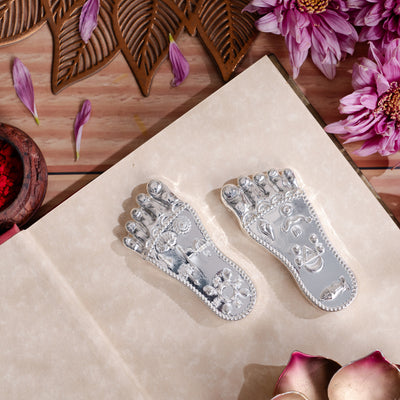
So the silence around Radha is not because ancient writers were squeamish or careless. They recorded the god's death. They declined to record hers. The most plausible reading is that in the theology that produced her, she does not have one. That is also why devotion focuses on the lotus feet of Krishna rather than any relic or grave. The gopis identify his footprints in the dust by five marks on his soles: flag, lotus, thunderbolt, barleycorn and elephant goad (10.30.25). The most worshipped part of him turns out to be the part that gets wounded. That is why a charan paduka sits in so many Indian homes. It is not a decoration, it is a place to put your surrender.
So what do you do with a story that isn't scripture?
Not throw it away. That would be the wrong lesson.
Living tradition carries versions of Radha's end all over Braj and Bengal, in folk song, in lila performance, in the poetry of Chandidas, Vidyapati and Mirabai. These are real, old and loved. They are simply not Puranic, and a page that claims otherwise cannot be cited.
The distinction is worth keeping everywhere in this subject. Radha Ashtami has a genuine Puranic charter in the Padma Purana. The story of the flute breaking does not. Both are part of how people love Krishna; only one is a verse. You will meet the same divide when you look up Krishna and Sudama (the Bhagavata never actually names that friend) or who Krishna's father was, where scripture cheerfully gives three answers at once. It runs through how Ram died, whether Hanuman is still alive, the seven chiranjeevis and the ten avatars of Vishnu too.
If the honest answer feels unsatisfying, notice that Krishna himself gave the same one. Asked, in effect, "where did you go": his reply was that he never left.
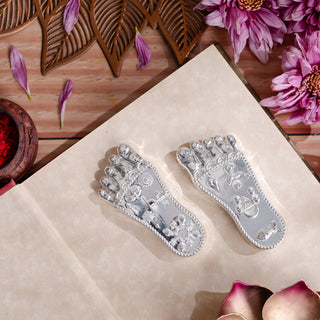
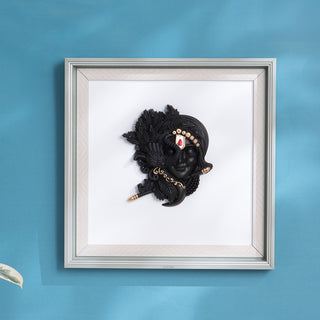
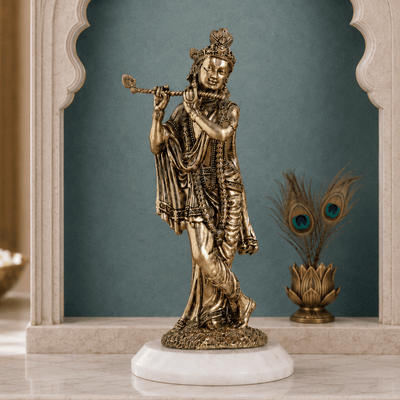
For most people that thought lands not while reading but while doing something ordinary. Lighting a lamp in the morning, wiping down a Radha Krishna murti before work, keeping a small Krishna where the day begins. If you want to build that habit properly, our guides on how to worship Lord Krishna, the seven best-sourced Krishna mantras and how to decorate a Krishna idol at home are built the same way this one is: from the texts, with the tradition clearly labelled where it is tradition. A simple charan paduka beside the lamp says the same thing the Gopi-gita says, in less space.
Radha has no tomb, no last words and no recorded death. After looking properly, I think that is not a hole in the story. It is the story.
Also read: What Happened to Radha After Krishna Left Vrindavan | Why Krishna Didn't Marry Radha | Where is Krishna's Flute Now | Why Radha Ashtami is Celebrated | What Happened to Krishna's Body After His Death