Ask ten people how Rama died and you get four answers. Shot by a hunter. Cursed. Drowned himself out of grief for Sita. Or he "returned to Vaikuntha", a polite way of saying nobody remembers.
Only the last is close. The hunter's arrow is not his story at all; it belongs to Krishna in the Mausala Parva and gets copy-pasted onto Rama constantly. That one is told properly here.
The real account is stranger and better. It sits in the Uttara Kanda, and the thing that ends Rama is not an enemy. It is a promise he made.
So how did Ram die?
He walked into a river. He did not die the way kings in stories usually die.
The sequence as the text gives it:
- Kala (Time) comes to the gates of Ayodhya in the form of an ascetic, saying he is a messenger from a great sage.
- He will speak to Rama only in private, and only on one condition: anyone who sees or hears them must be put to death.
- Rama agrees, and posts Lakshmana at the door to keep everyone out.
- The sage Durvasa arrives, demands to see Rama that instant, and threatens to curse the kingdom if he is refused.
- Lakshmana walks in. He chooses the city over himself.
- Rama, bound by his own word, gives up Lakshmana.
- He crowns his sons Kusha and Lava over two halves of the kingdom, leaves Ayodhya on foot, reaches the Sarayu, and enters the water.
Nobody defeats him. The man Ravana could not beat is undone by a sentence he agreed to before he knew what it would cost. That is the point of the ending, and most retellings skip it.
The visitor at the door
The scene is quiet in a way you do not expect from an epic. An ascetic asks for an audience, Rama receives him warmly, and only then does the visitor say who he is: Kala, come to ask whether Rama has finished what he came to do.
Rama is Vishnu's seventh avatar, and the visit is notice that the term is over. Avatars end, which is what sets them apart from the gods in the "who is most powerful" argument. The privacy is the plot device: it makes the death sentence necessary, and that makes everything else happen.
Not a battle. A closed door and a rule.
Why Lakshmana had to go first
Durvasa is the pressure. The sage announces that he has just completed a thousand-year fast and wants to be fed and received now. (The Uttara Kanda is quoted here from Manmatha Nath Dutt's 1894 translation and from the Sanskrit; the plain English is ours.) If he is not, he says, he will curse Rama, Ayodhya and everyone in it.
Lakshmana is standing at that door. He knows exactly what walking in will cost him. He walks in anyway.
This is the brother who followed Rama into fourteen years of exile without being asked. It is in character that his last act is to spend his own life on someone else's behalf. (The family is laid out properly in a separate piece.)
Rama does not argue with the rule. Vasishtha tells him that abandoning Lakshmana satisfies the vow as fully as killing him would, so Rama renounces him. Lakshmana goes to the Sarayu ahead of everyone and gives up his body there.1
Rama loses his brother before anything else. The ending starts with the person who was never once separated from him.
The walk to the Sarayu
What follows reads least like mythology and most like a real morning.
Rama installs Kusha and Lava as kings, sends word to his relatives, and then leaves. He walks out of the city in silence, having given up all action of the senses. On foot. Not on a chariot, not on Pushpaka, the flying vehicle he had taken back from Ravana.2 Like any pilgrim.
Then the text gives a small geographic detail that I find oddly moving. It is the kind of thing you only write if you have stood there:
अध्यर्धयोजनं गत्वा नदीं पश्चान्मुखाश्रिताम् । सरयूं पुण्यसलिलां ददर्श रघुनन्दनः
In plain English: Having gone a yojana and a half, the joy of the Raghus saw the river turned towards the west, the Sarayu of holy waters.
Valmiki Ramayana, Uttara Kanda 110.1
Turned towards the west. A river noted for its direction as he reaches it. Then he steps into the water on his own two feet (110.7). The place is remembered as the Gopratara or Guptar ford, and pilgrims still go to Ayodhya for it.
There is no death blow. He enters the water and does not come out.
The city that refused to outlive its king
He did not go alone.
The population of Ayodhya followed him out of the gates and into the river. Not as mourners standing on the bank. Into the water. The text says flatly that Rama came to that place saprajah, "with his people" (110.2). Later he asks Brahma to grant a world to the crowds who, he says, followed him out of love. Hari Prasad Shastri's translation has them yielding up their lives gladly, eyes wet with tears of joy, and ascending to the Third Heaven.
Gladly. That word is doing a lot of work. This is not tragedy. It is a departure the whole city chose to join.
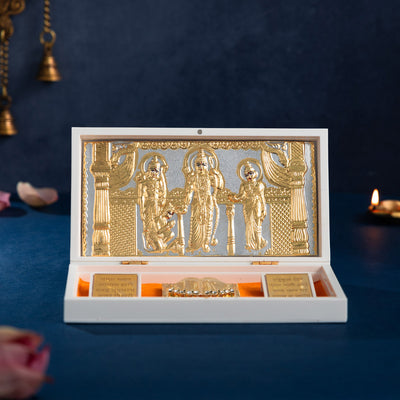
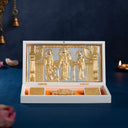
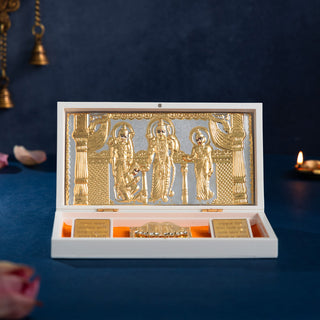
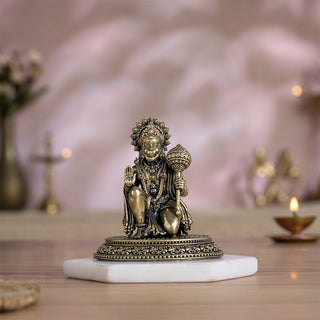
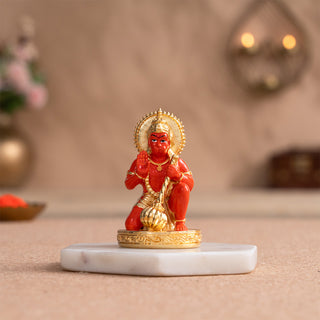
Which is also why the Ram Darbar image sits differently once you know the ending. Rama, Sita, Lakshmana and Hanuman together in one small shrine is not just a family portrait: it is the household the last book dissolves, one by one, in a very particular order. Sita has already gone back into the earth by this point. Lakshmana goes at the river. Rama follows.
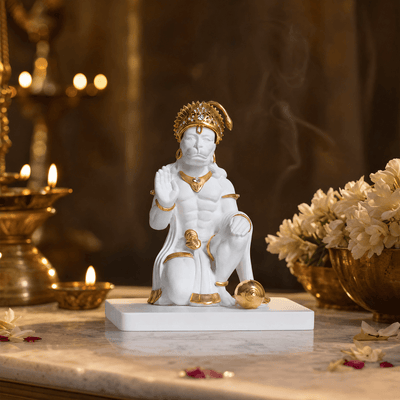
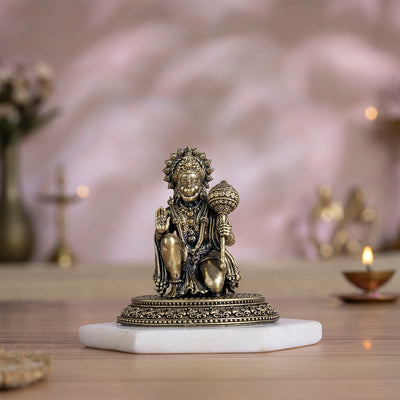
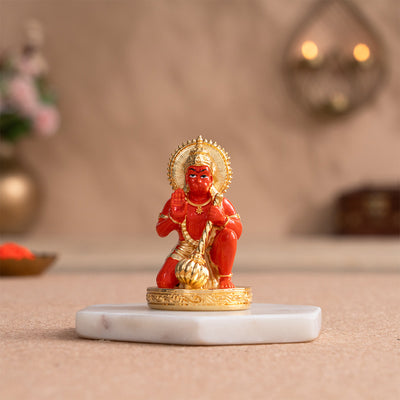
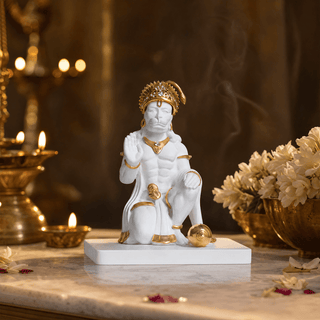
And Hanuman does not go. He is asked to stay, and he stays. That is why he is counted among the chiranjeevis, the deathless ones, and why the question of whether he is still alive has never quite closed. Every Ramayana ends with everyone leaving except him. So he keeps turning up in later stories long after this one finishes, from the Panchmukhi episode to the tale of his son Makardhwaja. His birthday is still marked twice a year in different parts of India, for reasons we've explained in this piece on Hanuman Jayanti.
The Bhagavata Purana tells it completely differently
The Srimad Bhagavatam covers Rama's departure too, in Canto 9, and compresses the whole ending into a few lines. There is no river in it, no ford, no walk out of the city:
स्मरतां हृदि विन्यस्य विद्धं दण्डककण्टकैः स्वपादपल्लवं राम आत्मज्योतिरगात् ततः
In plain English: Rama placed his own tender foot, pierced by the thorns of Dandaka, in the hearts of those who remember him, and then went into the light of the Self.
Bhagavata Purana 9.11.19
An earlier version of this article said the Bhagavata also drops the crowd, and used that to argue the two texts tell different stories. Checking the Sanskrit, that was wrong. Three verses later the Bhagavata says that the people of Kosala who touched Rama, or looked at him, or sat with him, or followed him, all went where yogis go (9.11.22). The word is anugatah, followed. The crowd is there in both books.
So the honest reading is narrower and more interesting than a flat contradiction. The Bhagavata drops the Sarayu and the ford. It keeps the one detail the Ramayana cares most about: that Ayodhya went with him.3 Two tellings at different altitudes, agreeing on the thing that matters. The Ramayana has always existed in more than one version, the argument A.K. Ramanujan made in "Three Hundred Ramayanas", and the endings vary like everything else.
If you're curious how the same tension runs through Vishnu's other descents, the ten avatars each end on their own terms, and rarely the way popular memory says. The Krishna avatar's closing chapters are the clearest parallel, right down to a city that empties out, and even Radha's disappearance is told in more than one way, for the same reason. A tradition this old does not keep one version of anything.
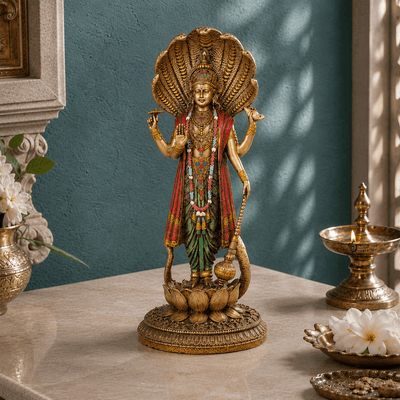
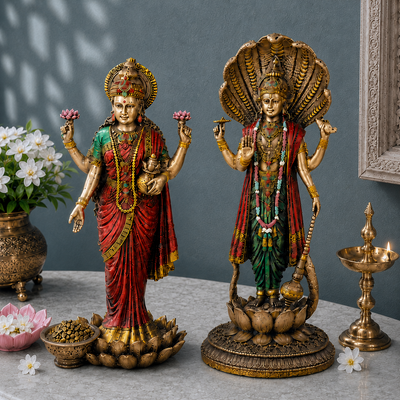
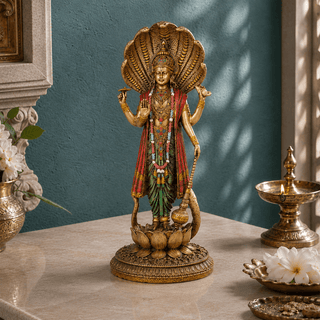
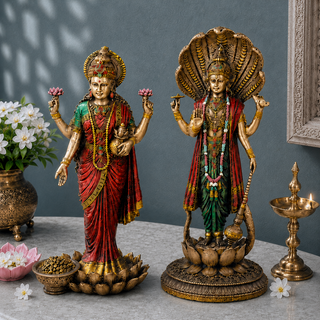
(And if this sends you looking for a standing Vishnu murti, there are placement customs worth reading first.)
Four things people get wrong about Rama's death
1. "Rama was killed, or died of a curse."
Nothing kills him. There is no weapon and no curse anywhere in the account. Time comes as a guest, the conversation is interrupted, Rama keeps his word, and he walks to the river. The hunter's arrow people attach to this belongs to Krishna's end in the Mausala Parva of the Mahabharata, not to Rama's.
2. "He drowned himself out of grief. It was basically a suicide."
Grief is genuinely in the story: he has lost Sita and then Lakshmana. But the river scene is not written as despair. The whole city walks in with him, gladly, and ascends to the Third Heaven. A despairing man does not get followed into the water by everyone he ruled.
3. "Every version says he entered the Sarayu."
They don't. The Bhagavata skips the river entirely and has Rama enter the light of the Self (9.11.19). What it does not skip is the crowd, which follows him in both texts (9.11.22). The difference is one of scale, not of story.
4. "The Ramayana is one fixed book, so the ending is settled."
It is not one fixed book. This whole ending sits in the Uttara Kanda, and much scholarship treats that book as a later addition. The next section lays it out.
The honest caveat: the Uttara Kanda is disputed
Everything above (the visit from Kala, Durvasa at the gate, the walk to the Sarayu) comes from the Uttara Kanda. And a good deal of scholarship treats the Uttara Kanda as a later addition to Valmiki's poem rather than part of its original core.
Macdonell put it about as bluntly as a philologist can, summarising Jacobi: "The seventh is undoubtedly a later addition, for the conclusion of the sixth was evidently at one time the end of the whole poem."
A History of Sanskrit Literature, 1900, p. 304
You can see the argument in practice. One of the most widely used online editions, valmikiramayan.net, carries only six kandas. The seventh is not there at all.8 The Shastri and Dutt editions include it, which is why we can quote it.
So the most famous account of Rama's death sits inside the most contested book of the epic. That does not make it false, or less meaningful to the people who have carried it for centuries. It means the text has a history, like every text does.
Notice what Valmiki is precise about and what he isn't. He dates Rama's birth exactly: the ninth day of Chaitra, which is why Ram Navami falls where it does.5 He describes Ayodhya's preparations for the homecoming in almost fussy detail: levelled roads, ground sprinkled with cold water, parched grain and flowers strewn about, flags on every house.6 (No rows of lamps, incidentally, which is a genuine surprise if you grew up lighting diyas for exactly that reason, and we've written about it here.) But for the death he gives no date at all. The precision runs out exactly where the later material begins.
Why this ending suits him
Rama's character is built on one trait, and it is not strength. He keeps his word even when keeping it ruins him. He goes into exile because his father made a promise, and gives up his throne, his comfort and eventually his wife for vows most of us would have quietly renegotiated.
His death is not a defeat. It's the final, costliest instance of the one thing he was.
And it is a strange comfort that the story does not end with a battle. It ends with a man walking out of his city in silence, towards a river, with everyone he ruled behind him. If you keep Rama in your home, that's the figure worth remembering: not the archer, the man who kept his word to the end. The same goes for the Hanuman murti beside him, who is the only one in the story asked to stay behind and carry the memory.
Also read: Lord Rama's Brothers | The Real Father of Sita | Is Lord Hanuman Still Alive? | Ram, the Avatar of Vishnu | What Happened to Krishna's Body