Most Ram Navami articles tell you it is the ninth day of Chaitra and then move straight to the rituals. Almost none of them quote the verse. That is a pity, because Valmiki wrote down the sky on the day Rama was born, in real detail, and it is the most interesting thing about the date.
What the Ramayana actually says about Rama's birth
The passage sits in the Bala Kanda, the first book of the epic. Ralph Griffith's English verse translation of 1870 reads:
Eleven months had passed away: / Twas Chaitra's ninth returning day. / The moon within that mansion shone / Which Aditi looks kindly on. / Raised to their apex in the sky / Five brilliant planets beamed on high. / Shone with the moon, in Cancer's sign, / Vrihaspati with light divine.
Two lines need unpacking. "That mansion which Aditi looks kindly on" is Punarvasu, the lunar mansion or nakshatra that the goddess Aditi presides over. Vrihaspati is Jupiter. So the moon stood in Punarvasu, with Jupiter next to it in Cancer.1
Griffith adds a long footnote quoting the scholar Schlegel, who names all five planets: the Sun in Aries, Mars in Capricorn, Saturn in Libra, Jupiter in Cancer and Venus in Pisces. Each one sits in the sign where it is held to be strongest. Schlegel read the whole picture as pointing to the spring equinox, then said he would leave it to astronomers to check whether the description holds together.2
One honest note. Valmiki never writes the words shukla paksha, the bright half of the month. The bright half follows from his own astronomy. If the sun is in Aries and the moon is in Cancer, the moon is about a quarter of the way round the sky from the sun, which is a waxing ninth. That is a derivation, not a quotation.
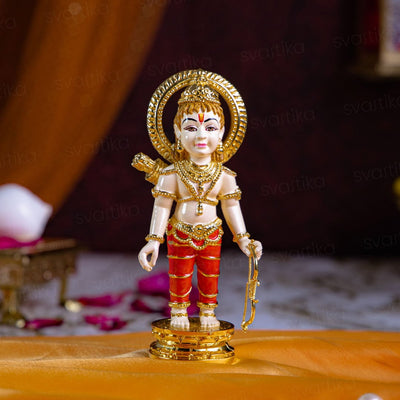
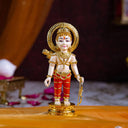
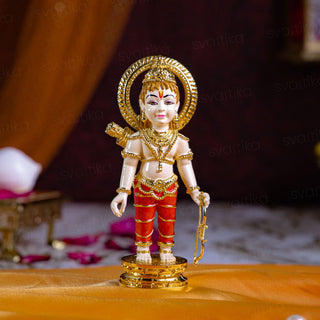
The epic also gives Rama three brothers born in the same stretch of days. If you want that side of the story, we have written about Rama's brothers and about Sita's real father separately. Many homes keep the birth story alive with a Ram Lalla murti, the child form of Rama, which is what the ninth day is really about.
Why the Ram Navami date changes every year
In 2027 Ram Navami falls on Thursday, 15 April. People often say the Hindu calendar drifts. It does not. It is measuring something the English calendar never tries to measure.
Robert Sewell and Sankara Balkrishna Dikshit set this out in The Indian Calendar (1896). A tithi, they write, is "the time occupied by the moon in increasing her distance from the sun by 12 degrees". Thirty tithis cover the full 360 degrees, so thirty tithis make one lunar month.
Here is the catch. The sun and the moon do not move at a steady speed. So the length of a tithi, in their words, "constantly alters". One tithi can be shorter than a day and the next longer.
That produces two effects the same book explains. A tithi in which the sun never rises is dropped from the calendar completely, and is called a kshaya tithi. A tithi in which the sun rises twice is counted twice, and is called adhika.4 This is why a festival sometimes looks like it has skipped a date, or is kept on two days running in two different towns.
On top of that comes the adhika masa, an extra month added every few years to keep the lunar year in step with the solar one. Between a stretching tithi and an extra month, a fixed tithi has to land on a different English date each year. The same machinery moves Navratri and Diwali too.
Sewell and Dikshit note one more thing worth knowing. North India ends its lunar months at the full moon and the south ends them at the new moon. So in the north the dark fortnight comes first in the month. The same tithi can therefore sit inside two differently named months depending on where you are standing.
Punarvasu or Abhijit? Two texts, two answers
If you have sat through a Ram Navami puja in north India, you have heard that Rama was born in Abhijit muhurta, at the middle of the day. Valmiki does not say that anywhere. Tulsidas does.
The Ramcharitmanas was written in Awadhi in the sixteenth century. F. S. Growse's translation of the Balkand passage reads: "On the ninth day of the sweet and holy month of Chait; in the bright lunar fortnight; under Abhijit, his favourite constellation."3
So Tulsidas supplies both things Valmiki left out, the bright fortnight and a named nakshatra. But his nakshatra is Abhijit, and Valmiki's is Punarvasu. They are not the same star.
Nobody here is wrong. These are two great books written centuries apart, and most north Indian practice follows Tulsidas, which is exactly why the main puja is held at madhyahna, the middle of the day. Saying the texts differ is more useful than blending them into one tidy sentence.
About clock timings: the moment the navami tithi opens and closes changes with the panchanga you follow and with your own longitude. A minute-precise muhurat copied from a website is often not sourced at all. Take the tithi from a local panchanga and let your family's practice set the hour.
How old is the festival?
It was already a large public festival by 1574 CE, and we can date it from inside a book.

Tulsidas signs off his own manuscript with a date. Growse's translation: "In this Sambat year of 1631, I write... on Tuesday the 9th of the sweet month of Chait, at the city of Avadh, on the day when the scriptures say Rama was born... while the enlightened keep the great birthday festival and hymn Rama's high glory."3
Sambat 1631 is 1574 CE. So the poet began the Ramcharitmanas at Ayodhya on Ram Navami itself, and says in passing that a large festival was already going on around him. That is a first-hand witness, not a later tradition looking back.
Growse also notes that at Chitrakut, the forest hill where Rama stayed in exile, the two main fair days of the year were Ram Navami in Chait and Diwali in Kartik. So by the nineteenth century the day was drawing crowds well beyond Ayodhya.
How Ram Navami is kept at home
At home it is a fast, a night vigil and a family puja. For recorded practice rather than rules, the useful book is M. M. Underhill's The Hindu Religious Year (1921), which wrote down what people were actually doing.

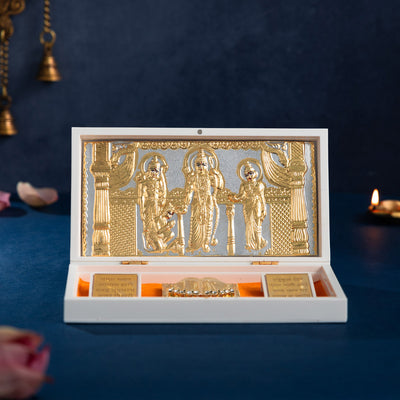
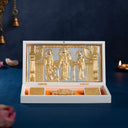
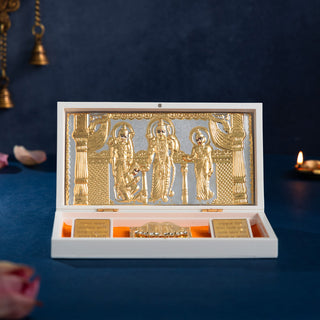
Underhill describes a fast kept on the ninth, and a vigil through the night that follows. The worship at home is of Rama together with Sita and Lakshmana, with mantras.5 Notice that the household image is the group, not Rama alone, which is why a Ram Darbar remains the common form in a home pooja room.
He also records that in Maharashtra the celebration ran on to midnight of the eleventh, with car processions at the larger temples on that evening. So the festival was not always a single day.
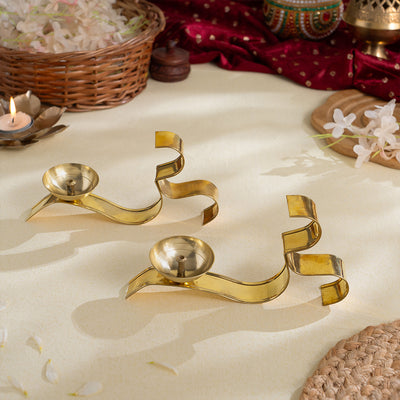
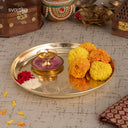
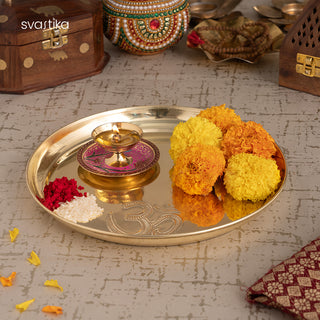
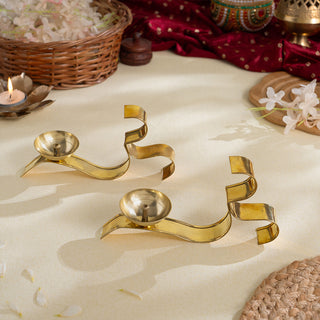
Beyond that, practice is family practice. Reading the Ramcharitmanas aloud, an akhand path over the days before, a cradle for the infant Rama, simple sweet offerings. If you keep a metal or marble murti out through the day, our guide on cleaning a marble idol covers the care afterwards. A row of brass diyas and a thali are usually all the equipment anyone needs, and the Lord Ram collection has the murtis if you are setting up a new altar.
Chaitra holds more than one birthday
Ram Navami does not stand alone. Chaitra is crowded.
The month opens with its first tithi, kept as Gudi Padwa in Maharashtra and Ugadi in the Deccan, both new year days. The nine nights that follow are Chaitra Navratri, and Ram Navami is the ninth of them. That is the shape of it: the festival closes the nine nights.
Four days later, on the thirteenth of the bright half, Jains keep Mahavira Jayanti. And at the full moon that ends the month, Underhill records Hanuman Jayanti, kept widely across Maharashtra and especially by the Ramdasi tradition. We have looked at why Hanuman Jayanti falls on more than one date, and the short answer is that no scripture ever gave him one.
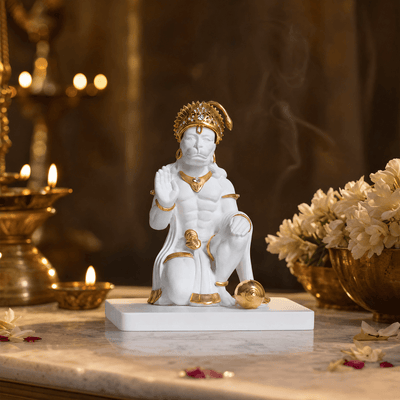
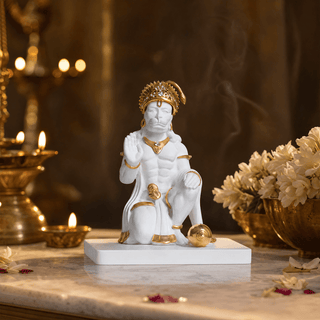
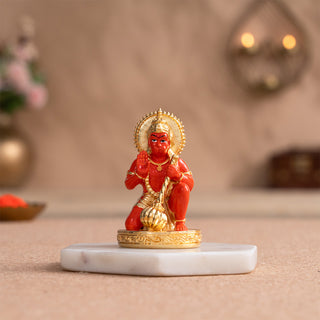
That closeness is not an accident of the calendar. Hanuman belongs to Rama's story, and tradition holds that he never died, which is why he appears in the list of the seven chiranjivis. Whether he is still present is a question devotees answer with their own practice. Many homes keep both together, which is why our Ram Navami and Hanuman Jayanti range pairs them, and our Hanuman idol collection sits naturally beside a Ram Darbar.
Three things people get wrong about Ram Navami
1. "Valmiki says Rama was born in Abhijit muhurta." He does not. Valmiki gives Punarvasu, with Jupiter in Cancer. Abhijit comes from the Ramcharitmanas, written far later. Only one of them says Abhijit.
2. "The date jumps around because the Hindu calendar is imprecise." The opposite is true. A tithi is an angular measurement of the moon's distance from the sun, and Sewell and Dikshit show why its length has to vary. Add the intercalated month and a fixed tithi cannot land on a fixed English date. The calendar is tracking two moving bodies at once, which is harder than counting to 365.
3. "It is a north Indian festival." Growse recorded Ram Navami as one of the two big fair days at Chitrakut. Underhill recorded processions running to the eleventh in Maharashtra, and a fast and vigil kept in ordinary homes. Ayodhya is the centre of it, but it was never only Ayodhya.
What the day is really asking of you
Ram Navami is a birthday, and birthdays in this tradition are not about the person being far away in the past. The fast, the vigil, the reading aloud, the cradle: all of it treats the birth as something happening now, in this room.
Valmiki's five exalted planets were his way of saying the same thing. The sky itself arranged the best of everything it had. You do not need a perfect muhurat or a big altar to join in. A clean lamp, the ninth tithi from your own panchanga, and the story read out loud will do. That is roughly what Tulsidas was doing in Ayodhya in 1574, and he thought it was enough.
Also read: How Did Ram Die | The 10 Avatars of Vishnu | The 6 Brothers of Ravana | Which Hanuman Idol is Good for Home | Diwali Diya Decoration from the Ramayana
Cover photo: Iharishs, CC BY-SA 4.0, via Wikimedia Commons.