Most retellings give you the four names and move on. But there is a small, strange moment in the Bala Kanda of Valmiki's Ramayana that decides the whole shape of the family, and almost nobody quotes it.
Dasharatha is standing with a golden bowl of payasam. It has just been handed to him by a being who rose out of the sacrificial fire. He gives half to Kausalya. He gives half of what's left to Sumitra. He gives half of that to Kaikeyi. And then, holding the last eighth, the text says he thought a while, and gave it to Sumitra again.
That pause is why there are four brothers instead of three.
Who were Lord Rama's brothers?
Three brothers, born to two of Dasharatha's three queens:
- Bharata: son of Kaikeyi, Dasharatha's youngest queen.
- Lakshmana: son of Sumitra.
- Shatrughna: also son of Sumitra.
Valmiki dates the births precisely, which is worth noticing because he is silent about dates elsewhere in the epic. Rama is born to Kausalya on the ninth day of Chaitra, under the star Punarvasu, in Cancer. That verse is the reason Ram Navami falls where it does in the calendar, and the reason it sits inside the Chaitra Navratri week.
Bharata comes the next day, the tenth of Chaitra, under Pushyami, in Pisces. Lakshmana and Shatrughna arrive later that same tenth day, under Ashlesha, in Cancer (Valmiki Ramayana 1.18).
So the birth order the text gives is Rama first, then the other three within about a day of each other. The commentary attached to the passage adds a detail people almost never mention: Bharata's birth is narrated first, but he is actually the youngest of the four.2
The bowl of payasam, and the maths that made them
The back story is Dasharatha's childlessness. He performs the ashvamedha and then the putrakameshti, the sacrifice for sons, guided by the sage Rishyasringa. From the fire comes a figure holding a vessel of payasam (sweet rice cooked in milk) and tells the king to feed it to his queens.
Here is the division, at 1.16.27–29:
Kausalya, one half. Sumitra, half of the remaining half (one quarter). Kaikeyi, half of what was left (one eighth). And then the king thought a while, and gave the last eighth to Sumitra again.
Kausalya was the senior queen, so her half follows protocol. Kaikeyi's eighth follows protocol too. The second helping to Sumitra follows nothing. It reads like a man improvising with the last spoonful in the bowl, and it produces the brother who will spend fourteen years in a forest so his elder is not alone.
Later Vaishnava tradition reads the fractions as portions of Vishnu: Rama as half, Bharata as a quarter, and so on. The translator of the Bala Kanda pushes back on that directly in a note on this very chapter: the fractions "may be reckoned as the share of the dessert consumed by the queens, but not as a cleaved portion of Vishnu as he is an indivisible entity."1
The Bhagavata Purana handles it more simply. It says the Lord came "along with three of His expansions," who appeared as the four sons Rama, Lakshmana, Bharata and Shatrughna (9.10.2). Four expressions of one thing, not one thing sliced up. If you want the longer arc of that idea, it sits inside the Rama avatar story and the broader ten avatars of Vishnu.
Lakshmana: the brother who is never not there
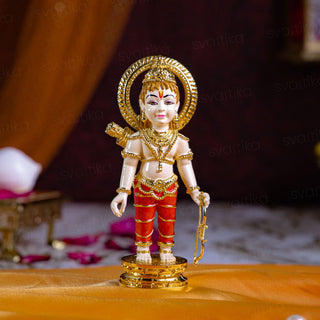
Lakshmana attaches himself to Rama from childhood and never really detaches. He follows him to the forest without being asked. He builds the huts. He stands guard while the other two sleep. Sumitra's second son goes to Kausalya's son, and it is presented as a fact of temperament rather than duty.
The part that gets left out of most summaries is how it ends. In the Uttara Kanda, Kala (Time himself) arrives at the palace as an ascetic and asks Rama for a private meeting, on the condition that whoever interrupts them must be put to death. Rama agrees. Then the sage Durvasa turns up at the gate, having fasted a thousand years, and threatens to curse Ayodhya if he is not admitted immediately.5
Lakshmana interrupts. He knows the price. He chooses the city.
Rama keeps his word and gives him up, and only after that does he walk out to the Sarayu himself. We wrote about that whole sequence in detail in how Ram died: it is not the death by weapon or curse that most people have been told. The brother goes first. That is the shape of it.
Bharata: the brother who ruled with a pair of sandals
Bharata never sat on the throne he inherited. He gets treated unfairly in retellings because his mother is the villain of the Ayodhya Kanda. He was away at his maternal grandfather's home when Kaikeyi extracted her two boons and sent Rama into exile. He came back to a dead father and a throne he had never wanted.
What he does next is the reason his name survives. He goes into the forest to bring Rama home, argues, fails, and finally asks for Rama's sandals. He carries them back, places them on the throne, and rules from Nandigrama for fourteen years as a regent for a pair of shoes.
This is where the whole Indian idea of charan padukas (the feet of the divine standing in for the divine) gets one of its clearest stories. Bharata does not sit on the seat. He sits below it.
He also lives like an exile in his own capital: matted hair, bark clothes, no royal comforts. The epic is quietly making a point about which brother's fourteen years were harder.
Shatrughna: the brother nobody writes about
Shatrughna is Sumitra's second son and Bharata's constant companion, the way Lakshmana is Rama's. The pairing tracks the payasam. Sumitra's two boys attach themselves to the other two households, one each.
He gets almost nothing in the main story. No exile, no war, no famous speech. His moment comes late, in the Uttara Kanda, when Rama sends him to deal with Lavanasura, a rakshasa terrorising the Madhu forest with a trident given by Shiva. Shatrughna waits for the moment the trident is out of the demon's hands, kills him, and then founds a city on that ground: Madhura, the Mathura that will matter enormously in a much later story.6
His name means "slayer of enemies." He is the only brother who fully earns it in single combat, and he is the one you will not find on a poster.
Did Rama have a sister? The Shanta question
Valmiki does not say Rama had a sister.
You have probably read that he had an elder sister named Shanta, whom Dasharatha gave away in adoption to King Romapada of Anga, and who later married the sage Rishyasringa, the same sage who conducts the sacrifice that produces the four brothers. It is a lovely, tidy circle.
At 1.11.3 the text says the king of Anga "will beget a fortunate girl named Shanta." Dasharatha then twice refers to her as Romapada's own daughter, "your daughter Shanta" (1.11.5, 1.11.19).3 She is real, she matters, and she is not written as Dasharatha's child.
The adoption version is an old and widespread tradition, and the translator of this very passage flags it as exactly that: a separate tradition rather than what the verses state. That is the honest position. Believe it if it moves you; just don't cite Valmiki for it.
Five things people get wrong about Rama's brothers
1. "Lakshmana and Shatrughna were twins." Valmiki says both were born to Sumitra on the tenth of Chaitra under Ashlesha. He never uses a word for twins, and the verse actually describes them as born on separate occasions.2 Translators sometimes use the word "twins" as shorthand, and the shorthand hardened into a fact.
2. "Sumitra got two shares as a reward." The text is odder and more human than that. Dasharatha handed out three portions by seniority, then paused with the leftover eighth and gave it to Sumitra a second time. No reason is recorded. It's an afterthought that produced Lakshmana or Shatrughna, depending on how you read the order.
3. "Lakshmana is Shesha, Bharata is the Sudarshana chakra, Shatrughna is the conch." None of that is in Valmiki's birth account. The Bhagavata says only "three of His expansions" and names none of them. It's later Vaishnava tradition, and a beautiful one, the same devotional habit that produced the many stories about who gave the Sudarshana chakra to Vishnu's avatars. Tradition, not Bala Kanda.
4. "Rama had a sister, Shanta, whom Dasharatha gave away." Covered above. Valmiki gives Shanta to Romapada by birth, not by adoption.
5. "Hanuman was Rama's fifth brother." He wasn't, and the epic never claims it, but the affection behind the mistake is real, because Hanuman is treated as family from Kishkindha onwards. If his story interests you, whether Hanuman is still alive, who his father was, and whether he had a wife each have longer answers than you'd expect.
One more note, said plainly: Lakshmana's renunciation and Shatrughna's Lavanasura campaign both sit in the Uttara Kanda, the seventh book, which a good deal of scholarship treats as a later addition to the epic.9 The widely used valmikiramayan.net edition carries only six kandas and leaves it out entirely.4 That doesn't make the stories worthless. It does mean they stand on slightly different ground than the Bala or Ayodhya Kanda, and you should know which ground you're standing on. The same caution applies to Ravana's family tree, which lives in the same book.
Why the four still stand together
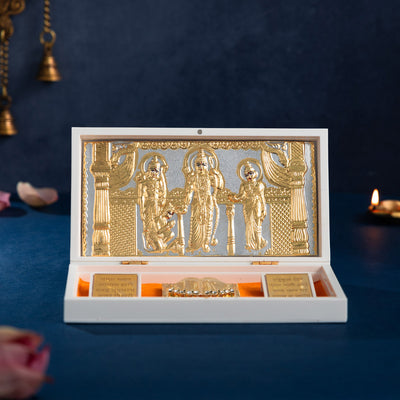
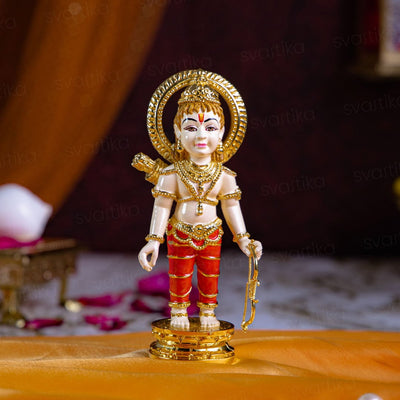
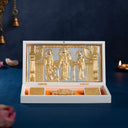
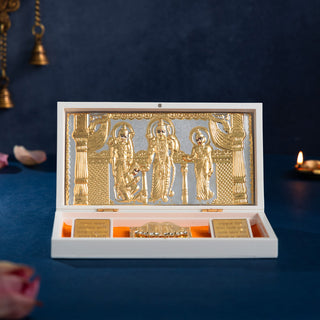
Walk into most Indian pooja rooms and you will not find Rama alone. You will find the Ram Darbar: Rama and Sita seated, Lakshmana standing at his shoulder, Hanuman at their feet. Bharata and Shatrughna are usually absent from the image, which is its own quiet unfairness, though some larger darbar sets include all four.
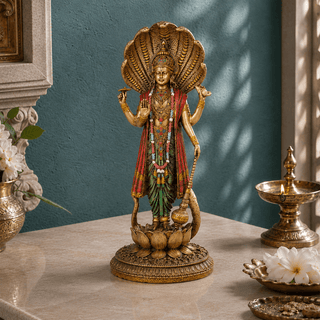
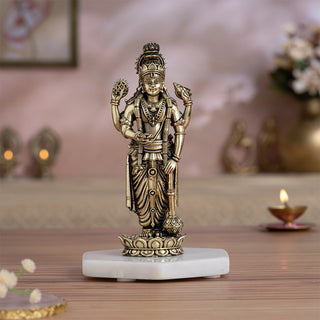
What the grouping is really saying is that Rama is not worshipped as an individual. He is worshipped inside a set of relationships. That is the difference between him and almost every other form of Vishnu people keep at home: the standing Vishnu stands alone, but Rama comes with a household.
If you keep a Ram Darbar at home, you are keeping a family that split a dessert, split a kingdom, and refused to split from each other. That is a more interesting thing to have on a shelf than a single hero.
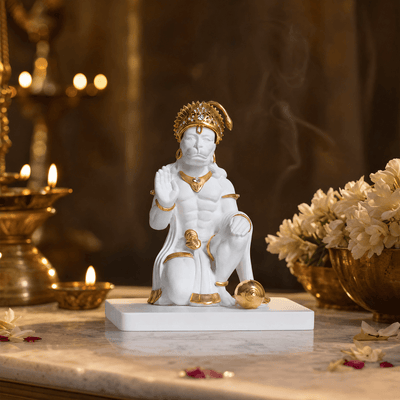
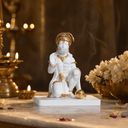
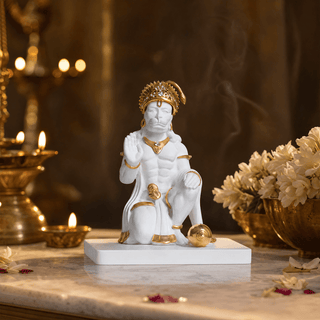
And Hanuman at their feet is the last piece of the logic. The brothers are bound by blood and a bowl of kheer. He is bound by nothing but choice, which is why Hanuman idols often sit slightly apart in the same shrine, and why his birthday is celebrated twice a year in different parts of India.
Where to read this yourself
Everything above can be checked. The payasam division is Bala Kanda sarga 16, the births are sarga 18, Shanta is sarga 11: all of them are online in Sanskrit with word-by-word English at valmikiramayan.net, and it costs nothing to look. The Bhagavata's version of the four sons is Canto 9, Chapter 10. Lakshmana's end and Shatrughna's campaign are in the Uttara Kanda, which you'll need the Shastri or Dutt translations for, both free on archive.org.
Reading the actual verses is worth it, because the epic is less tidy than the retellings and much better.
If you want the family completed, the two obvious next questions are who Sita's real father was (Valmiki's answer is stranger than the popular one) and how the tradition ranks Rama against the other great forms of God. For the household side of it, our guide to what belongs in a pooja room and the Lord Ram collection both start from the same idea: the murti is a relationship, not an ornament.
Also read: How Did Ram Die | Who Is the Real Father of Sita | The Brothers of Ravana | The Legend of Ram, Avatar of Vishnu | Diwali Diya Decoration and the Ramayana