Almost every article on this question quotes the same scene: Rama's coronation, Sita smiling, a blessing of immortality. Lovely image. It is not in the text. The real passage sits in a different epic, and it is better.
The sentence everyone should be quoting is in the Mahabharata, not the Ramayana
Years after the Ramayana ends, Bhima is walking through the forest of Gandhamadana, in a hurry and in a mood. An old monkey lies across the path with his tail over it. Bhima tells him to move. The monkey says he is too old, and suggests Bhima lift it himself.
Bhima (the strongest of the five brothers, the one who kills with his bare hands) cannot lift the tail with one hand. Then he braces and tries with both arms, and still cannot move it.1 It is the epic's way of ranking the two of them without staging a fight.
Sanskrit below comes from the Baroda critical edition of the Mahabharata and from Valmiki's text; the English is ours.
What follows is the part that matters. Bhima asks who he is, and Hanuman tells him, including the boon he had asked of Rama at the end of the war:
यावद् रामकथा वीर भवेल् लोकेषु शत्रुहन् तावज् जीवेयम् इत्य् एवं तथास्त्व् इति च सो ऽब्रवीत्
In plain English: As long as Rama's story lives in the worlds, hero, let me live that long. And Rama said, "So be it."
Mahabharata, Vana Parva 147.37
That's the whole answer to the title question, spoken by Hanuman himself. No coronation scene, no necklace, no list of eight names. He asked to stay for the story.
A quiet detail sits under this meeting. Bhima is a son of Vayu, and so is Hanuman, which makes it a meeting between brothers and the tail test funnier. If you've ever wondered who Hanuman's father actually was, Valmiki gives two answers on purpose, and both are correct.
What Brahma and Indra actually promised him
The boons people call "immortality" come much earlier, in Kishkindha Kanda 66. The vanara army has reached the southern shore and nobody can cross. Jambavan takes Hanuman aside and tells him his own life story back to him, because Hanuman has forgotten it.
Anjana, once the apsara Punjikasthala, married to the vanara chief Kesari. Vayu, who promised her a son who would match him at leaping and flight. The child who jumped at the rising sun thinking it was fruit, was struck down by Indra's thunderbolt, and broke his left hanu, his jaw, on a mountain peak. Valmiki says outright that this is where the name comes from (66.24). He is named after the day he was hurt.
Then come the boons, at verses 27 to 29:
प्रसादिते च पवने ब्रह्मा तुभ्यं वरं ददौ। अशस्त्रवध्यतां तात समरे सत्यविक्रम स्वच्छन्दतश्च मरणं तव स्यादिति वै प्रभो।
In plain English: Brahma gave you this boon: that you cannot be killed by weapons in battle. And Indra gave you this: that your death will come only when you yourself choose it.
Valmiki Ramayana, Kishkindha Kanda 66.27-29
Read those slowly, because neither says he will never die. One says weapons won't finish him. The other puts the timing in his own hands. That is conditional deathlessness, which is a different thing from being unkillable. It explains why he sits on the list of chiranjivis, and why who could ever defeat him has a stranger answer than "nobody."
So where is Hanuman now?
Textually, there is one honest answer: Gandhamadana. That forest meeting with Bhima is the only place an epic actually puts Hanuman after the Ramayana ends, and it's already a full age later.1
Everything else is living tradition, and it's worth naming which is which. Devotees point to Kishkindha in Karnataka, to Anjaneri hill near Nashik, to Gandhamadana, to the Himalayas. None has a verse behind it. They are places where people have felt him, which is a different kind of claim, not a worse one.
Then the belief I like most. Many households hold that wherever the Ramayana is recited, Hanuman is in the room listening, and some keep an empty seat at a Sundar Kand path for that reason. No chapter and verse for it. But it follows his own boon so neatly you can see how it grew: if his life is tied to the telling, the telling is where you would look. It's the same instinct behind the two dates on which Hanuman Jayanti is observed across different regions.
Three things people get wrong about this
1. "Sita blessed him with immortality at the coronation." Yuddha Kanda 128 is the passage always cited, and it is a gift-giving, not a boon-granting:
अवेक्षमाणा वैदेही प्रददौ वायुसूनवे। अवमुच्यात्मनः कण्ठाद्धारं जनकनन्दिनी
In plain English: Then Sita, daughter of Janaka, took the necklace from her own neck and gave it to the son of the Wind.
Valmiki Ramayana, Yuddha Kanda 128.79
Rama gives Sugriva a garland and Angada armlets. Nobody is made deathless.3 It's a gift of honour, publicly given, and it's beautiful. It just isn't what people say it is.
2. "Nobody has ever hurt Hanuman." Valmiki disagrees, twice. In Yuddha Kanda 59, Ravana strikes Hanuman on the chest with the flat of his palm, and Hanuman shakes over and over before he steadies himself (59.60-61). Hanuman strikes back and Ravana rocks like a hill in an earthquake. Ravana then calls him a foe worth praising, and Hanuman snaps back that his own strength should be ashamed of itself, since Ravana is still breathing (59.65-66). Later in the same battle Hanuman lands a fist on Ravana's chest and drops him to his knees, bleeding and senseless on the floor of his chariot (59.114-117). Blows land in both directions. Ravana's household, incidentally, was full of such fighters: his brothers alone are a study in wasted power.
Indrajit's Brahmastra also works. It binds Hanuman in Sundara Kanda 48, though the text is careful that he reasoned it out first:
ग्रहणे चापि रक्षोभिर्महन्मे गुणदर्शनम्। राक्षसेन्द्रेण संवादस्तस्माद् गृह्णन्तु मां परे
In plain English: There is something to be gained even in being seized by these demons: it will get me a conversation with their king. So let my enemies take me.
Valmiki Ramayana, Sundara Kanda 48.44
He then stayed motionless on purpose. And the comic footnote is real: the rakshasas tied him with ordinary bark rope on top of the weapon, which released him, because one binding cannot sit on top of another (48.48). They freed him from the Brahmastra by accident.
3. "The eight chiranjivis are a Puranic list." The verse naming Ashwatthama, Bali, Vyasa, Hanuman, Vibhishana, Kripa, Parashurama and Markandeya circulates as a memory-shloka, not a passage from any named Purana. Each figure's deathlessness is attested separately. The neat list is devotional shorthand; Kishkindha Kanda 66.27-29 is the stronger citation.
He himself says he is weaker now
Hanuman tells Bhima he no longer has the form he used to cross the ocean.
Bhima asks to see it. Hanuman says no:
अयं प्रध्वंसनः कालो नाद्य तद् रूपम् अस्ति मे
In plain English: This is an age of decline. I no longer have that form.
Mahabharata, Vana Parva 148.6
He explains it through the yugas: the world has thinned out, and so has he.
But the scene does not stop there, and most retellings cut it short. Bhima says he will not leave without seeing it. Hanuman smiles, and shows him the form anyway, growing until he blots out the whole grove. Then he adds that he could grow larger still, as much as he wishes (Vana Parva 149.1-9).
So the honest picture is not a spent god, and not an untouched one either. The age has shrunk what he shows. What he has is still there.
In the same conversation he gives Bhima the most useful promise in this whole subject: he will sit on the flagstaff of Arjuna's chariot and roar, and those roars will take the life out of Arjuna's enemies (Vana Parva 150.15). That's why Arjuna's banner is called Kapidhvaja, the monkey-standard. And it is the only genuinely scriptural reason Hanuman belongs at an entrance: not a vastu rule, but a promise he made to sit at the front of someone's vehicle and shout down whatever was coming. If you're choosing a Hanuman idol for your home, that's a far better reason than any direction chart.
Why "as long as the story is told" is the strangest boon in the epics
Most deathlessness in Indian texts is a punishment. Ashwatthama wanders. Bali is bound. Hanuman asked for a condition that depends entirely on other people. He handed the terms of his own survival to strangers he would never meet.
It rhymes with something already true about him. In Valmiki he cannot cross the ocean until Jambavan recites his story back to him.2 He runs on the story being spoken aloud. That's why anyone reading about Rama as an avatar of Vishnu, or about how Rama's own life ended, is holding up one small end of it.
The Hanuman that later texts added
Much of what people know about Hanuman came centuries after Valmiki.
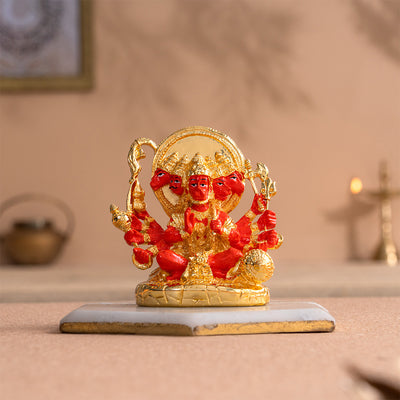
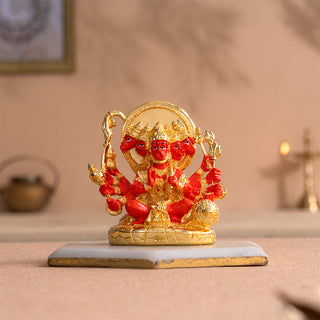
The five-faced Panchmukhi form is nowhere in Valmiki. It comes from the Bengali Krittivasi Ramayana of roughly the 15th century, in the passage known as Mahirabonerpala, and a 16th-century Telugu Mairavana charitra. Makardhwaja, his son, has no epic citation at all: not in Valmiki, not in Tulsidas. The marriage to Suvarchala belongs to the Parashara Samhita and survives in temple worship in Telangana.9 The Shiva Purana calls him an avatar of Shiva outright, while other Puranas call him a portion of Vayu, and Valmiki does neither, a genuine disagreement, of the same kind you find when people ask which god is the most powerful or count how many avatars Shiva has.
None of that weakens the answer. It proves it. The story kept growing in Bengali, Telugu, Braja and Awadhi for two thousand years after Valmiki, which is precisely the condition his boon was written on.
What this means if you keep a Hanuman murti at home
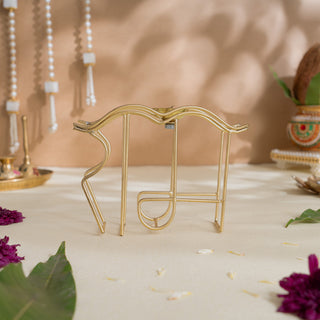
Skip the rules about mace angles and mandatory directions. No Purana legislates a household shrine. Tuesday and Saturday worship and the sindoor offering are regional custom: widespread, meaningful, and not scripture. They do not need a fake citation to be worth doing.
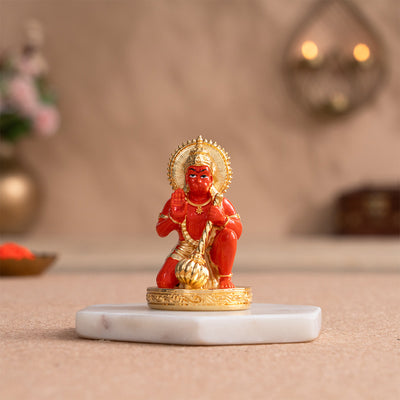
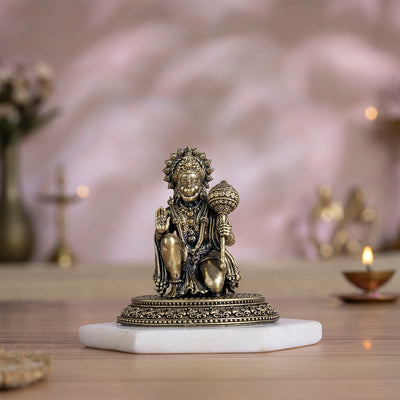
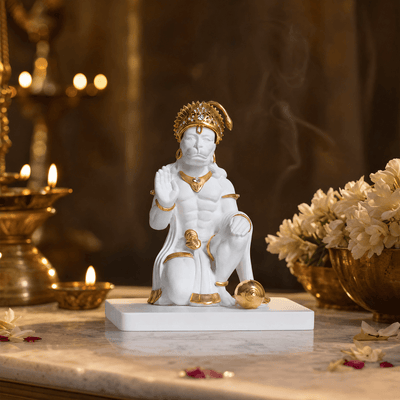
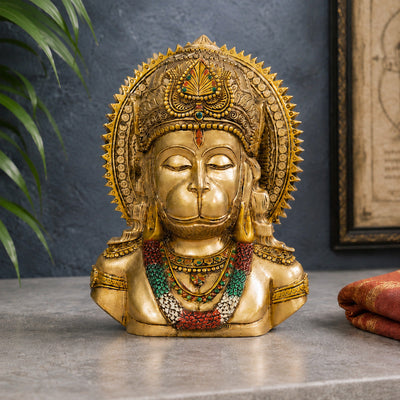
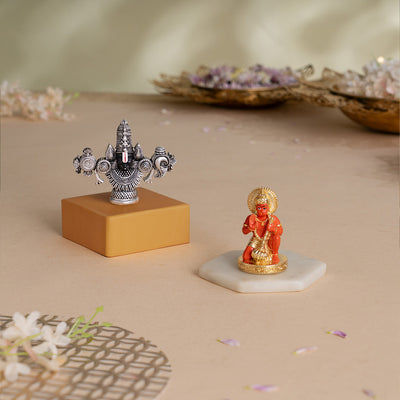
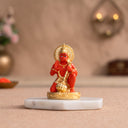
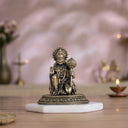
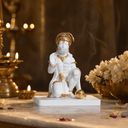
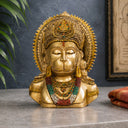
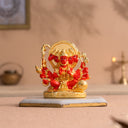
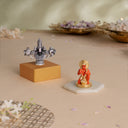
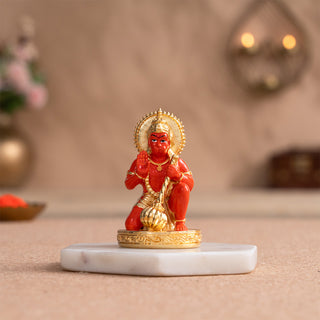
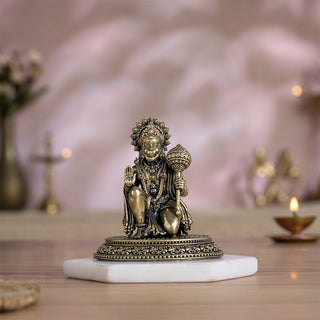
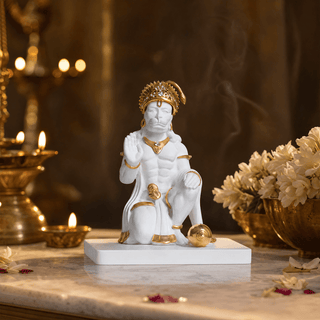
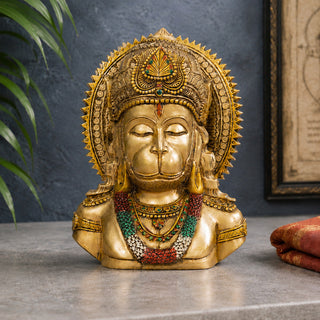
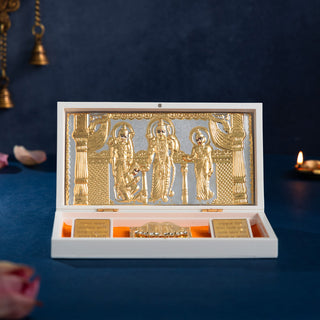
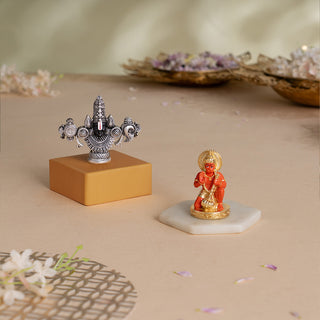
The iconography is real, though. Vira Anjaneya is the warrior with the mace raised. Dasa or Bhakta Hanuman stands with folded hands and head bowed, the form most at home in a family shrine. There is the Sanjivani-bearer with the mountain on his palm, and the abhaya mudra, the open palm meaning do not be afraid. A kneeling Hanuman in Ram bhakti is that second form exactly: hands folded, listening, which is the posture this entire article has been about. You'll find the full range across our Hanuman idols and murtis and among the older brass idols.
And if someone in the house is in pain, the thing to reach for isn't a placement rule. It's the Hanuman Bahuk: forty-four verses Tulsidas wrote around 1607 CE when his own arms hurt too much to sleep. People still recite it for exactly that, four hundred years later.
Which brings it back around. Hanuman asked to live as long as Rama's story is told. Not as long as the sun burns, not as long as the gods allow. As long as someone is still telling it. Every Sundar Kand path in a living room, every grandmother explaining where Sita came from or who Rama's brothers were, every diya lit on the night he came home (that's what Diwali diyas are for) is the condition of the boon being met.
He's alive because we haven't stopped talking. That's the deal he made.
Also read: Who Can Defeat Lord Hanuman | Lord Hanuman's Father | The Panchmukhi Hanuman Story | The 7 Chiranjeevis | What is Hanuman Bahuk | The 10 Biggest Hanuman Statues in India, by Verified Height