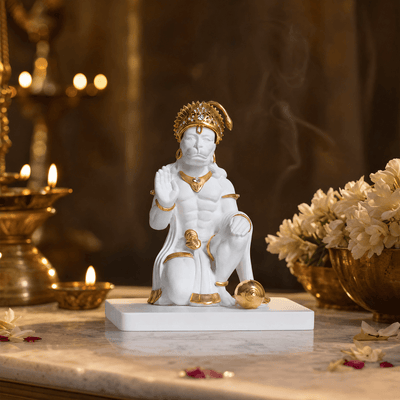
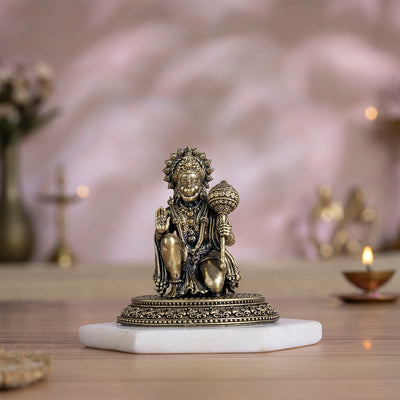
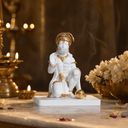
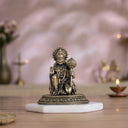
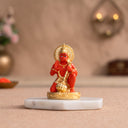
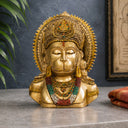
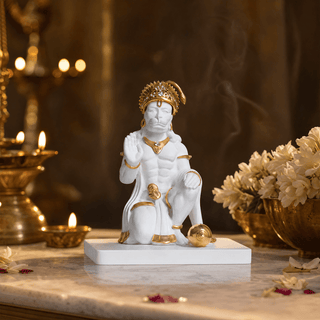
If you have stood in front of a Hanuman murti and wondered why one arm is raised and the other rests on the knee, that is a good question. It just is not the question "Hanuman Bahuk" answers.
Search the phrase today and you will find pages explaining the "symbolic arm posture of Hanuman," complete with meanings for the angle of the elbow. None of them cite anything, because there is nothing to cite. No Agama, no Shilpa Shastra text on image-making, no Purana describes a posture by that name.
What the name actually belongs to is a poem. An old man in Varanasi, in pain so bad that medicine and mantra had both failed him, sat down and wrote his way out of it.
What does "Hanuman Bahuk" mean?
Bahu is Sanskrit and Braja for the arm. Bahuk, in the sense Tulsidas used it, means the disorder or affliction of the arm, pain in the shoulder and arm severe enough to be named.
So the title is not "Hanuman's arm." It is closer to "the arm-affliction poem, addressed to Hanuman." Tulsidas had the ailment. Hanuman was the one he was asking for help.
The work is written in Braja Bhasha, the old literary dialect of the Mathura region. It runs to 44 verses across four metres: roughly two Chhappaya, one Jhulna, five Savaiya, and thirty-six Ghanakshari. Those numbers come from standard Braja editions, not a critical edition, so treat them as traditional.
Who wrote it, and why was he in pain?
Tulsidas (1511–1623 by traditional dating) is the poet behind the Ramcharitmanas, the Awadhi retelling of the Ramayana that most of north India actually knows the story from. He also wrote the Hanuman Chalisa, forty chaupais plus dohas, probably the most recited devotional text in India today, and the Vinaya Patrika, 279 stanzas of petition addressed to Rama's court.
The Hanuman Bahuk comes late, dated to about Vikram Samvat 1664 (around 1607 CE), near the end of his very long life. Biographical tradition records it plainly. He had severe pain in his arms and body. Medicines, amulets and the mantras he had spent a lifetime with had all failed.
What he did then is the whole point of the poem. He wrote the pain down. He describes his own body failing him across several stanzas. That is unusual for devotional verse of that period. Tradition records that he was relieved after composing it.
You do not have to believe the cure to find the document remarkable. A man who had written the definitive Rama epic of his language spent his last years writing a poem about how much his arm hurt, and addressed it to a monkey god. That is a very human thing to have done.
What is actually inside the 44 verses?
The Bahuk moves through four clear stages.
- Invocation. It opens by praising Hanuman through his familiar deeds: the ocean leap, the burning of Lanka, the mountain carried whole.
- The complaint. Tulsidas turns to his own body. The arm, the pain, the sleeplessness, the humiliation of a scholar who cannot use his writing hand.
- The argument. He does not simply beg. He reasons with Hanuman, points out that he has nowhere else to go, and occasionally sounds genuinely annoyed, the way you can only be with someone you trust completely.
- The surrender. He ends where every Tulsidas work ends, at Rama's feet, with Hanuman as the one who carries the request there.
The tone is what people miss. The Hanuman Chalisa is public and confident. The Bahuk is private and frayed. If the Chalisa is a hymn sung in a crowd, the Bahuk is what someone mutters at three in the morning.
Where did the "arm posture" idea come from?
Best guess: somebody read the title, saw bahu, knew it meant arm, and assumed the phrase described Hanuman's arm rather than the poet's. From there it spread the usual way. One page copies another, and soon there are hundreds, all describing a gesture nobody has ever carved.
It is a modern misunderstanding, not an old heresy. No traditional commentator ever read it that way. And it is easy to see why it stuck: Hanuman iconography really is full of meaningful arm positions, so a "symbolic arm posture" sounds plausible before you check.
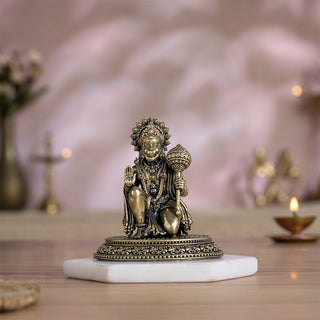
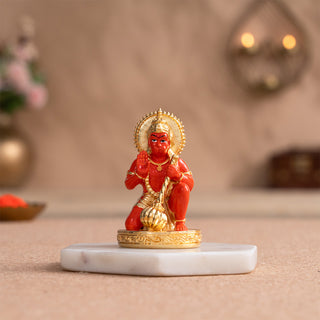
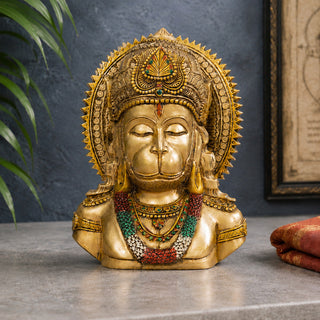
Those positions are real and they have proper names. The raised mace of Vira Anjaneya, the warrior form. The folded hands and bowed head of Dasa or Bhakta Hanuman, the servant standing before Rama. The open palm of abhaya mudra, meaning "do not be afraid." The flying figure with Sanjivani mountain balanced on one palm. Those are the terms to look up, and our guide to which Hanuman idol is good for home goes through them one by one.
Three things people get wrong about Hanuman Bahuk and Hanuman
1. "Sita blessed Hanuman with immortality at Rama's coronation."
This is repeated everywhere, and the passage everyone points to does not say it. Valmiki's Yuddha Kanda, Sarga 128, describes the gift-giving at the coronation: Rama gives Sugriva a chaplet, Angada a bracelet, and Sita takes off her pearl necklace and gives it to Hanuman (verses 78–79, 83). A gift of honour in front of the whole court. No boon of deathlessness is granted to anybody in that scene.6
The real anchor is elsewhere and it is stronger. In the Mahabharata, when Hanuman meets Bhima at Gandhamadana, he says the boon he asked Rama for was this: "may I live as long as the history of thy deeds remaineth extant on earth!" (Vana Parva, Section CXLVII, Ganguli's translation). His life is tied to the survival of the Ramayana.7 We wrote about that in detail in is Lord Hanuman still alive, and it also explains why he turns up in the traditional list of chiranjeevis.
2. "Nobody has ever hurt Hanuman."
Valmiki disagrees, twice, and is not embarrassed about it. In Yuddha Kanda 59, Ravana strikes Hanuman on the chest with the palm of his hand and Hanuman "reeled repeatedly." Hanuman hits back and Ravana "shook like a mountain when the earth trembles." Ravana then says, "Well done! Well done! O, monkey!" And Hanuman answers, "Cursed be that strength since you do still survive!" (verses 60–65). Two of the strongest beings in the epic land real blows on each other and neither falls.5
Earlier, Indrajit binds him with the Brahmastra (Sundara Kanda 48.36–37). The text is careful that Hanuman allowed it (being captured gets him an audience with Ravana), but the weapon worked. There is a comic footnote too: the rakshasas then tied him with ordinary ropes, which cancelled the Brahmastra, "because the bondage of that missile does not indeed coexist with another bondage." They freed him from a divine weapon by accident.3 Who can defeat Lord Hanuman walks through all of it, including Ravana's own brothers.
3. "The rules about Hanuman worship come from scripture."
Tuesday and Saturday worship, the offering of sindoor, south-facing Dakshinamukhi shrines: these are devotional practice and regional temple convention. They are widespread, they are meaningful, and they vary from region to region. No Purana legislates them for a home shrine.
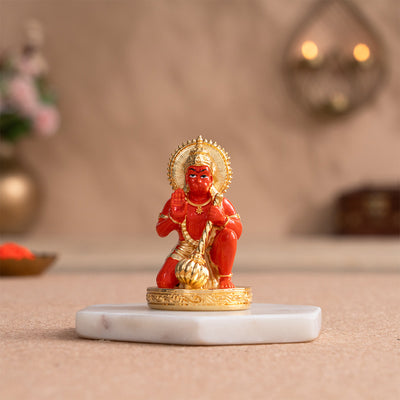
Saying so does not weaken them. The sindoor tradition, where devotees smear vermilion on the murti in memory of Hanuman covering himself in it for Rama's long life, is lovely and needs no fake citation to justify it. It is why a Sinduri Hanuman murti is finished the way it is: the colour is the story. If you want the one line of scripture that really does explain Hanuman as a household guardian, it is his promise to Bhima in the Mahabharata: "Remaining on the flagstaff of Arjuna's car will I emit fierce shouts that will damp the energy of thy foes" (Vana Parva, Section CL). That is why Arjuna's banner is Kapidhvaja, and it is a much better reason to put him at your doorway than a rule nobody can source.
How is the Hanuman Bahuk used today?
The Bahuk is still recited for physical ailment: arm and shoulder pain, chronic illness, recovery after injury. Tulsidas wrote it for pain, so people read it for pain.
It is harder going than the Chalisa. The Braja is denser, the Ghanakshari metre has long lines, and the mood is not celebratory. Many households pair the two rather than swapping them: Chalisa daily, Bahuk when someone is unwell. Tuesdays and Saturdays are customary, and Hanuman Jayanti is when you will hear it most.
If you want to recite in front of a murti at home, the sensible advice is boring and true: keep the space clean, keep it where you will actually sit, and do not over-engineer the rules. Our notes on what to keep in a pooja room and how to clean a marble idol cover the practical side, and the Sai Baba mantra for health and these Krishna mantras work in the same devotional grammar.
The Hanuman that Tulsidas was writing to
Valmiki gives him two fathers on purpose, using two precise legal categories: kshetraja-putra of Kesari, the social and legal son, and aurasa-putra of Vayu, the begetter (Kishkindha Kanda 66.18–19). Even his name comes from an injury: as a child he leapt at the rising sun mistaking it for fruit, Indra's vajra shattered his left hanu, his cheekbone, and the text says outright that this is where the name Hanuman comes from (66.21–24). We untangle all three answers, including the Shiva Purana's claim that he is an avatar of Shiva, in who was Lord Hanuman's father.
His famous invincibility is also two separate boons, not one. Brahma granted indestructibility by missiles; Indra granted that death would come to him only by his own will (66.27–29). That is chosen death, not unkillability.1
And here is the quality Valmiki actually praises him for. Searching Ravana's inner chambers, Hanuman worries that looking at other men's sleeping wives damages dharma. He resolves it not by claiming a vow of celibacy (he never does that anywhere in Valmiki), but by saying that in his mind "there indeed was not even a little disturbance," and "my that mind is very steady" (Sundara Kanda 11.37–41). Steadiness, not abstinence.2 The lifelong-brahmachari framing came later, and so did the stories that grew around it, like the Suvarchala marriage and the sweat-born son Makardhwaja.
A man asking for relief from pain, addressing a god whose defining trait is a mind that does not waver. The choice makes sense.
So what should you take from all this?
If you came looking for the meaning of Hanuman's arm posture, here is the honest exchange: no hidden mudra, but a real poem with a real date, a real author, and a real reason for existing. That is a good trade.
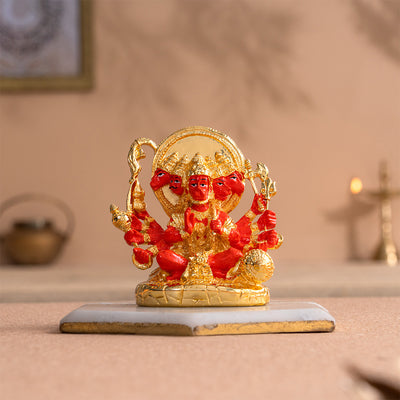
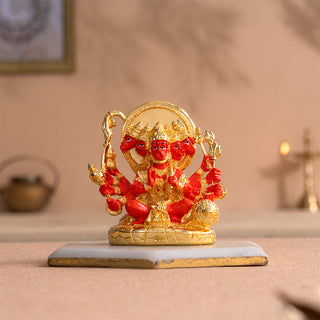
It also points at something about the whole tradition. The strongest material is almost never the mystical-sounding claim. It is the ordinary, verifiable detail: an epic that admits Ravana staggered him, a Mahabharata passage where he refuses to show Bhima his old form because "diminution is going on this age," a poet in Varanasi with a bad shoulder. The five-faced Panchmukhi form is genuinely beloved and genuinely not in Valmiki. It comes from the fifteenth-century Bengali Krittivasi Ramayana and a sixteenth-century Telugu retelling. Knowing that makes it more interesting, not less.
Hanuman is a supporting character who refuses to stay one. He appears in the middle of the Rama avatar story, outlives it, walks into the Mahabharata, and ends up on more household shelves than almost anyone. Tulsidas, who told Rama's whole story including his brothers and Sita's origins, knew exactly who to call when his own body failed. So do a lot of people, still, four hundred years later.
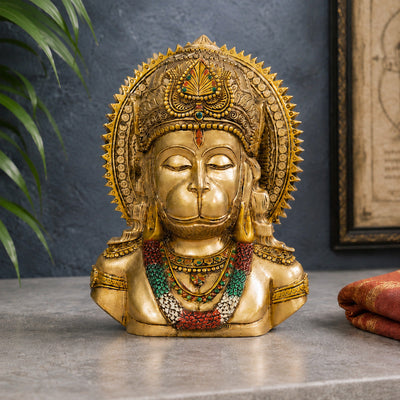
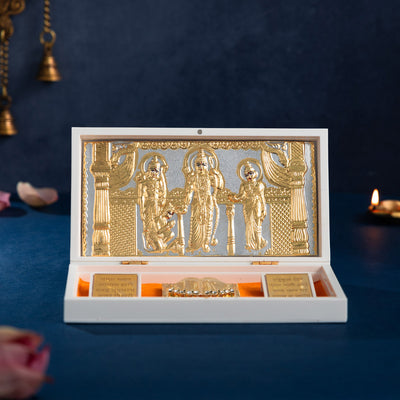
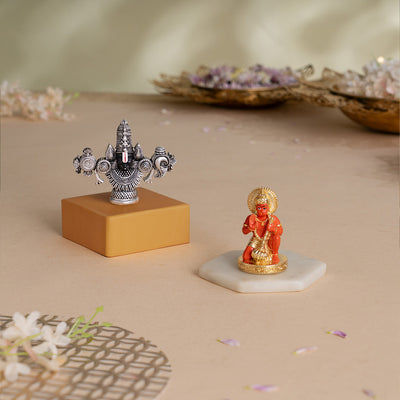
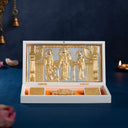
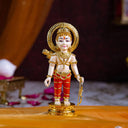
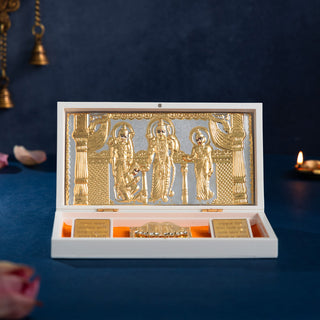
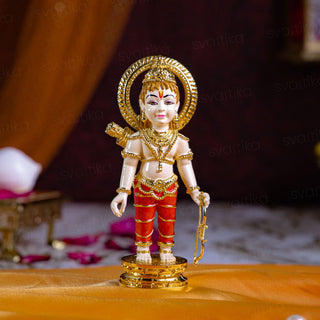
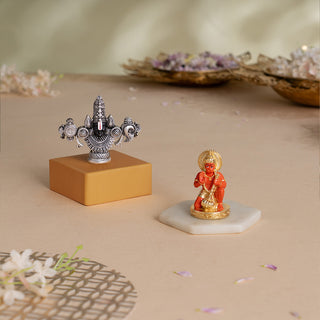
If you are bringing him home for that reason, the form matters more than the direction it faces. Our Hanuman murtis range from the small sindoor-finished figures to the kneeling brass forms in Ram-bhakti, and a Ram Darbar puts him exactly where he always chose to stand: at Rama's feet, listening.
Also read: Is Lord Hanuman Still Alive | Who Can Defeat Lord Hanuman | Who Was Lord Hanuman's Father | The Panchmukhi Hanuman Story | Which Hanuman Idol Is Good for Home