Ask this online and you get one word back. Nobody.
Which is a shame, because the Ramayana gives a better answer. Valmiki was not writing a comic where the hero never takes a punch. He wrote scenes where Ravana knocks Hanuman sideways, a divine weapon ties him up, and the strongest man of a later age cannot lift his tail. None of it makes Hanuman smaller. It makes him real.
Ravana hit him in the chest, and Hanuman reeled
Ravana struck Hanuman on the chest with the flat of his palm, and Hanuman shook. Not a weapon, just a slap from a ten-headed king. The scene is Yuddha Kanda, sarga 59, with Rama's army and Lanka's in the open field, and Ravana and Hanuman face to face. (All Sanskrit quoted here is Valmiki's; the English is ours.)
एवमुक्तो महातेजा रावणो राक्षसेश्वरः। आजघानानिलसुतं तलेनोरसि वीर्यवान् स तलाभिहतस्तेन चचाल च मुहुर्मुहुः। स्थितो मुहूर्तं तेजस्वी स्थैर्यं कृत्वा महामतिः
In plain English: Ravana, lord of the demons, struck the son of the wind on the chest with his palm. Hit by that palm he shook again and again; then he stood a moment, and made himself steady.
Valmiki Ramayana, Yuddha Kanda 59.60–61
He does not fall. But he wobbles, and the poet writes it down. Then Hanuman slaps him back and Ravana rocks like a hill in an earthquake. And then something odd happens. Ravana stops mid-battle and praises him.
साधु वानर वीर्येण श्लाघनीयोऽसि मे रिपुः। धिगस्तु मम वीर्यस्य यत् त्वं जीवसि रावण। सकृत् तु प्रहरेदानीं दुर्बुद्धे किं विकत्थसे
In plain English: “Well struck, monkey. Your courage makes you an enemy worth praising.” Hanuman answered: “Shame on my strength, Ravana, if you are still alive. Strike once more, fool. Why stand there boasting?”
Valmiki Ramayana, Yuddha Kanda 59.65–66
Note what he is angry about. Not Ravana's blow. His own, for leaving the man standing.
And it does not stay a draw. Later in the same sarga Hanuman drives a fist into Ravana's chest. Ravana goes down on his knees, blood running from his mouth and eyes and ears, senseless on the floor of his own chariot (59.114–117). Hanuman can be hit. He also hits harder.
Indrajit's Brahmastra actually worked
Indrajit fired the Brahmastra at Hanuman, and it worked. It binds him, and he goes down and lies still. The scene is Sundara Kanda 48, in the garden at Lanka, after Hanuman has torn the place apart.
But read the verses just before it. Hanuman has already done the arithmetic in his head:
ग्रहणे चापि रक्षोभिर्महन्मे गुणदर्शनम्। राक्षसेन्द्रेण संवादस्तस्माद् गृह्णन्तु मां परे
In plain English: There is something to be gained even in being seized by these demons: it will get me a conversation with their king. So let my enemies take me.
Valmiki Ramayana, Sundara Kanda 48.44
He then settled on his objective and stayed motionless.
He says he is protected by Brahma, Indra and Vayu, and has no fear. He is not overpowered. He is walking into the throne room the only way a spy can, as a prisoner.
Then the rakshasas, not trusting a divine weapon, tie him up with bark rope as well:
स बद्धस्तेन वल्केन विमुक्तोऽस्त्रेण वीर्यवान्। अस्त्रबन्धः स चान्यं हि न बन्धमनुवर्तते
In plain English: Bound with that bark rope, the strong one was released from the weapon. For the weapon's binding does not stay on when another binding follows it.
Valmiki Ramayana, Sundara Kanda 48.48
Ravana's own guards freed him from the most powerful weapon in the world by being thorough.
So did a weapon defeat Hanuman? A weapon landed. He let it. Then it fell off.
What his boons actually protect against
Hanuman's boons are two narrow grants, not one big cheat code. Weapons cannot kill him, and he dies only when he chooses to. Jambavan lists them in Kishkindha Kanda 66.
प्रसादिते च पवने ब्रह्मा तुभ्यं वरं ददौ। अशस्त्रवध्यतां तात समरे सत्यविक्रम स्वच्छन्दतश्च मरणं तव स्यादिति वै प्रभो।
In plain English: Brahma gave you this boon: that you cannot be killed by weapons in battle. And Indra gave you this: that your death will come only when you yourself choose it.
Valmiki Ramayana, Kishkindha Kanda 66.27–29
An earlier version of this article said Brahma's boon covered missiles only, and argued that a bare hand slipped through a gap in it. That was wrong, and the error came from an English word, not from Valmiki. The Sanskrit is ashastra-vadhyatam, and shastra is the ordinary word for a weapon. Where Sanskrit does draw the line, shastra is the blade in the hand and astra is the thing thrown or invoked. So the boon is broader than "missiles", not narrower, and has no loophole for palms.3 Ravana's slap lands because a slap was never going to kill him.
The two boons are still narrow, and still the point. Weapons will not finish him. The timing is his own. That is not invulnerability, it is closer to sovereignty. He is still alive, and sits among the chiranjivis, because nobody else holds the switch.
Bhima could not lift his tail
Bhima could not lift Hanuman's tail, even with both arms. The Ramayana never stages a strength contest for Hanuman, but the Mahabharata does, and it is the cleverest ranking scene in either epic. It is not even a fight.
The Pandavas are in exile. Bhima finds an old monkey lying across the path with his tail in the way and tells him to move. The monkey says he is too old, just lift it aside. Bhima tries with one hand. Nothing. Then with both arms, everything he has. The tail does not move.7
Bhima is the strongest of the five brothers, and also a son of Vayu. That makes this a meeting between half-brothers. Vyasa never has them wrestle. He does not need to.
And then Hanuman says the thing that reframes the whole question. Bhima asks to see the form he had when he crossed the ocean for Rama, and Hanuman says no:
अयं प्रध्वंसनः कालो नाद्य तद् रूपम् अस्ति मे
In plain English: This is an age of decline. I no longer have that form.
Mahabharata, Vana Parva 148.6
Bhima refuses to leave without seeing it, so Hanuman shows him anyway. He swells until he hides the grove, then remarks that he could grow further still if he wanted to (Vana Parva 149.1–9). The yugas have reduced what he displays. Time is the only thing in either epic that gets to reduce him at all.
The obstacles he solved by not fighting
Hanuman beat two of his three obstacles by thinking, not fighting. They block him on the way to Lanka in Sundara Kanda 1.
Mainaka, the golden mountain rising to offer him rest, he brushes past with his chest. The only obstacle he meets with force, and it was not even hostile.
Surasa, mother of serpents, has a boon that everything crossing must pass through her mouth. Hanuman does not fight a boon. He grows enormous, she opens wider, then he shrinks to thumb-size, darts in and out, and tells her the boon is satisfied.
Simhika, who catches things by their shadow, he beats by expanding until she cannot handle what she has caught.4
Two of three solved by wit. Hanuman is undefeated not because his arms are bigger, but because he keeps choosing the frame of the contest.
Five things people get wrong about this
1. "Nobody has ever hurt him." Valmiki disagrees twice, in the scenes above. Ravana's palm strike lands. Indrajit's Brahmastra binds. Hanuman is unbeatable in the sense that he is never actually stopped, not in the sense that nothing ever touches him.
2. "Sita blessed him with immortality at the coronation." Yuddha Kanda 128 is the passage everyone cites, and it does not say it. Sita takes the pearl necklace off her own neck and gives it to Hanuman (128.79). Rama gives Sugriva a garland and Angada armlets. It is a scene of honours, not boons. The real anchor is stronger. In the Mahabharata, Hanuman tells Bhima that what he asked Rama for was to live as long as Rama's story lives in the worlds (Vana Parva 147.37). His life is tied to the survival of the story.
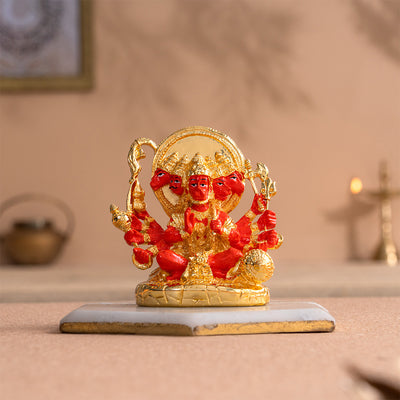
3. "The Panchmukhi form is in the Ramayana." Not in Valmiki at all. Ahiravana, the abduction to Patala, the five lamps, the five-faced form with Narasimha, Garuda, Varaha and Hayagriva: all of it comes from later regional retellings, chiefly the Bengali Krittivasi Ramayana of around the 15th century and a 16th-century Telugu Mairavana charitra. Roughly two thousand years after Valmiki. Real and beloved, simply younger than people assume. The same cycle gives us Makardhwaja.
4. "The Ramayana calls him a brahmachari." It doesn't. The one place the question comes up is Sundara Kanda 11. He has just searched Ravana's sleeping quarters, and he worries that looking at other men's wives damages dharma. He settles it without citing a vow. He says that nothing in his mind moved, that the mind drives every sense, and that his is well settled (11.41–42). Composure, not abstinence. The celibacy framing (and everything built on it, including the Suvarchala marriage tradition) is later devotional emphasis laid over a subtler original.
5. "Hanuman Bahuk is a posture of his arm." Nowhere in any iconographic or scriptural source. Hanuman Bahuk is a 44-verse Braja poem Tulsidas wrote around 1607 CE, when his arms hurt badly. Bahu means arm. It is a petition for relief.
Is he stronger than Bali, or Shiva, or anyone else?
Valmiki never stages a contest between Hanuman and Vali, and the Puranas never adjudicate Hanuman against Mahabali. Those rankings are folk comparison, not something the epics settle. Anyone handing you a confident tier list is making it up.
What the texts do give is more useful. The Shiva Purana calls Hanuman an avatar of Shiva. Other Puranas call him a marud-amsha, a portion of Vayu. Valmiki gives him two fathers, Kesari as kshetraja and Vayu as aurasa. Those frameworks genuinely disagree, and the disagreement beats a ranking. We ran the same argument for Shiva and for the most powerful god in Hinduism, where the answer is also "the texts don't agree, and here's why."
So who finally defeats Hanuman?
Two answers, and both are in the text.
The first is Hanuman. Indra's boon put death in his own hands. Every time the story could have gone against him, the deciding move is his: to be bound, to shrink, to hold back. His invincibility is a decision he keeps making.
The second is time, and he admits it to Bhima's face. The strongest being in the Ramayana tells the strongest man in the Mahabharata that he is not what he was. There is no enemy in that sentence. Only age.
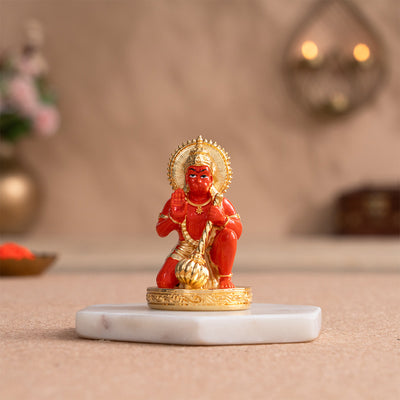
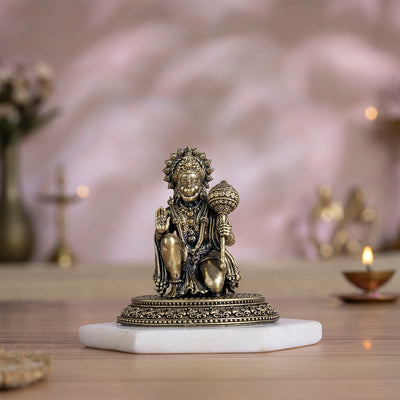
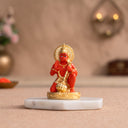
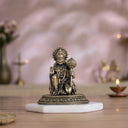
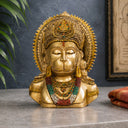
Which is maybe why he is almost never carved in triumph. The Hanuman forms people keep are the folded hands, the slight bow, the kneeling Ram Bhakti posture. All of them show someone who could win any fight choosing not to be the point of the scene. That is the Dasa or Bhakta form. On choosing between them, see which Hanuman idol suits a home, where we were equally honest about which placement rules are scripture and which are custom.
There is one real scriptural reason Hanuman stands at doorways, and it is not a Vastu rule. In the same Gandhamadana meeting he promises Bhima this:
विजयस्य ध्वजस्थश् च नादान् मोक्ष्यामि दारुणान् शत्रूणां ते प्राणहरान् इत्य् उक्त्वान्तरधीयत
In plain English: “And standing on Arjuna's flagstaff I will let out terrible roars that take the life out of your enemies.” Having said this, he vanished.
Mahabharata, Vana Parva 150.15
That is why Arjuna's banner is Kapidhvaja. He asked to be posted at the front of somebody else's chariot. A threshold is just a smaller version of the same job.
So that is the answer to the title. Ravana could stagger him. Indrajit could bind him. Rama's war could not have been won without him. Nobody defeats him, and he spends the epic acting like the win was never his to claim. Whether you keep him in brass or marble dust, or simply mark Hanuman Jayanti, that is the part worth carrying home. When Rama left the world, Hanuman stayed. What he asked for was not to be unkillable, but to be here as long as the story is told.
Also read: Is Lord Hanuman Still Alive | Who Was Lord Hanuman's Father | The Panchmukhi Hanuman Story | Makardhwaja, the Son of Hanuman | What Is Hanuman Bahuk