Most articles about Panchmukhi Hanuman open with a list. Five faces, five directions, five qualities. Read three of them and you still have no idea why he needed five faces in the first place. The five faces are not a power-up. They are the solution to a puzzle, and somebody had to invent that puzzle first.
Why did Hanuman need five faces at all?

Hanuman needed five faces because his enemy could only be killed by five lamps going out at the same instant. One body has one mouth. That is the whole difficulty.
The setting is the last stretch of the war in Lanka. Ravana is losing. His brothers are gone, his sons are gone, his army thins by the day. If you want the full cast of who he lost, the story of Ravana's six brothers covers it.
So Ravana calls in a relative from the underworld: Ahiravana, a sorcerer-king of Patala and a devotee of the goddess. Ahiravana does not fight. He waits until the camp sleeps, slips past the guards, and carries Rama and Lakshmana away to Patala, to be sacrificed at his goddess's altar at dawn. Lakshmana had been at Rama's side every day of the exile, and of Rama's four brothers he was the one who never left.
Hanuman goes after them. He finds the palace. He gets past the gate. Then he runs into the real problem. Ahiravana's life is held in five lamps burning in five separate directions inside the chamber. Put out four and the fifth revives him.
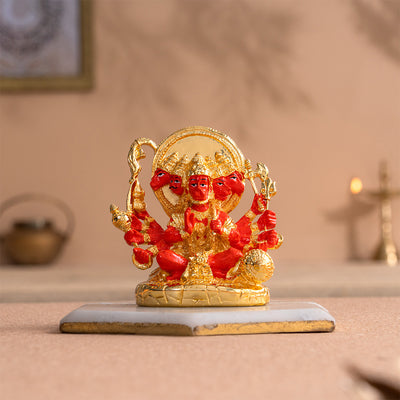
So Hanuman becomes Panchmukhi: five faces, one breath, five flames dead at once. The five faces are an answer, not an ornament.
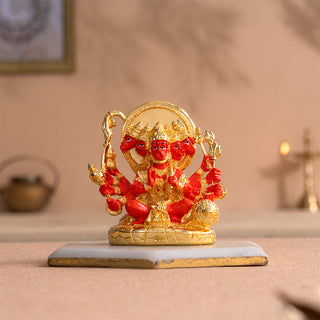
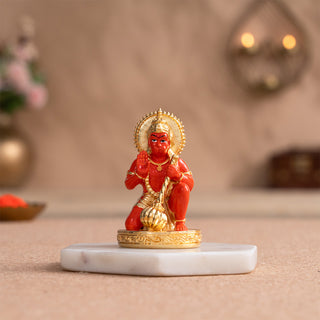
The five faces of Panchmukhi Hanuman, and which way each one looks

The arrangement is consistent across the traditions that carry this story:
- Hanuman (Anjaneya): facing east. His own face, the one you already know.
- Narasimha: facing south. The lion-man Vishnu became to tear apart Hiranyakashipu. The Narasimha avatar story is the fiercest thing in the Puranas.
- Garuda: facing west. Vishnu's eagle, the one who eats serpents. Useful in a snake-ruled underworld.
- Varaha: facing north. The boar who lifted the earth out of the cosmic waters, told in the Varaha avatar story. Another form that goes down and brings something back up.
- Hayagriva: facing upward. The horse-headed form of Vishnu, keeper of recovered knowledge.
Notice what four of the five have in common. Narasimha, Varaha and Hayagriva are all forms of Vishnu, and Garuda is Vishnu's own mount. Only one face on that body is Hanuman's.
That is the theology of the icon, stated without a word of explanation. Rama is Vishnu on earth, the whole premise of the Rama avatar, one of the ten avatars of Vishnu. So when Rama lies helpless on an altar in Patala, the servant carries the master's own arsenal. The rescue is Vishnu rescuing himself, through a devotee.
Where the Panchmukhi Hanuman story actually comes from
The Panchmukhi episode is not in Valmiki's Ramayana. Not a line of it. No Ahiravana, no Patala abduction, no five lamps, no five faces.
It appears instead in later regional Ramayanas. The best-known is the Bengali Krittivasi Ramayana of roughly the fifteenth century, in the passage called the Mahirabonerpala. A Telugu Mairavana charitra, attributed to the sixteenth-century poet Adithya Kavi, carries its own telling, and there are Tamil, Oriya and Malayalam versions of the same night.
Valmiki is usually dated to the last few centuries BCE. Krittivasa is fifteenth century CE. That is a gap of around two thousand years.
This does not make the story fake, and it should not make you love it less. Regional Ramayanas are how the epic survived in India. Not as one frozen Sanskrit text, but as a story retold in every language, each generation adding what its listeners needed. The Bengali version needed a night where devotion was tested in the dark. So it wrote one.
Be honest about the date and the story gets better, not worse. Somebody in fifteenth-century Bengal designed a lock that only a five-faced god could open. That same appetite for retelling is why how Rama finally died reads so differently depending on which text you pick up.
Four things people get wrong about Panchmukhi Hanuman
1. "It's part of the Ramayana."
Only if you mean the Ramayana as a living tradition rather than Valmiki's text. Valmiki has none of it, and neither does Tulsidas's Ramcharitmanas. Anyone who hands you a Sundara Kanda verse number for the five faces is inventing it.
2. "Hanuman was never hurt by anyone."

Valmiki disagrees, quite cheerfully. In Yuddha Kanda 59, Ravana strikes Hanuman on the chest with the flat of his palm and Hanuman "reeled repeatedly." Hanuman hits back and Ravana "shook like a mountain when the earth trembles." Ravana then compliments him: "Well done! Well done! O, monkey!", and Hanuman snaps back, "Cursed be that strength since you do still survive!"4
Indrajit binds him too, with the Brahmastra, in Sundara Kanda 48. The text is careful that Hanuman allowed it, since capture was the only way to get an audience with Ravana. But the weapon worked.3 He is unstoppable, not untouchable. And who can actually defeat Hanuman goes into that properly.
3. "Makardhwaja is in the Ramayana."
He is not, in either Valmiki or Tulsidas. He belongs to this same Ahiravana cycle in the regional retellings, which is why he gets his own section below. No verse number exists for him anywhere, and pretending otherwise is what makes people stop trusting devotional writing.
4. "Vastu says you must never keep Panchmukhi Hanuman at home."
No Purana or Agama I can point to says anything about which Hanuman form belongs in a private house. Those rules are regional custom, and they contradict each other from state to state. Custom is worth respecting. It is not worth dressing up as scripture.
The gatekeeper turned out to be his own son
The guard at Ahiravana's gate was Makardhwaja, Hanuman's own son. He is half monkey and half fish, and he says so himself when Hanuman arrives.
Hanuman has never married and has no idea what the man is talking about, so he asks him to explain. The answer is one of the strangest things in the whole Hanuman corpus. After burning Lanka, Hanuman dived into the ocean to cool his tail. A drop of his sweat fell into the water, and a makara swallowed it. Makardhwaja was born from that.
Sweat and a fish means no woman, no desire, no broken vow. The tradition wanted Hanuman to have a son without it costing him anything, and this is the workaround it built. The full account is in the story of Makardhwaja.
Father and son fight. Neither will step aside. Makardhwaja was raised to guard that gate; Rama is inside. Makardhwaja loses, and Hanuman, instead of killing him, makes him king of Patala on the way out. The most loyal gatekeeper in the story is loyal to the wrong side, and his father rewards the quality rather than punishing the allegiance. Which raises the obvious question, and whether Hanuman ever had a wife has a stranger answer than you would expect.
What Valmiki does give us instead

Valmiki gives Hanuman a full history instead, and it is more careful than the popular version.
In Kishkindha Kanda 66, Jambavan recites Hanuman's history back to him, because Hanuman has forgotten it. Anjana was formerly the apsara Punjikasthala. Kesari is the father who holds him in law and lineage; Vayu the wind-god is the one who begot him. Valmiki uses two precise terms for this, kshetraja-putra and aurasa-putra, and means both.1 So who Hanuman's father really was has three defensible answers, and the texts disagree.
The same passage explains his name. As a child he leapt at the rising sun thinking it was fruit, and Indra's thunderbolt broke his left hanu, his jaw, as he fell. He is named after an injury.
It also gives his two boons. Brahma granted that no missile could destroy him. Indra granted that death would come only by his own will. That is not invulnerability. It is a man who chooses his own ending, which is why he is counted among the chiranjeevis and why Hanuman is believed to still be alive.
One more, because it is my favourite. Crossing the ocean in Sundara Kanda 1 he meets three obstacles. Mainaka he handles with his chest. Surasa he beats by shrinking to thumb-size and slipping through her mouth, and Simhika by playing with his own shadow.2 Two of three are solved by thinking. The strongest being in the epic mostly wins by being clever.
Is Hanuman a form of Shiva or a son of Vayu?
Both, depending on which text you open. The Shiva Purana identifies Hanuman as an avatar of Shiva himself. Other Puranas call him a marud-amsha, a portion of the wind. Valmiki does neither. Vaishnava traditions do not accept the Shiva-avatar reading; Shaiva ones build a great deal on it. Three frameworks, three answers, all held at once by people who worship the same god. It is also why the most powerful god in Hinduism question has no single winner.
The epithets preserve all of it. Anjaneya from his mother. Kesari-nandan from his father. Pavanputra and Maruti from the wind. Bajrangbali from the thunderbolt that scarred him. Every name he carries is an argument about who he is.
Should you keep a Panchmukhi Hanuman at home?
Yes, and no scripture says otherwise. No Purana or Agama sets rules about which Hanuman form belongs in a private house. This is the corner of the internet built entirely on confidence with nothing behind it. Tuesday and Saturday worship, the sindoor offering, south-facing shrines. These are devotional practice and regional temple convention, widespread and meaningful, but not legislated by any Purana. The same goes for the Hanuman Bahuk, which is a Tulsidas poem about arm pain, not the hand-posture the internet keeps insisting it is.
There is one genuinely scriptural reason why Hanuman belongs at a doorway, and almost nobody uses it. It is in the Mahabharata, not the Ramayana. Meeting Bhima at Gandhamadana, Hanuman promises: "Remaining on the flagstaff of Arjuna's car will I emit fierce shouts that will damp the energy of thy foes."6 That is why Arjuna's banner is called Kapidhvaja, the monkey-standard. Hanuman at an entrance is not a Vastu rule. It is a promise he made in a forest.
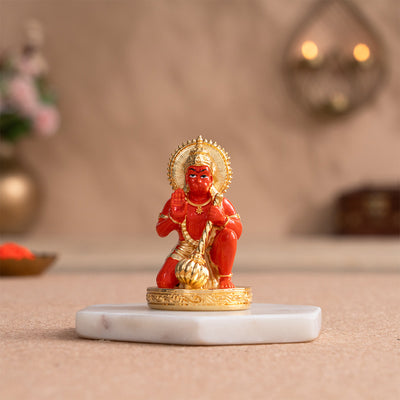
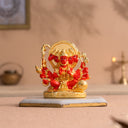
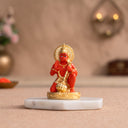
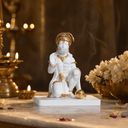
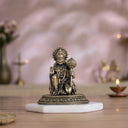
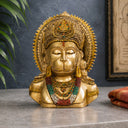
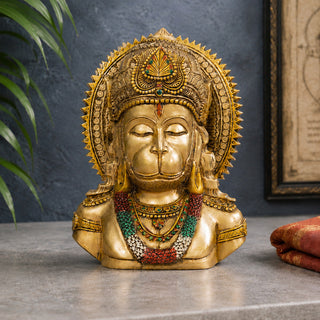
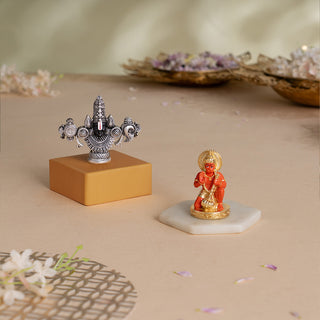
As for the form: the Panchmukhi is his watchful, protective face, which is why it is so often set near an entrance. The folded-hands Dasa form suits an inner shrine. We have laid out the difference in which Hanuman idol suits a home, and we make Panchmukhi Hanuman idols in brass and gold plate, including this five-faced murti with orange enamel, alongside the quieter seated forms.
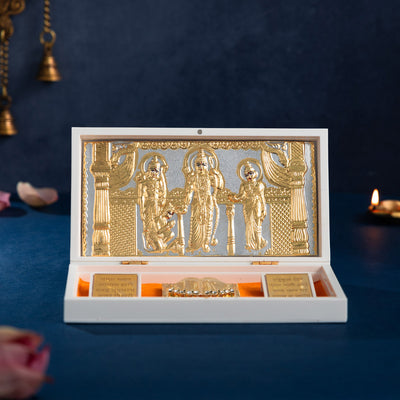
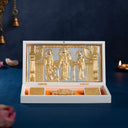
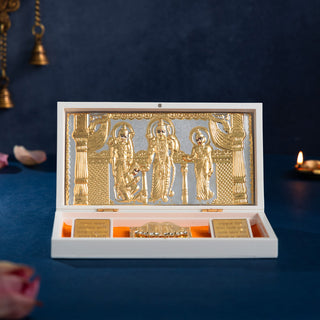
Lamps are the other honest link here, since the whole episode turns on five flames. Lighting a brass diya at the threshold on a Tuesday needs no scriptural warrant. It is simply what people have done for a very long time. And if you want the whole Ayodhya household in the shrine rather than Hanuman alone, the Ram Darbar and Lord Ram idols keep him where he always stood, at Rama's feet.
Why this story lasted

Every big Hanuman moment in Valmiki happens in daylight and in company. The leap across the ocean, the burning of Lanka, the mountain carried back with the herb on it. Rama is somewhere in the frame, or an army is watching.
Ahiravana's night is the opposite. No army, no orders. Rama is unconscious on an altar and cannot help. Hanuman is underground, alone, fighting his own son at a gate, facing a lock designed to be unopenable.
That is what the five faces were invented for. Not a display of power, but the moment devotion has to work with nobody watching. A fifteenth-century poet understood something about faith that a battle scene could never show.
The next time you see the five-faced murti, you are not looking at a list of attributes. You are looking at five flames going out at once.
Also read: Is Lord Hanuman Still Alive | Who Can Defeat Lord Hanuman | Son of Hanuman: Makardhwaja | What is Hanuman Bahuk | Why Hanuman Jayanti is Celebrated Twice | The 10 Biggest Hanuman Statues in India, by Verified Height