Almost every list of India's biggest Hanuman statues copies its numbers from the last list, and the numbers are wrong. One page says the tallest is 176 feet. Another says 135. A third hands the title to a statue in Shimla that is barely a hundred feet tall.
So this list only carries heights that can be traced to a source you can open yourself. Where the sources disagree, that is said out loud instead of being smoothed over.
The 10 biggest Hanuman statues in India
Ordered by height, counting only statues that are actually built and standing today.1
- Statue of Bhagavan Hanuman — 187 ft (57 m). Manav Bharti University, Solan, Himachal Pradesh. Completed 2019. The tallest in the country, and the one almost every list leaves out.
- Madapam Hanuman — 171 ft (52 m). On the bank of the Vamsadhara river, Narasannapeta mandal, Srikakulam district, Andhra Pradesh. Completed 2020. Usually described as the world's tallest Hanuman.
- Panchamukhi Hanuman — 161 ft (49 m). Bidanagere, Kunigal taluk, Karnataka. Completed 2022. The tallest five-faced Hanuman anywhere.
- Veera Abhaya Anjaneya Hanuman Swami — 135 ft (41 m). Paritala village, Krishna district, Andhra Pradesh, on NH-65 about 30 km from Vijayawada. Opened 22 June 2003.2
- Hanuman of Damanjodi — 108 ft 9 in (33.1 m). Damanjodi, Koraput district, Odisha. Completed 3 March 2017.
- Shri Hanuman Jakhu — 108 ft (33 m). Jakhu Hill, Shimla, Himachal Pradesh. Unveiled 2010.3
- Hanuman Murti, Shahjahanpur — 105 ft (32 m). Shahjahanpur, Uttar Pradesh. Completed 2013.
- Hanuman of Nandura — 105 ft (32 m). Shri Balaji Mandir, Nandura, Buldhana district, Maharashtra, right beside the Mumbai–Nagpur highway.
- Agara Hanuman — 102 ft (31 m). Agara, Bengaluru, Karnataka. Completed 2012.
- Statue of Lord Hanuman, Simariya — 101 ft (30.8 m). Chhindwara district, Madhya Pradesh. Completed 2014. The tallest statue in Madhya Pradesh.

Two things stand out straight away. Six of the ten went up after 2010, so this is a living building tradition and not a historical one. And four of the ten are in Andhra Pradesh and Karnataka, which is not an accident. The Anjaneya devotion of the Deccan has been building tall for a long time.
Why the "tallest" title keeps changing hands
Because the people making the claim are not measuring the same thing, and because new ones keep going up.
The Paritala statue was described as the second tallest Hanuman in the world when it opened in 2003, and it carried that reputation for years.2 Then Damanjodi arrived in 2017, Madapam in 2020, Bidanagere in 2022. Every one of those launches produced a fresh round of "world's tallest" headlines, and none of the older pages was ever corrected. That is why a search today returns four different winners.
There is a plain measurement problem underneath it too. Madapam is quoted as 171 ft in one place and 176 ft in another. The 176 ft figure looks like the planned height for the project rather than the finished statue.1 Nobody rechecked after it was built, so both numbers now circulate as fact.
And heights get quoted with the plinth included, or without it, depending on which sounds better. A statue on a twenty-foot base can honestly be called either. Nobody ever says which they mean.
If you want one sentence to carry away: Solan is the tallest in India at 187 ft, Madapam is the one the world calls tallest at 171 ft, and both numbers get quoted carelessly.

 26% off
Jakhoo in Shimla is not the tallest. It is the highest.

This is the most repeated error on the subject, and it comes from a real fact being described sloppily.
The Shri Hanuman Jakhu statue is 108 ft tall, which puts it sixth on this list. But it stands on Jakhu Hill at roughly 8,500 feet above sea level, and that makes it the highest-placed Hanuman statue in the world by a very wide margin.3 It was unveiled in 2010 by the then Chief Minister of Himachal Pradesh, Prem Kumar Dhumal, along with Nikhil Nanda.
"Highest" became "tallest" somewhere in the retelling. A Guinness filing then gets cited as though a filing were the same thing as a record, which it is not. An application is not an award.
Go anyway. Standing at 8,500 feet with the Shimla ridge below you and a hundred-foot Hanuman above you is worth the climb, and the temple is old regardless of the statue. Just do not repeat the tallest claim.
The one that is carved from a single stone
There is a category the height table cannot show, and it belongs to a statue less than a fifth the size of the leaders.
The Viswaroopa Bhakta Anjaneya at Nanganallur in Chennai is 32 ft tall, nowhere near this list. But it was cut from one piece of granite.5 The idol was installed in 1989 and the kumbhabhishekam completed in 1995. Every statue in the top ten is built: concrete over a steel frame, panels, joints, a hollow core. Nanganallur is carved.
That is a completely different kind of difficulty, and by the older reckoning it is a completely different kind of achievement. A concrete statue can be made as tall as the budget allows. A monolith can only ever be as tall as the stone that came out of the quarry.
The Hanuman Vatika at Rourkela in Odisha is a useful marker for how recent all of this is. At 75 ft it was inaugurated in 1994 by Biju Patnaik, then Chief Minister, and sculpted by Sri Lakshman Swami of Hyderabad.4 For its time it was enormous. Today it would not make the top ten.
Why Hanuman, of all the gods, is the one people build big

You do not see many 170-foot Ganeshas outside a festival pandal. With Hanuman it keeps happening, and the reason sits in the text rather than in the engineering.
Hanuman is the only major deity whose size is part of the story. In the Sundara Kanda he grows to cross the ocean, and Valmiki gives real attention to the growing itself, the hill flattening under his feet and the trees dragged up in his wake.6 Sculptors have something to work from that most deities never give them.
There is a counterweight in the Mahabharata that almost nobody carves. When Bhima meets him in the forest of Gandhamadana and asks to see that ocean-crossing form, Hanuman first refuses and says the age has thinned him out.7 Then he shows it anyway, and adds that he could grow larger still. We went through that scene in full in whether Hanuman is still alive, because the same conversation carries the boon his deathlessness actually rests on.
So the big statues are making an argument. They are not saying Hanuman is powerful in the abstract. They are pointing at one specific afternoon on one specific shore. It is the same instinct that puts him at gates and on dashboards, and it has a better basis than any direction chart: his own promise to sit on the front of Arjuna's chariot and roar down whatever was coming.
It shows in the poses too. The Paritala statue holds the mace high, the warrior Vira Anjaneya. Bidanagere is the five-faced Panchmukhi form, which is not in Valmiki at all and comes from the Bengali Krittivasi Ramayana around the 15th century. A story that kept growing for two thousand years is exactly what his place among the chiranjivis rests on, and the same late-tradition pattern explains Makardhwaja as his son and the marriage to Suvarchala.
Five things people get wrong about these statues
1. "The Shimla statue is the tallest Hanuman in the world." It is 108 ft and sixth in India. It is the highest by altitude, at about 8,500 feet. Two different words, and only one of them is true.3
2. "Paritala is still the tallest in India." It was near the top when it opened in 2003, and it is a genuinely astonishing thing to come upon from a highway. It is now fourth.12
3. "Madapam is 176 feet." That looks like the proposed height. The built statue is recorded at 171 ft.1 A small difference, but it is the kind of number that gets copied for a decade.
4. "These are ancient." Not one of the ten is old. The oldest, Nandura, dates from around 2000. Six were finished after 2010. The colossal Hanuman is roughly one generation deep, built by temple trusts and local devotees with donated money, not by kings.
5. "Bigger means more sacred." No text says anything of the kind. Scale is devotion made visible and there is nothing wrong with it, but the murti in a family shrine is not a lesser object. The Nanganallur monolith is the strongest craft achievement on this whole subject and it does not make the height table at all.


If you are planning to actually visit
Four of these are easy. The rest take planning.
Paritala is the simplest big statue in the country to see. It stands directly beside NH-65 between Hyderabad and Vijayawada, and you can be looking up at it two minutes after pulling over. Nandura is the same idea on the Mumbai–Nagpur road in Buldhana. Both were built where they are so that travellers would see them, which is the whole point of them.
Jakhoo in Shimla means a climb up Jakhu Hill or the ropeway, and monkeys who will take your spectacles seriously. Agara is inside Bengaluru and takes an afternoon.
Madapam, the record holder, is the hardest of them: Narasannapeta mandal in Srikakulam district, well off the usual Andhra route, out on the riverbank. Bidanagere is near Kunigal, about two hours from Bengaluru, and worth pairing with Shravanabelagola if you are going for the height anyway.
Tuesdays and Saturdays are heaviest everywhere, and Hanuman Jayanti more so — which falls on two different dates depending on the region, so check which one your destination keeps before you book anything.
What most people take home instead
Almost nobody visits one of these and leaves without something small for the shelf or the car, and the form matters more than the size.
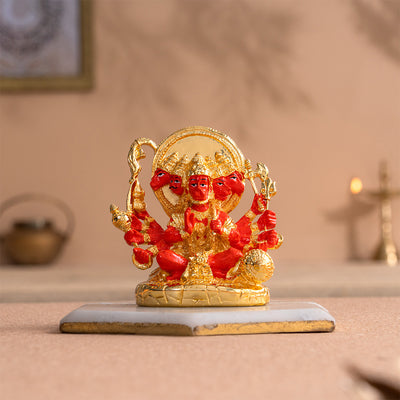
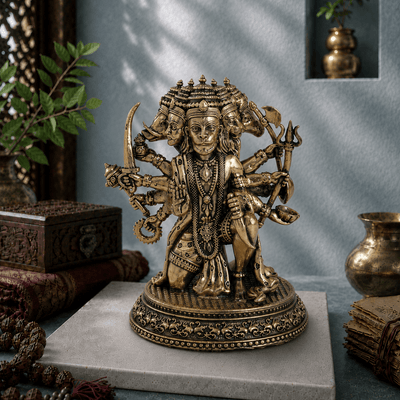
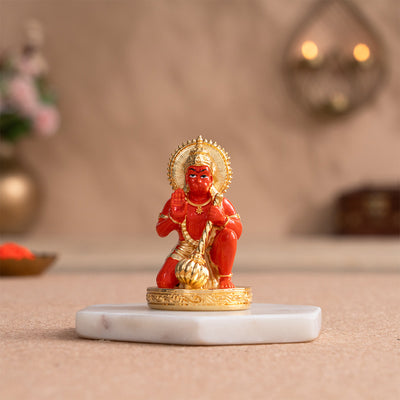
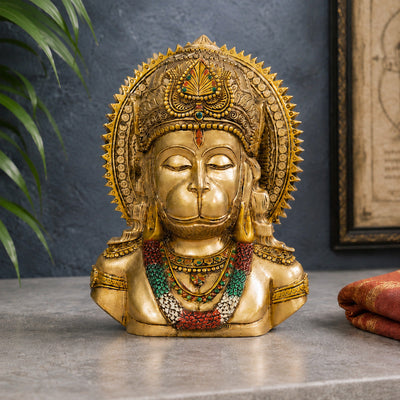
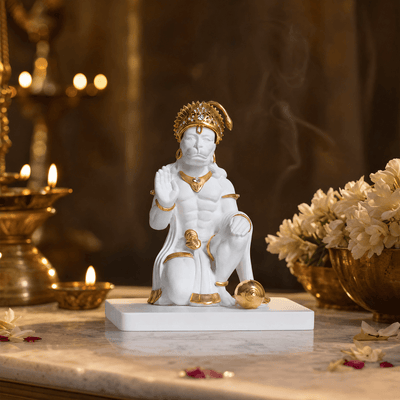
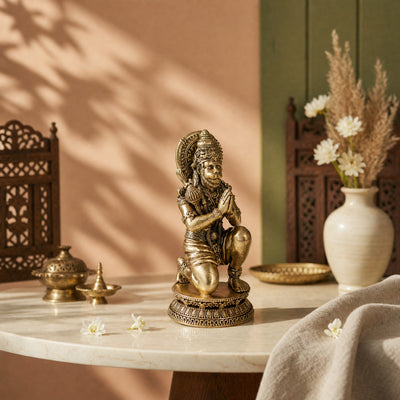
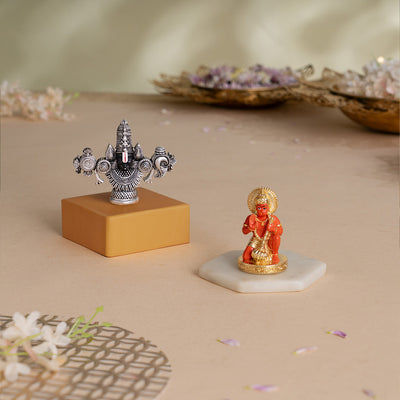
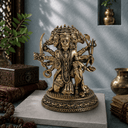
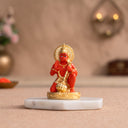
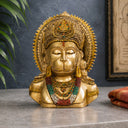
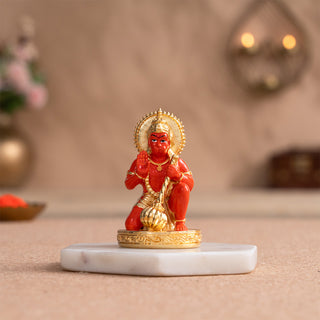
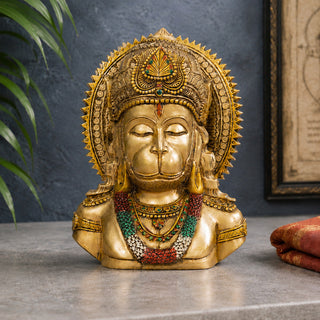
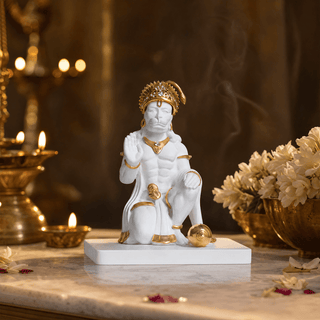
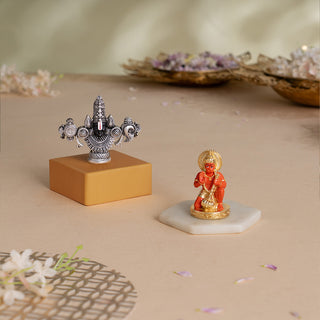
Vira Anjaneya is the warrior with the mace raised, the Paritala pose. Dasa or Bhakta Hanuman stands with folded hands and head bowed, and that is the form most at home in a family shrine — a kneeling Hanuman in Ram bhakti is that one exactly. Then there is the Sanjivani bearer with the mountain on his palm, and the abhaya mudra, the open palm that means do not be afraid. We went through how to choose between them in which Hanuman idol is good for the home.
The Hanuman collection covers the range, the older brass idols hold their surface for decades, and the small sinduri form is the one that ends up on car dashboards more than any other, which is fitting given the flagstaff promise. If you are setting up the shelf itself, our notes on what to keep in a pooja room cover the practical side, and the wider god idols range sits alongside it.
And if someone in the house is in pain, the thing to reach for is not a placement rule. It is the Hanuman Bahuk, the forty-four verses Tulsidas wrote around 1607 CE when his own arms hurt too much to let him sleep.
Which is the quiet joke sitting inside this whole subject. We keep building him taller, and the text he comes from keeps saying the size was never the point. He crossed the ocean only after Jambavan reminded him who he was. He shrank when the age thinned out. What he asked Rama for in the end was not height. It was to stay as long as the story is still being told — and every one of these ten statues is somebody telling it in concrete.
 25% off
Also read: Is Lord Hanuman Still Alive | The Panchmukhi Hanuman Story | The Wife of Lord Hanuman | Who Can Defeat Lord Hanuman | Which Hanuman Idol Is Good for Home