Start with the door.
A woman is bathing. She has asked a boy to stand outside and let nobody in. A man arrives, says he lives here, and tries to walk past. The boy blocks him. The man does not know who this boy is. The boy does not know who this man is. Within a few minutes the boy has lost his head, and the man has ruined his own marriage.
That is the story most of us grew up with. What almost nobody explains is why neither of them knew each other. And the answer to that is also the answer to the question in the title.
What is the relation between Ganpati and Gauri?
Mother and son. That is the whole relation, and you can stop reading here if that is all you came for.
The confusion is usually about the names, not the family. Many people meet "Gauri" for the first time during Ganeshotsav in Maharashtra. They hear that Gauri has come to visit Ganpati, and reasonably assume she must be a separate goddess with her own arrangement with him. She is not. Gauri is Parvati. It is one of her oldest epithets, meaning roughly "the fair one" or "the bright one." It sits alongside her other names (Uma, Bhavani, Shailaputri, Annapurna) the way Vighnaharta and Vinayaka sit alongside Ganesha.
So when the households of Pune and Mumbai say Gauri is arriving to see her son, they mean Parvati is arriving to see her son. It is not a visit between two allies. It is a mother coming to check on her boy.
Gauri, Parvati, Uma: one goddess, many names
Gauri, Parvati and Uma are one goddess. Each name preserves a story or a quality. Parvati means "daughter of the mountain," because she is the daughter of Himavan, the Himalaya. Gauri points to her complexion and her radiance. Durga and Kali are fiercer expressions of the same feminine principle, which is why the many-armed Durga and the calm Gauri of a household shrine can be spoken of as one.
Her marriage to Shiva is its own long story, told across the Puranas and remembered in vrats like Hariyali Teej, where the count of her lifetimes of waiting is the whole point. If you are unclear on where Shiva himself comes from in the texts, that question has a surprisingly slippery answer too.
Ganesha's textual family, then, is Parvati and Shiva, with Kartikeya as brother. Shiva himself appears in many forms across the texts, but here he is simply a husband who came home at the wrong moment. Not Lakshmi, not Saraswati: those pairings are functional, not familial, which is worth remembering when you set up a shelf.
The Shiva Purana's version: a son made by a mother alone
The most widely followed account sits in the Shiva Purana, in the Rudrasamhita, Kumarakhanda section. J. L. Shastri's translation for Motilal Banarsidass lays the chapters out plainly, and the chapter titles alone tell you the shape of the story:
- Chapter 13: Birth of Ganesa
- Chapter 16: Ganesa's head is chopped off
- Chapter 17: Resuscitation of Ganesa
- Chapter 18: Ganesa crowned as the chief of Ganas
The crucial detail is in chapter 13. Parvati creates the child herself. Shiva has no part in the making of him. She forms him and gives him life, and she sets him at her door as her own guard, answerable to her.1
That detail is the mechanism of the entire tragedy. Shiva returns and finds a boy he has never seen refusing him entry to his own home. The boy is not being rude; he is doing exactly what his mother told him. Shiva has no way of knowing that. The head comes off because of a gap in knowledge, not because of malice.
And then the restoration comes from Parvati. Her grief is what forces it. The child is revived with an elephant's head, and in chapter 18 he is given a position that is more than compensation: chief of the ganas, which is where the name Ganapati, "lord of the ganas," actually comes from. He is not simply patched up. He is promoted.
That is why the mother-son bond in this myth feels so much fiercer than the usual divine family arrangement. He is hers by making, hers by loyalty, and hers by rescue.
The Brahmavaivarta Purana tells it completely differently
The Puranas do not agree on how Ganesha was born.
The Brahmavaivarta Purana has a whole Ganesa Khanda, translated by Rajendra Nath Sen in 1922 for the Sacred Books of the Hindus series. In its chapter VIII, Parvati obtains a boon from Krishna, and the child comes from that. There is no door, no confrontation, no axe.
The head is lost differently too. Chapter XI is a discourse between Parvati and Shani (Saturn) and in this stream it is Shani's gaze that destroys the infant's head. The mother's grief is still the engine of what follows, but the cause is astrological rather than marital.2
The same text even has a chapter, number XX, devoted to explaining why Ganesa was given the face of an elephant at all. That is quietly revealing. A Purana does not usually stop to justify something nobody was asking about. The fact that the text felt the need to explain the elephant head suggests the head was already a settled, familiar image, and the story arrived afterwards to account for it.
Do not blend the two versions into one smooth narrative. Plenty of retellings do, and you end up with Shani and Shiva both somehow present at a beheading that only one of them causes. They are two separate traditions, both old, both legitimate.
Why Gauri comes to visit during Ganeshotsav
Because a mother is visiting her son. The Jyeshtha Gauri observance, which falls in the middle of the Ganesh Chaturthi days, is where most people meet this pairing. The Gauris are welcomed into the house with footprints drawn at the doorstep, dressed and ornamented, fed a proper feast, and seen off after a few days.7 It is also the stretch of the year when most families do their festival gifting, so the two arrivals get tangled together in memory.
This needs an honest label: Jyeshtha Gauri as it is observed in Maharashtrian homes is living household tradition. The Puranas cited above do not prescribe it.8 That does not make it less real. It makes it a different kind of real, the kind that survives because families keep doing it, not because a text ordered it.
Regional practice also varies more than people expect. In many households Gauri is understood exactly as this article describes her, as Ganpati's mother arriving to see her son. In other communities the Gauris are received as a pair of sisters. Both are held sincerely, and neither is a mistake. Folk tradition is allowed to have more than one shape.
What is consistent is the emotional logic. The son is already installed in the house. The mother arrives during his stay. Both leave by water. If you have ever done a home visarjan and felt the small drop in the chest when the clay softens, you already understand the theology without needing the vocabulary for it.
Three things people get wrong here
1. "Gauri and Parvati are two different goddesses"
They are one. Gauri is an epithet of Parvati, not a separate figure with a separate biography. If a page tells you Gauri is Ganpati's aunt, foster mother, or an unrelated goddess who happens to visit, it is repeating a misreading of a festival name.
2. "Ganesha broke his own tusk to write the Mahabharata"
This one is worth checking because it is repeated everywhere. The Mahabharata's own account of how it was written is in Adi Parva, Section I, and Kisari Mohan Ganguli's translation of it is freely readable. In that passage Brahma proposes Ganesa as scribe. Ganesa agrees on the condition that his pen never stop. Vyasa counters that Ganesa must not write anything he has not understood, and then deliberately knots his verses so the pauses buy him time to compose.
It is a wonderful scene: a poet outwitting his own stenographer. But it says pen. There is no tusk in it, no snapping, no ink of blood.4 Scholars also generally regard the whole Vyasa-Ganesha scribe episode as a later addition rather than part of the epic's oldest layer. If you want the tusk stories that are genuinely textual, the Parashurama episode in the Brahmavaivarta Purana's chapter XLIII is the best-attested of them.
3. "The Bhagavata Purana tells the moon-curse story"
It does not. The Syamantaka jewel narrative runs across Bhagavata Purana 10.56 and 10.57, and you can read both. Krishna falls under suspicion because Satrajit's brother Prasena vanishes in the forest wearing the gem. Satrajit then accuses him publicly, and the rumour spreads through Dvaraka. That is it. No moon, no fourth lunar day, no Ganesha, no curse anywhere in either chapter.56
The moon material lives in a different text entirely: the Ganesa Purana's Upasanakhanda, chapter 62, which Greg Bailey's translation titles as a description of the Moon's curse and favour. Both halves of the popular belief are real stories. The join between them is what was invented later. There is a fuller version of this in our piece on seeing the moon on Ganesh Chaturthi.
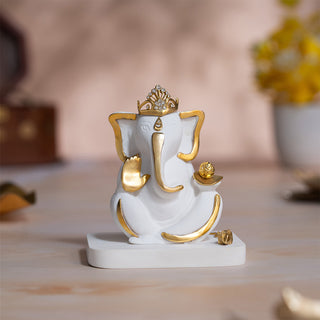
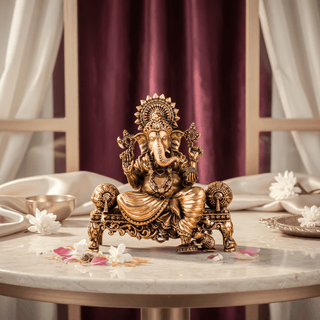
What the mother-son bond changes about how he is worshipped
Once you take the Shiva Purana account seriously, a few habits of Ganesha worship stop looking arbitrary.
He is invoked first, before every other deity, in almost all puja, a precedence that has nothing to do with who is considered most powerful. The usual explanation is that he removes obstacles. The story adds a second layer: the boon of being worshipped first is part of what Parvati secures for him after the beheading. It is a mother's settlement, not just a job description.
The offerings have their own textual weight. The Ganesa Purana gives durva grass six chapters: chapter 63 for its origin tale and chapters 64 to 68 as a full Durvamahatmya.3 No flower in that text comes anywhere close, which makes the favourite-flower question more interesting than it looks. On the other side of the same logic, there is a real Puranic reason tulsi stays off his tray: Brahmavaivarta Purana, Ganesa Khanda, chapter XLVI, on the reciprocal curses of Tulsi and Ganesa.
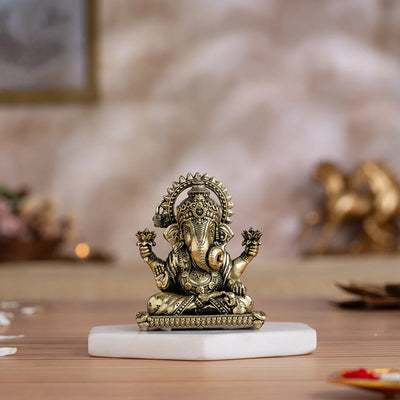
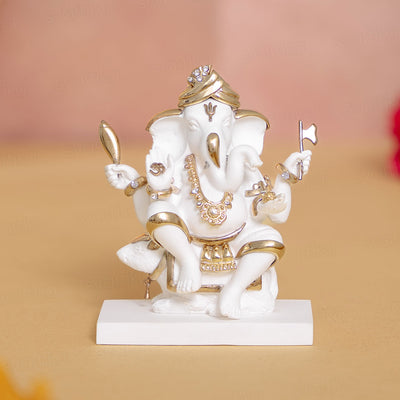
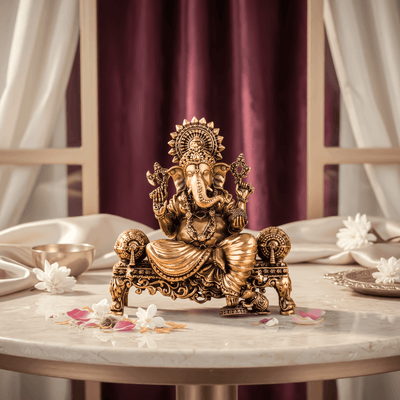
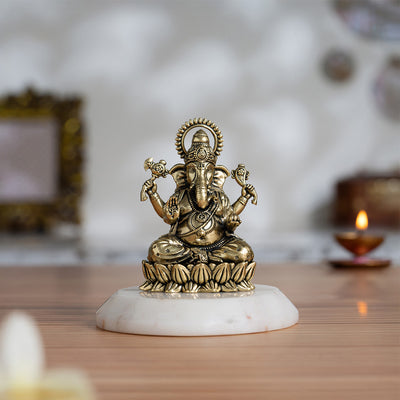
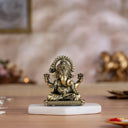
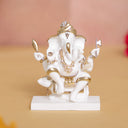
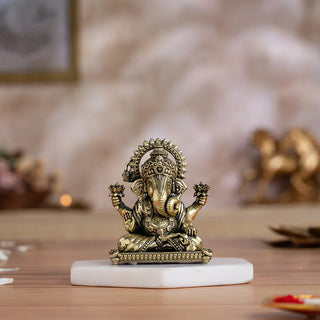
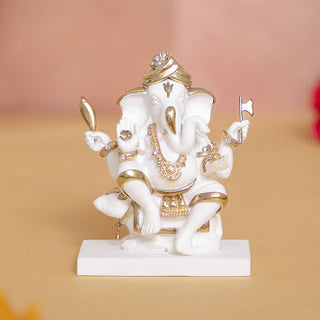
And for anyone setting up a shrine at home: much of the popular guidance around murtis is tradition rather than scripture, and worth knowing as such. That includes what a right or left-curving trunk means, which form suits a home, and which direction the idol should face. Useful systems, all of them. Just not Puranic commands. The one genuinely practical thing nobody argues about is keeping the murti clean, and marble and brass both have their own way of being looked after.
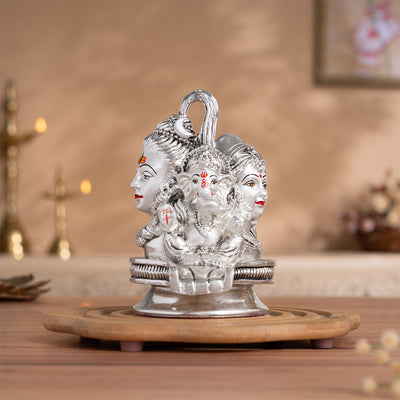
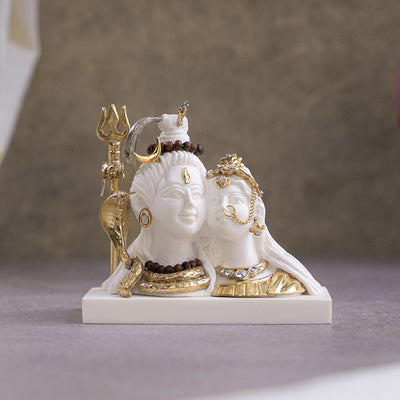
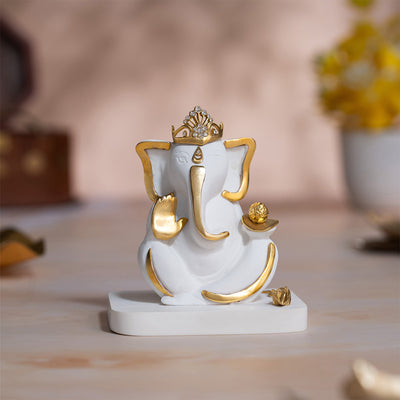
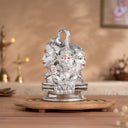
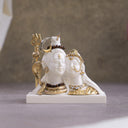
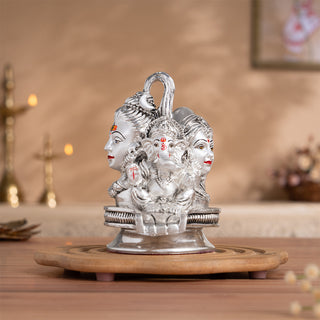
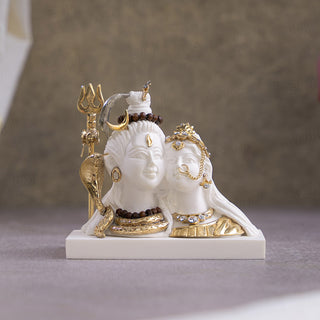
If you specifically want the mother-son relationship visible on your shelf rather than implied, a Shiv Parvati Ganesh murti puts all three in one frame, which is a quieter way of remembering that this began as a family story about a misunderstanding at a door.
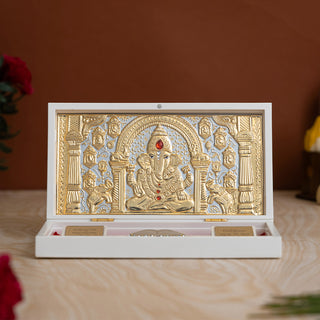
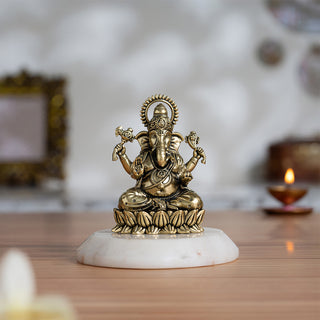
What we could verify, and what we could not
Verified directly: the Shiva Purana's Kumarakhanda chapter sequence (13, 16, 17, 18) in Shastri's translation; the Brahmavaivarta Purana's Ganesa Khanda chapters VIII, XI, XX and XLVI in Sen's 1922 translation; the Ganesa Purana Upasanakhanda's chapter list in Bailey's translation; and Ganguli's Adi Parva Section I plus Bhagavata Purana 10.56 and 10.57 read in full.
Not verified, and labelled as such: the Jyeshtha Gauri observance and the mother-versus-sisters variation are household tradition, not something the Puranas above prescribe. Where we quote a chapter number, we opened a translation showing it. Where we could reach only a chapter title, we have told the story at that level of confidence and left the dialogue uninvented.
The rest is the part that does not need a footnote. A mother made a son. A father did not recognise him. She refused to accept the loss. He came back with a different head and a better title, and a few thousand years later people still bring him home for ten days every year and cry a little when he leaves. You do not need a verse number for that to land.
Also read: Who Broke the Tooth of Lord Ganesha | Lord Ganesha in Dream Meaning | The 5 Daughters of Lord Shiva | Ganesh Chaturthi Decoration Ideas | Ganesh Laxmi Murti Position Guide