Ask this question in a room full of people and you will get two confident answers.
Someone will say Shiva has no parents at all, that he is svayambhu, self-born, and the question itself is wrong. Someone else will say Brahma is his father, and they will be able to tell you the story. Both people are quoting real scripture. Neither has read the other one's book.
That is the actual answer to this question, and it is more interesting than either half.
Does Lord Shiva have a mother?
No.
Across the Puranas, the epics and the Upanishads, no text gives Shiva a mother. There is no birth scene with a womb in it, no woman named as the one who carried him, no equivalent of Devaki or Kaushalya. Compare that with everyone else. Krishna has Devaki and Yashoda, and people still argue about who counts as his real father. Sita's parentage is complicated enough to fill an essay. Even Hanuman, born of the wind, has a father the texts argue over.
Shiva has nobody. And once you notice that gap, the father question stops being a genealogy question and becomes something else: does Shiva have an origin at all?
Two great bodies of text answer that opposite ways.
The Bhagavata Purana: a crying blue child between Brahma's eyebrows
In the Bhagavata Purana, Shiva is born from Brahma. Most articles on this topic skip the passage because it complicates their headline.
In the third canto, Brahma is trying to create and it is not going well. He gets angry. From that anger, out of the space between his eyebrows, a child appears. The text says the boy is coloured red and blue, and that he cries.
The child asks for a name and a place. And Brahma, precisely because he had cried, calls him Rudra.1
That is the whole etymology. Rud is to cry or to howl. Brahma names the child for the sound he made. Then Brahma gives him eleven more names and eleven places to live: Manyu, Manu, Mahinasa, Mahan, Shiva, Ritadhvaja, Ugraretatva, Bhava, Kala, Vamadeva and Dhritavrata (Bhagavata Purana 3.12.7 to 12).
That list is where the eleven Rudras come from. Notice too that "Shiva" appears here as one name among eleven, not as the name of the being. The name we use every day is, in this telling, a nickname Brahma handed out.
After the naming, Brahma tells him to go and procreate. Rudra produces beings so fierce and so numerous that Brahma gets frightened and asks him to stop and do tapas instead. Which he does. The ascetic Shiva of Kailasa, in this version, is a son who was asked by his father to please calm down.
The Bhagavata Purana is a Vaishnava text. It is not hostile to Shiva anywhere. Later it calls him the greatest of all Vaishnavas, which is a remarkable thing for a Vishnu-centred book to say.2 But it does place him inside the created order rather than above it. He has an origin, a naming, and a job.
The Shiva Purana: he was here before Brahma was
The Shiva Purana says Shiva has no beginning and no end.
In the Vidyeshvara-samhita there is a famous scene. Brahma and Vishnu are arguing about who is greater, and a column of light appears between them with no top and no bottom. Vishnu becomes a boar and dives to find the base. Brahma becomes a swan and flies to find the crown. Neither finds an end. The text describes Shiva's body as being without a beginning or an end (Vidyeshvara-samhita 7.30).4
This is the Lingodbhava, and it is the reason a Shiva shrine so often holds a smooth pillar rather than a face. The shape is the argument. A form with no top and no bottom is a form with no birth.
One honest note, because a lot of pages overstate this scene: the chapter does not actually say Brahma and Vishnu were born from Shiva. It says his body is beginningless and that they could not find its ends. Those are not the same claim.
The strange part: both answers sit in one chapter
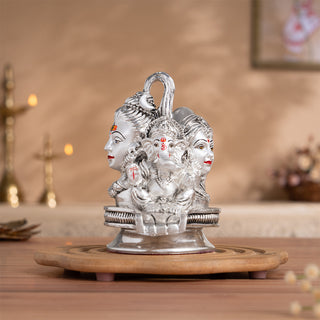
The Shiva Purana prints both answers twenty-eight verses apart. Its Shatarudra-samhita opens with the five faces of Shiva: Sadyojata, Vamadeva, Tatpurusha, Aghora and Ishana. These are the five you see carved on a Panchamukhi linga and chanted in the Panchabrahma mantras.
At verse 6 of that chapter, Sadyojata, the first of the five, is described as born as the son of Brahma.
Twenty-eight verses later, in the same chapter, Ishana is called the unborn lord, all-pervading and all-bestowing (Shatarudra-samhita 1.6 and 1.34).3
One face born of Brahma, another face unborn. No scribe was asleep. The text is doing something deliberate, and once you see it the whole confusion dissolves.
Why the texts contradict each other, and why that is fine
Two things are going on.
The first is sectarian. Vaishnava Puranas like the Bhagavata organise reality with Vishnu at the centre, so Rudra enters as part of the creative machinery. Shaiva Puranas organise it with Shiva at the centre, so Brahma and Vishnu become participants in a story that was already running. These books were composed in conversation with each other, often as replies, and the question of who is the most powerful god is the argument they are having. Anyone who has read about who can defeat Shiva in battle has seen the same pattern: the Bhagavata has Krishna overpowering Shiva at Banasura's city, and the Shiva Purana has Shiva as Sharabha felling Narasimha. Each tradition writes its own god as unbeatable.
The second reason is more interesting, and it is the one the Shatarudra-samhita is quietly signalling.
The tradition distinguishes between the form and the formless: saguna and nirguna. The manifest form, the one with a blue throat and a tiger skin and a wife and two sons, has an origin story, because everything with a form does. The ground of being underneath it does not, because there is nothing prior to it that could produce it. Sadyojata is a face. Ishana is not a face at all.
So "was Shiva born?" is really two questions wearing one shirt. Which Shiva are you asking about?
His wife has parents. He does not.
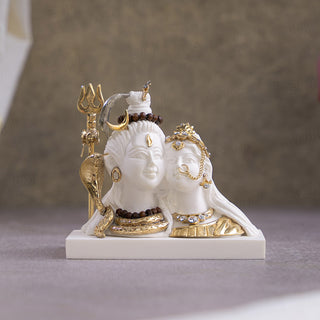
Sati is the daughter of Daksha Prajapati, and the whole tragedy of the yajna and her death depends on that parentage being specific. When she returns as Parvati she is the daughter of Himavan, king of the mountains, and Mena. The story of her lives and her tapas to win Shiva is one of the most fully told biographies in Hindu literature.
Their sons are documented too. Kartikeya's birth is a full narrative cycle. Ganesha's origin is told several ways, and the argument over his relationship with Gauri and over how he lost a tusk has kept commentators busy for centuries.
Everyone in that family has a story of where they came from. The head of the house does not. That is not an omission. It is the design.
Four things people get wrong about Shiva's family
1. "No text ever gives Shiva a birth"
Very common, and wrong. The Bhagavata Purana gives him one in vivid detail, right down to the colour of the child and the reason for the name (3.12.7 to 12). And the Shiva Purana itself concedes that one of the five faces was born as the son of Brahma.
2. "Brahma is definitely Shiva's father"
Also too strong. One tradition says so. Another says Brahma is downstream of Shiva. And the Shiva Purana holds both positions in one chapter. The accurate sentence is: in the Bhagavata Purana's account, Rudra emerges from Brahma. Not "Brahma is Shiva's father, full stop."
3. "Jalandhara is Shiva's son, so Shiva does have children by other means"
The Shiva Purana never calls him a son in the way people mean it. The brilliance from the eye in Shiva's forehead is cast into the briny ocean, and it takes the form of a boy crying where the Ganga meets the sea. The Ocean takes him home and raises him, which is exactly what the name means, jala-dhara, water-borne.6 And the name is given by Brahma, not Shiva: because the boy made Brahma's eyes water (Yuddha-khanda 14.2 to 5, 14.24, 14.31). The full Jalandhara story reads much better as discarded rage taking a body than as paternity.
4. "Shiva has five daughters"
There is no Purana anywhere that lists five daughters of Shiva. Only Ashokasundari has a solid textual home, in the Padma Purana's Bhumi-khanda, and even there she is created by Parvati out of curiosity about the wish-granting Kalpavriksha rather than born of Shiva (Bhumi-khanda 102.43, 102.71 to 74).7 The rest of that circulating list mixes regional folk tradition with names lifted from elsewhere: Vasuki, for one, is a male naga king. We went through that list carefully here.
What svayambhu actually means
Svayambhu is usually translated as "self-born", and that translation does damage, because in English "born" smuggles in a moment of birth. Nothing in the word requires one. Closer to the sense: existing of itself, not caused by another. The Shvetashvatara Upanishad, the oldest sustained meditation on Rudra as the supreme, speaks of him as one without a second. That is what the linga says in stone, and it is why so many great Shiva shrines are called svayambhu lingas: not carved, simply found.
It also explains the iconography people notice without asking about. Vishnu's ten avatars form a sequence with a direction: a closed list, in order, going somewhere. Shiva's appearances do not behave like that at all, which is why the count of his avatars keeps changing depending on which chapter you open. A being with no origin does not need a timeline.
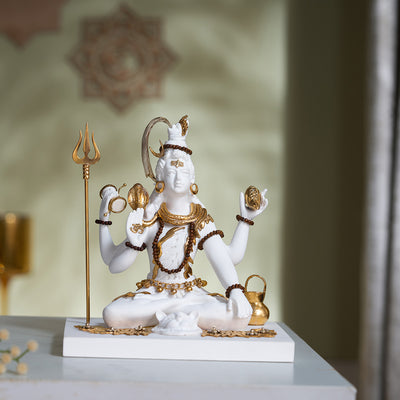
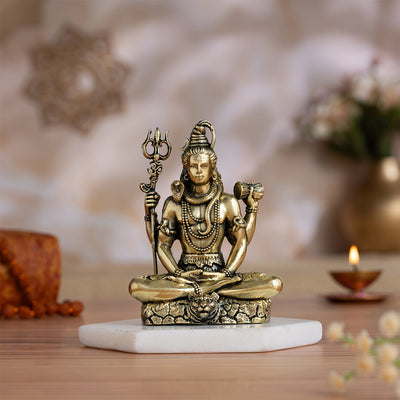
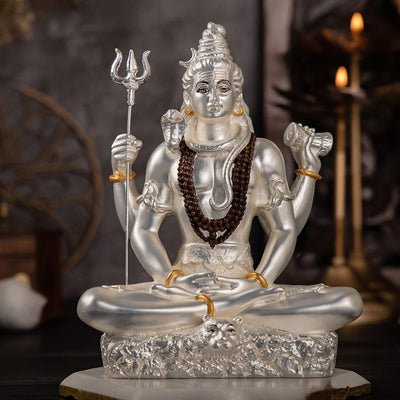
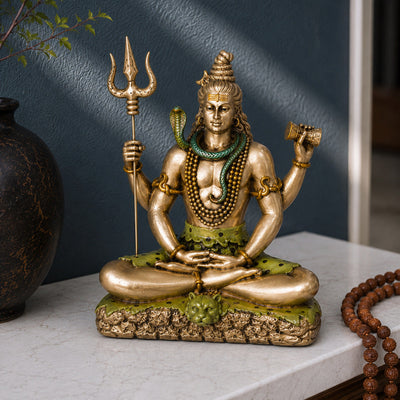
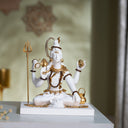
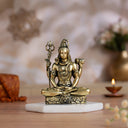
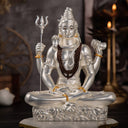
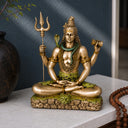
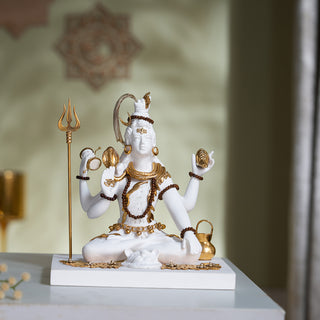
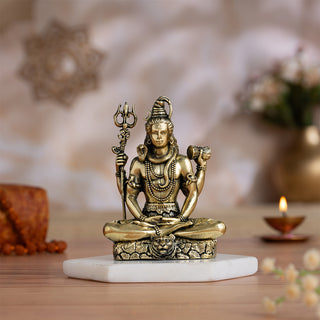
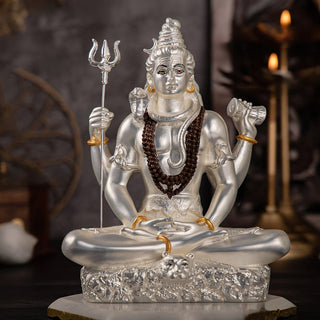
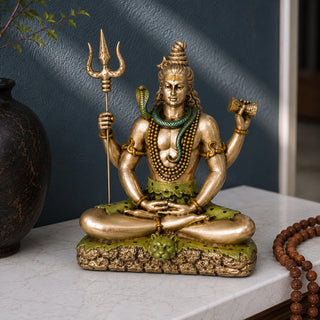
You can see the same idea in how he is shown in a Shiv murti for the home. He is almost never shown as a child. There is no Bal Shiva the way there is Bal Krishna or Bal Ganesha, and that absence is doctrinal, not accidental. He is shown seated in deep meditation, eyes half closed, already old and already outside time.
Does any of this change how you keep him at home?
Practically, no. And the Shiva Purana is unusually relaxed about the whole thing.
Its instructions for domestic worship say a linga may be made of clay, cow-dung, flowers, jaggery, butter, ashes or even cooked rice, worshipped with whatever modes of service are easily available (Vidyeshvara-samhita 11.32 to 33, 19.18). The ideal size is twelve fingers of the devotee's own hand; shorter is less effective, longer does no harm.5 The place should be a holy spot, or simply anywhere that makes daily worship possible.
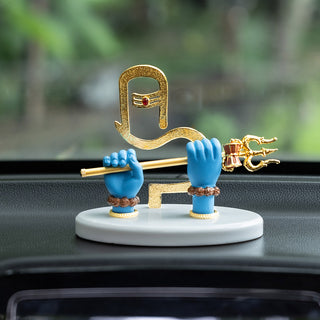
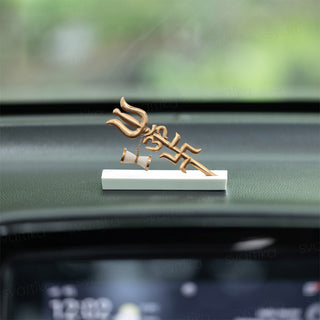
That is a scripture written for people with small houses, not for temple budgets. If you have been told that keeping a Shiva statue at home is risky, these chapters say the opposite, warmly. The same goes for the long list of things people believe are forbidden on Maha Shivratri, the night when Shivratri worship fills every household. Much of that list is custom rather than anything the text asks for. Custom is worth respecting; it is just worth knowing which is which. A brass murti on a clean shelf with water offered daily meets the actual scriptural condition, and the basics of a pooja room matter more than the size of the idol.
So what is the honest answer?
Shiva has no mother in any major text. That part is settled.
He has a father in exactly one strand of the tradition: the Bhagavata Purana's Brahma, whose anger produced a red and blue child who cried until he was given a name. In the Shaiva strand he has no origin at all, and the pillar of light with no top and no bottom is the image for it. The Shiva Purana, which you would expect to argue hardest for the second position, calmly prints both.
It prints both because it is not doing biography. These are two ways of pointing at something the tradition believes is prior to the question, using the only vocabulary human beings have: family, birth, naming.
And the tradition kept the paradox instead of tidying it up. Whoever assembled that chapter could have deleted the line about Sadyojata. They left it in. That was a choice, and it is a better answer than either side alone.
Also read: How Many Avatars Does Shiva Have? | Who Can Defeat Lord Shiva? | Who Is the Biggest Devotee of Lord Shiva? | The Story of Jalandhara | The 10 Sons of Brahma