Ask ten people how Lord Ganesha lost his tusk and nine will tell you the same story. Sage Vyasa was dictating the Mahabharata. Ganesha had promised to write without stopping. His pen broke. So he reached up, snapped off his own tusk, and kept going.
It is a beautiful story. It is the one on the temple wall, in the children's book, in every listicle. And when you actually open the Mahabharata and read its account of its own writing, the tusk is not there.
There are at least four stories in circulation. They are not equally supported, and the ranking is almost the opposite of what most people assume. Here are all four, with an honest note on how much weight each one can carry.
The short answer: Parashurama broke it
The clearest scriptural answer sits in the Brahmavaivarta Purana, in the section devoted entirely to Ganesha, the Ganesa Khanda. Chapter XLIII of that section is titled, in Rajendra Nath Sen's 1922 translation, as the breaking or extraction of a tooth of Ganesha by Parashurama.1 Not a passing line. A chapter with the event in its title.
The setting is Kailasa. Parashurama, the axe-wielding avatar of Vishnu and a devoted student of Shiva, comes to see his teacher. Ganesha is at the door and turns him away, because Shiva is resting. Anyone who knows the story of Ganesha and Parvati will recognise the shape of this immediately. Ganesha guarding a door is where his troubles usually begin.
The argument becomes a fight. Parvati's son does not back down easily, which is no surprise if you have read about Parvati's own long persistence. Parashurama throws the axe. Here is the detail that makes the story work: the axe was a gift from Shiva. Ganesha recognises his father's weapon and refuses to dodge it, because dodging would be an insult to the one who gave it. He takes the blow. The tusk breaks.
That is not a story about losing a fight. It is a story about respect being more important than a tooth, which is a very Ganesha kind of point to make.
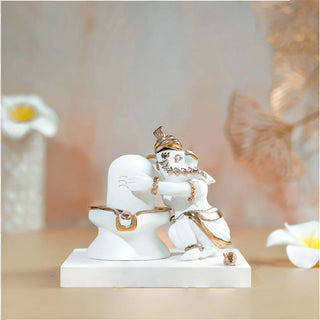
The famous story: the pen that was not supposed to stop
The Mahabharata's own account of its writing has no tusk in it.
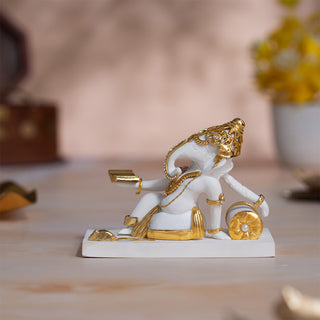
In Kisari Mohan Ganguli's translation, the first section of the Adi Parva describes how the epic came to be written down. Vyasa has composed the Mahabharata in his mind and needs a scribe fast enough to keep up. Brahma tells him to think of Ganesha. Ganesha agrees, on one condition: the pen must not stop. If Vyasa pauses in his dictation, Ganesha stops writing and leaves.
Vyasa accepts, and adds a condition of his own. Ganesha must not write a single line he has not first understood. Then Vyasa quietly starts knotting his verses, packing them so tight that Ganesha has to slow down and think, which buys Vyasa the seconds he needs to compose the next stretch.
It is a duel of wits between a poet and his scribe, and it is genuinely delightful. But notice what is missing. There is a pen. There is no broken pen, no tusk, no snapping, no ink of blood. The passage does not contain the moment the whole world remembers.
One more point, stated carefully. Textual scholars generally hold that the Vyasa-Ganesha scribe episode is a later addition to the epic rather than part of its oldest layer, and that it does not stand in the main text of the Bhandarkar Oriental Research Institute's critical edition. That is consensus, not something we can give you a page number for. So the most famous tusk story is attached to a passage that is itself late. And even that passage does not mention the tusk.
The third story: the moon that laughed
In the third story Ganesha throws his tusk at the moon for laughing at him. The moon episode behind it is genuinely scriptural.
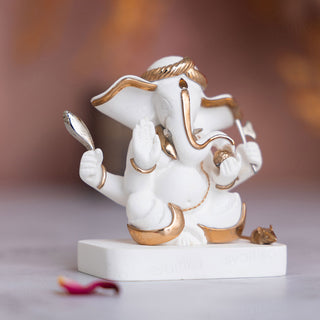
Ganesha, after a heavy meal of modaks, is riding home on his mouse. The mouse stumbles. Ganesha falls, his belly splits open, the modaks scatter. Chandra, the moon, watches from above and laughs. Ganesha, furious, breaks off his tusk and hurls it at him, and curses the moon so that anyone who looks at him on that day will be falsely accused of something they did not do.
The moon material is real, and it lives in a specific place: the Ganesa Purana's Upasanakhanda, chapter 62, which Greg Bailey's translation titles as a description of the moon's curse and favour.3 Notice that title. Curse and favour. Ganesha stories almost never end in punishment alone, so this one probably resolves rather than simply condemns.
What we could not verify is the tusk-throwing itself, and it is better to say so than to pretend. The chapter is confirmed and its title tells us what it covers. The narrative inside it was not readable in this pass. So: the moon episode is scriptural, the curse is scriptural, and the tusk as the projectile is how the story is popularly told. If you have ever wondered what to do if you see the moon on Ganesh Chaturthi, this is the chapter your grandmother's advice descends from.
The fourth story: the demon and the deliberate weapon
The fourth version is the shakiest of the four, and it turns up constantly in retellings.
In it, Ganesha faces an elephant-faced demon (Gajamukhasura in most tellings) who has a boon making him immune to every weapon. Out of options, Ganesha breaks off his own tusk and throws it. The tusk is not a weapon, so the boon does not cover it. The demon is subdued and becomes Ganesha's mouse.
It is a good story with a clever internal logic, the same logic that runs through the Narasimha avatar, where a boon is defeated by finding the one gap in its wording. But it does not appear in the chapter lists of the three Puranas we read for this article. That does not prove it is absent from the wider tradition, which is enormous. It does mean we are not going to hand you a chapter number for it, and you should be suspicious of any page that does without saying where they read it.
Three things people get wrong about Ganesha's tusk
1. "The Mahabharata says he used his tusk as a pen." It does not. Ganguli's Adi Parva, Section I, is the passage in question, and it says pen.2 The tusk-as-pen image seems to have grown out of the story rather than out of the text, which is a very common thing for a good image to do. Say it as tradition and it stays beautiful. Say it as scripture and it is simply wrong.
2. "Krishna was accused of stealing the Syamantaka jewel because he saw the moon on Ganesh Chaturthi, and the Bhagavata Purana says so." The Bhagavata Purana does not say so. Its Syamantaka narrative runs across Canto 10, chapters 56 and 57, and there is no moon in it, no fourth lunar day, no Ganesha, no curse.56 Krishna falls under suspicion because Satrajit's brother Prasena vanishes in the forest wearing the gem. Satrajit then says publicly that Krishna must have killed him, and the rumour spreads through Dvaraka. The scandal is entirely social. Two real stories from two different texts were welded together by later tradition. Both halves are genuine. The join is the invented part, and you can check this one yourself in twenty minutes.
3. "A right-facing trunk is dangerous and a broken tusk means bad luck in an idol." The classical iconographic literature does not work this way at all. T. A. Gopinatha Rao's 1914 survey of Ganapati runs across thirty-odd pages and sorts him by named form: Heramba, Nritta, Lakshmi, Uchchhishta, Unmatta-uchchhishta, Kavala, Prasanna Ganapati, each defined by arms, posture, vahana and companions.4 Trunk direction is not a category in that scheme at all, and neither is the tusk. The right-versus-left trunk belief is temple and Vastu tradition. It means something real to the people who hold it. It is not a Puranic rule, and nobody has bought the wrong murti.
Ekadanta: did the stories explain the image, or the other way round?
The image came first. The stories came later to explain it.
"Ekadanta" (the one-tusked) is among Ganesha's oldest names. It is not a nickname that arrived with the Puranas. It is in the vocabulary from early on. So by the time these stories were written down, the broken tusk was already a fact about how he looked. The stories are not reporting an event. They are explaining an image that was already settled.
You can see the same instinct elsewhere in the same text. The Brahmavaivarta Purana's Ganesa Khanda has a whole chapter, XX, devoted to explaining why Ganesha was given the face of an elephant at all.1 A text does not need to explain something unless it has already become a given. The elephant head was there; the reason had to be supplied afterwards.
Read that way, four stories about one tusk stop being a contradiction to resolve. They are four traditions each answering the same question in its own idiom. One makes it about respect for a teacher's gift. One makes it about a promise kept at any cost. One makes it about wounded dignity and a curse that softens. One makes it about outwitting a boon. Ask what each story wants the tusk to mean and all four suddenly make sense at once.
What this means for the murti on your shelf
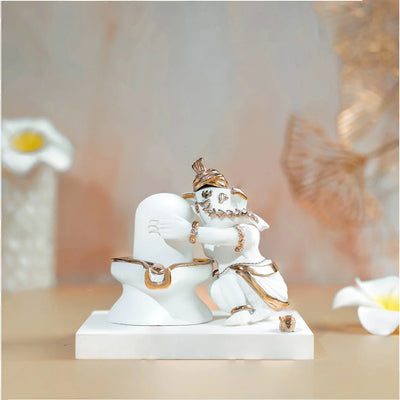
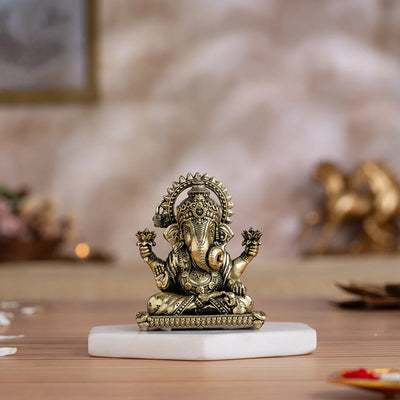
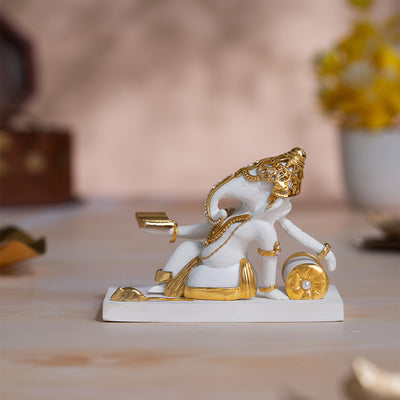
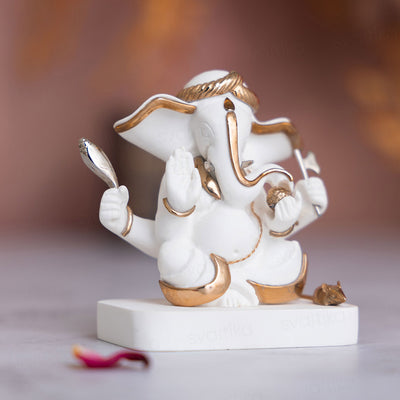
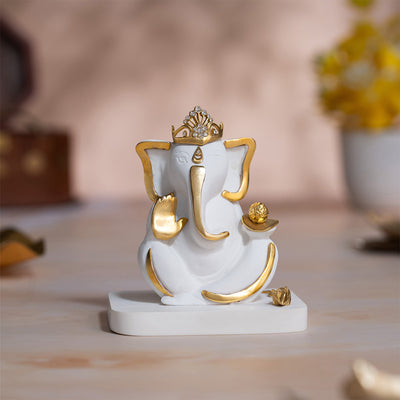
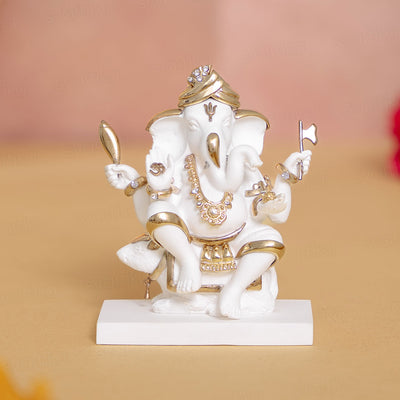
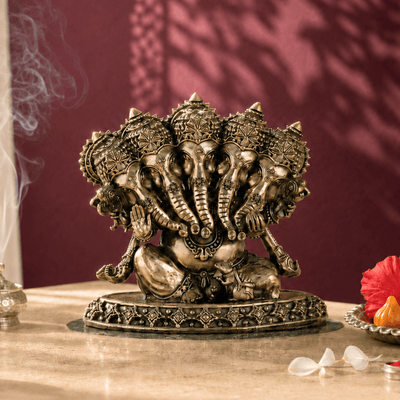
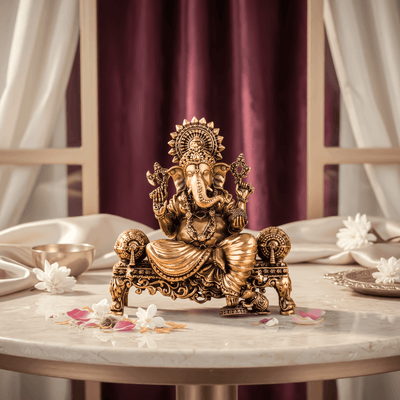
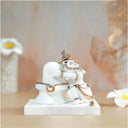
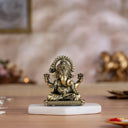
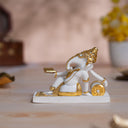
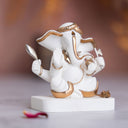
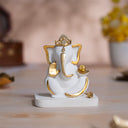
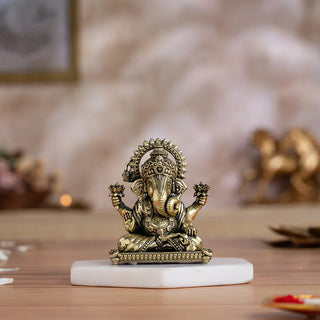
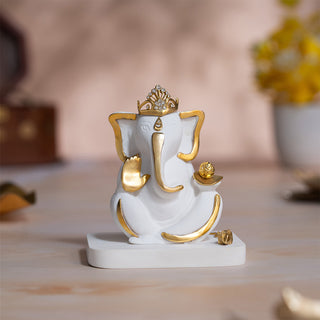
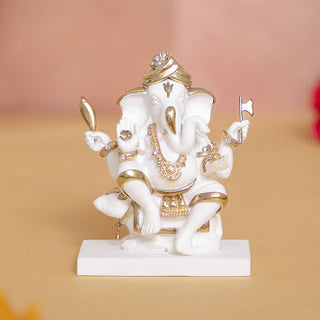
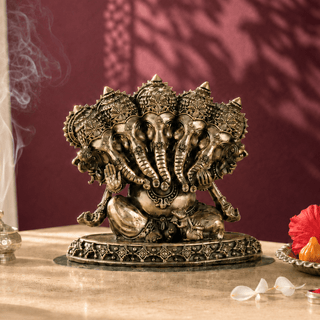
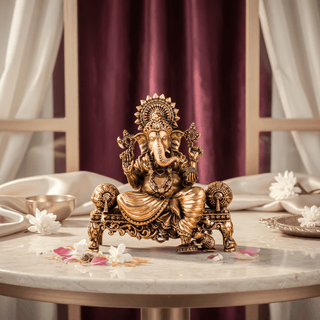
If you have a Ganesha at home, look at him properly for a second. In almost every murti made anywhere in India, one tusk is whole and the other is a stump. Sculptors have kept that asymmetry for centuries without needing to agree on which story caused it. You can see it clearly on something as simple as a small brass Ganesh murti seated on a lotus, where the broken tusk is right there at eye level on a three-inch idol.
That asymmetry is the point. He is the god who is visibly incomplete and completely fine about it. The remover of obstacles carries a permanent one on his own face.
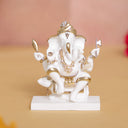
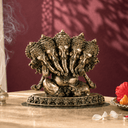
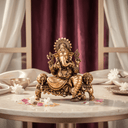
Which is a gentler thing to carry into your pooja room than any rule about direction or material. If you are choosing an idol, our Ganesh murtis run from small brass pieces for a daily shrine to marble-dust premium pieces with gold-plated ornament for a living room. The questions worth asking are practical. Where will it sit? How will you keep it clean? Is it the right form for a home rather than a temple?
And when Ganesh Chaturthi comes round, the same honesty applies to the rest of it. Why tulsi is kept off his tray genuinely does come from a Purana. What his favourite offering is has a more surprising answer than the flower people expect. Which direction the idol faces is Vastu reasoning rather than scripture, and immersing him at home rests on a very old principle about invited presence being respectfully seen off. Knowing which is which does not make any of it less moving. It makes it yours.
The tusk, in the end, is the smallest and most stubborn thing about him. Four stories, three texts, one broken tooth, and a god who has never once looked bothered by it.
Also read: Relation Between Ganpati and Gauri | Lord Ganesha in Dream Meaning | Ganesha Trunk Right or Left Meaning | Who Are Lord Shiva's Father and Mother | Ganesh Chaturthi 2026 Muhurat and Visarjan