Ask ten people which flower Lord Ganesha likes best and about eight will say red hibiscus. Jaswand. The big, loose, almost theatrical red bloom you see heaped in front of Ganpati pandals every September.
It is a lovely answer. It is also not what the scriptures say, and the thing they say instead is far more interesting.
The short answer: the texts care about a grass
The Ganesa Purana deals most directly with how Ganesha is worshipped. Greg Bailey translated its first section, the Upasanakhanda, for Harrassowitz in 1995, reissued in India by Motilal Banarsidass. Read its ninety-three chapter titles in order and one thing jumps out.
Chapter 63 is called "The Tale of the Durva Grass." Chapters 64 to 68 are the Durvamahatmya, an extended passage on the greatness of durva. That is six chapters, one after another, on a single offering.1
No flower gets anything close to that. Not hibiscus, not marigold, not lotus. Six chapters for a common grass that grows in the cracks of Indian footpaths and gets mowed down by every municipal gardener in the country.
So the honest answer to "which is the favourite flower of Lord Ganesha" is a gentle correction of the question. He has a favourite offering, the texts are noisy about it, and it is durva.
Why a grass, and not something grand
Durva, or doorva, is Cynodon dactylon. Bermuda grass. It survives being trodden on, grows back from almost nothing, and needs no gardener. The word durvankur that people use in puja simply means its fresh young shoots.
I should be straight about the limits here. I verified that chapter 63 exists and what it is titled, in a named translation by a named scholar. I did not read the narrative body of that chapter. So I will not retell its plot and dress it up as scripture.
What I can tell you is the version people commonly recount: that Ganesha swallowed a demon of burning heat, often named Analasura, and that the fire in his stomach was cooled only when sages laid blades of durva on him. It is a good story and it explains why durva is offered in fresh, cool, twenty-one-blade bunches. Treat it as the popular telling, because that is what it is until someone reads you the chapter.
Either way, the logic underneath is easy to like. The god who removes obstacles is pleased by the plant that no obstacle can kill.
So where does red hibiscus come from?
From practice, and from a lot of it.
Red hibiscus is tied most strongly to Devi and to Hanuman across most of India. Its use for Ganesha is real and widespread, especially in Maharashtra during Ganeshotsav and in Bengal, where red flowers have a long link with power and auspiciousness.6 Go to a flower market in Pune the week before Ganesh Chaturthi and jaswand is what you will be sold, by the kilo.
None of that is fake. It is living tradition with real devotional weight behind it. It is just not a Puranic ruling, and the difference matters if you came here looking for what the texts say rather than what the market sells.
You will notice this pattern across almost every question people ask about Ganesha. The right or left curve of his trunk, the direction an idol should face, which form belongs at home. In each case there is a confident popular rule and a much quieter textual record. Knowing which is which does not make you less devout. It makes you harder to sell things to.
What actually goes on the tray
A standard Ganesha tray holds four things: durva, modak, red flowers and patri leaves.
- Durva, the one with textual weight behind it, usually as bunches of three or five blades tied together, twenty-one bunches in total. The twenty-one count is household practice, not a verse I can point you to, but it is remarkably consistent across regions.5
- Modak, the steamed sweet, which is so tightly bound to him that his own iconography holds one. Several of his forms in the classical texts are literally defined by what they hold.
- Red flowers broadly, with hibiscus at the front, plus marigold because it is cheap, abundant, holds its colour and does not wilt in an afternoon.
- Patri, the twenty-one leaves used in patri puja, a set that varies by region and family and is one of the more beautiful bits of Indian ritual botany.
If you are assembling a tray for the first time and want the practical version rather than the scriptural one, our pooja essentials range covers most of what you will need, and the flowers you can pick up fresh that morning.
The Ganesa Purana's attention to worship goes well beyond durva, by the way. Chapter 46 of the same Upasanakhanda is the sahasranama, the thousand names. A text that lists a thousand names for one deity and then spends six more chapters on his grass is not being casual about any of this.
Three things people get wrong about Ganesha's offerings
1. "Scripture says hibiscus is his favourite flower"
It does not. I looked for it. What the Ganesa Purana's Upasanakhanda actually does is hand six consecutive chapters to durva grass, and no comparable treatment to any flower. If a text wanted to declare a favourite flower, that was the place to do it, and it did not. Hibiscus for Ganesha is regional custom, held warmly and practised widely, and it deserves to be described as exactly that.
2. "He broke his own tusk to write the Mahabharata"
This one is worth a detour because it is the most repeated Ganesha story in existence. I read Kisari Mohan Ganguli's translation of Adi Parva, Section I, the passage where the epic describes its own writing. Brahma proposes Ganesha as scribe. Ganesha agrees on the condition that his pen never stop. Vyasa counters that Ganesha must not write anything he has not first understood, and then deliberately knots his verses so the pauses buy him time to compose.
It is a wonderful scene, a straight contest of wits between poet and scribe. There is a pen in it. There is no tusk, no snapping, no ink of blood.3 Scholars also generally hold that this whole scribe episode is a later addition rather than part of the epic's oldest layer. Meanwhile the tusk-breaking that is scriptural, Parashurama's, gets a full chapter in the Brahmavaivarta Purana and almost nobody tells it.2 We went through all four contenders in who broke the tooth of Lord Ganesha.
3. "Any flower is fine as long as your heart is in it"
Mostly true, with one famous exception that is not sentiment but text. Tulsi stays off a Ganesha tray, and unlike most of the rules floating around this subject, that one has a chapter behind it. More on that below.
The one plant that stays off the tray
Holy basil is not offered to Ganesha. Almost every Hindu household in India knows this, and almost every explanation you find online treats it as folklore.
It is not folklore. The Brahmavaivarta Purana's Ganesa Khanda, in Rajendra Nath Sen's 1922 translation for the Sacred Books of the Hindus series, gives chapter XLVI to the reciprocal curses of Tulsi and Ganesa, framed around the sage Bhargava worshipping Ganesa without basil leaves. I verified the chapter and its framing in an actual published translation, though the narrative body was beyond what I could read in that scan, so I will not invent dialogue for you.
After a whole article of gently walking back popular beliefs, it is a pleasure to say this one checks out. The full story is in why tulsi is not offered to Lord Ganesha.
The pattern underneath is one of the more coherent systems in Hindu worship. Tulsi belongs to Vishnu above all. Bilva to Shiva. Durva to Ganesha. Who receives which plant is not random, and the exclusions are as meaningful as the offerings.
How to offer durva without overthinking it
Pick fresh shoots, not dried ones. Rinse them. Tie them in small bunches of three or five blades. Most households make twenty-one bunches and place them on the murti, usually on the head and at the feet, while reciting the ashtottara or whatever names your family uses.
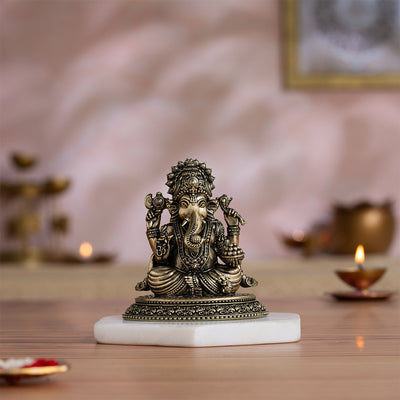
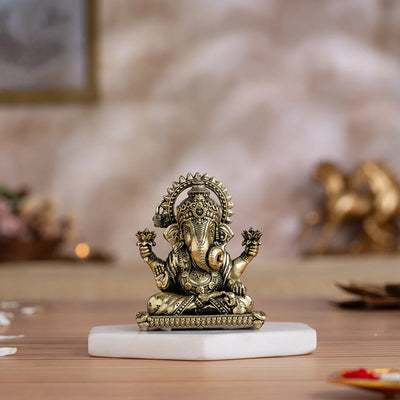
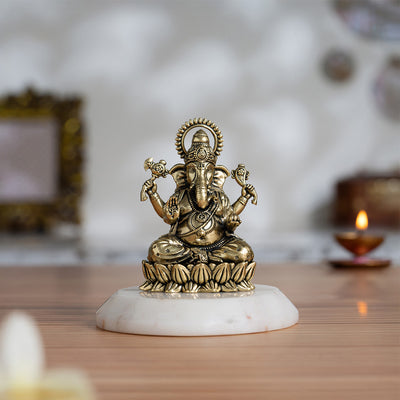
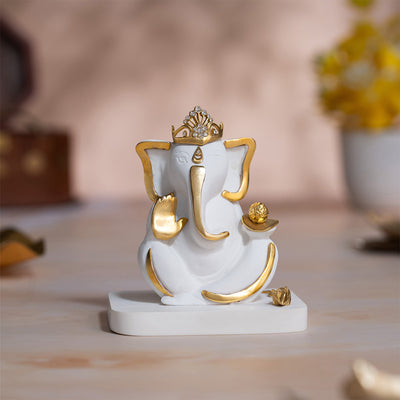
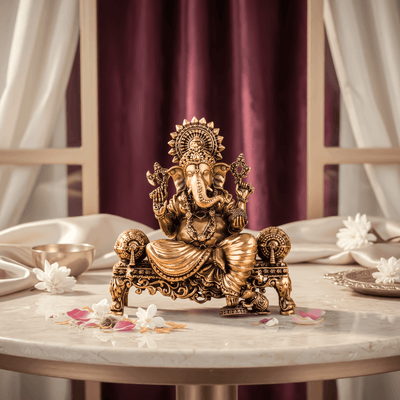
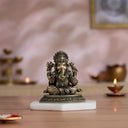
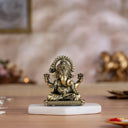
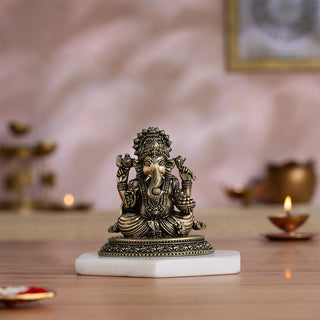
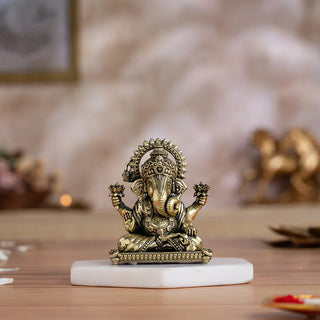
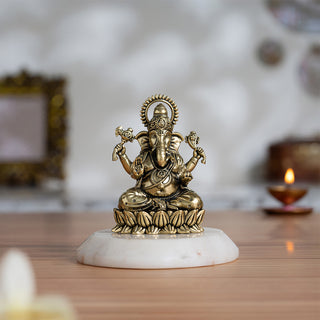
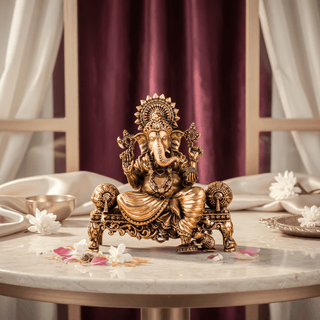
The blades should be laid on the idol, not scattered around it. That is the whole technique. If you have a small seated murti like a brass Ganpati idol on a lotus, there is a natural ledge between the lotus petals and the crown where a bunch of durva sits without falling, which is the sort of detail nobody writes down but every grandmother knows.
Clear the durva the next morning. It dries fast and looks sad by day two. If you are worshipping a metal murti through a long festival, our guide on cleaning idols properly covers what not to use, which matters more than people think for plated pieces from our brass collection.
Why this question is better than it looks
"Favourite flower" sounds like a small question. It opens into how Ganesha worship is actually built.
The texts are emphatic about a weed. The market is emphatic about a bloom. Both traditions are real, both are old, and the interesting part is that they disagree quietly and nobody notices, because nobody checks.
That gap runs through this whole subject. It is there in how Gauri and Ganpati are related, where the answer is simply mother and son but the Siva Purana's account of a son made by one parent alone is stranger than the summary.4 It is there in the belief that seeing the moon on Ganesh Chaturthi gets you falsely accused, where two genuine stories from two different texts have been welded together by later tradition. It is there in what dreaming of Ganesha means, which has no scriptural basis at all.
None of this should make anyone put down their hibiscus. Offer the flower. It is beautiful, it is what your family has always done, and Vighnaharta has never been fussy. Just add a few blades of durva beside it, because that is the one the texts actually asked for.
If you are setting up a shrine for the season, our Ganesh idols for the home run from pocket temples to ten-inch murtis, Ganesh Chaturthi gifts covers what you carry to someone else's, and what belongs in a pooja room is a sensible place to start. When the festival ends, immersing a clay Ganesha at home is theologically complete, not a compromise. And if you keep Ganesha alongside Lakshmi, the placement conventions are worth a read before Diwali Lakshmi Puja.
Also read: Why Tulsi Is Not Offered to Ganesha | Who Broke the Tooth of Lord Ganesha | Ganesha Trunk Right or Left Meaning | Relation Between Ganpati and Gauri | Ganesh Chaturthi Decoration Ideas