Every year the same argument starts in some family group chat. One person says the rakhi must be tied before 1 pm. Someone else has a screenshot saying after 1:30. A third person points out that the calendar on the fridge shows the festival on a different date entirely.
Nobody is lying. The confusion is built into how Raksha Bandhan is dated, and once you see the mechanism it stops being confusing.
When is Raksha Bandhan? It is a tithi, not a date
In 2027 Raksha Bandhan falls on Tuesday, 17 August, with the thread muhurat from 5:51 am to 12:58 pm (New Delhi). Raksha Bandhan is fixed to the purnima, the full moon tithi, of Shravana. A tithi is not a day. Robert Sewell and Sankara Balkrishna Dikshit set this out in The Indian Calendar (1896): a tithi is the time the moon takes to gain 12 degrees on the sun.
The moon does not travel at a steady speed. So that time keeps changing. Sewell measured tithis running from 21 hours 34 minutes at the shortest to 26 hours 6 minutes at the longest, with an average near 23 hours 37 minutes.1
A tithi can therefore begin at 4 in the morning and end in the afternoon of the next day. The full moon tithi may cover only part of the date printed on your calendar. That is the whole reason people say "tie it before such and such time." They are talking about when the tithi ends, not about a lucky hour.
This same elasticity is why Navratri sometimes runs eight days and why Janmashtami often falls on two different dates for two neighbours. Sewell notes that in twelve lunar months there are usually about thirteen tithis dropped and seven repeated.
Why there is no single rakhi muhurat
Sewell gives the general rule plainly: "the tithi current at sunrise of the solar day gives its name and numeral to that day."

Then he adds a second half that most timing lists leave out. Some rites are ordered for a fixed part of the day. In those cases the tithi running at that moment governs, not the one at sunrise. He works through examples where the correct day for a rite turns out to be the day before the day that carries the tithi's name. The same catch decides the Ganesh Chaturthi midday window and the day of the Karwa Chauth fast.
There is a bigger problem underneath. The two great authorities do not agree on the basic naming rule. Ebenezer Burgess, translating the Surya-Siddhanta in 1860, writes: "The civil day receives the name of the lunar day which ends in it."5 Sewell says the tithi current at sunrise names the day. Burgess says the tithi that ends in it does. Two rules, two possible answers, both old and both respectable.
So "the panchang says" is a weaker sentence than it sounds. There is no single panchang. Opening the Calendar Reform Committee, Jawaharlal Nehru said: "I am told that we have at present thirty different calendars, differing from each other in various ways, including the methods of time reckoning." The Committee's own appendix lists more than fifty printed panchangas circulating in seven languages. It also records an unsettled dispute about ayanamsa.6
The honest instruction is simple: tie the rakhi while the Shravana purnima tithi is running where you live, and take the minute from the almanac your family already follows.
What bhadra actually is
Most rakhi timings are really telling you to avoid bhadra. A karana is half a tithi, and bhadra is the name of one of them, the vishti karana. Because a tithi is elastic, its halves are elastic too, so bhadra is a moving stretch of hours rather than a fixed slot.
Worth saying clearly: avoiding bhadra for tying the rakhi is panchanga convention. It is not a command from any Purana we could open. Different panchangas mark the window differently. If yours gives one, follow it. If two disagree, neither is cheating you.
The oldest detailed account says the rakhi was not for brothers
In the oldest detailed account, the rakhi binds people who are not related at all. James Tod, a British officer who collected Rajput bardic chronicles, published Annals and Antiquities of Rajasthan in 1829. His account of the rakhi is the earliest widely circulated one in English, and it describes something quite different from what we do now.
"The Rajpoot dame bestows with the Rakhi the title of adopted brother... the public recognition of being the Rakhi-bund Bhae, the bracelet-bound brother of a princess."
In Tod's Rajasthan the rakhi is a way of adopting a protector who is not your relative. He says the claim it creates is stronger than blood. Tod received rakhis himself, from three queens and from the Rana's sister, and sent back gold each time. Actual sisters and brothers get one closing sentence in his account: sisters give clothes, brothers give gold in return.2
William Crooke, working independently in northern India, reached the same place from another direction in 1896. He files the festival under amulets and knotted cords, not under family: "On the full moon of Sawun is held the Salono or Rakshabandhan festival, when women tie these amulets round the wrists of their friends."3 Note the word friends.
Tod also preserves an origin story nobody repeats today. He writes that "Durvasa the sage instructed Salone (the genius or nymph presiding over the month of Sawun) to bind on rakhis, or bracelets, as charms to avert evil." A charm against harm, given by a sage most people know only for his part in the end of the Yadava line.
M.M. Underhill's The Hindu Religious Year (1921) sorts it the same way, listing Rakshabandhana in her chapter on knotted threads and protective objects. Three writers, three methods, one conclusion: the thread's job was protection.
Three things people get wrong about Raksha Bandhan
1. That Rani Karnavati sent a rakhi and Humayun rode in and saved her. The story comes from Tod, written three centuries after the events from bardic chronicles. And Tod's own version has no rescue in it. Chittor falls. "Kurnavati, mother of the prince... led the procession of willing victims to their doom." Only afterwards does "the tardy advance of Hemayoon with his succours" persuade Bahadur Shah to withdraw. Tod adds that instead of chasing him, Humayun "commenced a pedantic war of words with Buhadoor, punning on the word Cheetore." Even in the source everyone quotes, the rakhi saved nobody.
2. That it has always been a brother and sister festival on Shravana purnima. Tod cannot keep the date straight himself. On one page he calls it a spring festival. On another he says it is "held on the last day of Sawun." Crooke, thirty years later, describes friends rather than siblings. The kinship meaning we take for granted is real and it is loved, but it grew. It was not the starting point.
3. That there is one correct rakhi time. There is one correct tithi. The clock time depends on which naming rule your tradition follows, which panchanga you own, and where you are standing. A time printed with no place attached is not a fact.
Five other festivals share the same full moon
Shravana purnima is a busy tithi. In brahminical practice it carries Shravani Upakarma, the day the sacred thread is changed and the year's Vedic study begins. In Tamil Nadu and Kerala the same rite is Avani Avittam. Both are older than the rakhi customs and share the date.

On the Konkan coast the day is Nariyal Purnima. Underhill describes it in 1921 as "Cocoanut Full Moon, at Sravana full moon. From this date the south-west monsoon is supposed to abate, and coasting trade can be resumed." She calls it a traders' festival: coconuts are offered to the sea when it is safe to sail again.4
In parts of Madhya Pradesh and Uttar Pradesh it is Kajari Purnima, close cousin to the Kajari Teej songs earlier in Shravana. In Gujarat it is Pavitropana, when Shiva is offered a cotton thread. Crooke also records the barley sprout custom, Jayi in the upper country and Bhujariya in the Central Provinces, where the sprouts are shared with male friends.
One full moon, five festivals, one calculation. It is a good reminder that a tithi is a shared unit, a bit like the way Buddha Purnima and Gudi Padwa anchor whole regions to one lunar moment.
How to keep the day without arguing about the clock
Find the Shravana purnima tithi in the almanac your family actually uses. Tie the rakhi while it is running. If your panchanga marks a bhadra stretch, wait it out. That is the entire rule, and it has been the rule for a long time.
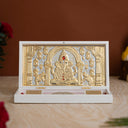
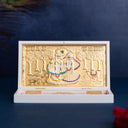
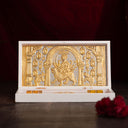
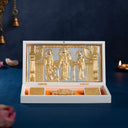
Everything else is yours to shape. Many families do a short puja first, with a lamp, a tilak and something sweet. If you keep a small travelling shrine or a Ganesha pocket temple, this is a natural day to bring it out. The whole festival began as a protective object carried on the body. Gifts follow the same logic: a rakhi gift that lasts, rather than one that is finished by evening. Our notes on meaningful rakhi gifts go into that further, and Bhai Dooj later in the year picks up the same thread.
The honest ending is that this festival changed. It went from an amulet tied by a queen on a stranger she wanted as a protector, to a thread tied by a sister on the brother she already has. That shift took two centuries and nobody voted on it. Reading Tod and Crooke does not take the meaning away. It shows you that a living festival is allowed to grow, the way Diwali and Chhath grew, and the way Hanuman Jayanti came to be kept twice in different regions.
A short note on the mantra
Many families recite a Sanskrit line while tying the rakhi, beginning yena baddho bali raja. It is widely attributed to a Purana. We could not open a text carrying it, so we will not give a chapter or verse number for it here. It is the mantra recited in practice, and that is what we can honestly say about it. See our note on the Ganesh Chaturthi moon rule for a similar case of custom outrunning its sources. Chaitra Navratri is dated the same way.
Also read: Krishna Janmashtami: Vrat Vidhi and Timings | Ganesh Chaturthi: Tithi, Muhurat and Visarjan | Karwa Chauth: Traditions and Puja Timing | Navratri: Tithi, Colours and Fasting Rules | Raksha Bandhan Gifts With Spiritual Meaning