A young woman is walking through a city with a dead child on her hip. She is knocking on doors and asking for medicine. The child has been dead long enough that people are backing away from her.
That is where this story starts, and most retellings skip past it to the moral. It's worth slowing down, because the way the Buddha handled her is genuinely strange. He didn't console her or explain impermanence. He gave her an errand.
Who was Kisa Gotami before her son died?
The commentarial account gives her a hard life even before the loss. Born into a poor family in Savatthi, married into a wealthy one, she was treated badly there until she gave birth to a son. The boy was what finally made her respectable.
He died as a toddler. Because her whole standing had rested on him, she seems to have refused the fact entirely. She picked up the body and went looking for a cure, house to house, the way you would look for a doctor.
People told her there was no medicine for this. One man, described as wise, realised she was past reasoning with and sent her to the Buddha instead. This was during the decades the Buddha spent teaching across the Gangetic plain, the period that produced the core of what he actually preached.

What did the Buddha actually tell her to do?
She asked him for medicine for her son. He said yes.
That's the first surprising move. He didn't correct her. He told her to go and bring back a small quantity of white mustard seed, siddhattha, a kitchen ingredient every household in the city had within arm's reach.
Then the condition: the seeds had to come from a house where no one had ever died. Not a parent, not a child, not a servant.
So she went. And every house had mustard seed, and every house had a death, one after another after another. Every household had its own dead to name, and in the commentary's telling they say so plainly: the living here are few, the ones we have lost are many.
Somewhere in that walk it landed. The commentary has her put the body down at the edge of the city herself. When she came back, the Buddha asked whether she had got the seeds. She said no. And he said the line the whole story turns on: you thought that you were the only one who had lost a son.
Notice what he did not do. He didn't perform a miracle. Compare how divine intervention usually works in Indian narrative: the resurrections and boons of the Vishnu avatar cycle, or the deathless figures of the seven chiranjeevis. The Buddha's method is closer to fieldwork. He sent her to collect data, and the data changed her.
Where this story actually comes from, and why it matters
The mustard seed episode is not a sutta. It is not something the Buddha says in one of his recorded discourses. It comes from the Dhammapada-atthakatha (the commentary on the Dhammapada) attached to verse 114.1 Commentaries like this were compiled centuries after the discourses, out of an oral storytelling tradition that grew up around the verses.
That does not make it false or worthless. Commentarial narrative is how the tradition taught itself for a very long time, and parables are how most people learn anything. But there is a real difference between "the Buddha said this" and "the tradition tells this about the Buddha." It is worth keeping straight. It is the same care you'd want applied to the snails-on-Buddha's-head story, which turns out to have no scriptural basis at all.
The verse the story is hung on is Dhammapada 114, and it's a good one:
Better than a hundred years in the life of a person who does not perceive the Deathless, is a day in the life of one who perceives the Deathless.
Read that next to the story and the point sharpens. The son's hundred years were never coming. What she got instead was one afternoon of seeing clearly.

The part almost every retelling leaves out
Most versions online end at the mustard seeds. The commentary doesn't.
After she was ordained as a nun, she was on duty one evening in the assembly hall and watched the oil lamps. Some flared. Some steadied. Some guttered and went out. She watched flames appear and disappear, and saw the same fact she had walked into that morning, but this time in something ordinary, and with nobody beside her to point at it.
That is the beat that makes her a practitioner rather than a person who was once taught a lesson. The insight arrived twice: the first time she needed the Buddha, the second time a lamp.
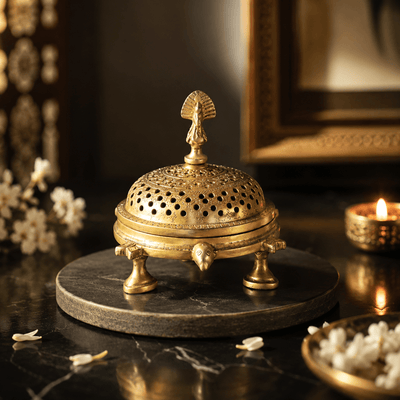
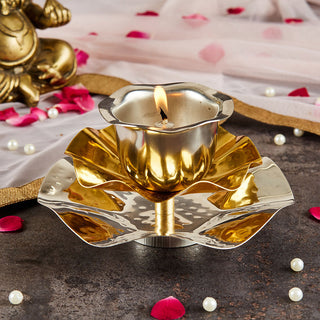
There is something quietly right about a flame being what showed her. Lamps carry this weight across Indian traditions: the row of Diwali diyas lit for Rama's return, the everyday evening lamp in a home puja space. A plain brass diya is the most obvious impermanent thing in the house. It is also what we light when someone is gone.
Three things people get wrong about this story
1. "The Buddha taught her that life is suffering"
He didn't say that, here or anywhere. In his first sermon the first noble truth isn't a verdict on existence: it's an enumeration. Birth, ageing, death, sorrow, lamentation, pain, distress and despair are dukkha; "in short, the five clinging-aggregates are stressful."4 It is a diagnosis of a mechanism, which is clinging, not a claim that everything is miserable. Kisa Gotami's problem was never that her son died. It was that she could not put him down.
2. "It was one baby son"
The texts disagree, and the disagreement is not small. The commentary gives her one son. Her own verses in the Therigatha count a catastrophe on a different scale:
Dve puttā kālakatā, Patī ca panthe mato kapaṇikāya; Mātā pitā ca bhātā, Ḍayhanti ca ekacitakāyaṁ
In plain English: Two sons dead. A husband dead on the road, and she with nothing. Mother, father and brother burning together on one pyre.
Therigatha 10.1, verse 7
An earlier version of this article said Mara taunts her about "your sons", plural, in the canonical Kisagotami Sutta. That was our error. The Pali word there is mataputta, a compound meaning "one whose son is dead" that does not mark number at all. Thanissaro Bhikkhu reads it plural, Bhikkhu Bodhi singular.3 The plural was an English choice, not a Pali fact.
So it is two accounts, not three. One son in the commentary, two sons and half a family in her own verses. The Samyutta does not say.
3. "It's a story about accepting death"
Half right. The commentary is careful that she doesn't just accept: she ordains, practises, and awakens. The story is a beginning, not a resolution. Compare how grief functions elsewhere in Indian narrative: the long separation in Radha's story, or the departures of Rama and Krishna, where grief is the mood the story ends in. Here it's the door in.

Her own voice, and a genuine puzzle
Kisa Gotami has her own poem in the Pali canon: the Therigatha, the collection of verses by the early Buddhist nuns, and one of the oldest bodies of women's writing anywhere in the world.
It does not mention the mustard seed. Not once.
What it describes is worse, and we quoted it above: two children dead, a husband dead on the road, parents and brother on one pyre, and her wandering half-mad and half-clothed until she met the Buddha. Then it turns to the eightfold path and the Deathless, and to how hard the householder's life is for a woman.
And there's a further wrinkle. Thanissaro Bhikkhu, in his introduction to the translation, points out that the Pali commentary assigns this exact life-story (the snakebite, the two children, the family in the fire) to a different nun altogether, Patacara. His own comment on it is refreshingly blunt: "Why this story is attributed to Patacara in the Commentary when it is obviously Kisa Gotami's in the Canon, is hard to tell."2
So somewhere in the transmission, two grieving women's stories appear to have swapped places, and nobody has cleanly resolved it. If you came for a neat parable, that's inconvenient. If you came to understand how these texts were assembled and passed down for centuries before anyone wrote them, it's the most useful thing on this page.
She meets Mara, and she isn't afraid
The last place we see her in the canon, she is sitting alone in the Blind Man's Grove after her meal, and Mara (death, temptation, whatever you want to call that figure) comes to unsettle her. He asks why she sits there like a woman whose son is dead, and whether she is looking for a man.
Her answer is not grief. It's closer to a boundary being set:
I've gotten past the killing of sons; with that, the search for men has ended. I don't grieve, I don't weep... Having destroyed the entire army of darkness, free of fermentations I dwell.
Mara recognises he's been recognised, and vanishes. That's the ending the story deserves, and it's her voice, not the Buddha's.

So what was the truth of life he taught her?
Not a doctrine. He never handed her a proposition to believe.
He was consistent about this. He refused, on the record, to say whether the cosmos is eternal, or whether an awakened one exists after death. He compared anyone who demands those answers first to a man shot with a poisoned arrow, who won't let the surgeon work until he knows the archer's caste.5 His last recorded words were an instruction too, not a revelation: all compounded things vanish, so strive with earnestness.6
With Kisa Gotami he did what he did with everyone: he arranged a situation in which she could see something for herself. The mustard seeds were never the point. The doors were: a hundred kitchens, a hundred households, every one holding a loss.
She went out believing her grief was uniquely hers. She came back knowing it was the most ordinary thing in the world. That is not a small consolation. It is, more or less, the whole teaching.
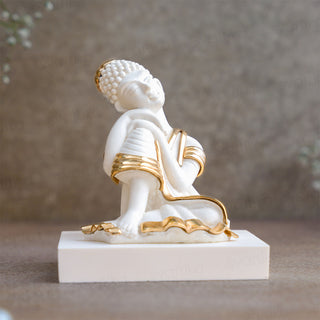
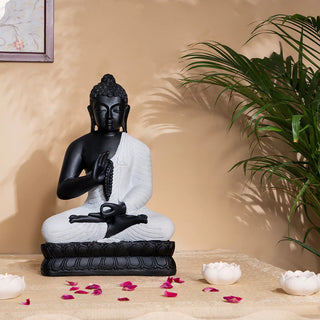
It's also why a seated Buddha figure looks the way it does. The half-closed eyes aren't sleep and aren't ecstasy: they're the face of someone who has looked at this squarely and isn't flinching. That's the quality people are reaching for when they keep a Buddha idol at home, or place a small meditating Buddha somewhere they'll see it on an ordinary bad morning. Not decoration exactly. It sits differently from the rest of the things in a room. A reminder, the way the lamp was for her. (If it's marble or stone, it will need dusting rather than washing; there's a short guide to cleaning marble idols if you're unsure.)
If you want to follow the thread further: what he taught after this became the seated practice that travelled to China and Japan, his birth and death are marked together on Buddha Purnima, and his near-contemporary Mahavira was teaching a strikingly different response to the same problem, which is worth reading beside this: start with Mahavir Jayanti and his teachings.
One last honest note. Because this is commentarial literature rather than a discourse, we can't date the mustard seed episode or say it happened. What we can say is that it was being told, and told well, a very long time ago, and that the woman at its centre left verses in her own name telling a harder story than the one that made her famous. Both are worth having.
Also read: What Did Buddha Preach to the People | The 108 Snails on Buddha's Head Story | What Zen Meditation Actually Means | Why We Celebrate Buddha Purnima | Mahaveer Jayanti and Mahavira's Teachings