Here is something odd about the phrase "Zen meditation." Take it apart and it says the same thing twice.
"Zen" is how Japanese speakers pronounced the Chinese word chan. Chan was how Chinese translators wrote down the Sanskrit dhyana. And dhyana already means meditation: the absorbed, settled attention that runs through Indian practice long before any of this reached China. The word travelled India to China to Japan, shedding a syllable at each border, and what came out was a school named after the thing it does.
So "Zen meditation" is close to saying "meditation meditation." That is the first useful thing to know. The name promises no secret. It tells you that people sit down.
What Dogen actually tells you to do
Dogen gives physical instructions, not atmosphere. The Fukanzazengi, his "Universal Recommendation for Zazen," reads more like a carpenter explaining a joint than a poem about stillness.
He tells you to use a thick mat with a round cushion on top. Sit in full lotus if you can, with each foot on the opposite thigh; half lotus is fine, one foot on one thigh. Keep the spine straight. Then this line, which is the most quoted physical instruction in Zen: your ears should be in line with your shoulders, and your nose in line with your navel.1
Rest the right hand on the left foot, left palm on the right palm, thumb-tips lightly touching. Sit upright, not tilting forward or back. Eyes stay open. Breathe gently through the nose. Sway your body left and right a few times to find the centre, and then settle into steady, unmoving sitting.
That is the whole set-up. No mantra, no visualisation, no breath counting, no timer. Zen gets sold as a mind practice, but its founding manual spends most of its words on where to put your knees.
He thought this mattered enough to write it twice. The Zazengi fascicle of his Shobogenzo ("On the Model for Doing Meditation") repeats the same posture almost line for line, sitting "not leaning to the right, inclining to the left, bending forward, or arching back," ears aligned with shoulders and nose with navel. Then he closes the whole thing in a sentence: "Seated meditation is a practice and not something for intellectual study. It is the Dharma Gate to peace and joy."2
Zen meditation is not "emptying your mind"
Dogen contradicts the emptying-the-mind idea in his own text. His instruction is: when a thought arises, do not get involved with it. That's different from stopping it or pushing it away. It just means not following it. There is a real difference between a thought passing through a room and you following it out the door.
Then he gives the line that has confused and delighted readers for eight centuries: think the fundamental thought, which is not thinking. Non-thinking, in this reading, is a third thing. It is not thinking about something, and it is also not blankness. It is awake and it is not chasing.
If you have ever given up on meditation because your mind would not go quiet: by Dogen's own instructions you were not failing. A mind producing thoughts is a mind doing what minds do. The practice is in not grabbing them.
This idea did not start with Dogen either. Six centuries earlier in China, Huineng pushed harder and asked whether sitting still is even the point. He is the Sixth Patriarch, and his Platform Sutra is the one Chinese Zen text the tradition calls a sutra. "In our School," he says, "to sit means to gain absolute freedom and to be mentally unperturbed in all outward circumstances, be they good or otherwise."4 Sitting, for him, is a condition of mind rather than an arrangement of legs. Thomas Cleary's translation of the same chapter is blunter still: "Sitting meditation in this school basically does not fixate on mind, and it does not fixate on purity. Also it is not immobility."5
He is sharpest about teachers who sell the blank-mind method. Some of them, he says, "instruct their disciples to keep a watch on their mind for tranquility, so that it will cease from activity". The result is that "ignorant persons become insane from having too much confidence in such instruction. Such cases are not rare, and it is a great mistake to teach others to do this." That is a thirteen-hundred-year-old warning against exactly the thing most people now assume Zen is.
The same plainness runs through the older Indian material this grew out of. In one discourse the Buddha picks up a handful of leaves in a simsapa grove, points at the whole forest, and says what he has taught is the handful.7 That fuller picture of his actual syllabus is in what the Buddha preached to the people.
The hardest idea in Zen: the sitting is not a method
We assume meditation is a tool. You sit to become calmer, sharper, kinder, enlightened. Sitting is the ladder; the good state is the roof. Dogen refuses that model. Zazen, he writes, "is not learning concentrated meditation. It is simply the Dharma-gate of peace and joy, the realisation in practice of enlightened wisdom."
The sitting is not the path to realisation. In Dogen's Soto framing, the sitting is the realisation, happening.
This is genuinely hard to hold. Sit to get something and you have already made the present moment a means to a better one, which is exactly the grasping the practice is about. Sit for no reason at all and most of us stop within a week.
Worth saying clearly: this is Dogen's position, within the Soto school. It is not a neutral description of all Zen. Anyone who tells you "Zen says" without naming which teacher and which century is flattening a live argument.
Zen is not one method: just sitting versus the koan
The two great streams disagree about what you actually do on the cushion.
Dogen's line is shikantaza: just sitting. Nothing added. No object of concentration, no puzzle to solve.
The other stream works with koans, and its most famous collection is the Wumenguan, the Gateless Gate, put together by the Chinese master Wumen Huikai in 1228. It opens with a few lines:
A monk asked Joshu, "Has the dog the Buddha nature?" Joshu replied, "Mu."
That is Case 1, and generations of practitioners have spent years with it. Mu is usually rendered as "no" or "nothing," but the point is not the translation. The koan is not a riddle with a hidden answer; it is a question designed to exhaust the part of you that wants answers.
Just sitting and koan work look like the same activity from outside: a person on a cushion, not moving. Inside, they are two different bets about how a stuck mind comes unstuck.
D.T. Suzuki, writing from the Rinzai side, put the split about as plainly as anyone: "Koan and zazen are the two handmaids of Zen; the first is the eye and the second is the foot."6 On that reading the sitting is not the destination, it is what carries you there, which is precisely the idea Dogen spent his life refusing.
Three things people get wrong about Zen meditation
1. "It is about stopping your thoughts."
This is the belief that makes people quit. Dogen's text says do not get involved with the thought (non-involvement, not suppression) and calls the state non-thinking rather than no-thinking. Huineng, older and ruder, says teaching people to shut the mind down is "a great mistake." Blankness is not the goal and never was.
2. "The Flower Sermon is an event from the Buddha's life."
The Buddha stands before an assembly on Vulture Peak, says nothing, and simply holds up a flower. Only Mahakasyapa smiles. The Buddha says the eye of the true teaching has been transmitted, and hands it to him. It is Zen's own origin myth: teaching passed mind to mind, outside words.
It is a beautiful story. It is also not in the Pali canon. Its famous form is Case 6 of that same Wumenguan, compiled in 1228 CE, roughly seventeen centuries after the Buddha lived.3 That does not make it worthless; founding stories are how traditions explain themselves, and this one holds Chan's whole self-understanding in a single image. But it is Chinese Song-dynasty literature, not Indian scripture, and a reader deserves to know which shelf it came off.
Zen is not the only place where a much-loved story sits in commentary rather than scripture. The mustard-seed episode is the same shape, and we walked through its textual layers in how the Buddha taught Kisa Gotami.
3. "Zen is a relaxation technique."
Zen arrived in the English-speaking world through a wellness door, and the word now gets used for scented candles and slow interior design. Nothing wrong with any of that. But the tradition's own texts are not offering stress relief. They are asking you to sit still with an unedited mind for a long time, which is frequently uncomfortable. Dogen calls the result peace and joy. He does not call it easy.


Where does the Buddha figure fit into all this?
Almost every Zen hall has one. So do a lot of Indian homes, sitting in a corner of the pooja room or on a shelf in the living room, and the reason is not always devotional.
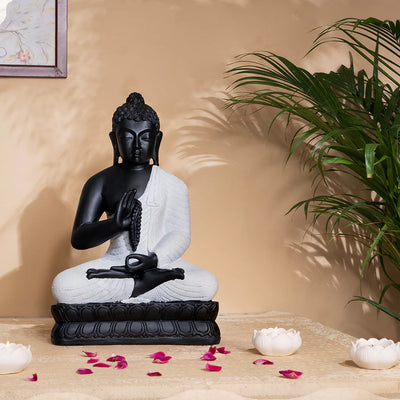
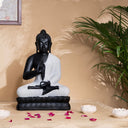
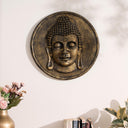
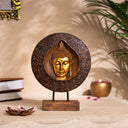
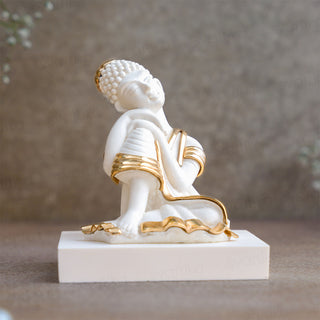
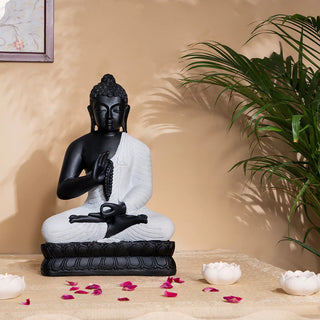
A seated Buddha is a posture diagram. Look at the sculpture and you are reading Dogen's instructions in stone: legs folded, spine upright, hands resting one in the other with the thumbs meeting, eyes lowered rather than shut. A small seated meditating Buddha placed where you sit is less an object of worship than a reminder. It shows how a body holds itself when it is not bracing against anything.
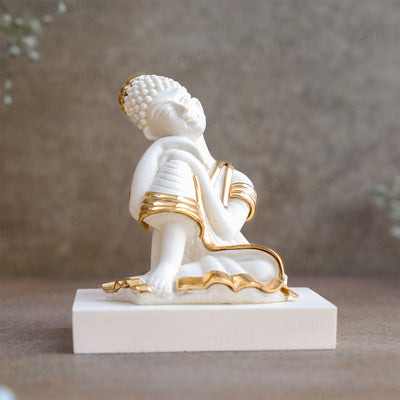
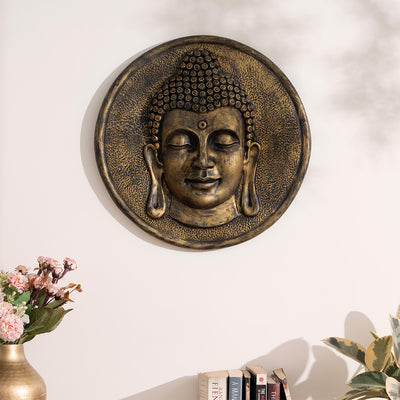
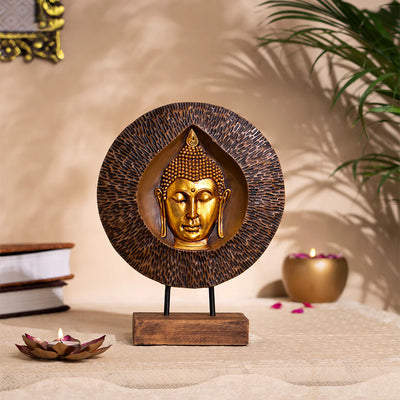
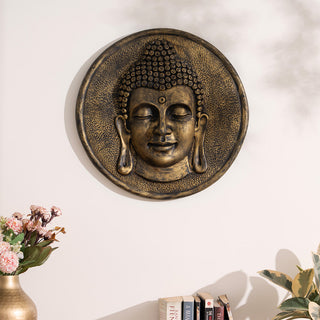
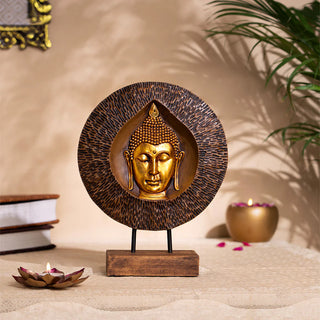
The bumps on a Buddha's head are the subject of a story about snails that is retold everywhere and appears in no canonical text. We checked the two canonical lists of the Buddha's physical marks item by item in the 108 snails story. Our guide to cleaning a marble idol covers the practical side, the wider range of Buddha statues for the home is seated figures in wood, brass and white and gold, and a seated Buddha is a common housewarming gift: it reads as calm rather than a claim about anyone's religion.
How to actually start, without buying anything
Take Dogen literally. It is more useful than any modern adaptation.
- Find a quiet-ish place and a firm cushion. A folded blanket works.
- Sit cross-legged if you can, on a chair if you cannot, feet flat and back unsupported.
- Straighten up. Ears over shoulders, nose over navel. Sway gently side to side and let yourself settle in the middle.
- Hands in the lap, right palm up, left palm on it, thumb-tips just touching. When the thumbs collapse or press, you have drifted. It is a quiet feedback loop.
- Eyes open, gaze soft and downward, a metre or so ahead.
- Breathe through the nose. Do not manage it.
- When a thought arrives, do not follow it. Let it be traffic.
Ten minutes is plenty at the start. Many people light incense: a stick of loban or dhoop burning down is the traditional timer in a lot of halls, and it beats a phone alarm because nothing beeps at you.
What you should not expect is a result. Some sittings are calm, most are ordinary, a few are restless and dull, and by Dogen's account none of that is the score.
How Zen sits next to Indian practice
Readers in India often arrive at Zen sideways: strangely familiar and strangely foreign at once.
Familiar, because dhyana is Indian vocabulary and the whole silent-sitting apparatus grew here first. Foreign, because most household practice in India is sound-shaped rather than silence-shaped: a mantra repeated, a name held, a bell, an aarti. If your practice runs on repetition, something like Krishna mantras, daily Krishna worship or the Sai Baba mantra tradition is doing a related job by a different road. It gives the mind one thing so it stops shopping for others.
One claim is worth flagging because it turns up constantly. Some Puranic Hindu texts count the Buddha among the avatars of Vishnu, and this gets repeated as though it were a shared position. It belongs to Puranic Hinduism, not to any Buddhist text, and Buddhist tradition has never accepted it. We lay out that list in the ten avatars of Vishnu. Treat it as a later cross-tradition claim, not neutral history.
For the historical Buddha rather than the philosophy, see Buddha Purnima. The parallel renunciant movement of the same period is Mahavir Jayanti: the two were arguing with the same assumptions.
So what does Zen meditation mean?
It means seated meditation. A posture described in unglamorous detail by a thirteenth-century teacher who cared where your thumbs went. And an instruction to stop following your thoughts, which is smaller and more doable than emptying your mind.
And in Dogen's Soto reading, it means giving up the idea that sitting is a step towards something. That claim is what makes Zen difficult. His own words for it were peace and joy: not because sitting is pleasant, but because there is nowhere else you are supposed to be getting to.
A cushion, a wall, ten minutes. The tradition does not ask for more. What it does with the corner of a home is a separate question: our notes on calm home arrangement, quiet table decoration, simple living-room pieces and the wider home decor range are a decent place to wander next.
Also read: What Did Buddha Preach to the People | How Buddha Taught Kisa Gotami | Why We Celebrate Buddha Purnima | Can We Keep a Shiva Statue at Home