Every list of temple mysteries carries it. The flag on the Jagannath Temple at Puri, they say, flies in the opposite direction to the wind, every day, and nobody can explain it.
The claim has travelled a long way. It is on the Government of India's own tourism website, which states that the flag “consistently flutters in the opposite direction of the prevailing wind, as if guided by an unseen divine hand” — and, in the same paragraph, that the servitors climb 165 metres. The temple is about 65 metres tall. A 165-metre Hindu temple would be more than twice the height of the Qutub Minar and taller than anything of its kind ever built. It is a one-digit slip, laundered into a national fact.
So it is worth going carefully. Not to take anything away from Puri — by the end of this you should think more of that flag, not less — but because the real thing is stranger and better documented than the story.
What the Patitapabana Bana actually is
The flag is called the Patitapabana Bana, the banner of the purifier of the fallen. It is hoisted every day on the mast above the Nilachakra, the eight-spoked wheel of eight metals at the summit of the main spire.
A description written by a Sri Mandira Purohita for the Orissa Review in 2010 gives the particulars: the flag is red or yellow, triangular, with the symbol of a moon and a star painted on it in white, and “every day the flags are changed.” The same article measures the wheel beneath it — 3.5 metres high, about 11 metres round, eight spokes each one foot ten inches long, weighing a little over a quintal and a half.14
And it records something easy to miss. The vimana, the temple tower, is described as having five parts: Bhumi, Bada, Gandi, Mastak and Dhwaja. The flag is not an ornament fixed to the building. It is counted as part of the building.

One more detail from a 2012 Orissa Review article on the Patitapabana, and it turns out to matter: “At times five to twelve flags are hoisted on the top of the temple.”3 On special occasions a flag as long as the temple is tall — the Padukakhia Bana — is flown so that its lower end reaches the road.
What is the science behind the Jagannath Temple flag?
Three things, none of them exotic, and all of them well documented in ordinary engineering literature.
The wind you feel is not the wind up there. Puri is a dense coastal town and the temple stands inside a walled compound. Over built-up ground the wind profile does not begin at your feet; it effectively begins around two-thirds of the way up the surrounding rooftops. Below that you are in sheltered, disorganised air.
Big blunt objects reverse the flow behind them. This is the standard treatment in the ASHRAE handbook: air separates at the sharp edges of a building and forms recirculating zones over the roof, the sides and the leeward wall, extending some distance into the wake.6 The same chapter notes that the downwash on the upwind face separates before it reaches the ground and moves upwind. Reversed flow near a large structure is not an anomaly. It is what the handbook tells engineers to expect.
And the wheel makes its own wake. A NASA study of vortex flows found isolated pockets of genuinely reversed flow, unattached to any surface, carried downstream as far as four diameters behind the obstacle.7 The Nilachakra is a 3.5 m bluff body sitting directly below the flag; a pennant a metre or two behind it sits well inside that zone. Vortex shedding from a body that size in a light breeze runs at roughly one swing every three seconds — slow enough to watch.8
There is a street-level version of the same physics that anyone can check. A study of a real urban canyon found that “the direction of wind at street level is opposite to the flow above roof level” once the ambient wind exceeds about 1.5 to 2 metres per second.5 That is a gentle breeze. In a built-up street, the wind at your feet running against the wind overhead is the normal condition, not the miracle.
One thing that does not explain it, and saying so matters: wind shear alone. The change of wind direction with height over open ground runs about 0.05 to 0.15 degrees per metre.9 Over 65 metres that is three to ten degrees. Nowhere near a reversal. The mechanism is the temple's own wake, not the atmosphere quietly turning.
The claim is not in the Purana, and not on the temple's own website
This is the part that settles it.
The flag claim does not appear in the Skanda Purana's Purushottama Kshetra Mahatmya. It is not on the temple administration's own pages. It is absent from the Orissa Review's dedicated article on the Patitapabana, and from its architectural surveys. It is not in Rajendralala Mitra's Antiquities of Orissa of 1875, and it is not in the book-length account of the temple published in 1895 — a volume of some hundred thousand characters that does not mention the temple flag at all.

None of that proves the flag behaves ordinarily. Absence of a claim is not disproof. But it does tell you what kind of claim this is. Devotees, priests, chroniclers, colonial surveyors and the temple's own administration have described this building exhaustively for centuries, and not one of them thought a wind-defying flag was worth writing down. It is a modern story about an old temple.
The Archaeological Survey had them shorten the flag — because of the wind
And here is the evidence that runs the other way, all of it from the people who actually look after the flag.
Odisha's regional press reported in 2018 that the Archaeological Survey of India asked for the flag's length to be reduced, first to twenty-one hand-lengths and then to fourteen, to prevent wind loading from damaging the temple.4 Before Cyclone Fani in 2019 the servitors swapped the regular flag for a shorter one as a precaution; the full-size flag was restored on 9 May, once the storm had passed. During Fani itself the flag was torn off the mast. It was blown away again before Cyclone Amphan in 2020. In May 2026 a Kalabaisakhi thunderstorm tore it, and on another occasion the bamboo flagpole broke and the flag was found scattered.
A flag that defied the wind would not need shortening on an engineer's advice. It would not be swapped for a smaller one before a cyclone. It would not end up in pieces on the roof.
The people closest to this flag have always known exactly what it is.
The wind at your feet is not the wind on the spire
So what is the devotee on the Bada Danda actually seeing? Something real, and worth explaining rather than dismissing.
Start with the height, which almost every retelling gets wrong. The temple administration gives it as “about 214 feet and 8 inches high from the road level.”1 The Archaeological Survey measures 57.28 metres from the floor of the inner enclosure to the apex of the Nilachakra.2 Both are right. The temple stands on a rise, the Nilagiri, and the difference between the two figures is the mound. Sixty-five metres above the road, fifty-seven above the temple floor. Not one hundred and sixty-five.

Now add Puri's own weather. The India Meteorological Department's measurements at Bhubaneswar found the sea breeze setting in around four in the afternoon, blowing predominantly from the south, and shifting the wind direction by twenty to forty degrees when it arrived. It appeared cleanly in only four of fifteen occasions studied.10 The classical description of the cycle has the sea breeze ending around sunset, with the land breeze not starting for another two or three hours.11
Which brings us to the timing, and this is the part nobody mentions. The flag is changed in the evening, near sunset, before the Sandhya Dhupa. That is precisely the hour when the surface wind is at its weakest, its most variable, and its least likely to agree with the wind sixty-five metres up. The most watched moment of the day is also the moment the two are most likely to disagree.
Why a flag was never a reliable pointer
There is an assumption buried in the whole claim, and it is worth pulling out: that a flag reliably points downwind.
It does not. A flexible sheet in a steady, uniform airflow is unstable — the physics literature on flag flutter is largely a literature about the transitions from periodic flapping into chaotic motion.12 A flag does not sit still and indicate a direction. It snaps, rolls and reverses on its own, in air that is perfectly straightforward.
Put that flag behind a stone tower and beneath a three-and-a-half-metre iron wheel, and asking which way it “should” be pointing stops being a well-formed question.

Remember too that five to twelve flags may be flying at once. They sit at different heights, in different parts of the same disturbed air. They routinely stream in different directions from one another, which you can see for yourself in almost any photograph taken from the right angle. If a flag were a reliable indicator of the wind, that alone would be impossible.
Three things people get wrong about the climb
The daily change is real, and it is far more remarkable than the wind story. But the details get mangled.
It happens once a day, not twice. In the evening, before the Sandhya Dhupa — around five in winter, six in summer.
It is about eight hundred years old, not eighteen hundred. The temple was completed in the thirteenth century. Every version of this story that says 1,800 years is describing something that could not have happened.
The climb is the spire, not 165 metres. The servitors who do it are the Chunara, listed in the temple's own record of rights for “hoisting the flag (Dwaja) and lighting the Mahadipa” atop the temple. A Lenka servitor is present when the flag is tied.
What remains after those corrections is still extraordinary. A man from a specific family climbs the outside of a fifty-seven-metre stone tower, barefoot, without a harness, at dusk, and does it again tomorrow.
 9% off
The shadow, the birds and the eighteen years
Three companion claims travel with the flag, and they deserve the same treatment. We went through them in more detail in our piece on the facts about the Jagannath temple, so briefly here.
“The temple casts no shadow.” Puri sits at about 19.8°N, inside the tropics, which means it has exactly two zero-shadow days a year, when the sun passes directly overhead at noon. The Astronomical Society of India lists Puri's dates as 19 May and 24 July.13 The phenomenon is real, precisely predictable, and happens twice a year rather than always. That is a better fact than the myth.
“No bird flies over the temple.” In no primary source. There is a quiet irony in it too: the servitor who hoists the flag is titled Chunara Garuda Sevaka, and the hall below has a Garuda pillar at its centre. The temple is full of birds; it is just that they are carved.
“If the flag is not changed, the temple closes for eighteen years.” A widely held belief, and no documented instance of it happening. It is a way of saying the duty is absolute, which it is.
What is actually worth being amazed by
The wind story asks you to believe the temple breaks physics. The truth on offer is better: the temple is so large, and so cleverly shaped, that it makes its own weather in the few metres around its summit, and a flag placed there behaves in ways that genuinely surprise people standing sixty-five metres below in air the building has already turned around.
And then, at the hour when the sea breeze dies and before the land breeze starts, a man climbs it. No rope. Bare feet. The same family, the same duty, the same wall, for eight hundred years. If you want something at Puri that resists easy explanation, it was never the cloth. It was always the climb.
The same instinct sits behind the other questions people ask about this temple — why Jagannath has no hands, and why his eyes are so large. In both cases the tradition's own answer turns out to be more interesting than the one going around. For how the temple and its festival began, there is the Rath Yatra story as the Skanda Purana tells it.
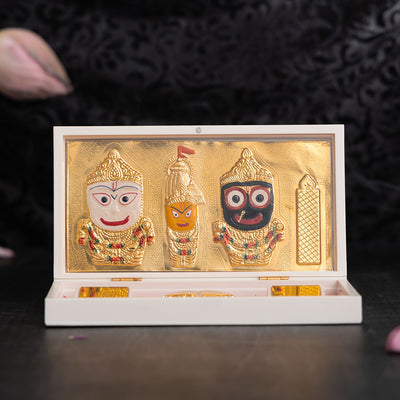
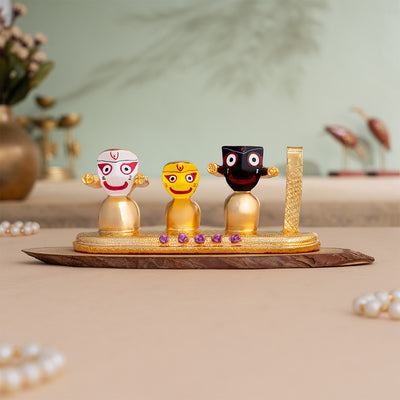
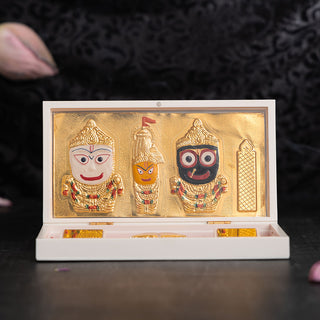
And if you keep a Jagannath murti at home, the triad is the point — Jagannath with Balabhadra and Subhadra, the three of them together, as they stand on the Ratnavedi at Puri.
Also read: Facts About the Jagannath Temple | Why Jagannath Has No Hands | Why Lord Jagannath Has Big Eyes | Who Is the Mother of Lord Jagannath | Why Rath Yatra Is Celebrated