Start with the strangest part of the story, because nobody tells you this bit.
A god came down to earth, heartbroken, looking for his wife. He did not build a palace. He crawled into a termite mound under a tamarind tree and stayed there. He had no food. A cow started walking up the hill every day to stand over the anthill and let her milk run into it. When the cowherd found out his cow was giving nothing at milking time, he raised an axe at her, and the god came out of the mound and took the blow himself.
That is the god crores of people queue eleven hours to see. And most of us, if we are honest, could not tell you a single scene from his story before reading that paragraph.
So who is Balaji, exactly?
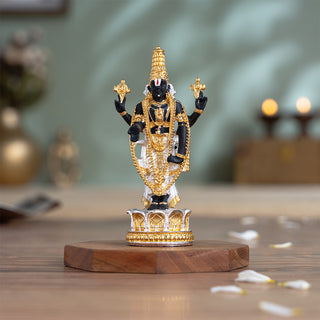
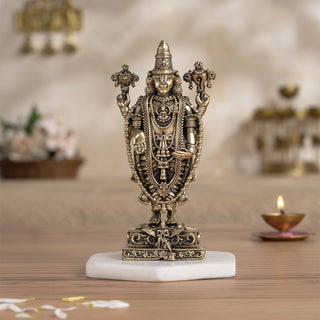
Balaji is Vishnu. Specifically, he is Vishnu in the form he took on the Venkata hill in the Seshachalam range of Andhra Pradesh: the deity of the Tirumala temple, worshipped as Srinivasa, Venkateswara and Venkatachalapati, and in old Tamil as Tiruvengadamudaiyan, "the one who owns Tiruvengadam."
Here is the first gentle correction, and it catches almost everyone. "Balaji" is not a scriptural name. You will not find it in the Puranas that carry his story, or on the Tirumala Tirupati Devasthanams' own pages, which say Srinivasa and Venkateswara throughout. Balaji is what pilgrims from the north and west called him: a household name that travelled along pilgrimage routes and stuck so hard that it is now the name most of India uses. It is a loved name rather than a verse. That does not make it lesser. It makes it ours rather than the text's.
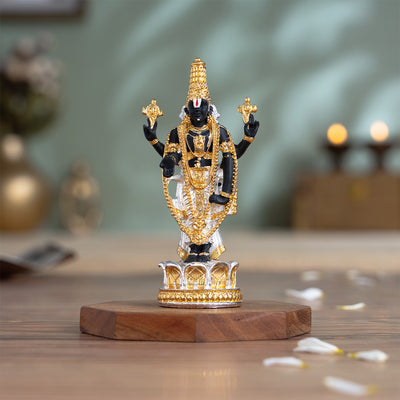
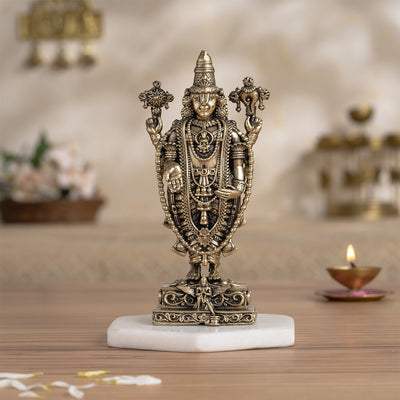
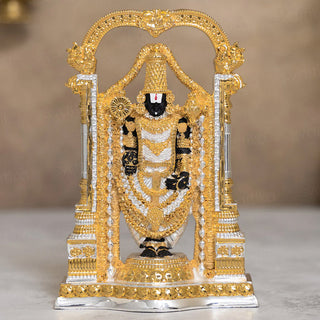
If you have read about the ten avatars of Vishnu, it helps to be clear that Venkateswara is not one of them. He is not a descent like Narasimha or Rama or Vamana, each of whom came for a specific task and left. He is Vishnu choosing to stay put in one place, in stone, indefinitely. That is a different kind of story, and it is why Balaji idols tend to show him standing still, arms in a fixed gesture, rather than mid-action.
The story as the temple itself tells it
The Tirumala Tirupati Devasthanams publishes its own version of the legend, and it is worth following beat by beat because the popular retellings drop half of it.
It begins with a different form of Vishnu entirely. Adi Varaha, the boar who lifted the earth out of the waters, had Garuda bring the hill Kridachala to a spot east of the Swami Pushkarini tank. That hill became Venkatadri. This matters more than it sounds, and we will come back to it.
Then the sorrow. Lakshmi had left. Vishnu came down to the hill searching for her and took shelter in an anthill beneath a tamarind tree, living on nothing. In TTD's telling, Brahma and Shiva took the forms of a cow and her calf so that milk would reach him: a lovely detail, because the sacred cow in Indian tradition is almost always the one who gives without being asked. A Chola king's cow was the vessel. The cowherd's axe fell. The Lord took the wound.3
That moment tells you what kind of god this is. He did not stop the axe or curse the man. He stepped in front of an animal. If you want the shape of devotion in one image, it is not the gold and the diamonds: it is that.
 1% off
Padmavati, Akasa Raja, and the loan nobody expected
Srinivasa married a princess named Padmavati and borrowed the wedding money from Kubera. This stretch of the story is closer to a village romance than a cosmic epic.
The cursed king of the earlier episode was reborn as Akasa Raja, who one day found an infant girl inside a lotus and named her Padmavati. Narada told him she was destined to marry Vishnu himself. Vishnu, now walking the world as Srinivasa, met her, and in the popular retellings the meeting happens while he is chasing an elephant through the forest, which is the least dignified way any god has ever met his wife.
He had a mother for the occasion. Vakula Devi, an elderly saint, raised him as her son and went to arrange the match. TTD's account says she had been Yasoda in an earlier life: Krishna's foster mother, who raised a child she never got to see married. This time she got the wedding. Whoever added that detail understood something about grief.
Then the part everyone has heard, usually wrongly. The wedding was enormous and Srinivasa did not have the money, so he borrowed a huge sum from Kubera, the god of wealth. TTD states this plainly on its legend page.
What TTD does not say anywhere (not on the legend page, not on the history page) is that your hundi offering is helping him repay that loan with interest until the end of Kali Yuga. That framing is real, it is beloved, and millions of people give with it in their hearts. But it is folk interpretation grown around a scriptural story, not temple doctrine.4 It is worth knowing which is which, and then giving anyway if you want to.
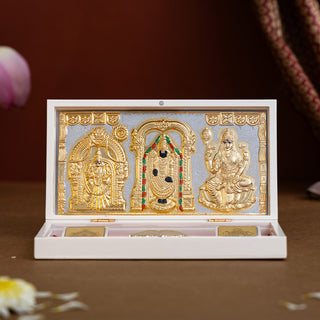
When Lakshmi finally returned, the story closes: Vishnu turned himself into a granite statue, with both goddesses beside him, and stayed. That is the murti in the sanctum. Not a representation of him. Him, in the telling.
 16% off
The hill was not his to begin with
By the temple's own account, Venkatadri belonged to Adi Varaha first. Srinivasa asked him for the land, and Varaha gave it as a gift. In return, TTD states, the first darshan, the first worship and the first offerings at Tirumala belong to Sri Bhu Varaha Swamy, not to Venkateswara.3
Most visitors walk straight past the Bhu Varaha Swamy shrine on the bank of the Swami Pushkarini without knowing they are supposed to enter it first. Which means a very large number of us have been doing the darshan in the wrong order for a very long time. If that kind of detail interests you, there are more genuinely lesser-known things about Tirumala that get lost under the viral ones.
Three things people get wrong about Balaji
1. "He is one of the ten avatars of Vishnu." He is not, and the temple's own historian says so flatly. T.K.T. Viraraghavacharya, who wrote TTD's History of Tirupati, puts it in a line: "He is not any of the ten Avatars of Vishnu. He is Narayana Himself."5 An avatar comes down for a job (kill a tyrant, lift the earth, restore a dharma) and then leaves. Venkateswara comes down looking for his wife and never leaves. That is the whole difference, and it is why he ends up with a hill rather than a chapter.
2. "The image was always obviously Vishnu." This one is more interesting than the confident version. The earliest Tamil poets to sing about the hill saw two gods in the same figure. Viraraghavacharya notes that the first three Alvars "described the form of Tiruvengadamudaiyan as one in whom both Vishnu and Siva existed in happy combination" (Periya Alvar's stanza lists matted locks and a dagger alongside the chakra and the coiling snake) while leaving "no doubt that He was Vishnu Murti."5 Later Vaishnava tradition settled the matter firmly, and the temple has been unambiguously Vishnu's for a very long time. But the ambiguity is old, it sits in the poetry, and pretending it never existed flattens a real piece of history.
3. "Shaving your head at Tirumala is a scriptural rule." It is carried by the Neela Devi story and by centuries of unbroken practice, not by a Puranic verse anyone can point you to. That is not a downgrade. Something millions of people have done for that long is doing real work whether or not a verse authorises it, and saying so honestly respects it more than inventing a citation would.
 10% off
Why this story still lands
Strip away the gold and what you have is a god who lost someone, went looking, ended up living rough in a mud mound, was kept alive by an animal's kindness, fell in love, could not afford the wedding, borrowed money, and then decided he could not bear to leave, so he turned to stone and stayed.
Every single beat of that is a human beat. That is probably why the queues are what they are.
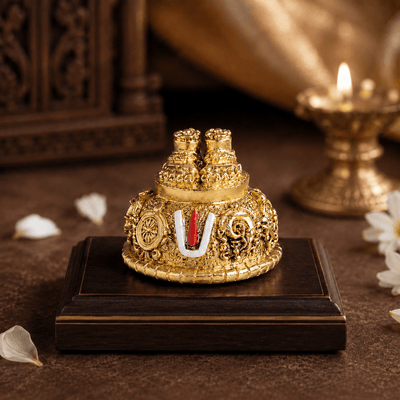
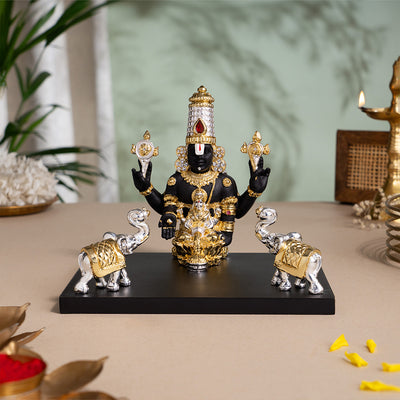
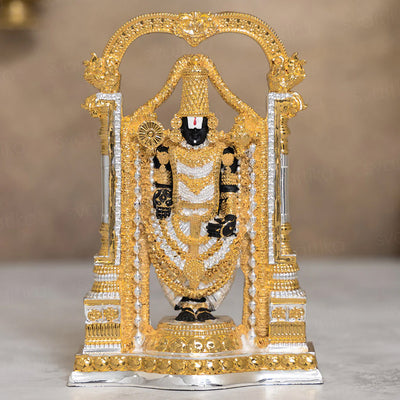
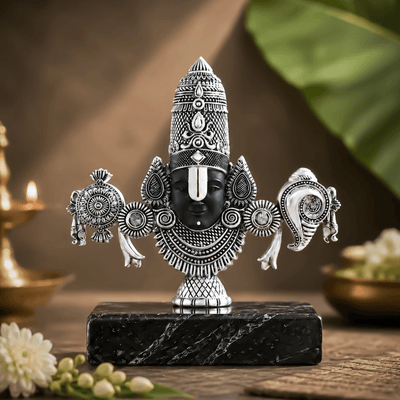
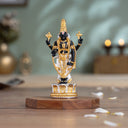
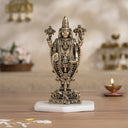
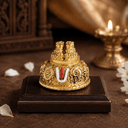
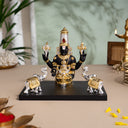
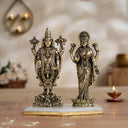
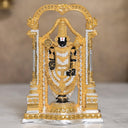
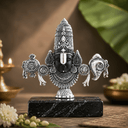
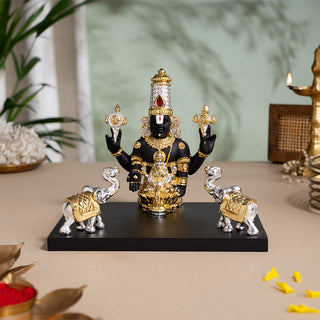
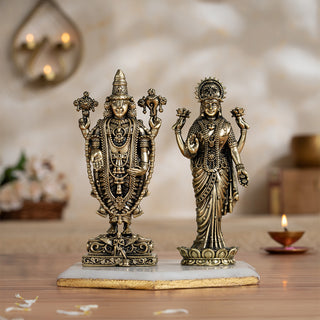
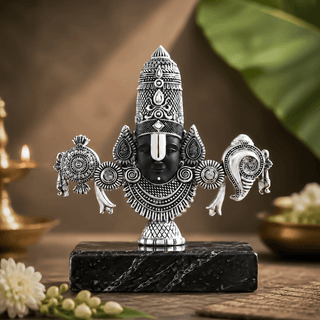
It also explains the shape devotion to him takes at home. People rarely keep a dramatic Balaji. They keep a still one: a standing figure, a face, a pair of feet. The feet especially: at Tirumala the gesture of surrender is placing your head where his feet are, which is why a Balaji charan paduka carries the weight it does, and why there are old rules about where charan padukas are placed at home.
If you are setting up a space for him, the usual sense applies: a clean east or north-east facing spot, and the same care you would give any standing Vishnu idol at home. There is a short list of things worth keeping in a pooja room if you are starting fresh, and separate guidance on which idols suit a car dashboard, where a great many Balaji faces actually live in this country.
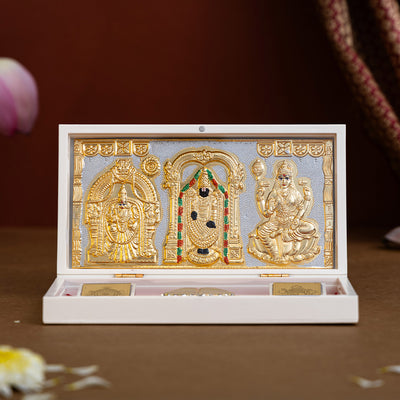
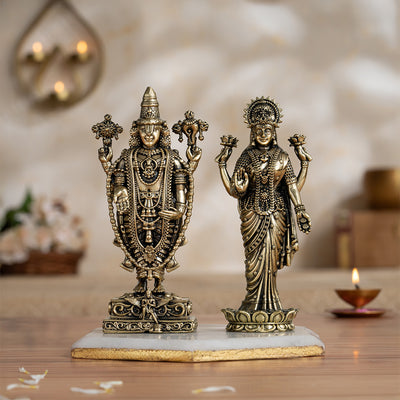
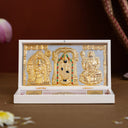
And Lakshmi belongs in the picture, because the story ends with her returning. Homes that keep Balaji very often keep Lakshmi beside him, and the Diwali Lakshmi puja is where that pairing gets its yearly airing.
One last thought. Bhrigu went looking for the greatest god and got his answer from the one who apologised.1 Devotees have argued about that ever since. The god on the hill said nothing, took a loan, and stayed.
Also read: 10 Tirumala Temple Secrets | The 10 Avatars of Vishnu | Varaha Avatar Story | Who Is Lord Vishnu's First Devotee | Can We Keep a Standing Vishnu Idol at Home