There is a temple in Telangana where Hanuman is not standing alone.
Almost everywhere else in India he is by himself, or he is kneeling at Rama's feet, or he is tearing open his chest to show who lives inside it. But at the Suvarchala Anjaneya Swamy temple, he is seated with a wife beside him. Couples go there specifically to pray for their marriages.
That temple is the reason this question is worth taking seriously. Something real is being remembered there. The question is what.
So did Lord Hanuman have a wife or not?
Both answers are true, depending on which text you open.
The mainstream position across almost all of Hindu practice is that Hanuman is celibate. He is invoked as a brahmachari, and wrestlers and students pray to him for exactly that reason. Millions of people would tell you, correctly for their tradition, that the question does not arise.
Then there is the minority strand, preserved mainly in Telugu-speaking regions and in one Sanskrit text, which says he did marry, and that he married in order to remain celibate. That sounds like a contradiction. It is actually rather clever.
What neither camp can claim is Valmiki. And that is where any honest answer has to start.
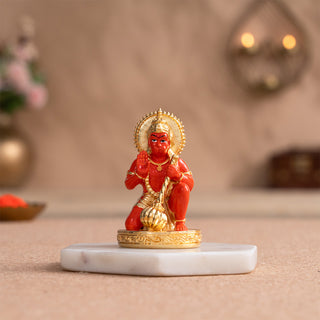
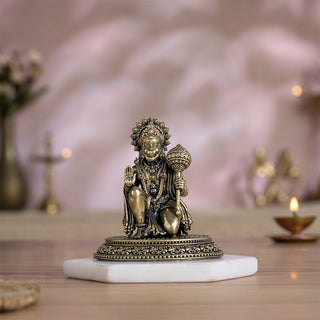
What Valmiki's Ramayana actually says about Hanuman's marriage
Nothing. Not a line.
The Valmiki Ramayana is a long, detailed epic that finds room for the genealogies of monkeys, the furnishings of Ravana's palace, and the exact way the ocean looked from mid-air. It tells us who Hanuman's father was. In fact it gives him two, Kesari as his social father and Vayu as his begetter, in Kishkindha Kanda 66. It tells us his mother Anjana was formerly an apsara named Punjikasthala. It tells us how he got his name from a broken jaw, and exactly which boons Brahma and Indra gave him afterwards.2
It never once mentions a wife, a son, or a vow of celibacy.
That silence cuts both ways, and this is the part most articles skip. It means there is no epic warrant for Suvarchala. It also means there is no epic warrant for calling Hanuman a brahmachari. Valmiki simply did not treat his marital status as part of the story.
Who was Suvarchala, and where does her story come from?
Suvarchala is a daughter of Surya. Her story comes from the Parashara Samhita, sometimes called the Hanumat Charitra, a two-volume Sanskrit work traditionally ascribed to the sage Parashara and given over entirely to Hanuman's life. The text is real and extant; you can find scanned editions of both volumes online.8 It sits closer to devotional and tantric literature than to epic scripture, which matters when you weigh it against Valmiki.
Hanuman studied under Surya, the sun god. The boy who once mistook the sun for a fruit and leapt at it grew up to take the sun as his teacher. He learned the Vedas and the sciences of grammar and speech while Surya travelled his daily course, flying backwards in front of the chariot so he could keep facing his guru.
But one branch of learning could not be taught to an unmarried student. In the older Indian schema, certain knowledge belonged to the grihastha, the householder stage of life, and could only pass to someone who had entered it. Hanuman's education could not be completed while he stayed a bachelor.
Surya's solution was to give him his own daughter, Suvarchala, born of the sun's own radiance and herself an ascetic. The marriage was performed. And according to the tradition, the moment the wedding was complete, Suvarchala returned to her tapasya. The union was never consummated. Its entire purpose was to satisfy a technical requirement so that a lesson could be given.
The marriage story does not break Hanuman's celibacy. It exists to protect it. Married on paper, untouched in fact.
The temple where Hanuman has a consort
The Suvarchala Anjaneya Swamy temple in Telangana enshrines Hanuman together with Suvarchala, one of very few places in India where he appears with a consort at all. Devotees facing delays or difficulties in marriage come there to ask for help, the logic being that a deity who married out of duty rather than desire is the right one to petition about a marriage that will not happen.
A living temple with its own ritual calendar is much stronger evidence that a tradition is genuinely old than any number of blog posts repeating each other. It is also, honestly, the strongest thing this story has going for it, because the textual side is thinner than most articles admit.
Here is the caveat, stated plainly. The Parashara Samhita exists and it is entirely about Hanuman. I have not been able to read its marriage chapter directly, and so I am not going to give you a chapter or verse number for it. Anyone who does hand you one, without saying where they got it, is guessing.
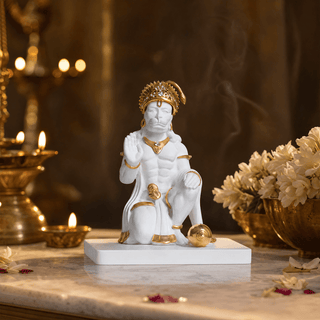
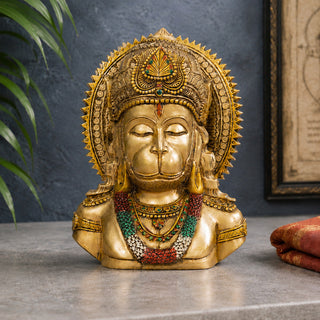
Then where did his son come from?
If Hanuman is celibate, the obvious follow-up is Makardhwaja, the son who guards the gates of Patala and ends up fighting his own father without knowing it.
The conception is the whole point. After burning Lanka, Hanuman went to the sea to cool his tail. A drop of his sweat fell into the water and was swallowed by a makara, a great sea creature. Makardhwaja was born from that. No woman. No desire. No vow broken.
That is not an accident of storytelling. It is the same instinct that produced the Suvarchala marriage, working from the opposite direction: a wife without a marriage bed, a son without a mother.
Makardhwaja is not in Valmiki either, and he is not in Tulsidas's Ramcharitmanas. He belongs to the same regional cycle as the Panchmukhi Hanuman story, the Ahiravana episode found in the Bengali Krittivasi Ramayana of around the fifteenth century and in a sixteenth-century Telugu Mairavana charitra. Same underworld, same night, same rescue. If you have read one of those stories, you have already met the other.
Was Hanuman even a brahmachari? Valmiki says something better
Valmiki never calls Hanuman a brahmachari. He praises something else.
In the Sundara Kanda, Hanuman has to search Ravana's inner chambers for Sita. That means walking through rooms full of sleeping women. He knows how it looks. He stops and examines himself, and the objection he raises is a dharmic one: that looking at other men's sleeping wives will cost him.1
Then he settles it. And he does not settle it by invoking a vow.
"There indeed was not even a little disturbance in my mind… my that mind is very steady."
— Valmiki Ramayana, Sundara Kanda 11.37–41
Not "I am celibate." Not "I have taken a vow." He says his mind did not move.
The virtue Valmiki gives Hanuman is composure. Steadiness. A mind that stays where he puts it. The brahmachari framing is a later devotional emphasis laid over something subtler and, to my reading, more interesting, because abstinence is a rule you keep, while steadiness is a state you are in. Valmiki's Hanuman is not resisting anything. There is nothing to resist.
Which means the entire marriage debate may be answering a question the oldest text never asked.
Four things people get wrong about Hanuman's marriage
1. "The Ramayana says Hanuman was a brahmachari."
It does not. The vow appears nowhere in Valmiki. In the one place where the subject comes up at all (Sundara Kanda 11), Hanuman defends himself by describing a steady, undisturbed mind, not a rule he is following. The celibacy framing is real and old in devotional practice, but it is not epic scripture.
2. "The Suvarchala story is a modern invention."
Also no. It is attributed to the Parashara Samhita, a genuine two-volume Sanskrit text on Hanuman's life, and it is upheld by a functioning temple in Telangana with its own ritual calendar. What it is not is epic material. Calling it tradition is accurate. Calling it fabricated is not.
3. "Makardhwaja proves Hanuman broke his celibacy."
The story says the exact opposite. Sweat and a sea creature, no mother, no contact. The birth was constructed specifically so that nothing was broken. If you read it as evidence against his chastity, you have read it backwards. And there is no verse number for Makardhwaja anywhere in Valmiki or Tulsidas. He is folk and regional tradition, and saying so is more useful than pretending otherwise.
4. "There is one correct answer and the other traditions are wrong."
Hindu tradition is comfortable holding several accounts at once, and this is a good example. The same religion gives Hanuman two fathers and a third theological origin without embarrassment: Kesari, Vayu, and the Shiva Purana's claim that he is an avatar of Shiva. A single deity carrying multiple biographies is normal here, not a flaw in the record.
Why the tradition worked so hard on this
Hanuman is the one figure in the epics whose defining quality is that his attention never wavers. Everything about him is single-pointed. Ravana lands a blow on his chest and Indrajit ties him with a Brahmastra, and still nothing in the epic actually stops him.5 He leaps an ocean because Jambavan reminds him he can. He carries a whole mountain because he cannot tell which herb is the right one. He is still alive, according to the Mahabharata, on a boon he asked for himself: to live as long as Rama's story is told on earth.7 Among the deathless figures of Hindu tradition, his is the strangest boon of all, because it depends entirely on someone else's fame surviving. He stayed on past Rama's own departure so the telling would continue. Even his immortality points away from him.
A wife complicates that. Not morally: plenty of gods are married and nobody minds. It complicates it structurally, because Hanuman's whole meaning is undivided attention, and a household divides attention. So when the tradition did give him a wife, it gave him one who went straight back to her own tapasya. And when it gave him a son, it gave him one born from sweat.
Both stories are the tradition saying: yes, but nothing changed. He is still looking at Rama.
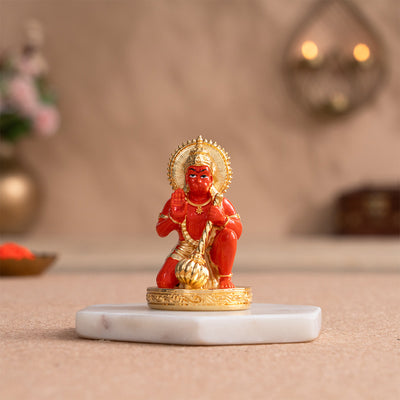
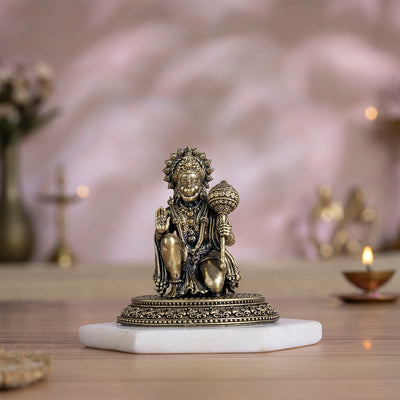
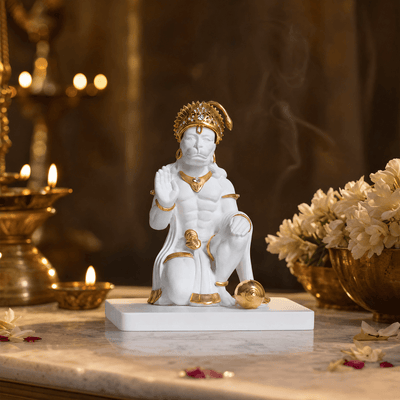
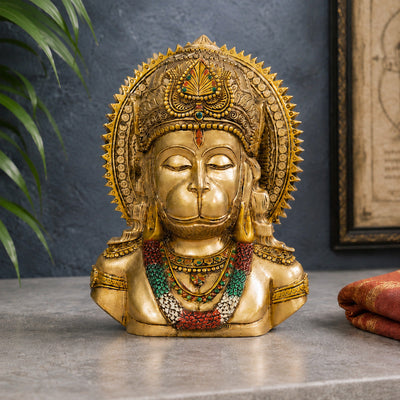
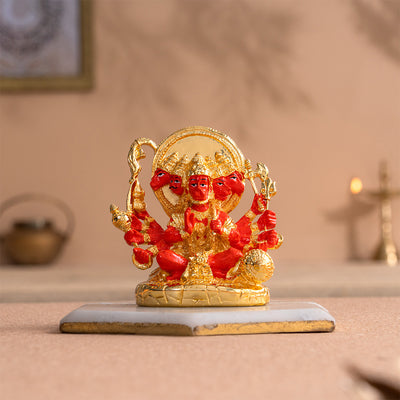
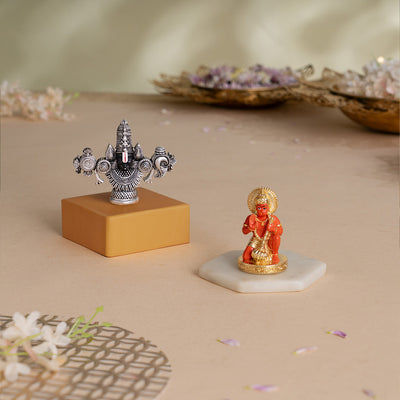
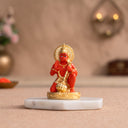
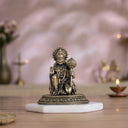
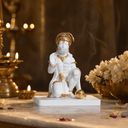
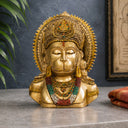
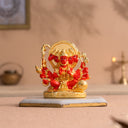
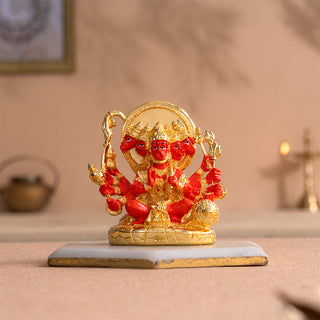
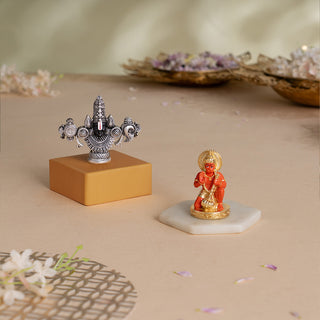
You can see the same instinct in the sculpture. Across centuries of temple art, Hanuman appears as the warrior with his mace raised, as the mountain-bearer flying with the herb, as Panchamukhi with five faces, and most often of all as Dasa Hanuman, hands folded, head slightly bowed, the servant. Not one of those forms is a domestic one. Even the seated Hanuman in Ram bhakti, calm and kneeling, is oriented outward at someone he is serving. The form you choose for a home shrine is really a choice about which of those postures you want in the room.
 25% off
So what should you tell someone who asks?
Tell them this. Valmiki gives Hanuman no wife. Most of India worships him as unmarried. One tradition, recorded in the Parashara Samhita and kept alive at a temple in Telangana, says he married Suvarchala, a daughter of Surya, so that his education could be completed, and that the marriage stayed celibate by design.
And then the good part, which almost nobody mentions. The oldest text never made celibacy the point in the first place. It praised a mind that did not move.
The marriage, the sweat-born son, the brahmachari title: all of it is later tradition protecting something Valmiki had already described more simply. A man in a room full of sleeping strangers, who checked his own mind, found it still, and got on with the work. That is the version I would keep, and it happens to be the oldest one.
Devotees who keep his Hanuman Jayanti twice a year already know this instinctively. So does anyone who has recited the Hanuman Bahuk, which, despite what half the internet claims, is not an arm posture but a poem Tulsidas wrote in old age because his arms hurt too much to sleep. Even his devotional literature is about somebody asking him for help, not about him.
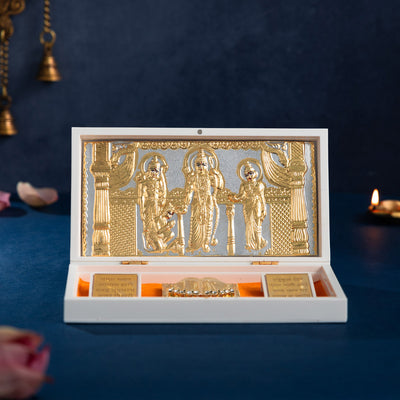
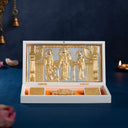
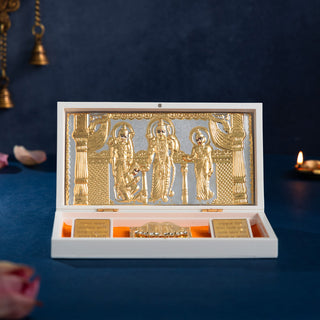
Our Hanuman idols are made in those same postures, in brass and in gold-plated marble dust. The Lord Ram collection holds the darbar pieces, where he stands where he has always preferred to stand: at the edge of the frame, behind the brothers, watching Rama.
Also read: Who Was Lord Hanuman's Father? | The Son of Hanuman: Makardhwaja | Is Lord Hanuman Still Alive? | The Panchmukhi Hanuman Story | Which Hanuman Idol Is Good for Home?