Somebody buys a Ganesha murti, brings it home, puts it on a shelf, and then makes the mistake of searching for where it should go. Within ten minutes they have read that it must face north-east, that it must never face south, and that getting it wrong invites trouble.
That is a rough thing to do to a person who was simply happy about their new murti.
So let's separate three things almost every page on this topic mashes together: what scripture says, what Vastu says, and what is plain common sense wearing the costume of a rule. Once you can tell them apart, the whole question gets lighter.
Do the Puranas say anything about which way a Ganesh idol should face?
No. And this is the part people find surprising.
The Puranas have a great deal to say about Ganesha. The Siva Purana devotes several chapters to his birth, his beheading and his restoration.5 The Ganesa Purana's Upasanakhanda spends six full chapters (chapter 63 plus a five-chapter Durvamahatmya at 64 to 68) on durva grass alone.3 The Brahmavaivarta Purana explains why tulsi is kept off his offering tray.4 These texts are not shy about detail.
What none of them do is tell a householder which wall to put the murti against.
The classical texts that do discuss orientation of an image are the Mayamatam and the Manasara. Both are manuals of architecture and image installation: they deal with temple structures, plinths, proportions and the consecration of a deity in a built shrine. A temple's garbhagriha faces a particular way for reasons involving the whole building's geometry. Your shelf in a two-bedroom flat is not a garbhagriha, and these texts were not written with it in mind.
So if you have been told "the shastras say your Ganesha must face north-east," the honest response is: which shastra, and which chapter? Nobody has ever been able to produce one.
Then where does the north-east rule come from?
From Vastu Shastra, and it has a real internal logic worth understanding rather than just obeying.
In the Vastu Purusha Mandala (the grid that underlies Vastu's reasoning about a plot or a room) each direction is assigned to a presiding power. The north-east corner is the ishana corner, named for Ishana, a form of Shiva, and it is treated as the quarter of the devatas. It is the direction associated with clarity, with the first light of the day, and with whatever in a house is meant to be pure and undisturbed.
That is why Vastu puts the pooja space there. Not because a Purana ordered it, but because within Vastu's own system, the devatas' corner is where you build the devatas' room. It is coherent. It is old. It is also a different kind of authority from scripture, and it deserves to be named for what it is.
The same reasoning produces the rest of the advice you have read. East is the sunrise direction, so a worshipper is often told to face east. North is associated with Kubera and with increase, which is why north-facing is the other common recommendation. South carries associations with Yama and the ancestors, which is why Vastu prefers you not sit facing it during worship. None of it is arbitrary.
You are allowed to find that beautiful and still know it is not a Puranic injunction.
Which way should the idol face, and which way should you face?
Vastu's guidance is mostly about where the shrine sits and which way the worshipper faces. The idol's own facing is a consequence of that. If the shrine is in the north-east and you sit facing east or north to worship, then the murti is looking back at you, which means it faces west or south. That is the arrangement, and it is why you will see the seemingly contradictory advice "place it in the north-east" and "let it face west" on the same page. Both are true at once.
The practical version, stripped of drama:
- Put the shrine in the north-east part of the room or home if you can.
- Sit facing east or north when you worship.
- Let the murti face you, which usually means west or south.
- Do not place the idol so it faces directly out of the main door.
That last one is the only piece of directional advice most people find intuitive without being told. A murti positioned to stare out of the front door feels like it is leaving. That instinct is doing more work in this tradition than any compass reading.
Three things people get wrong about Ganesh idol direction
1. "The shastras prescribe the direction."
They do not. There is no Puranic passage legislating the orientation of a household image, and the texts that discuss image orientation at all (the Mayamatam, the Manasara) are temple-architecture manuals addressing consecrated structures.1 The rule is Vastu tradition. Calling it scripture borrows an authority it does not have, and it also makes people afraid of something they should be enjoying.
2. "Facing the wrong way brings misfortune."
This is the sentence that does the actual harm, and it appears on almost every page about this. It has no textual basis at all. Vastu discusses favourable and less favourable placements; it does not threaten. When you see a directional claim attached to a consequence (loss, delay, obstacles) you are usually reading marketing copy, not tradition.
3. "A right-facing trunk needs a special direction and special rules."
The right-trunk versus left-trunk distinction is temple and Vastu lore rather than iconographic doctrine. The classical iconographic literature classifies Ganapati by named form (Uchchhishta, Unmatta-uchchhishta, Kavala, Lakshmi, Heramba, Prasanna and Nritta Ganapati among them) each defined by number of arms, posture, vahana and companions. T. A. Gopinatha Rao's survey of these Agamic forms in Elements of Hindu Iconography (1914) runs across pages 35 to 67 without ever making trunk-curve direction a category of classification. If you own a right-trunk murti, you have not bought a problem. We went through this properly in a separate article on trunk direction.
The pattern repeats across this whole subject. People confidently cite the Bhagavata Purana for the moon curse on Ganesh Chaturthi. But read Canto 10, chapters 56 and 57, and there is no moon in the Syamantaka story, no fourth lunar day and no Ganesha.67 Krishna is suspected because Prasena vanishes wearing the jewel and Satrajit accuses him publicly. The moon material lives in a different text entirely. A real tradition, a real text, and a join between them somebody added later.
Does the rule change during Ganesh Chaturthi?
The festival murti is a different case.
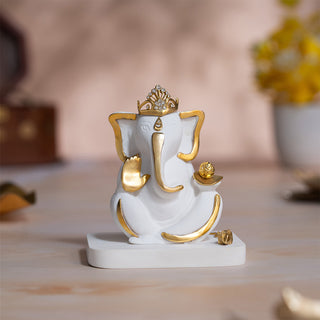
A Chaturthi Ganpati is invited in for a fixed number of days and then seen off. The logic underneath that is avahana and visarjana: you call the presence into a temporary clay image, and at the end you take leave of it respectfully. That is why the festival idol is made of something designed to dissolve. The impermanence is the point, not a compromise.
Which means the placement question changes shape. A festival Ganpati goes wherever the family can gather around it: the hall, the biggest room, somewhere there is space to sit. Nobody moves a sofa for a compass. The Chaturthi tithi and visarjan timings matter far more to how the ten days go than the wall the murti is against.
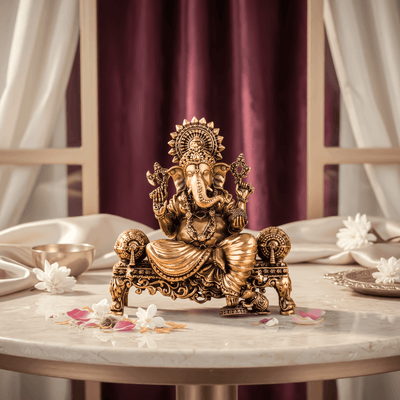
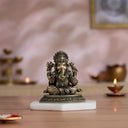
A permanent brass or marble murti is the opposite case. It stays, it is never immersed, and it is worth thinking about placement once, properly, because you are not going to move it. Something from the brass collection on a clean shelf will outlast most of the furniture around it, and a wipe now and then keeps it looking the way it did the day it arrived.
Where not to put the shrine
Most of the genuinely useful placement advice has nothing to do with direction and everything to do with respect.
- Not in or against a bathroom wall. Shared plumbing walls too.
- Not under a staircase. People walk above the murti all day.
- Not on the floor. A shelf, a chowki, or a small mandir gives it a proper seat.
- Not in a bedroom if you can avoid it, though for a one-room home, a clean high shelf is completely fine, and anybody who tells you otherwise has never lived in a one-room home.
- Not somewhere you will forget it. A shrine behind a door that never opens is worse placed than one facing south.
Keep it clean, keep it at or above chest height when you are seated, and keep the area around it uncluttered. That, plus a lamp lit reasonably often, is the whole of it. If you want the fuller version, we have a longer guide on what belongs in a pooja room and another on Vastu-friendly ways to arrange a home. The same applies to everything else on the shelf (a shankh, a Shree Yantra): the direction advice for each comes from the same Vastu framework and carries the same weight. A tidy shelf and a few good pooja essentials do more for a daily practice than any amount of compass anxiety.
Does the type of idol change the answer?
Not for direction. It does change other things.
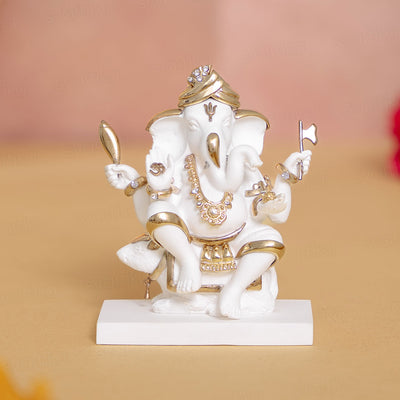
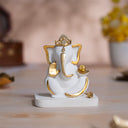
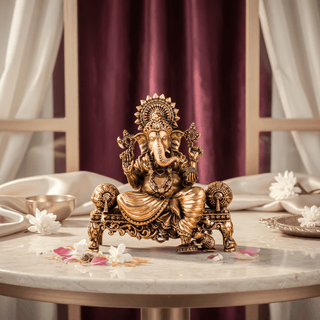
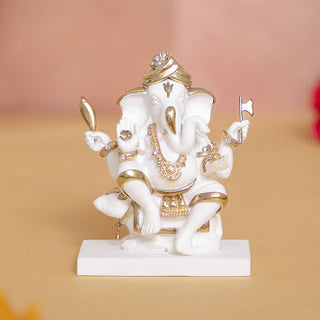
A seated Ganesha in lalitasana (one leg folded, one hanging) reads as settled and at ease, which is why it is the usual recommendation for a home. A dancing Nritta Ganapati is magnificent, and sits better in a living room than a shrine. Material matters practically: clay is meant to dissolve, which is why home visarjan works the way it does, while brass, marble and panchaloha are permanent and never immersed. Our note on which Ganesha idol suits a home covers the forms in more detail, and the full Ganesha collection is the easiest way to see them side by side.
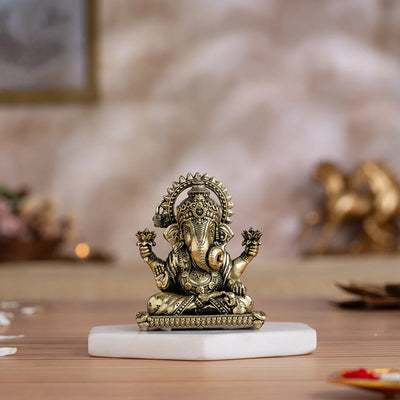
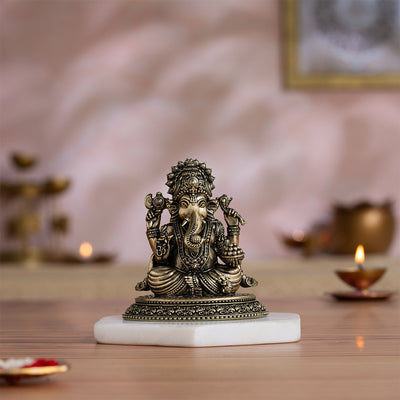
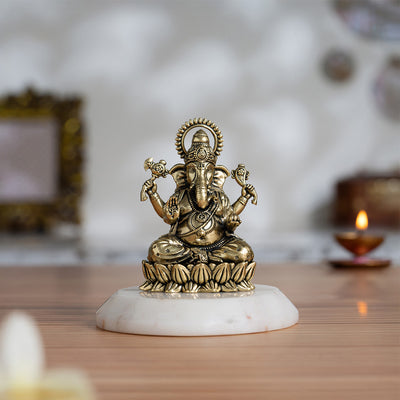
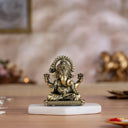
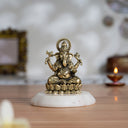
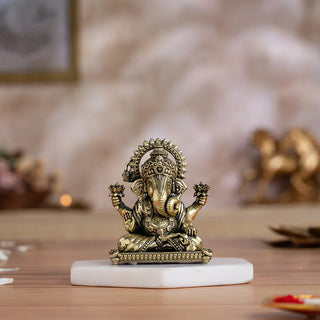
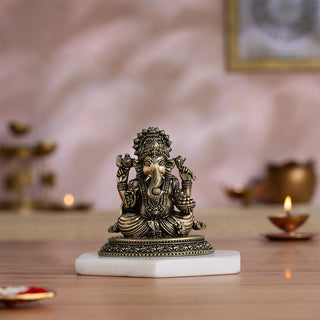
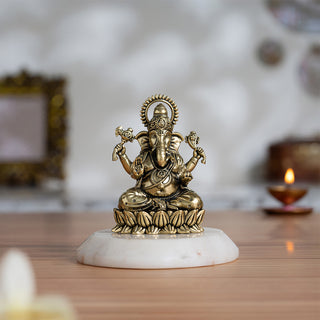
One small pleasure while you are looking: pick up your own murti and check which way the trunk curves. Most home idols, like this small brass Ganesha seated on a lotus, curve to the left: the arrangement people call vamamukhi and associate with the householder's life. It is not a rule you have to obey. It is just a nice thing to notice about an object you are going to look at every morning for years.
What about Ganesha with Lakshmi?
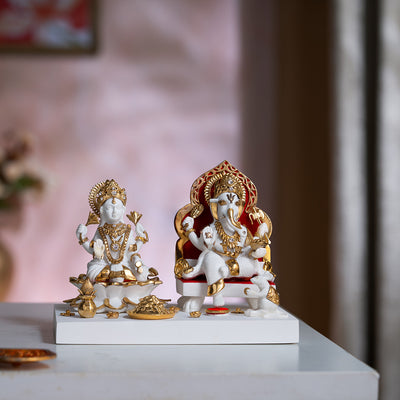
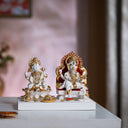
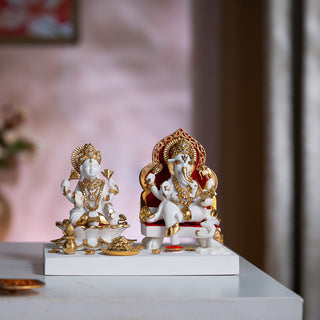
The Diwali pairing has its own convention: Lakshmi is placed to Ganesha's right, which is the viewer's left. The reasoning is the ordering of worship: Ganesha is invoked first in almost every puja, so his position anchors the arrangement.
This too is household custom rather than Puranic instruction. What is genuinely old is the association itself. "Lakshmi Ganapati" appears as one of the named Agamic forms in Gopinatha Rao's list, so the Ganesha-Lakshmi connection has been in the iconographic tradition for a very long time.2 It is just not the pairing most of us have in mind at Diwali. We go through the placement question properly in the Ganesh Lakshmi murti position guide.
Lakshmi is not Ganesha's mother, wife or sister. His family in the texts is Parvati, Shiva and Kartikeya. The Lakshmi pairing is functional (obstacles removed, then prosperity), not familial.
So what actually matters
If your home allows a north-east shrine with you facing east, take it. It has been followed for a long time, and there is no reason to be contrary about it.
If your home does not allow it (and most flats do not) put the murti somewhere clean, high, well-lit and where you will actually stop in front of it. Nothing in the Ganesa Purana, the Siva Purana or the Brahmavaivarta Purana suggests that a compass reading stands between a person and their ishta devata.
The texts spend their pages on other things. On how he lost a tusk. On six chapters about a grass. What they are consistently interested in is the quality of the attention you bring, and that is not something a wall can take away from you.
People search for what it means to see Ganesha in a dream and find confident lists of fixed meanings. Those lists are folk interpretation, not shastra, and saying so is kinder than pretending otherwise. The tradition is old enough and deep enough that it does not need invented rules propping it up.
Put it where you will see it. Keep it clean. That is genuinely the whole instruction.
Also read: Ganesha Trunk Right or Left: What It Means | Which Ganesha Idol Is Good for Home | Ganesh Laxmi Murti Position Guide | Why Tulsi Is Not Offered to Ganesha | Things to Keep in Your Pooja Room