When is Mother's Day 2027?
Mother's Day is the second Sunday of May every year. In 2027 that is Sunday, 9 May.
Notice that the date never moves to a different weekday. That is strange for a day India celebrates, because almost every festival here runs on the moon. Navratri, Janmashtami and Karwa Chauth all slide by a week or two each year. Mother's Day never does.
That one fact tells you where it came from.
Who actually started Mother's Day
A woman named Anna Jarvis. Her mother had died, and a Sunday school superintendent asked her to arrange a memorial service. She used that service to argue for a national day for mothers.
A book published in 1915, only a year after the holiday became law, records it plainly. Our American Holidays: Mothers' Day says the day "was started in Philadelphia in 1908." The idea "originated with Miss Anna Jarvis, of Philadelphia, to whom the idea came when she was asked by the superintendent of the Sunday-school in the Virginia town in which her deceased mother had long been the moving spirit, to arrange a memorial service." About two hundred thousand people are estimated to have taken part in that first celebration.2
Six years later it was federal law. On 8 May 1914 Congress approved a Joint Resolution saying that "the second Sunday in May shall hereafter be designated and known as Mother's Day." The note in the margin of the statute book reads "Permanent designation."1 That resolution is the only reason your calendar shows the same Sunday every year.
Jarvis is said to have spent her later years fighting what the day became. I could not open a primary source for that story, so take it as widely repeated rather than documented.

The white carnation was a mourning flower
In the original observance, a man was asked to tell his mother he loved her if she was living, "and if she is dead, to wear a white carnation as a token of remembrance."2 White was the colour for a mother you had lost.

So Mother's Day did not begin as a cheerful brunch. It began as a memorial for a dead woman, arranged by her daughter. The cards, the flowers and the discount codes all came later. If your mother is gone, you are actually closer to the founder's intention than anyone else is.
Three things people get wrong about Mother's Day
1. It descends from the old English Mothering Sunday
It does not. Mothering Sunday fell in the middle of Lent and was about going back to the church where you were baptised. The 1915 compilation rejects the link in its own words: "We cannot claim for Mothers' Day an unbroken line of descent from the old holiday when English apprentices went 'a-mothering.'" It calls the American day "perhaps the most conscious and deliberate effort a nation ever made publicly to honor motherhood." In other words, it was invented on purpose, and the people who invented it knew that.
2. Julia Ward Howe founded it in 1870
Howe founded something, but not this. In her memoir Reminiscences she writes that she wanted "to institute a festival which should be observed as mothers' day, and which should be devoted to the advocacy of peace doctrines. I chose for this the second day of June."
Different date. Different purpose. Hers was an anti war observance, prompted by the Franco Prussian War, and she ran it in Boston for several years before letting it go. She had asked, "Why do not the mothers of mankind interfere in these matters, to prevent the waste of that human life of which they alone bear and know the cost?"3
3. India has an ancient version of the same day
India honours mothers in far older words than America does. But there has never been a Hindu Mother's Day on a fixed date, and there is a clean mathematical reason why there cannot be one.
Why India has no fixed Hindu Mother's Day
Indian festivals are counted in tithis. A tithi is a lunar unit, and Sewell and Dikshit's The Indian Calendar (1896) defines it as "the time occupied by the moon in increasing her distance from the sun by 12 degrees," with thirty tithis making one full lunation.
The catch is that a tithi is not a fixed length. As the same book puts it, "since, however, the motions of the sun and moon are always varying in speed, the length of a tithi constantly alters." The average tithi runs 23 hours 37 minutes 28 seconds. The longest is 26 hours 6 minutes. The shortest is 21 hours 34 minutes.6
Stack that variation across a year and any Hindu observance drifts. A tithi that fell on a Tuesday last year can fall on a Saturday this year. That is why Chaitra Navratri and Raksha Bandhan move, and why Radha Ashtami is never on the same weekday twice in a row.
A holiday defined as "the second Sunday" is a different kind of object. It is built on a seven day week and a solar calendar. India adopted the shape along with the day.
What Indian texts actually say about mothers
The most quoted line is from the Taittiriya Upanishad. English versions here follow Max Muller.4
मातृदेवो भव । पितृदेवो भव । आचार्यदेवो भव । अतिथिदेवो भव ।
In plain English: Treat your mother as a god. Treat your father as a god. Treat your teacher as a god. Treat your guest as a god.
Taittiriya Upanishad, Shiksha Valli 1.11.2
Greeting cards print the first line alone. The context is better than the card. A teacher is speaking to a student who has just finished studying the Veda, sending him home. It is a convocation address, and the first thing on the list is his mother.
Notice also that it is one instruction with four names in it. Mother, father, teacher, guest. Nobody gets a separate Sunday. They get a single sentence you are supposed to live by, which is a heavier ask than a card.
The Mahabharata weighs a mother against the earth
The sharpest line comes from the Vana Parva of the Mahabharata, in the episode called the Yaksha Prashna.5 Yudhishthira's four brothers lie dead beside a lake. A yaksha, a spirit guarding the water, will revive them only if Yudhishthira answers his riddles.
One of the riddles, and the answer:
किं स्विद्गुरुतरं भूमेः किं स्विद् उच्चतरं च खात् ॥
माता गुरुतरा भूमेः पिता उच्चतरश्च खात् ।
मनः शीघ्रतरं वायोश्चिन्ता बहुतरी नृणाम् ॥In plain English: What is heavier than the earth? What is higher than the sky? The mother is heavier than the earth. The father is higher than the sky. The mind is faster than the wind. Our worries outnumber blades of grass.
Mahabharata, Vana Parva 3.297.40–41 (critical edition); English after Kisari Mohan Ganguli
It is a riddle answered with his brothers' bodies in front of him, and the first thing he reaches for is his mother. The epic attaches no date to that. It just says it, and moves on.
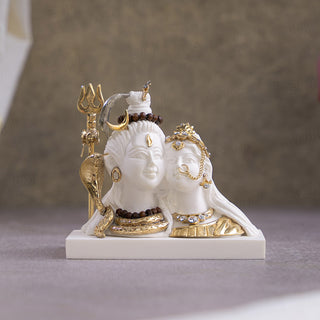
You find the same weight all over the tradition. Jagannath has a mother story. Sita's parentage is argued over in the Ramayana. Ganesha was made by Parvati before Shiva ever met him, and Hanuman's birth is told through Anjana. The mother is rarely a side character in these stories.
How to give a Mother's Day gift that means something
Extend a gesture she already knows: touching her feet, feeding her, keeping her memory in the house. Nothing in scripture prescribes a Mother's Day gift, because there is no Mother's Day in scripture. Those gestures are much older than the holiday.

A gift works when it extends one of those gestures instead of replacing it. That is why feet appear so often in Indian devotional objects. A Lakshmi charan paduka is a pair of footprints, and the whole meaning of the object is the act of bending down. It says something a bouquet cannot.
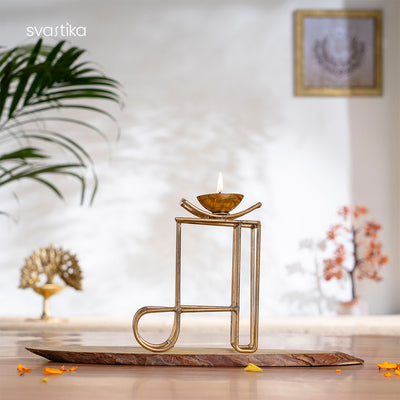
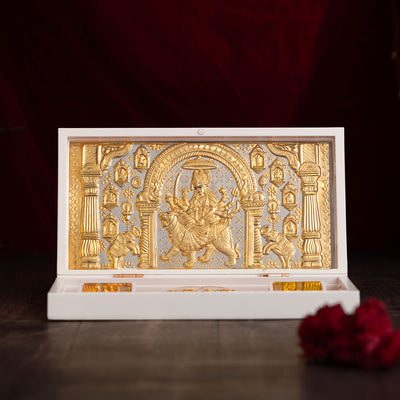
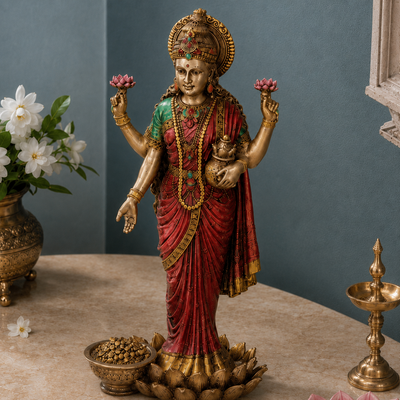
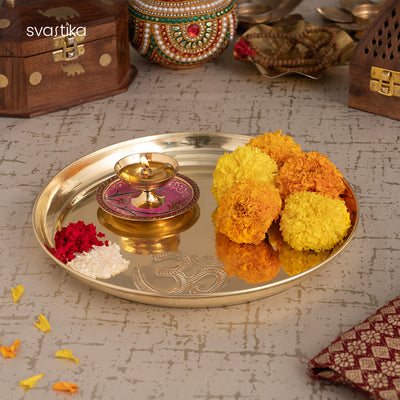
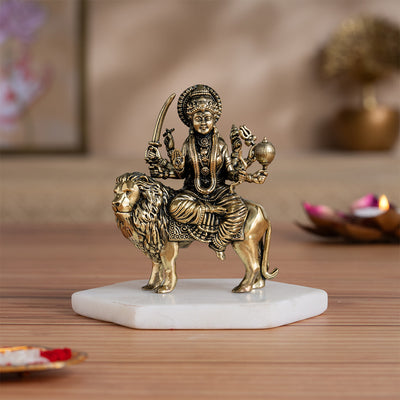
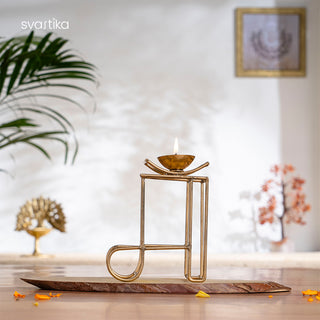
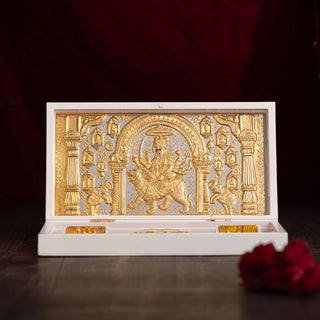
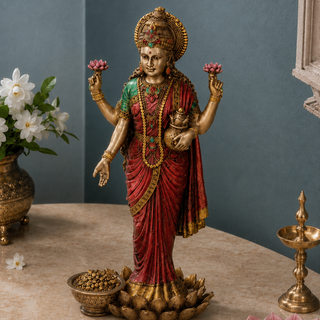
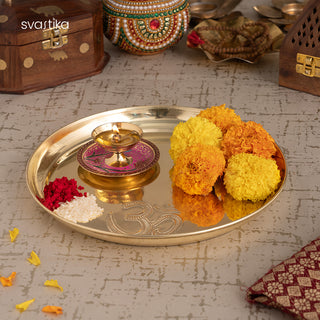
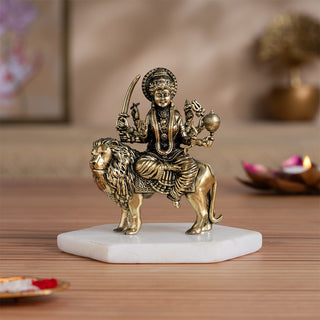
The same logic applies to anything for her puja corner. A brass diya she will actually light, a small murti of the deity she already prays to, a thali that replaces the chipped steel plate she has used for twenty years. Browse the Mother's Day gifts range or the Durga idols and Lakshmi idols if you want to match the goddess she keeps in her house rather than the one an ad told you to buy. If she already has a marble murti, learn how to clean it safely and do it for her.
Brass is the safest choice for a mother who cooks and prays in the same small kitchen corner. It survives oil, soot and daily handling, which is more than most decorative gifts manage. Our guide to devotional Mother's Day gift ideas goes deeper into matching the object to the person.
Is it wrong to celebrate a borrowed holiday?
No, and pretending it is Indian is the only dishonest option here.
The date came from Philadelphia in 1908 and from a law passed in Washington in 1914. That is a fact, and it does not need defending. Plenty of things we keep were borrowed, including Father's Day, which took America until 1972 to make official.7
What is worth noticing is what the borrowed day is standing in for. Anna Jarvis wanted one fixed Sunday because she was afraid people would otherwise never stop and say it. India's answer was different and older. It put the instruction inside a graduation speech and inside a riddle asked over four dead bodies, so a person would carry it every day instead of once a year.
Both are trying to solve the same problem. One uses a calendar. The other uses a conscience. If you get the second Sunday of May and the conscience, you have more than either tradition asked for.
The white carnation is worth remembering too. The founder of the holiday built it around a woman who was no longer there. For a lot of readers, that will be the truest part of the day.
Also read: Devotional Mother's Day Gift Ideas | When is Father's Day | The 5 Daughters of Lord Shiva | How Many Hands Does Durga Have | Buddha and Kisa Gotami