Most articles on the Chiranjivis read like a roll call. Seven names, seven backstories, done. The question nobody asks is who made the list.
Go looking for it in the actual texts and something odd happens. You find the people. What you cannot find is the group of seven. Nobody in the Mahabharata, the Ramayana or the Bhagavata Purana ever says "here are the seven who will not die."
And the closest thing to a real scriptural list has a stranger logic than a reward for good behaviour. Most of these people are still alive because a future age needs them for a job.
Who are the 7 Chiranjivis?
Chiranjivi is a plain Sanskrit compound: chiram (long) and jivi (living). Long-lived. Not, strictly speaking, eternal. That distinction matters more than it sounds.
The 7 names, as they are almost always given:
- Ashwatthama: son of Dronacharya, the last man standing on the Kaurava side of Kurukshetra.
- Bali (Mahabali): the asura king who gave away three steps of earth to a dwarf.
- Vyasa: the sage who compiled the Vedas and composed the Mahabharata.
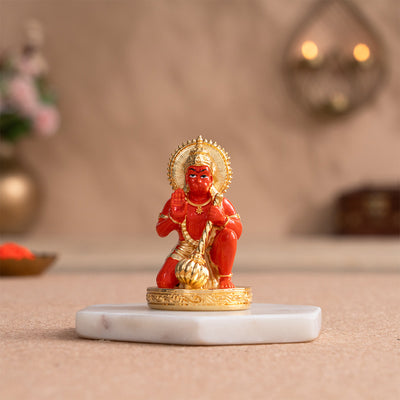
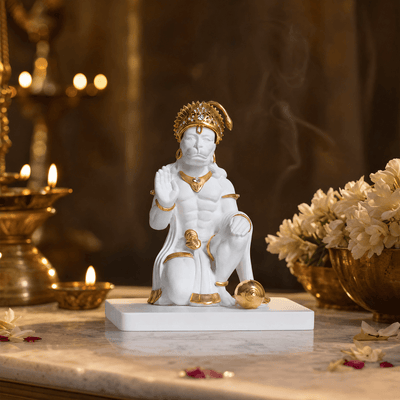
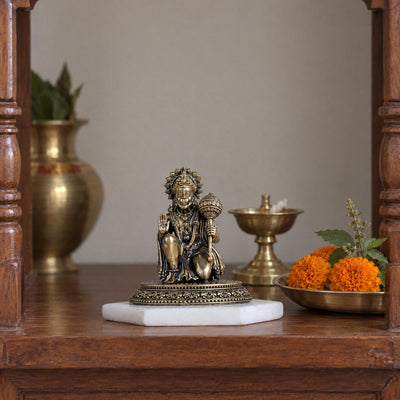
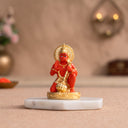
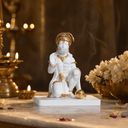
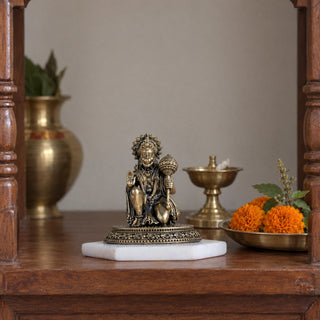
- Hanuman: Rama's devotee, and the only one on this list most Indians pray to daily.
- Vibhishana: Ravana's younger brother, who crossed over to Rama's side.
- Kripacharya: the royal teacher of the Kuru princes, Ashwatthama's uncle.
- Parashurama: the axe-bearing Brahmin, the sixth avatar of Vishnu.
They come bundled in a two-line Sanskrit verse: Ashwatthama Balirvyaso Hanumanshcha Vibhishanah / Kripah Parashuramashcha Saptaite Chiranjivinah. Recite it in the morning, the tradition says, and you get long life.
Here is the honest part. That verse circulates as a smarana shloka, a remembrance verse, and no one can produce the Purana chapter it comes from. It is late and its author is unknown. That is no insult; remembrance verses exist to be recited, not footnoted. But seven is a devotional convenience, not a scriptural count.
The real list is in the Bhagavata Purana, and it is about the future
Bhagavata Purana 8.13 names 5 of the 7 in advance, not as immortals, but as staff booked for an age that has not started yet.
Hindu cosmology divides a day of Brahma into fourteen manvantaras, each with its own Manu, its own Indra and its own seven sages. We are in the seventh, the Vaivasvata manvantara. The eighth, the Savarni manvantara, has not started.
The Bhagavata Purana names its staff in advance. At 8.13.15-16 it lists the seven sages of that coming age: Galava, Diptiman, Parashurama, Ashwatthama, Kripacharya, Rishyashringa and Vyasa. A few verses earlier, at 8.13.12-13, it says Bali will be the Indra of that age.
Four of the 7 Chiranjivis (Parashurama, Ashwatthama, Kripacharya, Vyasa) plus Bali, all in one chapter, all assigned to a future that has not begun. Their deathlessness is not a medal. It is a scheduling requirement.
The same chapter also quietly wrecks the number 7. Galava, Diptiman and Rishyashringa survive into that same age, so they are just as long-lived as the four beside them.1
Bali got an appointment, not immortality

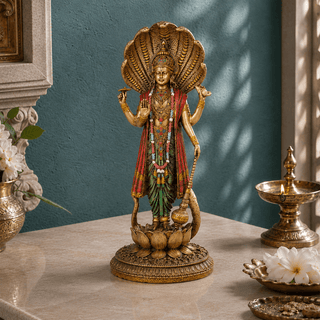
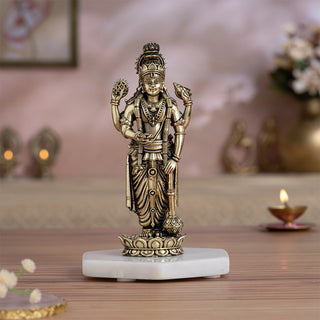
Bali's story is the one people know best, usually through Onam. Grandson of Prahlada, son of Virochana. The Mahabharata gives that lineage plainly in the Adi Parva.6 A generous king, powerful enough to worry the gods, which is why Vishnu came to him as Vamana, the dwarf, and asked for three paces of land.
What happened after is less known. In Bhagavata Purana 8.22, Vishnu does not just push Bali underground and walk away. He tells him he will become Indra during the reign of Savarni Manu (8.22.31), gives him the realm of Sutala until then (8.22.32), and promises him personal protection and the ability to see him there (8.22.35).
So Bali was not granted immortality. He was given a start date and a place to wait: a promotion with a very long notice period.2 His yearly return to Kerala, which Onam celebrates, is a regional tradition layered on top of that.
Vamana is the fifth of the ten avatars of Vishnu, and Bali's grandfather Prahlada is the reason the Narasimha avatar exists.
Ashwatthama's curse has an expiry date

Krishna set a term of 3,000 years, not eternity. Everyone knows Ashwatthama wanders the earth to this day, wounded and rotting. Almost nobody quotes the sentence Krishna actually passed, in the Mahabharata's Sauptika Parva, Section XVI, after the night raid in which Ashwatthama killed the sleeping sons of the Pandavas:
तस्मात्त्वमस्य पापस्य कर्मणः फलमाप्नुहि।
त्रीणि वर्षसहस्राणि चरिष्यसि महीमिमाम्।।
अप्राप्नुवन्क्वचित्काञ्चित्संविदं जातु केनचित्।
निर्जनानसहायस्त्वं देशान्प्रविचरिष्यसि।।In plain English: So take the fruit of this evil deed. For three thousand years you will wander this earth. Nobody anywhere will speak with you. You will cross empty country alone, with no one at your side.
Mahabharata, Sauptika Parva 16.6–7
3,000 years. A number, not eternity. And it is the Sanskrit's own number, not a translator's flourish: trini varsha-sahasrani stands in the vulgate and in the Pune critical edition alike.4 Krishna set a clock.
The Bhagavata Purana then tells the same night from a different angle. In Canto 1, Chapter 7, Draupadi pleads for the boy's life because he is a teacher's son, and Krishna's men cut the jewel from his head, shear his hair, strip his wealth and drive him out. That version records no 3,000-year curse at all.3
Two texts. One night. Different punishments. Neither of them says "immortal."
Hanuman asked for it himself, and asked for something stranger
The version you hear is that Rama rewarded Hanuman with immortality. The Valmiki Ramayana's Uttara Kanda, Canto XL, tells it the other way round. Hanuman asks, and what he asks for is not deathlessness. He asks that life stay in his body only for as long as Rama's story is still being told on earth. Rama agrees on exactly those terms (so shall it be, as long as the worlds last) and garlands him with a pearl necklace.7
Hanuman is not immortal in his own right. He is immortal conditionally, and the condition is human memory. Every time a Ramayana is read aloud, the boon is renewed. The reader is part of the mechanism.
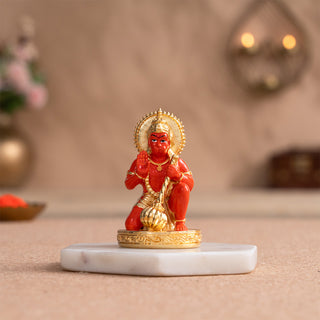
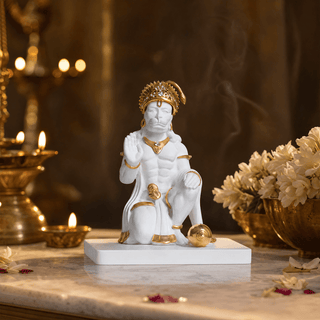
It explains why is Hanuman still alive has never gone away as a question in Indian homes. It also explains the density of his living tradition: the Panchmukhi form, the Hanuman Bahuk recited for pain and illness, two Hanuman Jayantis in a year, Makardhwaja, the old argument about whether anyone can defeat him. Of the 7, he is the only one still worshipped as a living presence.
One honest note: this scene sits in the Uttara Kanda, the last book of the Ramayana, long regarded as a later addition to Valmiki's poem. The Yuddha Kanda's own ending, at sarga 128, has Sita give Hanuman a pearl necklace and nothing more: no boon of immortality.8 Worth knowing. The Uttara Kanda is still scripture to the tradition that uses it.
Vibhishana never asked, which is exactly why he got it
Vibhishana's immortality predates Rama entirely. The common line is that he earned it by choosing Rama over Ravana. The chronology says otherwise.
The Uttara Kanda, Canto X, describes the brothers of Lanka performing enormous penance and Brahma appearing to grant boons. Ravana asked for absolute immortality and was flatly refused: there can be no absolute immortality for you, ask for some other boon.7 So he negotiated a list instead: gods, nagas, yakshas, daityas, danavas, rakshasas, none of them could kill him. He left humans and monkeys off it himself, because creatures like that were beneath his notice. The entire Ramayana turns on that one sentence of arrogance. (His other brothers made their own famous requests in the same scene.)
Vibhishana stood in the same place. He asked only that his mind stay steady in dharma whatever he was thrown into, and that the Brahmastra come to him untaught. Brahma gave him both, then added immortality unrequested: his mind was not inclined to unrighteousness, Brahma said, even though he was born among rakshasas.
The boon was not a reward for siding with Rama. It was already his. His loyalty to Rama came from the same character that earned it.
Vyasa, Kripacharya and Parashurama: the thin cases

Go looking for a dramatic boon scene for these three and you will not find one.
Vyasa compiled the Vedas, fathered Dhritarashtra and Pandu, and appears across yugas as narrator and presence. His standing rests on that continuity and the Savarni sage list, not a granted boon.
Kripacharya was born from a clump of reeds, taught the Kuru princes, survived Kurukshetra, and shows up in the same future-sage list. Again: no boon scene, just an appointment.
Parashurama is a special case: he is an avatar of Vishnu — the sixth in the standard Dashavatara, though the Bhagavata's longer catalogue of incarnations numbers him elsewhere — and avatars run on different rules. He appears in the Ramayana to confront the young Rama, and again in the Mahabharata as Bhishma's and Karna's teacher. That already spans two yugas. The rest of his story is stranger than the list suggests, including how the Mahabharata explains twenty-one purges of a class that kept coming back: see Parashurama, the sixth avatar of Vishnu.
Three of the 7, then, are on the list mainly because the Bhagavata's Savarni chapter needs them alive later. That is a real scriptural basis.
The eighth immortal nobody counts: Markandeya

The Mahabharata's Vana Parva, Section CLXXXVII, calls Markandeya the longest-lived being after Brahma. Neither all-destroying Death nor the dotage that decays the body has power over him, and he describes watching the universe dissolve and reform more than once: floating on the cosmic waters, finding the child Narayana under a banyan tree.5
That is a clearer and older statement of deathlessness than the texts give for Kripacharya or Vyasa. Markandeya is in the epic, by name, being told he cannot die. And he is not on the list.
Some versions of the shloka add a second line naming him as the eighth: a quiet admission that 7 was never firm. 7 survives because it scans in a two-line verse, not because anyone counted.
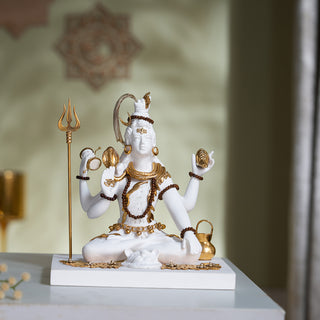
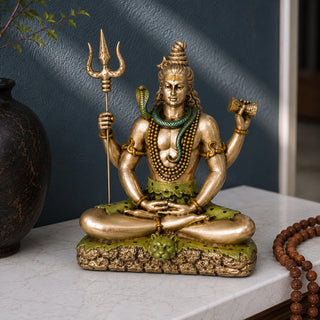
Markandeya's own story is a Shiva story: the boy fated to die at sixteen who clung to the Shivalinga and was spared. Which is its own reminder that who can defeat Shiva and most powerful god in Hinduism get answered very differently depending on which text you are holding.
Five things people get wrong about the Chiranjivis
1. "The verse is from the Puranas." No chapter can be produced for it. Every immortality in it checks out against an older text; the grouping of seven does not.
2. "Ashwatthama was cursed to be immortal." Krishna set a term of 3,000 years. The Bhagavata's account of that night has no wandering curse at all: only the jewel, the shorn hair and banishment.
3. "Rama granted Hanuman immortality." Hanuman requested it, and requested a conditional version: life in his body as long as Rama's story is told. The reader keeps the boon running.
4. "Ravana was immortal." He asked, Brahma said no. What he got was an exemption list, and he wrote humans and monkeys out of it himself. That is the plot of the Ramayana in one refusal.
5. "There are exactly 7." The Mahabharata puts Markandeya beyond the reach of death. The Savarni list adds Galava, Diptiman and Rishyashringa. Seven is a round number in a memorable verse, not a census.
So why does the list survive?
Because it does something a census cannot. Those 7 names are a compressed lesson: survive with honour (Vibhishana), give until it costs you (Bali), serve without asking what you get (Hanuman), and be careful what you do in the dark, because it follows you for three thousand years (Ashwatthama). Good verse. Just not scripture, and saying so takes nothing from it.
What it does take away is the flat idea that these seven were handed eternal life as a prize. The texts are stranger. One asked for a boon that depends on you remembering him, so if you keep a Hanuman murti in Ram bhakti in your pooja room, by the terms Hanuman himself set, that is not decoration. That is participation.
The same texts have more of this: how Rama's own life ended, what happened to Krishna's body, and the equally contested question of how many sons Brahma had, where four major texts give four different answers. Contradiction is not a flaw in this tradition. It is how it keeps every argument on record.
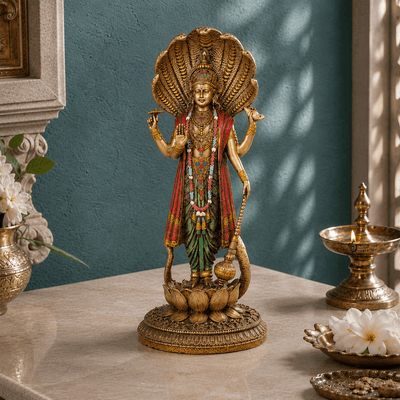
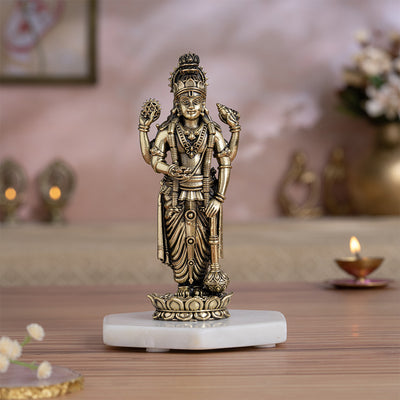
Browse our Hanuman idols, Vishnu idols and Shiva idols if you would like one of these presences at home.
Also read: Is Lord Hanuman Still Alive | Parashurama, the Sixth Avatar | 10 Sons of Brahma | Most Powerful God in Hinduism | The 6 Brothers of Ravana | Which Hanuman Idol is Good for Home